Mike Barson | |
|---|---|
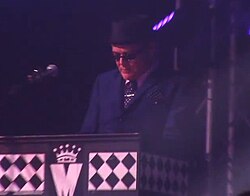 Barson performing live with Madness in 2017 | |
| Background information | |
| Born | Michael Barson (1958-04-21) 21 April 1958 Edinburgh, Scotland |
| Genres | 2-tone |
| Occupations |
|
| Instruments |
|
| Years active |
|
| Labels | |
| Member of | Madness |
| Website | madness |
Michael Barson (born 21 April 1958) is a British multi-instrumentalist, songwriter, and composer. In a career spanning more than 45 years, Barson came to prominence in the late 1970s as keyboard-player for the band Madness. He is often known by the nicknames "Monsieur Barso" or "Barzo".1
Early years
Barson was born in Edinburgh, Scotland. He grew up in North London with his two brothers, Dan and Ben, who are also musicians2 (Ben being one of Roland Gift's collaborators).3 At some point, his mother moved the family from Kentish Town to Crouch End.4 Barson attended Brookfield School, and then Hornsey Art School, as he wanted to be a commercials artist, however Barson only completed the first foundation year as he "fucked it up a bit".4 He then applied for a three-year course at the London School Of Printing, but turned up two hours late for an interview.4
Prior to forming Madness, Barson and fellow future Madness member Lee Thompson gained some notice as graffiti artists in the mid-1970s. After reading about the emerging New York graffiti scene, they spray-painted their nicknames Mr B and Kix, along with two friends' names, Cat and Columbo, around north London. They managed to spray their nicknames on George Melly's garage door, prompting Melly to write a newspaper article declaring: "If I ever catch that Mr B, Kix and Columbo, I'm going to kick their arses".5
Music career
Madness
Barson co-founded a band called The North London Invaders in 1976 with Lee Thompson and Chris Foreman.6 The band later changed their name to Madness in 1979, after the song by Prince Buster.7 Madness became a successful British band during the late 1970s to mid-1980s, having initial success as part of the Two-Tone movement. Barson was and is a prominent songwriter in the band, writing and/or composing "My Girl", "Night Boat to Cairo", "Embarrassment", "The Return of the Los Palmas 7", "Grey Day", "House of Fun", "Driving in My Car", "Tomorrow's (Just Another Day)", and "The Sun and the Rain", and was effectively the musical director.8
However, Barson felt increasing exhaustion from the music business, and in 1982, moved to the Netherlands with his wife during the recording of The Rise & Fall.910 He also reclused himself from the spotlight, and delayed the release of their single "Wings of a Dove", when he suddenly embarked on a campervan trip through Europe with his wife and dog, which first led to rumours that he was leaving the band. Eventually, in October 1983, he announced that he would be leaving the band, but agreed to stick around to finish the recording of their fifth studio album, Keep Moving. After playing his last gig with the band at the Lyceum Ballroom on 21 December 1983, Barson left the band in early 1984, and emigrated to the Netherlands.1112 Two years later, Madness disbanded, but Barson did join them for the recording of their farewell single, "(Waiting For) The Ghost Train".
Speaking about his departure in a 2017 interview, Barson said: "I think we got to a point where we got a lot of expectations and it was getting very difficult to move. Anyway I found it difficult yeah, that is why I left the band."13
Madness reunited in their original line-up in 1992,6 after announcing plans for a reunion concert, Madstock!, which was held at Finsbury Park, London on 8 and 9 August of that year.1415 This reunion also included Barson, marking the first time the full seven original members of the band performed with each other since 1983.
Other work
I’ve been breathing, eating, sleeping, just getting along. Living off the fruits of the past. It’s difficult to say what I do. Time goes by and it seems to get filled. But it’s good to be writing songs with Suggs again. We’re pleased with what we’ve done so far. The plan is to release them when we’re ready. I’ve no idea when that will be.
From the mid-80s to early 90s, Barson spent this time out of the public eye, remaining effectively retired from the music business. However, he was still writing and producing songs with some of his former bandmates, namely Suggs and Lee Thompson, between in his houseboat in Amsterdam and in Liquidator Studios in London, which Madness still owned. Most of these songs ended up on Suggs' eventual solo album, such as "She's Gone" and "Alcohol", and on subsequent Madness albums, such as "Lovestruck" and "Mr. Apples".1617
In 1995, he collaborated with Suggs on his first solo album The Lone Ranger,18 having co-wrote and produced a number of songs with Suggs since 1989. When No Doubt were recording songs for their fifth studio album Rock Steady, Barson was asked to play piano on the London version of the song "Everything in Time". Barson obliged and the track was produced by Madness producers Clive Langer and Alan Winstanley. The track was not included on the album,19 but was released a year later in 2003 on the compilation album Everything in Time (B-sides, Rarities, Remixes).
Both Barson and his bandmate, Suggs, contributed to Audio Bullys' album Higher Than the Eiffel, released in 2010. They both appear on the tracks "Twist Me Up" and "Goodbye".
References
References
- Augustyn, Heather (2010). Ska: An Oral History. McFarland. ISBN 9780786461974. Retrieved 10 November 2015.
- "The Magnificent 7 - Record Collector Magazine".
- "Album: Roland Gift". Independent.co.uk. 8 March 2002. Archived from the original on 14 May 2022.
- "SEVEN RAGGED MEN | How Madness started in Camden in 1976". Retrieved 5 June 2026.
- Petridis, Alexis (3 February 2015). "Spraying the 70s: the pioneers of British graffiti". The Guardian. Retrieved 4 February 2015.
- "BBC – Top of the Pops 2 – Top 5". Bbc.co.uk.
- "1979". madness.co.uk. Archived from the original on 12 October 2007. Retrieved 6 June 2026.
- Reynolds, Simon (2006). Rip it Up and Start Again: Postpunk 1978–1984. Faber & Faber. ISBN 9780571252275. Retrieved 10 November 2015.
- "Classic Tracks: Madness 'Our House'". www.soundonsound.com. Retrieved 10 November 2025.
- Silverton, Peter (23 December 1982). "Madness: Seven Up". Smash Hits. p. 15.
- "The Magnificent 7". Record Collector. 13 October 2009. Archived from the original on 22 February 2025. Retrieved 31 March 2025.
- "Seven Ragged Men | NME interview 1984". Sevenraggedmen.com.
- Flagrant, Dandy (10 January 2017). "Interview - Madness / Mike Barson : "never get rusty and old"". Indeflagration | Partage de musique indépendante & rétro (in French). Retrieved 6 June 2026.
- "BBC Top of the Pops 2 Top 5". BBC. Retrieved on 5 June 2007.
- "BBC Top of the Pops 2 Top 5". BBC. Retrieved on 5 June 2007.
- "HIT PARADE, International, 2025". Madnessography. 28 November 2025. Retrieved 28 December 2025.
- Reed, John (2010). House of Fun: the story of Madness. London: Omnibus. p. 368. ISBN 978-1-84772-619-3.
- The Lone Ranger (CD reissue liner notes). Suggs. Cherry Red Records. 2016.
- "Everything in Time (London)". Ndifc.net. Retrieved 10 November 2015.