| Miitopia | |
|---|---|
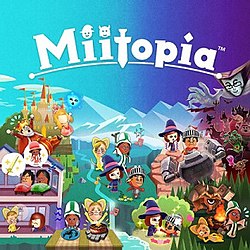 3DS cover artwork | |
| Developer | Nintendo EPDa |
| Publisher | Nintendo |
| Director | Yuichiro Ito1 |
| Producer | Kouichi Kawamoto1 |
| Designer | Kazuhiro Yoshikawa1 |
| Programmer | Takaomi Ueno1 |
| Artist | Kyohei Seki1 |
| Writer | Reizo Hirama1 |
| Composer | Toshiyuki Sudo1 |
| Platforms | Nintendo 3DS, Nintendo Switch |
| Release | Nintendo 3DS
|
| Genres | Action-adventure, role-playing |
| Mode | Single-player |
Miitopiab is a role-playing video game developed and published by Nintendo for the Nintendo 3DS. It was originally released in Japan on December 8, 2016 and worldwide in 2017. A remastered version developed by Grezzo for the Nintendo Switch released on May 21, 2021.
Set in the eponymous land of Miitopia, the game features a fully customizable cast of Mii avatars in roles ranging from protagonists and non-player characters to antagonists and hostile enemies. Its narrative centers on a party of Mii adventurers as they seek to defeat the villainous Dark Lord, who is responsible for stealing the faces of Miitopia's inhabitants.
Miitopia sees each of the player's Miis, all assuming different character classes, explore hostile areas linearly strewn about a hub world and fight monsters by way of a turn-based battle system. Only the player's central Mii can be controlled during fights, with all other party members acting independently through artificial intelligence (AI). In between combat encounters, inns are visited where the Miis rest, eat food, converse amongst each other, and form interpersonal relationships in a manner similar to a life simulation game. The relationship statuses between Miis directly affect the nature of fights; friendships generate combat perks whereas heated conflicts worsen the party's statistics.
Miitopia received mixed reviews; commentators praised its art direction, life simulation elements, and humor—many comparing its premise to Tomodachi Life (2013)—but criticized its narrative, combat system, and hands-off gameplay structure as repetitive and lackluster. Additional customization features introduced in the Switch remaster were received positively by numerous outlets.
Gameplay
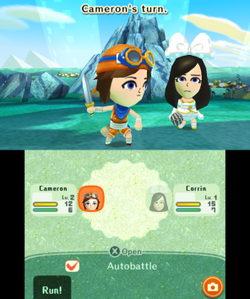
Miitopia is a role-playing video game with life simulation elements.2 Its cast of main protagonists, non-player characters, antagonists, and hostile enemies is fully customizable as Mii avatars, and are created gradually as the story progresses.34 These avatars can be made from scratch in the game itself or imported through a number of outlets. In the 3DS version, these methods include transferring Miis from the 3DS' built-in Mii Maker application, importing existing Miis from Tomodachi Life, selecting Miis from the user's friends list, scanning a specialized QR code, or searching through an online database of player-made Miis.4 For the Switch remaster, the player can transfer Miis from the Switch's Mii Maker5 or use a similar online database accessible through the Nintendo Switch Online service.6 The remaster also introduces "makeup" and wigs that permit further Mii customization in the form of additional hair types, eyes, facial features, and miscellaneous shapes.7
Miitopia's gameplay centers on the player's party of Mii adventurers, which is limited to four members at any one time. Each party member is assigned a personality type and one of several character classes, named "jobs", which specialize in specific strengths and can serve offensive or supportive roles. These include warriors, mages, thieves, idols, and others; as the game progresses, more classes become available.48 The party explores levels linearly strewn about a hub world. Selecting a level initiates a cutscene where the Miis automatically walk in a straight line along a preset path, triggering comedic skits and randomly encountering monsters to be fought in turn-based combat.491011 Only the player's main Mii is manually controlled during a fight; all other teammates attack enemies and use items autonomously through AI.12 A toggleable "auto-battle" feature makes all elements of combat encounters removed from direct player input.1314 A Mii's designated personality can influence their behavior during combat; for example, a "stubborn" Mii may refuse to fight during its turn, while a "kind" Mii may offer to protect a teammate from harm.815
Each Mii has personalized statistics in the form of health points (HP), magic points (MP), Attack, Defense, Magic, and Speed; MP is used to employ powerful skils as opposed to standard attacks. During combat, items known as "sprinkles" can be applied to Miis to increase their HP or MP. A Mii can also be moved to "Safe Spots" where enemies cannot target them, allowing their HP and MP to automatically replenish, but as consequence the Mii loses a turn.1617 As levels are completed, the player acquires in-game currency in the form of gold coins.1418
The end of a level is marked by an inn that the party visits, where the player assigns Miis their rooms, feeds them to upgrade their combat statistics, purchase new gear using coins, and play minigames.1417 While at the inn, Miis can spontaneously begin dialogue with each other, forming interpersonal relationships. These connections later impact the flow of gameplay during combat encounters. Namely, friendships progressively generate new tag team abilities as the relationship becomes more intimate. Heated conflict can also occur, conversely worsening the party's statistics during fights.34 The odds of a connection growing stronger strengthens if two party members are placed in the same room at an inn.10 The Switch version introduces a horse companion that aides in combat, as well as "outings" that involve sending two Miis on an excursion during inn visits to increase their relationship level. Outings are accessed via "outing tickets" obtained through play.61019
Plot
The sinister Dark Lord reigns terror over the land of Miitopia, forcefully stealing its inhabitants' faces and attaching them to otherwise peaceful creatures to become hostile monsters. The main protagonist, a traveling Mii of the player's choice addressed as the "hero", arrives in the village of Greenhorne. The Dark Lord abruptly attacks the town and steals the faces of its citizens. At the request of a divine guardian, the hero chooses a character class and ventures to stop the Dark Lord and recover the faces of those afflicted. Along the way, the hero meets adventurer companions and meets the Great Sage. The team enters the kingdom of Neksdor, but the Dark Lord attacks, stealing the hero's companions and rendering them without a class. After the guardian gives the hero new powers, they journey through Neksdor, meeting three new companions. The team continues on to the Realm of the Fey, where the Dark Lord attacks, stealing the hero's companions and their character class again and prompting the guardian to provide a new group of character classes. The hero is tasked with saving the three Fab Fairies of the Realm, who show the team the way to the Dark Lord's castle in Karkaton. However, before they can open the door, the Dark Lord steals their faces. After retrieving their faces, the Fab Fairies open the door to Karkaton; when the team arrives there, the Dark Lord attacks again, stealing the hero's new companions but not their powers. The hero is tasked with saving their friends with help from the Great Sage.
The team fights and defeats the Dark Lord, and afterwards, it is revealed that it was a common Mii who a wisp known as the Dark Curse possessed. The Dark Curse attempts to possess the hero, but the Great Sage intervenes and is possessed instead, becoming the Darker Lord. The team tracks down the Darker Lord before reaching the top of its domain in The Sky Scraper. The heroes go to the Otherworld for a final showdown with the Darker Lord; although it evolves into the Darkest Lord, it is ultimately defeated. The Great Sage is freed and traps the Dark Curse, then explains its history to the hero. It was once an ordinary Mii who was rejected because they had a bland face; they decided to get rid of their face, and over time became a soul of hatred and malice, amalgamating into the Dark Curse. The hero is given the choice to either destroy the Dark Curse or provide them with a new face and body. If the hero provides the Dark Curse with a new life, the Great Sage takes them on their travels to have them atone for their mistakes. If the hero decides to destroy the Dark Curse, they use their divine power to destroy it. Regardless of the outcome, they are celebrated for saving Miitopia.
Development and release
Miitopia was developed primarily by Nintendo Entertainment Planning and Development (EPD) for the Nintendo 3DS.16 Its in-game backgrounds, weapons, and clothing were designed with assistance from Good-Feel.20 it released first in Japan on December 8, 2016. It later released worldwide in the United States and Europe on July 28 and in Australia on July 29.2 A demo version was distributed through the 3DS' eShop one month earlier on June 14, 2017.21 A Nintendo Switch remaster of Miitopia, developed by Grezzo, was released on May 21, 2021.2223
Reception
Critical response
| Aggregator | Score | |
|---|---|---|
| 3DS | NS | |
| Metacritic | 67/10024c | 71/10025d |
| Publication | Score | |
|---|---|---|
| 3DS | NS | |
| Famitsu | 31/4026 | N/A |
| Game Informer | 7.5/109 | N/A |
| GameRevolution | 2.5/53 | N/A |
| GameSpot | 5/1017 | 5/106 |
| Nintendo Life | 8/104 | 7/107 |
| Nintendo World Report | 6/102 | 6.5/1013 |
| Pocket Gamer | 3.5/527 | N/A |
| Polygon | 8/1015 | N/A |
| RPGamer | 3.5/512 | 2.5/511 |
| USgamer | 2.5/528 | N/A |
Miitopia received "mixed or average" reviews from critics on both 3DS and Switch, according to review aggregator website Metacritic.2425 Famitsu awarded both versions a score of 31/40.26
Miitopia's offbeat tone and life simulation elements was met with praise and direct comparisons to Tomodachi Life.391715 While acknowledging its influences from traditional Japanese role-playing games, Jon Mundy of Pocket Gamer felt Miitopia was moreso a casual, social experience akin to Tomodachi Life.27 In describing the Miitopia's personality system, Jeff Cork of Game Informer called it a hybrid between Tomodachi Life and "an old-school RPG".9 While Jonathan Leack from GameRevolution draws a similar comparison between Miitopia and Tomodachi Life, his opinion of the former was less favorable, feeling that the interactions between characters in Miitopia were "let down by uninteresting writing" and were less humorous compared to Tomodachi Life.3
The narrative, described as simple or generic,391629 garnered mixed opinions. Cork felt Miitopia's story was insufficiently engaging to justify its long runtime.9 Reviewing the Switch version, Alex Olney of Nintendo Life lauded the game's status as an informal crossover, with players incentivized to include any real or fictional individual as a character, as "turn[ing] a fairly basic plot into something genuinely memorable". He felt that the interludes between comedic scenes could become trite regardless.7 Kemps felt the core premise was aptly charming for a game centered on Miis but nontheless mostly a novelty.17 Miitopia's artistic presentation elicited praise; many critics described its art style as diverse, bold, and colorful.34712 Reception towards its soundtrack was more divisive; some described it as a highlight of the experience247 while others found it unremarkable.1130
Miitopia's combat mechanics were met with lukewarm reception. Most critics cited creativity to be Miitopia's greatest asset; Cork, Kemps, Leack, and Frank agreed that its creative spin on a more traditional role-playing concept was ultimately its main highlight.917315 Leack lamented unchallenging combat in earlier parts of the game,3 while Frank felt the high frequency of battles produced a trite gameplay experience.15 They both found that the auto-battle mechanic mitigated, but did not completely solve, this issue. Also criticized was that all party members except for the player's Mii were controlled by AI, predicting that this lack of control could lead to frustration.1715 Frank praised the "hidden intricacies" of the battle system as creative, due to characters' jobs and personality traits affecting their combat style.15
A lack of focus on direct player involvement was critiqued. Leack opined that an absence of player input when exploring areas made him feel like the game was on autopilot most of the time.3 Similarly, Heidi Kemps of GameSpot felt that Miitopia was a "slow slog you mostly watch rather than play",17 and Jon Mundy of Pocket Gamer also discussed a lack of challenge and player input.27 Reviewing the Switch version, Chris Scullion of Video Games Chronicle appreciated Miitopia's potential as an early introduction to the RPG genre for younger gamers, but believed players of any other persuasion would be disappointed in its gameplay's lack of mechanical depth.14 Allegra Frank of Polygon had similar feelings, saying that its gameplay structure often let the Miis "do their thing", but found that this was often enough to entertain her. She highlighted that the more uninvolved segments of Miitopia were balanced out by its overall dynamic nature, saying that the game periodically shaking up the cast, map, and combat occurred often enough to keep her engaged.15 The frequency of Miis experiencing comedic events during exploration cutscenes purely on their own was commended by Ozzie Mejia of Shacknews; he favorably compared Miitopia's customizable cast and air of unpredictability to a Dungeons & Dragons campaign.29
The additional customization features introduced in the Switch remaster were highlighted favorably. Alex Olney lauded the makeup mechanic as innovative and flexible, judging that it allows players to make accurate caricatures of "just about anyone and anything you can imagine".7 Mejia thought the addition of makeup made Mii creation engaging.29 Kat Bailey and Rebekah Valentine of IGN as well as Ana Diaz of Polygon commented on makeup's versatility in allowing the player to create virtually anything they desired in Mii form, and highlighted the number of custom Miis being shared online.3132
Sales
By February 2017, the 3DS version had sold over 168,000 copies in Japan.33 It amassed 1.22 million lifetime sales by December 31, 2022.34
During its first week in the UK, the Switch remaster sold 36% more copies at launch than the 3DS version, debuting at #2 behind Resident Evil Village.35 In Japan, the Switch port launched at #2 behind Rune Factory 5 with 72,725 physical copies sold, three times the sales of the 3DS version.36 By its second week of release, the remaster surpassed competition to take the #1 weekly sales spot in Japan, with 34,451 physical copies sold.37 According to Media Create, the Switch port debuted at #1 in South Korea.38 The Switch version has sold 1.79 million copies as of November 2023.34
Notes
Notes
References
References
- Nintendo EPD (December 8, 2016). Miitopia (Nintendo 3DS). Nintendo. Scene: Staff Credits.
- Bryan Rose (July 27, 2017). "Miitopia (3DS) Review". Nintendo World Report. Archived from the original on August 14, 2020. Retrieved August 16, 2020.
- Jonathan Leack (July 27, 2017). "Miitopia Review – You and Your Friends on a Forgettable Adventure". Game Revolution. Archived from the original on August 27, 2020. Retrieved August 16, 2020.
- Morgan Sleeper (July 27, 2017). "Miitopia Review (3DS) RPMii Maker". Nintendo Life. Archived from the original on September 14, 2020. Retrieved August 16, 2020.
- Mejia, Ozzie (May 20, 2021). "How do I import a friend's Mii character? - Miitopia". Shacknews. Archived from the original on August 21, 2025. Retrieved May 30, 2026.
- Kemps, Heidi (May 28, 2021). "Miitopia Review – Eyes Without a Face". GameSpot. Archived from the original on March 10, 2026. Retrieved May 30, 2026.
- Olney, Alex (May 21, 2021). "Review: Miitopia (Switch) - A Daft DIY Adventure With Boundless Appeal, If You Make The Effort". Nintendo Life. Archived from the original on January 30, 2026. Retrieved March 14, 2026.
- Sato (November 30, 2016). "Miitopia, The Tomodachi Life-Style 3DS RPG, Actually Has A Lot More To It Than Expected". Siliconera. Archived from the original on May 6, 2021. Retrieved May 5, 2021.
- Jeff Cork (July 28, 2017). "Miitopia Miis Face A Long, Quirky Journey". Game Informer. Archived from the original on July 30, 2017. Retrieved August 16, 2020.
- Minor, Jordan (May 26, 2021). "Miitopia (for Nintendo Switch) Review". PC Magazine. Archived from the original on November 21, 2025. Retrieved May 31, 2026.
- Masem, Matt (June 22, 2021). "Miitopia Switch Review". RPGamer. Archived from the original on February 7, 2026. Retrieved May 31, 2026.
- Sam Wachter (November 18, 2018). "Miitopia - Review". RPGamer. Archived from the original on July 13, 2020. Retrieved August 16, 2020.
- A. DeWitte, Joel (June 11, 2021). "Miitopia (Switch) - Review". Nintendo World Report. Archived from the original on April 13, 2026. Retrieved May 30, 2026.
- Scullion, Chris (May 27, 2021). "Miitopia review: A funny but shallow adventure". Video Games Chronicle. Archived from the original on February 12, 2026. Retrieved May 31, 2026.
- Allegra Frank (July 27, 2017). "Miitopia review". Polygon. Archived from the original on October 2, 2020. Retrieved August 16, 2020.
- Lee, Nathan (August 13, 2017). "Miitopia Review". RPG Fan. Archived from the original on April 22, 2024. Retrieved May 30, 2026.
- Heidi Kemps (July 29, 2017). "Miitopia Review". GameSpot. Archived from the original on October 2, 2020. Retrieved August 16, 2020.
- Kelly, Charlie (May 30, 2021). "Miitopia Review - Friendship can't quite save face". Checkpoint Gaming. Archived from the original on January 6, 2026. Retrieved May 31, 2026.
- Chamberlain, Paige (June 19, 2021). "Miitopia Nintendo Switch Review". RPG Site. Archived from the original on February 6, 2026. Retrieved May 30, 2026.
- "Products". Good-Feel Co., Ltd. Archived from the original on December 6, 2025. Retrieved May 30, 2026.
- Lada, Jenni (June 14, 2017). "Miitopia Demo Being Added To The eShop". Siliconera. Archived from the original on October 7, 2025. Retrieved May 28, 2026.
- Doolan, Liam (February 18, 2021). "The 3DS Game Miitopia Is Coming To Nintendo Switch This May". Nintendo Life. Archived from the original on February 18, 2021. Retrieved February 18, 2021.
- Lee, Julia (February 17, 2021). "Nintendo's Mii-powered RPG Miitopia is coming to Switch". Polygon. Archived from the original on February 17, 2021. Retrieved February 18, 2021.
- "Miitopia for 3DS Reviews". Metacritic. Archived from the original on January 11, 2018. Retrieved December 19, 2017.
- "Miitopia for Switch Reviews". Metacritic. Archived from the original on May 25, 2021. Retrieved May 27, 2021.
- Romano, Sal (November 29, 2016). "Famitsu Review Scores: Issue 1461". Gematsu. Archived from the original on December 1, 2016. Retrieved February 18, 2017.
- Jon Mundy (July 31, 2017). "Miitopia review - Nintendo makes the JRPG personal". Pocket Gamer. Archived from the original on June 3, 2020. Retrieved August 16, 2020.
- Caty McCarthy (July 31, 2017). "Miitopia Review: Tomodachi Lite". USgamer. Archived from the original on January 22, 2022. Retrieved August 16, 2020.
- Mejia, Ozzie (May 26, 2021). "Miitopia review: A pen-and-paper Mii-venture". Shacknews. Archived from the original on April 14, 2025. Retrieved May 31, 2026.
- Peeples, Jeremy (May 25, 2021). "Review: Miitopia (Switch)". Hardcore Gamer. Retrieved May 31, 2026.
{{cite web}}: CS1 maint: url-status (link) - Bailey, Kat; Valentine, Rebekah (April 30, 2021). "The Miitopia Mii Makeup Tool Is Inspiring Some Bizarre And Wonderful Creations". IGN. Archived from the original on June 5, 2023. Retrieved May 31, 2025.
- Diaz, Ana (April 30, 2021). "Miitopia players are making incredible things with the character creator". Polygon. Archived from the original on January 14, 2026. Retrieved May 31, 2026.
- Sato (February 15, 2017). "This Week In Sales: A Week For Everyone With Dragon Quest Monsters, Nioh, And Neptunia". Siliconera. Archived from the original on March 8, 2021. Retrieved May 21, 2021.
- 2023CESAゲーム白書 (2023 CESA Games White Papers). Computer Entertainment Supplier's Association. 2023. ISBN 978-4-902346-47-3.
- "Resident Evil: Village beats Miitopia to No.1 | UK Boxed Charts". GamesIndustry.biz. May 25, 2021. Archived from the original on May 25, 2021. Retrieved May 25, 2021.
- "Famitsu Sales: 5/17/21 – 5/23/21 [Update]". May 27, 2021. Archived from the original on May 27, 2021. Retrieved May 28, 2021.
- "Famitsu Sales: 5/24/21 – 5/30/21 [Update]". Gematsu. June 3, 2021. Archived from the original on May 17, 2022. Retrieved May 17, 2022.
- 巴哈姆特. "MediaCreate 5 月 17 日~5 月 23 日一週銷售排行榜 《符文工廠 5》新作奪冠". 巴哈姆特電玩資訊站. Archived from the original on June 7, 2021. Retrieved June 7, 2021.