| Middle Russian | |
|---|---|
| рѹсьскъ ꙗзыкъ | |
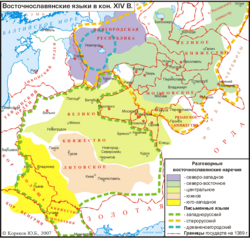 Middle Russian written language (orange dotted line) at the end of the 14th century | |
| Native to | Tsardom of Russia |
| Extinct | developed into the modern Russian language |
Indo-European
| |
| Language codes | |
| ISO 639-3 | – |
Middle Russian (среднерусский язык) is the historical stage of the Russian language that was spoken and written from the 14th to the 17th centuries. It developed following the fragmentation of Old Russian into the distinct Russian and Ruthenian branches, and lasted until the language reforms introduced by Peter the Great.1
In Russian scholarly literature, this period is often referred to as Old Russian (старорусский язык) or Old Great Russian (старовеликорусский язык).23 In English, "Old Russian" is typically reserved for the preceding Old East Slavic stage (7th–14th centuries) to maintain the chronological distinction between Old, Middle, and Modern Russian. These various terms are primarily used by linguists to classify units of language and determine their historical age or the period of their first written record.4
The Middle Russian era is conventionally divided into two distinct subperiods: Early Middle Russian (14th–15th centuries) and Late Middle Russian (16th–17th centuries).5
Context
In the history of the Russian language, three main chronological periods are distinguished:
- Old Russian (also called Old East Slavic; древнерусский язык): the common ancestor of Russian, Belarusian, and Ukrainian (7th–14th centuries);
- Middle Russian (or Old Great Russian; старорусский язык): the stage of the Russian language that chronologically succeeded Old East Slavic (14th–17th centuries);
- Modern Russian: the period of the national Russian language (from the mid-17th century to the present).16
Linguistic characteristics
During this period, the phonetic, morphological, and syntactic systems that closely resemble those of the modern Russian language began to form. Key linguistic changes include:789
- the change of е to о after soft consonants before hard ones: [н’ес] > [н’ос];
- the final formation of the system of oppositions of hard/soft and voiceless/voiced consonants;
- the replacement of the consonants ц, з, с in declension forms with к, г, х (рукѣ, ногѣ, сохѣ instead of руцѣ, нозѣ, сосѣ); in the Ukrainian and Belarusian languages, such case alternations are preserved: Ukrainian: на руці, на нозі; Belarusian: на руцэ, на назе;
- the loss of the category of dual number;
- the loss of the vocative case, which began to be replaced by the nominative case (брат!, сын!); the vocative case is preserved in the Ukrainian language and partly in Belarusian: Ukrainian брате!, сыну!; Belarusian браце!;
- the emergence and widespread use of the -а inflection in nouns in the nominative plural (города, дома, учителя) in contrast to its absence in similar forms in Ukrainian and Belarusian (Ukrainian доми, вчителі; Belarusian гарады, дамы, вучыцелі);
- the unification of declension types;
- the change of adjectival endings [-ыи̯], [-ии̯] into [-ои̯], [-еи̯] (простый, сам третий changes into простой, сам трете́й);
- the appearance of imperative mood forms with к, г instead of ц, з (пеки instead of пеци, помоги instead of помози) and -ите instead of -ѣте (несите instead of несѣте);
- the consolidation in living speech of one form of the past tense of verbs - the former participle ending in -л, which was part of the perfect forms;
- the emergence of common Great Russian words such as крестьянин (peasant), мельник (miller), пашня (arable land), деревня (village), and many others.
Dialects
Among the dialects that developed in the future Great Russian territory in the second half of the 12th – first half of the 13th century (Novgorod, Pskov, Smolensk, Rostov-Suzdal, and the akanye dialect of the upper and middle Oka and the Oka-Seym interfluve), the Rostov-Suzdal dialect primarily its Moscow variety became the most prominent.8
From the second quarter of the 14th century, Moscow became the political and cultural center of the Great Russian lands, and in the 15th century, vast Russian territories were united under its rule. Based primarily on Moscow dialects, alongside linguistic elements from other Russian regions (Ryazan, Novgorod, etc.), the norms of Moscow colloquial speech gradually developed by the 16th century. They combined northern Russian traits (the explosive consonant г, the hard т in third-person verb endings, etc.) with southern Russian features (akanye, etc.). The Moscow koine became exemplary, spreading to other Russian cities and exerting a strong influence on the written language. The emergence of book printing in the 15th and 16th centuries, which led to the publication of church and civil books in the semi-charter script, further contributed to linguistic unification. Many official documents and works from the 15th to 17th centuries were written in a language with a Muscovite colloquial basis (such as Afanasy Nikitin's A Journey Beyond the Three Seas, the works of Ivan IV the Terrible, The Tale of Peter and Fevronia of Murom, The Tale of the Capture of Pskov, and various satirical literature).10 During the Middle Russian period, the dialectal division of the language evolved. By the 17th century, two large dialectal groupings had formed Northern Russian and the Southern Russian group separated by transitional Central Russian dialects.11
Written language
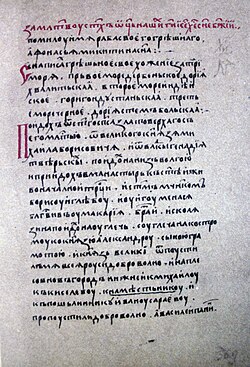
During the 14th–17th centuries, literary bilingualism gradually replaced the earlier diglossia. The Old Moscow recension of Church Slavonic coexisted with the proper Russian literary language, which was based on the vernacular.12 Various transitional forms emerged between these two idioms. Contradictory tendencies were observed in literary and linguistic processes: on the one hand, from the late 14th century, literature of various genres began to reflect vernacular speech accessible to broader strata of society; on the other hand, under the so-called second South Slavic influence, the language of many works became increasingly archaic. The resulting bookish "weaving of words" increasingly diverged from everyday speech.7
The German philologist Heinrich Ludolf noted: “But just as no Russian can write or discuss scientific matters without using the Slavic language, so, conversely, no one can get by with the Slavic language alone in domestic and intimate conversations, because the names of most ordinary things used in everyday life are not found in the books from which the Slavic language is learned. So they say that one must speak Russian and write in Slavic.” Highly innovative in this regard was the Life of Archpriest Avvakum, written by Avvakum in “natural Russian” essentially the vernacular of his time.1314 This contrast is evident from comparing the following examples:
Then they brought me to Bratsk ostrog, threw me in jail, and gave me straw... I lay like a dog in straw: sometimes they fed me, sometimes they didn't. There were so many mice, I beat them with a skufia, the fools wouldn't even give me a bat! I lay on my belly all the time: my back was rotting. There were lots of fleas and lice... And my wife and children were exiled twenty verst away from me. That woman Ksenia tormented her all that winter, barking and reproaching.
Likewise, in this time of ours, the Lord God, in his anger at the people, has deigned to remove our strong autocrat, our benevolent and merciful Tsar, who was kind to all. He, through his wise foresight and great mercy, had he not fallen ill, would have been able to alleviate the people's distress in every way. For already in the imperial city, the wrath of God has begun to flare up from the rulers' taxes and unjust judgments, and the people's thoughts have also begun to degenerate.
The 16th century saw the grammatical normalization of the Muscovite written language, which became the single national language of the Russian Tsardom. Driven by Moscow's ambition to be viewed as the Third Rome, official business language from the late 15th to early 16th centuries was deliberately archaized and standardized along the lines of literary Slavo-Russian. In high rhetorical styles, artificial neologisms and compound words were formed based on archaic models (e.g., великозлобство, зверообразство, властодержавец).
Church Slavonic orthography was codified in the grammars of Lavrentiy Zizaniy (1596) and Meletius Smotrytsky (1619). A century later, Vasily Trediakovsky, while studying at the Slavic Greek Latin Academy, argued that Smotritsky's attempt to base Russian grammar on formal Greek models contradicted the natural flow of Slavic speech. Although Smotritsky's grammar held sacred status, it required rethinking by the mid-18th century. Before Trediakovsky, Vasily Adodurov initiated this process in his grammar written in the late 1740s.15
The official Moscow language, virtually free of Church Slavonicisms, reached a high level of development by the early 17th century. It was used in government documents, legal codes, and almost all correspondence among the Moscow intelligentsia. The southwestern influence emanating from the Polish–Lithuanian Commonwealth brought a flood of Europeanisms into Russian literary speech. In the 17th century, the influence of Latin, the international language of science, grew significantly (e.g., introducing terms like вертикальный, фигура, глобус, градус, дистанция). Polish also served as a major supplier of European scientific, legal, and secular vocabulary.
Notes
Notes
References
References
- Лопатин & Улуханов 2005, pp. 448–450.
- Зализняк, А. А. (2011). Труды по акцентологии. Т. 2: Древнерусский и старовеликорусский акцентологический словарь-указатель (XIV-XVII вв.) (PDF). Studia philologica (in Russian). Moscow: Языки славянских культур. p. 352.
- Сичинава 2016, pp. 208–210.
- Краткий понятийно-терминологический справочник по этимологии и исторической лексикологии / Российская академия наук, Институт русского языка им. В. В. Виноградова, Этимология и история слов русского языка. Ж. Ж. Варбот, А. Ф. Журавлёв. — 1998.
- Пенькова 2023, pp. 739–767.
- Сичинава 2016, p. 208.
- F. P. Filin, Русский язык
- Иванов, В. В. (1997). "История русского языка". In Гл. ред. Ю. Н. Караулов (ed.). Русский язык. Энциклопедия (in Russian) (2-е изд., перераб. и доп ed.). Moscow: Научное издательство «Большая Российская энциклопедия»; Издательский дом «Дрофа». pp. 169–170. ISBN 5-85270-248-X.
- Иванов В. В. Восточнославянские языки
- Лопатин & Улуханов 2005, pp. 448–449.
- Захарова et al. 1970, p. 223.
- Бранднер, Алеш (1993). "Проблематика периодизации истории русского языка. Происхождение русского литературного языка" (PDF). Opera Slavica (in Russian) (III/2). Brno: Ústav slavistiky: 27–28. ISSN 2336-4459. Archived (PDF) from the original on 2022-06-17.
- Чернов, В. "На каком языке писал Аввакум?" (in Russian). Archived from the original on 2022-06-18. Retrieved 2023-11-10.
- "Язык и стиль «Жития протопопа Аввакума, им самим написанного» и других произведений". Archived from the original on 2023-11-10. Retrieved 2023-11-10.
- Сложеникина, Ю. В.; Растягаев, А. В. (2009). "Языковая и персональная модели Тредиаковского". Тредиаковский, Василий Кириллович (in Russian). Archived from the original on 2021-07-18.
Literature
- Захарова, К. Ф.; Орлова, В. Г.; Сологуб, А. И.; Строганова, Т. Ю. (1970). В. Г. Орлова (ed.). Образование севернорусского наречия и среднерусских говоров (in Russian). Moscow: Наука. p. 456.
- Лопатин, В. В.; Улуханов, И. С. (2005). "Восточнославянские языки. Русский язык". Языки мира. Славянские языки (in Russian). Moscow: Academia. pp. 444–513. ISBN 5-87444-216-2.
- Пенькова, Яна А. (2023). "Начинательные глаголы в конструкциях с инфинитивом в русской письменности XVI‒XVII вв: в поисках различий" (PDF). Вестник Санкт-Петербургского университета: Язык и литература (in Russian). 20 (4): 739–767.
- Сичинава, Дмитрий В. (2016). "Старорусские/среднерусские тексты в НКРЯ: от экстенсивной коллекции к корпусу". El’Manuscript–2016: Rašytinis palikimas ir informacinės technologijos (PDF) (in Russian). Vilnius: Iževskas. pp. 208–210.