| Micrognathism | |
|---|---|
| Other names | Micrognathia, strawberry chin, hypognathia1 hypognathism |
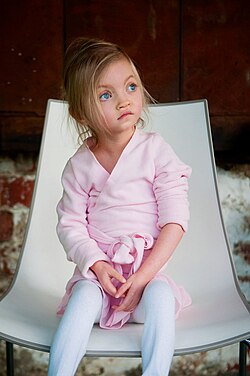 | |
| Girl with Wolf–Hirschhorn syndrome | |
| Specialty | Medical genetics |
Micrognathism is a condition where the jaw is undersized. It is also sometimes called mandibular hypoplasia.2 It is common in infants,34 but is usually self-corrected during growth, due to the jaws increasing in size. It may be a cause of abnormal tooth alignment and in severe cases can hamper feeding.5 It can also, both in adults and children, make intubation difficult, either during anesthesia or in emergency situations.
Causes
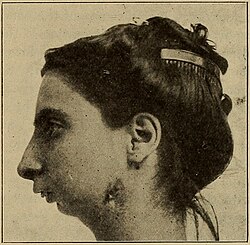
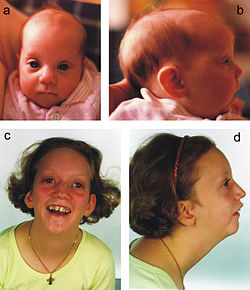
According to the NCBI, the following conditions feature micrognathism:6
- 11q partial monosomy syndrome
- 3-methylglutaconic aciduria, type VIIB
- 46,XY sex reversal 4
- 4p partial monosomy syndrome
- Achard syndrome
- Acrofacial dysostosis Cincinnati type
- Acrofacial dysostosis Rodriguez type
- Acrofacial dysostosis, Catania type
- Acromegaloid facial appearance syndrome
- Adams–Oliver syndrome 2
- Agnathia-otocephaly complex
- ALG1-congenital disorder of glycosylation
- Alveolar capillary dysplasia with pulmonary venous misalignment
- Amish lethal microcephaly
- Andersen–Tawil syndrome
- Aprosencephaly cerebellar dysgenesis
- Arterial tortuosity syndrome
- Arthrogryposis multiplex congenita 1, neurogenic, with myelin defect
- Arthrogryposis multiplex congenita 4, neurogenic, with agenesis of the corpus callosum
- Arthrogryposis multiplex congenita 5
- Arthrogryposis, distal, type 2E
- Autism spectrum disorder due to AUTS2 deficiency
- Autosomal dominant Robinow syndrome 1–3
- Autosomal recessive multiple pterygium syndrome
- Autosomal recessive osteopetrosis 5
- Autosomal recessive Robinow syndrome
- Autosomal recessive spastic paraplegia type 70
- Bailey-Bloch congenital myopathy
- Baller–Gerold syndrome
- Barber–Say syndrome
- Bartsocas–Papas syndrome 1 and 2
- Bohring–Opitz syndrome
- Bowen–Conradi syndrome
- C syndrome
- Camptomelic dysplasia
- Cardiofaciocutaneous syndrome
- Cat eye syndrome
- Catel–Manzke syndrome
- Cerebro-costo-mandibular syndrome
- Cerebrooculofacioskeletal syndrome 1–4
- CHARGE association
- Chondrodysplasia Blomstrand type
- Chondrodysplasia with joint dislocations, gPAPP type
- Cleidocranial dysostosis
- Coffin–Siris syndrome 6 and 12
- COG1 congenital disorder of glycosylation
- COG7 congenital disorder of glycosylation
- COG8-congenital disorder of glycosylation
- Cohen syndrome
- Cold-induced sweating syndrome 1
- Cole–Carpenter syndrome 1
- Complex lethal osteochondrodysplasia
- Congenital contractural arachnodactyly
- Congenital disorder of glycosylation type 1E
- Congenital disorder of glycosylation, type IIr
- Congenital disorder of glycosylation, type IIw
- Congenital lactic acidosis, Saguenay-Lac-Saint-Jean type
- Congenital myasthenic syndrome 19
- Congenital myopathy 20
- Congenital myopathy 22A, classic
- Congenital myopathy 22B, severe fetal
- Cornelia de Lange syndrome 1, 3, and 5
- Costello syndrome
- Cowden syndrome 5 and 6
- Cranioectodermal dysplasia 2 and 3
- Craniofacial microsomia
- Cutis laxa, autosomal recessive, type 1B
- D-2-hydroxyglutaric aciduria 1
- Desmosterolosis
- Developmental and epileptic encephalopathy 64, 77, 80, and 100
- Diamond–Blackfan anemia 1, 6, 10, 14 (with mandibulofacial dysostosis), 15 (with mandibulofacial dysostosis), 21
- Diaphragmatic hernia 4, with cardiovascular defects
- Diarrhea 10, protein-losing enteropathy type
- DiGeorge syndrome
- Distal arthrogryposis types 2B1 and 5D
- DPAGT1-congenital disorder of glycosylation
- Dubowitz syndrome
- Dysosteosclerosis
- Ehlers–Danlos syndrome, classic-like, 2
- Ehlers–Danlos syndrome, dermatosparaxis type
- Ehlers–Danlos syndrome, spondylodysplastic type, 1
- Emanuel syndrome
- Epilepsy, X-linked 2, with or without impaired intellectual development and dysmorphic features
- Fanconi anemia complementation groups L and P
- Faundes–Banka syndrome
- Feingold syndrome type 1
- FG syndrome 1
- Fibrochondrogenesis 2
- Fibromuscular dysplasia, multifocal
- Fontaine progeroid syndrome
- Frank–Ter Haar syndrome
- Fraser syndrome 3
- Galloway–Mowat syndrome 1, 2 (X-linked), 3, and 7
- GAPO syndrome
- Gaucher disease perinatal lethal
- Genitopatellar syndrome
- Gordon syndrome
- Granulocytopenia with immunoglobulin abnormality
- Greenberg dysplasia
- Hajdu–Cheney syndrome
- Hallermann–Streiff syndrome
- Hamartoma of hypothalamus
- Hereditary spastic paraplegia 23
- Holoprosencephaly 13, X-linked

- Hutchinson–Gilford syndrome
- Hydrolethalus syndrome 1 and 2
- Immunodeficiency 49
- Immunodeficiency–centromeric instability–facial anomalies syndrome 1
- Infantile neuroaxonal dystrophy
- Infantile-onset X-linked spinal muscular atrophy
- Intellectual developmental disorder, autosomal dominant 64, 65, and 70
- Intellectual disability, autosomal dominant 1
- Intellectual disability, X-linked 61
- Intellectual disability, X-linked syndromic, Turner type
- Intellectual disability, X-linked, syndromic, Bain type
- Isolated cleft palate
- Isolated congenital hypoglossia/aglossia
- Isolated Pierre Robin syndrome
- Isotretinoin-like syndrome
- Kabuki syndrome
- Keppen–Lubinsky syndrome
- Knobloch syndrome 2
- Langer–Giedion syndrome
- Larsen-like syndrome, B3GAT3 type
- Lateral meningocele syndrome
- Legius syndrome
- Lethal congenital contracture syndrome 1, 2, 7, and 9
- Lethal Kniest-like syndrome
- Lethal multiple pterygium syndrome
- Lissencephaly 7 with cerebellar hypoplasia
- Liver disease, severe congenital
- Loeys–Dietz syndrome 1 and 2
- Lymphatic malformation 6
- Mandibuloacral dysplasia progeroid syndrome
- Mandibuloacral dysplasia with type A lipodystrophy
- Mandibuloacral dysplasia with type B lipodystrophy
- Mandibulofacial dysostosis with alopecia
- Mandibulofacial dysostosis-microcephaly syndrome
- Marbach-Rustad progeroid syndrome
- Marden–Walker syndrome
- Marfan syndrome
- Marshall syndrome
- Matthew–Wood syndrome
- Mayer–Rokitansky–Küster–Hauser syndrome type 2
- Meckel syndrome 13 and 14
- Meckel syndrome, type 1
- Megalocornea-intellectual disability syndrome
- Meier-Gorlin syndrome
- Melnick–Needles syndrome
- Menke-Hennekam syndrome 1 and 2
- Microcephalic osteodysplastic primordial dwarfism, type 3
- Microcephalic primordial dwarfism due to ZNF335 deficiency
- Microcephaly 13, primary, autosomal recessive
- Microcephaly 16, primary, autosomal recessive
- Microcephaly 2, primary, autosomal recessive, with or without cortical malformations
- Microcephaly 4, primary, autosomal recessive

- Microcephaly, normal intelligence and immunodeficiency
- Microphthalmia, syndromic 12
- Miller syndrome
- Mohr syndrome
- Mucolipidosis type II
- Mucopolysaccharidosis, MPS-I-H/S
- Multiple congenital anomalies-hypotonia-seizures syndrome 1 and 2
- Myofibrillar myopathy 8
- Nager syndrome
- NEK9-related lethal skeletal dysplasia
- Nemaline myopathy 9
- Neonatal pseudo-hydrocephalic progeroid syndrome
- Nephrotic syndrome, type 11
- Nestor-Guillermo progeria syndrome
- Neu–Laxova syndrome 1 and 2
- Neuropathy, congenital hypomyelinating, 3
- Noonan syndrome 1, 2, and 13
- Oculodentodigital dysplasia, autosomal recessive
- Ogden syndrome
- Orofacial cleft 13
- Orofacialdigital syndrome IV
- Orofaciodigital syndrome types 6 and 14
- Osteogenesis imperfecta types 3, 10, 12, and 18
- Osteopathia striata with cranial sclerosis
- Oto-palato-digital syndrome, type II
- Otospondylomegaepiphyseal dysplasia, autosomal recessive
- Pallister–Killian syndrome
- Paris-Trousseau thrombocytopenia
- Periventricular nodular heterotopia 7
- Perlman syndrome
- Peroxisome biogenesis disorder 10A (Zellweger)
- Peroxisome biogenesis disorder 13A (Zellweger)
- Peroxisome biogenesis disorder 1A (Zellweger)
- Peroxisome biogenesis disorder 2A (Zellweger)
- Peroxisome biogenesis disorder 5A (Zellweger)
- PGM1-congenital disorder of glycosylation
- Phelan–McDermid syndrome
- Pierre Robin sequence with pectus excavatum and rib and scapular anomalies
- Pierre Robin syndrome-faciodigital anomaly syndrome
- Poikiloderma with neutropenia
- Polymicrogyria with or without vascular-type Ehlers–Danlos syndrome
- Pontocerebellar hypoplasia types 2E, 7, and 12
- Potocki–Lupski syndrome
- Prolidase deficiency
- Pyknodysostosis

- RAB23-related Carpenter syndrome
- Renpenning syndrome
- Restrictive dermopathy 1
- RFT1-congenital disorder of glycosylation
- Rhizomelic chondrodysplasia punctata types 1 and 2
- Ritscher–Schinzel syndrome 1 and 3
- Roberts-SC phocomelia syndrome
- Robinow syndrome, autosomal recessive 2
- Rothmund–Thomson syndrome type 2
- Rubinstein–Taybi syndrome due to 16p13.3 microdeletion
- Rubinstein–Taybi syndrome due to CREBBP mutations
- Rubinstein–Taybi syndrome due to EP300 haploinsufficiency
- Schwartz–Jampel syndrome type 1
- Seckel syndrome 1, 2, 5, 8, and 9
- SHORT syndrome
- Shprintzen–Goldberg syndrome
- Silver–Russell syndrome 1 and 2
- Smith–Lemli–Opitz syndrome
- Spinal muscular atrophy, lower extremity-predominant, 2b, prenatal onset, autosomal dominant
- Splenogonadal fusion-limb defects-micrognathia syndrome
- Spondyloepimetaphyseal dysplasia with joint laxity, type 1, with or without fractures
- Spondyloepimetaphyseal dysplasia-short limb-abnormal calcification syndrome
- Squalene synthase deficiency
- SSR4-congenital disorder of glycosylation
- Stickler syndrome types 1 and 2
- Stromme syndrome
- Syndromic X-linked intellectual disability Claes-Jensen type
- Syndromic X-linked intellectual disability Najm type
- Tetraamelia syndrome 1 and 2
- Thickened earlobes-conductive deafness syndrome
- Toriello–Carey syndrome
- Treacher Collins syndrome
- Ventriculomegaly and arthrogryposis
- Vici syndrome
- Whistling face syndrome, recessive form
- Wiedemann–Steiner syndrome
- X-linked intellectual disability with marfanoid habitus
- Yunis–Varon syndrome
- Zaki syndrome
Diagnosis
It can be detected by the naked eye as well as dental or skull X-ray testing.
Treatments
Micrognathia can be treated by surgery.
References
References
- Martínez-Frías, ML; Martín, M; Pardo, M; Torres, M; Cohen MM, Jr (1993). "Holoprosencephaly and hypognathia with two proboscides: report of a case and review of unusual proboscides". Journal of Craniofacial Genetics and Developmental Biology. 14 (4): 231–4. PMID 7883869.
- Hassani, Mohammad-Esmaiil; Karimi, Hamid; Hassani, Hosein; Hassani, Ali (2014-01-01). "Bilateral mandibular distraction in micrognathism or hypoplasia of mandible, hazrat fatemeh hospital". Journal of Acute Disease. 3 (4): 296–299. doi:10.1016/S2221-6189(14)60064-0. ISSN 2221-6189.
- Cang, Zhengqiang; Cui, Jiangbo; Pei, Jiaomiao; Wang, Zheng; Du, Yichen; Mu, Siqi; Dou, Wenjie; Fan, Xing; Zhang, Xi; Li, Yang (2023-04-12). "Prenatal diagnosis of micrognathia: a systematic review". Frontiers in Pediatrics. 11. doi:10.3389/fped.2023.1161421. ISSN 2296-2360. PMC 10130438. PMID 37124181.
- Berger, Jessica A.; Nelson, Olivia; Staben, James; Javia, Luv R.; Simpao, Allan F.; Khalek, Nahla; Oliver, Edward R.; Adzick, N. Scott; Lin, Elaina E. (2024). "Immediate postdelivery airway management of neonates with prenatally diagnosed micrognathia: A retrospective observational study". Pediatric Anesthesia. 34 (3): 267–273. doi:10.1111/pan.14806. ISSN 1460-9592. PMID 38069629.
- Hong, Paul; Brake, Maria K.; Cavanagh, Jonathan P.; Bezuhly, Michael; Magit, Anthony E. (2012). "Feeding and mandibular distraction osteogenesis in children with Pierre Robin sequence: A case series of functional outcomes". International Journal of Pediatric Otorhinolaryngology. 76 (3): 414–418. doi:10.1016/j.ijporl.2011.12.023. ISSN 0165-5876. PMID 22245167.
- "Micrognathia (Concept Id: C0025990)". NCBI. Retrieved April 2, 2024.