A microbody (or cytosome) is a type of organelle that is found in the cells of plants, protozoa, fungi, and animals. Organelles in the microbody family include peroxisomes, glyoxysomes, glycosomes and hydrogenosomes. In vertebrates, microbodies are especially prevalent in the liver and kidney. Many membrane bound vesicles called microbodies that contain various enzymes, are present in both plant and animal cells.
Structure
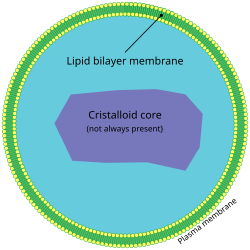
Microbodies are different type of bodies present in the cytosol, also known as cytosomes. A microbody is usually a vesicle with a spherical shape, ranging from 0.2-1.5 micrometers in diameter.1 Microbodies are found in the cytoplasm of a cell, but they are only visible with the use of an electron microscope. They are surrounded by a single phospholipid bilayer membrane and they contain a matrix of intracellular material including enzymes and other proteins, but they do not seem to contain any genetic material to allow them to self-replicate.1
Function
Microbodies contain enzymes that participate in the preparatory or intermediate stages of biochemical reactions within the cell. This facilitates the breakdown of fats, alcohols and amino acids. Generally microbodies are involved in detoxification of peroxides and in photo respiration in plants. Different types of microbodies have different functions:
Peroxisomes
A peroxisome is a type of microbody that functions to help the body break down large molecules and detoxify hazardous substances. It contains enzymes like oxidase, which can produce hydrogen peroxide as a byproduct of its enzymatic reactions. Within the peroxisome, hydrogen peroxide can then be converted to water by enzymes like catalase and peroxidase. The peroxisome was discovered and named by Christian de Duve.
Peroxisomes are derived from the smooth endoplasmic reticulum under certain experimental conditions and replicate by membrane growth and division out of pre-existing organelles.234 This is in line with homologies between the peroxisomal import machinery and the ERAD pathway in the endoplasmic reticulum,56 along with a number of metabolic enzymes that were likely recruited from the mitochondria.6
Glyoxysomes and glycosomes are known to be peroxisome variants because they not only have similar structures, but are also built using similar processes, using related proteins, and contains related enzymes that carry out often recognizably related pathways.7 Even when radically different enzymes are involved, the signal peptides are conserved.8
Glyoxysomes
Glyoxysomes are specialized peroxisomes found in plants and mold, which help to convert stored lipids into carbohydrates so they can be used for plant growth. In glyoxysomes the fatty acids are hydrolyzed to acetyl-CoA by peroxisomal β-oxidation enzymes. Besides peroxisomal functions, glyoxysomes also possess the key enzymes of the glyoxylate cycle.
Glycosomes
Glycosomes are specialized peroxisomes found in some protists such as the Kinetoplastida. They specialize in the breakdown of carbohydrates as well as other catabolic processes like purine salvage.7
Hydrogenosome
Hydrogenosomes are a variant of mitochondria to produce molecular hydrogen and ATP in anaerobic conditions.9 Their link to the mitochondria is proven by their structual and functional similarities and their use of mitochondrion-related proteins (imported from the nucleus).1011 Most of them are genomeless, but two examples are known to have a genome recognizably related to mitochondrial genomes.12
History
Microbodies were first discovered and named in 1954 by Rhodin.13 Two years later in 1956, Rouiller and Bernhard presented the first worldwide accepted images of microbodies in liver cells.13 Then in 1965, Christian de Duve and coworkers isolated microbodies from the liver of a rat. De Duve also believed that the name microbody was too general and chose the name of peroxisome because of its relationship with hydrogen peroxide.14 In 1967, Breidenbach and Beevers were the first to isolate microbodies from plants, which they named glyoxysomes because they were found to contain enzymes of the glyoxylate cycle.
References
References
- "Microbodies." Molecular Biology of Plant Cells. Ed. H. Smith. N.p.: University of California, 1978. 136-54. Print.
- Hoepfner D, Schildknegt D, Braakman I, Philippsen P, Tabak HF (July 2005). "Contribution of the endoplasmic reticulum to peroxisome formation". Cell. 122 (1): 85–95. doi:10.1016/j.cell.2005.04.025. hdl:1874/9833. PMID 16009135. S2CID 18837009.
- Schrader M, Costello JL, Godinho LF, Azadi AS, Islinger M (May 2016). "Proliferation and fission of peroxisomes - An update". Biochimica et Biophysica Acta (BBA) - Molecular Cell Research. 1863 (5): 971–83. doi:10.1016/j.bbamcr.2015.09.024. hdl:10871/18323. PMID 26409486.
- Lazarow PB, Fujiki Y (Nov 1985). "Biogenesis of peroxisomes". Annual Review of Cell Biology. 1 (1): 489–530. doi:10.1146/annurev.cb.01.110185.002421. PMID 3916321.
- Schlüter A, Fourcade S, Ripp R, Mandel JL, Poch O, Pujol A (April 2006). "The evolutionary origin of peroxisomes: an ER-peroxisome connection". Molecular Biology and Evolution. 23 (4): 838–45. doi:10.1093/molbev/msj103. PMID 16452116.
- Gabaldón T, Snel B, van Zimmeren F, Hemrika W, Tabak H, Huynen MA (March 2006). "Origin and evolution of the peroxisomal proteome". Biology Direct. 1: 8. doi:10.1186/1745-6150-1-8. PMC 1472686. PMID 16556314.
- Parsons M (2004). "Glycosomes: parasites and the divergence of peroxisomal purpose". Mol Microbiol. 53 (3): 717–24. doi:10.1111/j.1365-2958.2004.04203.x. PMID 15255886.
- Keller, GA; Krisans, S; Gould, SJ; Sommer, JM; Wang, CC; Schliebs, W; Kunau, W; Brody, S; Subramani, S (September 1991). "Evolutionary conservation of a microbody targeting signal that targets proteins to peroxisomes, glyoxysomes, and glycosomes". The Journal of cell biology. 114 (5): 893–904. doi:10.1083/jcb.114.5.893. PMID 1831458.
- de Graaf RM, Duarte I, van Alen TA, Kuiper JW, Schotanus K, Rosenberg J, et al. (December 2009). "The hydrogenosomes of Psalteriomonas lanterna". BMC Evolutionary Biology. 9 (1) 287. Bibcode:2009BMCEE...9..287D. doi:10.1186/1471-2148-9-287. PMC 2796672. PMID 20003182.
- Rada P, Doležal P, Jedelský PL, Bursac D, Perry AJ, Šedinová M, et al. (2011-09-15). "The core components of organelle biogenesis and membrane transport in the hydrogenosomes of Trichomonas vaginalis". PLOS ONE. 6 (9) e24428. Bibcode:2011PLoSO...624428R. doi:10.1371/journal.pone.0024428. PMC 3174187. PMID 21935410.
- Mai Z, Ghosh S, Frisardi M, Rosenthal B, Rogers R, Samuelson J (March 1999). "Hsp60 is targeted to a cryptic mitochondrion-derived organelle ("crypton") in the microaerophilic protozoan parasite Entamoeba histolytica". Molecular and Cellular Biology. 19 (3): 2198–205. doi:10.1128/MCB.19.3.2198. PMC 84012. PMID 10022906.
- Stechmann A, Hamblin K, Pérez-Brocal V, Gaston D, Richmond GS, van der Giezen M, et al. (April 2008). "Organelles in Blastocystis that blur the distinction between mitochondria and hydrogenosomes". Current Biology. 18 (8): 580–5. Bibcode:2008CBio...18..580S. doi:10.1016/j.cub.2008.03.037. PMC 2428068. PMID 18403202.
- de Duve C and Baudhuin P (1966). "Peroxisomes (Microbodies and Related Particles)" (PDF). Physiological Reviews. 46 (2): 323–357. doi:10.1152/physrev.1966.46.2.323. PMID 5325972.
- de Duve C (1969). "The peroxisome: a new cytoplasmic organelle". Proc. R. Soc. Lond. B Biol. Sci. 173 (30): 71–83. Bibcode:1969RSPSB.173...71D. doi:10.1098/rspb.1969.0039. PMID 4389648. S2CID 86579094.