In functional analysis, a branch of mathematics, Michael selection theorem is a selection theorem named after Ernest Michael. In its most popular form, it states the following:1
Michael Selection Theorem—Let X be a paracompact space and Y be a separable Banach space. Let be a lower hemicontinuous set-valued function with nonempty convex closed values. Then there exists a continuous selection of F.
Conversely, if any lower semicontinuous multimap from topological space X to a Banach space, with nonempty convex closed values, admits a continuous selection, then X is paracompact. This provides another characterization for paracompactness.
Examples
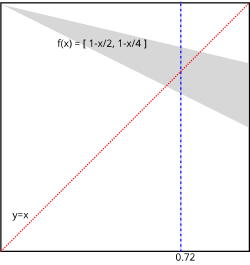
A function that satisfies all requirements
The function: , shown by the grey area in the figure at the right, is a set-valued function from the real interval [0,1] to itself. It satisfies all Michael's conditions, and indeed it has a continuous selection, for example: or .
A function that does not satisfy lower hemicontinuity
The function
is a set-valued function from the real interval [0,1] to itself. It has nonempty convex closed values. However, it is not lower hemicontinuous at 0.5. Indeed, Michael's theorem does not apply and the function does not have a continuous selection: any selection at 0.5 is necessarily discontinuous.2
Applications
Michael selection theorem can be applied to show that the differential inclusion
has a C1 solution when F is lower semi-continuous and F(t, x) is a nonempty closed and convex set for all (t, x). When F is single valued, this is the classic Peano existence theorem.
Generalizations
A theorem due to Deutsch and Kenderov generalizes Michel selection theorem to an equivalence relating approximate selections to almost lower hemicontinuity, where is said to be almost lower hemicontinuous if at each , all neighborhoods of there exists a neighborhood of such that
Precisely, Deutsch–Kenderov theorem states that if is paracompact, a normed vector space and is nonempty convex for each , then is almost lower hemicontinuous if and only if has continuous approximate selections, that is, for each neighborhood of in there is a continuous function such that for each , .3
In a note Xu proved that Deutsch–Kenderov theorem is also valid if is a locally convex topological vector space.4
References
References
- Michael, Ernest (1956). "Continuous selections. I". Annals of Mathematics. Second Series. 63 (2): 361–382. doi:10.2307/1969615. hdl:10338.dmlcz/119700. JSTOR 1969615. MR 0077107.
- "proof verification - Reducing Kakutani's fixed-point theorem to Brouwer's using a selection theorem". Mathematics Stack Exchange. Retrieved 2019-10-29.
- Deutsch, Frank; Kenderov, Petar (January 1983). "Continuous Selections and Approximate Selection for Set-Valued Mappings and Applications to Metric Projections". SIAM Journal on Mathematical Analysis. 14 (1): 185–194. doi:10.1137/0514015.
- Xu, Yuguang (December 2001). "A Note on a Continuous Approximate Selection Theorem". Journal of Approximation Theory. 113 (2): 324–325. doi:10.1006/jath.2001.3622.
Further reading
Further reading
- Repovš, Dušan; Semenov, Pavel V. (2014). "Continuous Selections of Multivalued Mappings". In Hart, K. P.; van Mill, J.; Simon, P. (eds.). Recent Progress in General Topology. Vol. III. Berlin: Springer. pp. 711–749. arXiv:1401.2257. Bibcode:2014arXiv1401.2257R. doi:10.2991/978-94-6239-024-9_17 (inactive 27 July 2025). ISBN 978-94-6239-023-2.
{{cite book}}: CS1 maint: DOI inactive as of July 2025 (link) - Aubin, Jean-Pierre; Cellina, Arrigo (1984). Differential Inclusions, Set-Valued Maps And Viability Theory. Grundl. der Math. Wiss. Vol. 264. Berlin: Springer-Verlag. ISBN 3-540-13105-1.
- Aubin, Jean-Pierre; Frankowska, H. (1990). Set-Valued Analysis. Basel: Birkhäuser. ISBN 3-7643-3478-9.
- Deimling, Klaus (1992). Multivalued Differential Equations. Walter de Gruyter. ISBN 3-11-013212-5.
- Repovš, Dušan; Semenov, Pavel V. (1998). Continuous Selections of Multivalued Mappings. Dordrecht: Kluwer Academic Publishers. ISBN 0-7923-5277-7.
- Repovš, Dušan; Semenov, Pavel V. (2008). "Ernest Michael and Theory of Continuous Selections". Topology and Its Applications. 155 (8): 755–763. arXiv:0803.4473. doi:10.1016/j.topol.2006.06.011.
- Aliprantis, Charalambos D.; Border, Kim C. (2007). Infinite Dimensional Analysis : Hitchhiker's Guide (3rd ed.). Springer. ISBN 978-3-540-32696-0.
- Hu, S.; Papageorgiou, N. (31 October 1997). Handbook of Multivalued Analysis. Vol. I. Kluwer. ISBN 0-7923-4682-3.