| Messier 100 | |
|---|---|
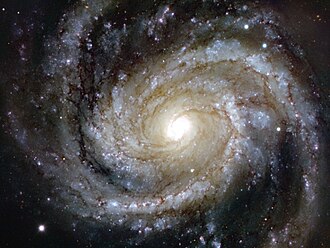 Galaxy Messier 100 imaged by ESO, revealing complex spiral arm structure | |
| Observation data (J2000 epoch) | |
| Constellation | Coma Berenices1 |
| Right ascension | 12h 22m 54.8616s2 |
| Declination | +15° 49′ 17.886″2 |
| Redshift | 0.0052402 |
| Heliocentric radial velocity | 1,571±1 km/s2 |
| Distance | 55 Mly3 |
| Group or cluster | Virgo Cluster |
| Apparent magnitude (V) | 9.34 |
| Characteristics | |
| Type | SAB(s)bc2 |
| Size | ~166,100 ly (50.93 kpc) (estimated)2 |
| Apparent size (V) | 7.4′ × 6.3′2 |
| Other designations | |
| HOLM 387A, IRAS 12204+1605, NGC 4321, UGC 7450, MCG +03-32-015, PGC 40153, CGCG 099-030 | |
Messier 100 (also known as NGC 4321 or the Mirror Galaxy) is a grand design intermediate spiral galaxy in the constellation of Coma Berenices.5 It is one of the brightest and largest galaxies in the Virgo Cluster and is approximately 55 million light-years3 from our galaxy, about 166,000 light-years in diameter. It was discovered by Pierre Méchain in 1781a and 29 days later seen again and entered by Charles Messier in his catalogue "of nebulae and star clusters".67 It was one of the first spiral galaxies to be discovered,7 and was listed as one of fourteen spiral nebulae by Lord William Parsons of Rosse in 1850. NGC 4323 and NGC 4328 are satellite galaxies of M100; the former is connected with it by a bridge of luminous matter.89
Early observations

After the discovery of M100 by Méchain, Charles Messier made observations of the galaxy depicting it as a nebula without a star. He pointed out that it was difficult to recognize the nebula because of its faintness.7 William Herschel was able to identify a bright cluster of stars within the "nebula" during his observations.7 His son John expanded the findings in 1833. With the advent of better telescopes, John Herschel was able to see a round, brighter galaxy; however, he also mentioned that it was barely visible through clouds. William Henry Smyth extended the studies of M100, detailing it as a pearly white nebula and pointing out diffuse spots.7
Star formation
Messier 100 is considered a starburst galaxy10 with the strongest star formation activity concentrated in its center, within a ring – actually two tightly wound spiral arms attached to a small nuclear bar of radius: one thousand parsecs11 – where star formation has been taking place for at least 500 million years in separate bursts.12
Supernovae
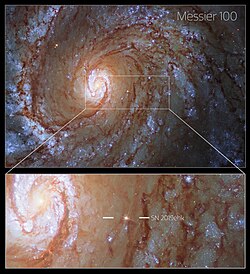
Seven supernovae have been identified in M100:5
- On 17 March 1901 Heber Curtis discovered SN 1901B (Type I, mag. 15.6),13514 at 110"W and 4"N from the galaxy's nucleus.15
- Heber Curtis discovered SN 1914A (type unknown, mag. 15.7)516 on 2 March 1914, at 24"E and 111"S from the galaxy's nucleus.1315
- Milton Humason, with observations from early to mid 1960,b discovered SN 1959E (Type I, mag. 17.5),517 located 58"E and 21"S from the galaxy's nucleus.18
- On 15 April 1979, amateur astronomer Gus Johnson discovered SN 1979C, the first Type II supernova found in the M100 galaxy. However, the star faded quickly, and later observations from x-ray to radio wavelengths revealed its remnant.51920
- SN 2006X (Type Ia, mag. 15.3) was discovered by Shoji Suzuki and Marco Migliardi on 7 February 2006, two weeks before fading to magnitude 17.5212223
- Jaroslaw Grzegorzek discovered SN 2019ehk (Type Ib, mag. 16.5) on 29 April 2019. The supernova reached a peak magnitude of approximately 15.8.24
- SN 2020oi (Type Ic, mag. 17.28) was discovered by Automatic Learning for the Rapid Classification of Events (ALeRCE) on 7 January 2020.52526
References and footnotes
- R. W. Sinnott, ed. (1988). The Complete New General Catalogue and Index Catalogue of Nebulae and Star Clusters by J. L. E. Dreyer. Sky Publishing Corporation/Cambridge University Press. ISBN 978-0-933346-51-2.
- "Results for object MESSIER 100". NASA/IPAC Extragalactic Database. NASA and Caltech. Retrieved 2006-08-31.
- "Messier 100". Hearst Observatory. Retrieved 2010-02-23.
- "Messier 100". SEDS Messier Catalog. Retrieved 30 April 2022.
- "Messier 100". SEDS: Spiral Galaxy M100 (NGC 4321), type Sc, in Coma Berenices. Retrieved 2010-02-23.
- "Catalog of Nebulae and Star Clusters". SEDS. Retrieved 2010-02-23.
- "Messier 100". SEDS: Observations and Descriptions. Retrieved 2010-02-23.
- S. di Serego Alighieri; et al. (2007). "The HI content of Early-Type Galaxies from the ALFALFA survey I. Catalogued HI sources in the Virgo cluster". Astronomy and Astrophysics. 474 (3): 851–855. arXiv:0709.2096. Bibcode:2007A&A...474..851D. doi:10.1051/0004-6361:20078205. S2CID 5332365.
- "NGC 4323". SIMBAD. Centre de données astronomiques de Strasbourg. Retrieved 2010-02-23.
- Wozniak, H.; Friedli, D.; Martinet, L.; Pfenniger, D. (1999). "Double-barred starburst galaxies viewed by ISOCAM". The Universe as Seen by ISO. 427: 989. Bibcode:1999ESASP.427..989W.
- Sakamoto, Kazushi; Okumura, Sachiko; Minezaki, Takeo; Kobayashi, Yukiyasu; et al. (1995). "Bar-Driven Gas Structure and Star Formation in the Center of M100". The Astronomical Journal. 110 (3): 2075. Bibcode:1995AJ....110.2075S. doi:10.1086/117670.
- Allard, E. L.; Knapen, J. H.; Peletier, R. F.; Sarzi, M. (2006). "The star formation history and evolution of the circumnuclear region of M100". Monthly Notices of the Royal Astronomical Society. 371 (3): 1087–1105. arXiv:astro-ph/0606490. Bibcode:2006MNRAS.371.1087A. doi:10.1111/j.1365-2966.2006.10751.x. S2CID 119370091.
- Pickering, E. C. (1917). "Ritchie's Nova". Harvard College Observatory Bulletin. 642: 1. Bibcode:1917BHarO.642....1P.
- "SN 1901B". SIMBAD. Centre de données astronomiques de Strasbourg. Retrieved 2010-02-23.
- Curtis, Heber Doust (1917). "Three novae in spiral nebulae". Lick Observatory Bulletin. 300: 108. Bibcode:1917LicOB...9..108C. doi:10.5479/ADS/bib/1917LicOB.9.108C.
- "SN 1914A". SIMBAD. Centre de données astronomiques de Strasbourg. Retrieved 2010-02-23.
- "SN 1959E". SIMBAD. Centre de données astronomiques de Strasbourg. Retrieved 2010-02-23.
- Humason, M. L.; Gomes, Alercio M.; Kearns, C. E. (1961). "The 1960 Palomar Supernova Search". Publications of the Astronomical Society of the Pacific. 73 (432): 175. Bibcode:1961PASP...73..175H. doi:10.1086/127650.
{{cite journal}}: CS1 maint: multiple names: authors list (link) - "SN 1979C". SIMBAD. Centre de données astronomiques de Strasbourg. Retrieved 2010-02-23.
- Mattei, J.; Johnson, G. E.; Rosino, L.; Rafanelli, P.; Kirshner, R. (1979). "Supernova in NGC 4321". International Astronomical Union Circular (3348): 1. Bibcode:1979IAUC.3348....1M. Retrieved 2024-11-25.
- "SN 2006X". SIMBAD. Centre de données astronomiques de Strasbourg. Retrieved 2010-02-23.
- Ponticello, N. J.; Burket, J.; Li, W.; Chen, Y. -T.; Yang, M.; Lin, C. -S.; Soma, M.; Migliardi, M.; Dimai, A. (2006). "Supernovae 2006U, 2006V, 2006W, 2006X. (Lick Observatory Supernova Search)". International Astronomical Union Circular (8667): 1. Bibcode:2006IAUC.8667....1P.
- "SN 2006X". Transient Name Server. IAU. Retrieved 1 January 2025.
- "SN 2019ehk". Transient Name Server. IAU. Retrieved 25 November 2024.
- "SN 2020oi". SIMBAD. Centre de données astronomiques de Strasbourg. Retrieved 2010-02-23.
- "SN 2020oi". Transient Name Server. IAU. Retrieved 1 January 2025.
Cite error: A list-defined reference named "koopmannkenney2004" is not used in the content (see the help page).
Cite error: A list-defined reference named "Chung2009" is not used in the content (see the help page).
- On March 15
- February 21 to June 17
External links
External links
- SEDS: Spiral Galaxy 100
- Messier 100 on WikiSky: DSS2, SDSS, GALEX, IRAS, Hydrogen α, X-Ray, Astrophoto, Sky Map, Articles and images
- ESA/Hubble Messier 100
- NASA Astronomy Picture of the Day