| Messapicetus Temporal range:
| |
|---|---|
| |
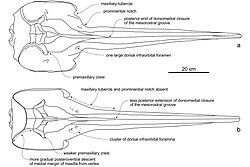
| M. gregarius and M. longirostris cranial diagrams | |
Scientific classification 
| |
| Kingdom: | Animalia |
| Phylum: | Chordata |
| Class: | Mammalia |
| Infraclass: | Placentalia |
| Order: | Artiodactyla |
| Infraorder: | Cetacea |
| Family: | Ziphiidae |
| Genus: | †Messapicetus Bianucci & Landini, 1992 |
Messapicetus is an extinct genus of beaked whale from the Late Miocene. It currently holds two species, M. longirostris from the Tortonian of Italy1 and M. gregarius from the Pisco Formation of Peru.2 However, a third unnamed species is represented in the St. Marys Formation of Maryland known from fragmentary material.3 M. gregarius is sexually dimorphic, males having tusks which are hypothesized to have been used in intraspecific combat for mates as in extant (living) beaked whales. Messapicetus reached a body length of about 4.1–4.5 meters (13–15 ft) and weighed 1.8 metric tons (2.0 short tons).4
References
References
- "Messapicetus longirostris a new genus and species of Ziphiidae (Cetacea) from the Late Miocene of "Pietra leccese" (Apulia; Italy)". arpi.unipi.it. Retrieved 2020-08-28.
- Ramassamy, Benjamin; Lambert, Olivier; Collareta, Alberto; Urbina, Mario; Bianucci, Giovanni (2018-01-16). "Description of the skeleton of the fossil beaked whale <i>Messapicetus gregarius</i>: searching potential proxies for deep-diving abilities". Fossil Record. 21 (1): 11–32. doi:10.5194/fr-21-11-2018. hdl:11568/956055. ISSN 2193-0074.
- Fuller, Anna J.; Godfrey, Stephen J. (2007-06-12). "A late Miocene ziphiid (Messapicetus sp.: Odontoceti: Cetacea) from the St. Marys Formation of Calvert Cliffs, Maryland". Journal of Vertebrate Paleontology. 27 (2): 535–540. doi:10.1671/0272-4634(2007)27[535:ALMZMS]2.0.CO;2. ISSN 0272-4634. S2CID 85606021.
- Lambert, O.; Collareta, A.; Landini, W.; Post, K.; Ramanssamy, B.; Di Celma, C.; Urbina, M.; Bianucci, G. (2015). "No deep diving: evidence of predation on epipelagic fish for a stem beaked whale from the Late Miocene of Peru". Proceedings of the Royal Society B. 282 (1815) 20151530. doi:10.1098/rspb.2015.1530. hdl:11568/760472.