 The astronomical symbol for planet Mercury, with the Arabic numeral 7 overlaid | |
| Program overview | |
|---|---|
| Country | United States |
| Organization | NASA |
| Purpose | Crewed orbital flight |
| Status | Completed |
| Program history | |
| Cost | |
| Duration | 1958–1963 |
| First flight |
|
| First crewed flight |
|
| Last flight |
|
| Successes | 11 |
| Failures | 3 (MA-1, MA-3, and MR-1) |
| Partial failures | 1 (Big Joe 1) |
| Launch sites | |
| Vehicle information | |
| Crewed vehicle | Mercury capsule |
| Launch vehicles | |
Project Mercury was the first human spaceflight program of the United States, running from 1958 through 1963. An early highlight of the Space Race, its goal was to put a man into Earth orbit and return him safely, ideally before the Soviet Union. Taken over from the US Air Force by the newly created civilian space agency NASA, it conducted 20 uncrewed developmental flights (some using animals), and six successful flights by astronauts. The program, which took its name from Roman mythology, cost $2.83 billion (adjusted for inflation).1n 1 The astronauts were collectively known as the "Mercury Seven", and each spacecraft was given a name ending with a "7" by its pilot.
The Space Race began with the 1957 launch of the Soviet satellite Sputnik 1. This came as a shock to the American public, and led to the creation of NASA to expedite existing US space exploration efforts, and place most of them under civilian control. After the successful launch of the Explorer 1 satellite in 1958, crewed spaceflight became the next goal. The Soviet Union put the first human, cosmonaut Yuri Gagarin, into a single orbit aboard Vostok 1 on April 12, 1961. Shortly after this, on May 5, the US launched its first astronaut, Alan Shepard, on a suborbital flight. Soviet Gherman Titov followed with a day-long orbital flight in August 1961. The US reached its orbital goal on February 20, 1962, when John Glenn made three orbits around the Earth. When Mercury ended in May 1963, both nations had sent six people into space, but the Soviets led the US in total time spent in space.
The Mercury space capsule was produced by McDonnell Aircraft, and carried supplies of water, food and oxygen for about one day in a pressurized cabin. Mercury flights were launched from Cape Canaveral Air Force Station in Florida, on launch vehicles modified from the Redstone and Atlas D missiles. The capsule was fitted with a launch escape rocket to carry it safely away from the launch vehicle in case of a failure. The flight was designed to be controlled from the ground via the Manned Space Flight Network, a system of tracking and communications stations; back-up controls were outfitted on board. Small retrorockets were used to bring the spacecraft out of its orbit, after which an ablative heat shield protected it from the heat of atmospheric reentry. Finally, a parachute slowed the craft for a water landing. Both astronaut and capsule were recovered by helicopters deployed from a US Navy ship.
The Mercury project gained popularity, and its missions were followed by millions on radio and TV around the world. Its success laid the groundwork for Project Gemini, which carried two astronauts in each capsule and perfected space docking maneuvers essential for crewed lunar landings in the subsequent Apollo program announced a few weeks after the first crewed Mercury flight.
Creation
Project Mercury was officially approved on October 7, 1958, and publicly announced on December 17.56 Originally called Project Astronaut, President Dwight Eisenhower felt that gave too much attention to the pilot.7 Instead, the name Mercury was chosen from classical mythology, which had already lent names to rockets like the Greek Atlas and Roman Jupiter for the SM-65 and PGM-19 missiles.6 It absorbed military projects with the same aim, such as the Air Force Man in Space Soonest.8n 2
Background
Following the end of World War II, a nuclear arms race evolved between the US and the Soviet Union (USSR). Since the USSR did not have bases in the western hemisphere from which to deploy bomber planes, Joseph Stalin decided to develop intercontinental ballistic missiles, which drove a missile race.10 The rocket technology in turn enabled both sides to develop Earth-orbiting satellites for communications, and gathering weather data and intelligence.11
Americans were shocked when the Soviet Union placed the first satellite into orbit in October 1957, leading to a growing fear that the US was falling into a "missile gap".1211 A month later, the Soviets launched Sputnik 2, carrying a dog into orbit. Though the animal was not recovered alive, it was obvious their goal was human spaceflight.13 Unable to disclose details of military space projects, President Eisenhower ordered the creation of a civilian space agency in charge of civilian and scientific space exploration. Based on the federal research agency National Advisory Committee for Aeronautics (NACA), it was named the National Aeronautics and Space Administration (NASA).14 The agency achieved its first goal of launching a satellite into space, the Pioneer 1, in 1958. The next goal was to put a man there.15
The limit of space (also known as the Kármán line) was defined at the time as a minimum altitude of 62 mi (100 km), and the only way to reach it was by using rocket-powered boosters.1617 This created risks for the pilot, including explosion, high g-forces and vibrations during lift off through a dense atmosphere,18 and temperatures of more than 10,000 °F (5,500 °C) from air compression during reentry.19
In space, pilots would require pressurized chambers or space suits to supply fresh air.20 While there, they would experience weightlessness, which could potentially cause disorientation.21 Further potential risks included radiation and micrometeoroid strikes, both of which would normally be absorbed in the atmosphere.22 All seemed possible to overcome: experience from satellites suggested micrometeoroid risk was negligible,23 and experiments in the early 1950s with simulated weightlessness, high g-forces on humans, and sending animals to the limit of space, all suggested potential problems could be overcome by known technologies.24 Finally, reentry was studied using the nuclear warheads of ballistic missiles,25 which demonstrated a blunt, forward-facing heat shield could solve the problem of heating.25
Organization
T. Keith Glennan had been appointed the first Administrator of NASA, with Hugh L. Dryden (last Director of NACA) as his Deputy, at the creation of the agency on October 1, 1958.26 Glennan would report to the president through the National Aeronautics and Space Council.27 The group responsible for Project Mercury was NASA's Space Task Group, and the goals of the program were to orbit a crewed spacecraft around Earth, investigate the pilot's ability to function in space, and to recover both pilot and spacecraft safely.28 Existing technology and off-the-shelf equipment would be used wherever practical, the simplest and most reliable approach to system design would be followed, and an existing launch vehicle would be employed, together with a progressive test program.29 Spacecraft requirements included: a launch escape system to separate the spacecraft and its occupant from the launch vehicle in case of impending failure; attitude control for orientation of the spacecraft in orbit; a retrorocket system to bring the spacecraft out of orbit; drag braking blunt body for atmospheric reentry; and landing on water.29 To communicate with the spacecraft during an orbital mission, an extensive communications network had to be built.30 In keeping with his desire to keep from giving the US space program an overtly military flavor, President Eisenhower at first hesitated to give the project top national priority (DX rating under the Defense Production Act), which meant that Mercury had to wait in line behind military projects for materials; however, this rating was granted in May 1959, a little more than a year and a half after Sputnik was launched.31
Contractors and facilities
Twelve companies bid to build the Mercury spacecraft on a $20 million ($221 million adjusted for inflation) contract.32 In January 1959, McDonnell Aircraft Corporation was chosen to be prime contractor for the spacecraft.33 Two weeks earlier, North American Aviation, based in Los Angeles, was awarded a contract for Little Joe, a small rocket to be used for development of the launch escape system.34n 3 The World Wide Tracking Network for communication between the ground and spacecraft during a flight was awarded to the Western Electric Company.35 Redstone rockets for suborbital launches were manufactured in Huntsville, Alabama, by the Chrysler Corporation36 and Atlas rockets by Convair in San Diego, California.37 For crewed launches, the Atlantic Missile Range at Cape Canaveral Air Force Station in Florida was made available by the USAF.38 This was also the site of the Mercury Control Center while the computing center of the communication network was in Goddard Space Center, Maryland.39 Little Joe rockets were launched from Wallops Island, Virginia.40 Astronaut training took place at Langley Research Center in Virginia, Lewis Flight Propulsion Laboratory in Cleveland, Ohio, and Naval Air Development Center Johnsville in Warminster, PA.41 Langley wind tunnels42 together with a rocket sled track at Holloman Air Force Base at Alamogordo, New Mexico were used for aerodynamic studies.43 Both Navy and Air Force aircraft were made available for the development of the spacecraft's landing system,44 and Navy ships and Navy and Marine Corps helicopters were made available for recovery.n 4 South of Cape Canaveral the town of Cocoa Beach boomed.46 From here, 75,000 people watched the first American orbital flight being launched in 1962.46
-
 Wallops Island test facility, 1961
 -
 Mercury Control Center, Cape Canaveral, 1963
 -
 Location of production and operational facilities of Project Mercury
Spacecraft

The Mercury spacecraft's principal designer was Maxime Faget, who started research for human spaceflight during the time of the NACA.47 It was 10.8 feet (3.3 m) long and 6.0 feet (1.8 m) wide; with the launch escape system added, the overall length was 25.9 feet (7.9 m).48 With 100 cubic feet (2.8 m3) of habitable volume, the capsule was just large enough for a single crew member.49 Inside were 120 controls: 55 electrical switches, 30 fuses and 35 mechanical levers.50 The heaviest spacecraft, Mercury-Atlas 9, weighed 3,000 pounds (1,400 kg) fully loaded.51 Its outer skin was made of René 41, a nickel alloy able to withstand high temperatures.52

The spacecraft was cone shaped, with a neck at the narrow end.48 It had a convex base, which carried a heat shield (Item 2 in the diagram below)53 consisting of an aluminum honeycomb covered with multiple layers of fiberglass.54 Strapped to it was a retropack (1)55 consisting of three rockets deployed to brake the spacecraft during reentry.56 Between these were three posigrade rockets: minor rockets for separating the spacecraft from the launch vehicle at orbital insertion.57 The straps that held the package could be severed when it was no longer needed.58 Next to the heat shield was the pressurized crew compartment (3).59 Inside, an astronaut would be strapped to a form-fitting seat with instruments in front of him and with his back to the heat shield.60 Underneath the seat was the environmental control system supplying oxygen and heat,61 scrubbing the air of CO2, vapor and odors, and (on orbital flights) collecting urine.62 The recovery compartment (4)63 at the narrow end of the spacecraft contained three parachutes: a drogue to stabilize free fall and two main chutes, a primary and reserve.64
Between the heat shield and inner wall of the crew compartment was a landing skirt, deployed by letting down the heat shield before landing.65 On top of the recovery compartment was the antenna section (5)66 containing both antennas for communication and scanners for guiding spacecraft orientation.67 Attached was a flap used to ensure the spacecraft was faced heat shield first during reentry.68 A launch escape system (6) was mounted to the narrow end of the spacecraft69 containing three small solid-fueled rockets which could be fired briefly in a launch failure to separate the capsule safely from its booster. It would deploy the capsule's parachute for a landing nearby at sea.70 (See also Mission profile for details.)
The Mercury spacecraft did not have an on-board computer, instead relying on all computation for reentry to be calculated by computers on the ground, with their results (retrofire times and firing attitude) then transmitted to the spacecraft by radio while in flight.7172 All computer systems used in the Mercury space program were housed in NASA facilities on Earth.71 (See ground control for details.)
-
 1. Retropack. 2. Heatshield. 3. Crew compartment. 4. Recovery compartment. 5. Antenna section. 6. Launch escape system.
 -
 Retropack: Retrorockets with red posigrade rockets
 -
 Landing skirt (or bag) deployment: skirt is inflated; on impact the air is pressed out (like an airbag)
Pilot accommodations

The astronaut lay in a sitting position with his back to the heat shield, which was found to be the position that best enabled a human to withstand the high g-forces of launch and reentry. A fiberglass seat was custom-molded from each astronaut's space-suited body for maximum support. Near his left hand was a manual abort handle to activate the launch escape system if necessary prior to or during liftoff, in case the automatic trigger failed.73
To supplement the onboard environmental control system, he wore a pressure suit with its own oxygen supply, which would also cool him.74 A cabin atmosphere of pure oxygen at a low pressure of 5.5 psi or 38 kPa (equivalent to the partial pressure of oxygen at sea level or the pressure of atmospheric air at an altitude of 24,800 feet or 7,600 metres) was chosen, rather than the atmosphere at sea level.75 This was easier to control,76 avoided the risk of decompression sickness ("the bends"),77n 5 and also saved on spacecraft weight. Fires (which never occurred during the course of Project Mercury) would have to be extinguished by emptying the cabin of oxygen.62 In such case, or failure of the cabin pressure for any reason, the astronaut could make an emergency return to Earth, relying on his suit for survival.7862 The astronauts normally flew with their visor up, which meant that the suit was not inflated.62 With the visor down and the suit inflated, the astronaut could only reach the side and bottom panels, where vital buttons and handles were placed.79

The astronaut also wore electrodes on his chest to record his heart rhythm, a cuff that could take his blood pressure, and a rectal thermometer to record his temperature (this was replaced by an oral thermometer on the last flight).80 Data from these was sent to the ground during the flight.74n 6 The astronaut normally drank water and ate food pellets.82
Despite the lessons learnt from the U2 program, which also utilized a pressure suit, initially no urine collection device was included for the Mercury astronauts. An inquiry on the subject was made in February 1961 by a student, but NASA responded by stating that "the first space man is not expected to have 'to go".83 The expected short flight times meant that this was overlooked, although after Alan Shepard had a launch delay of four hours, he was forced to urinate in his suit, short-circuiting some of the electrodes monitoring his vital signs. Gus Grissom wore two rubber pants on the second Mercury flight as a crude workaround. It would take until the third flight in February 1962 before a dedicated urine collection device was installed.84

Once in orbit, the spacecraft could be rotated in yaw, pitch, and roll: along its longitudinal axis (roll), left to right from the astronaut's point of view (yaw), and up or down (pitch).85 Movement was created by rocket-propelled thrusters which used hydrogen peroxide as a fuel.8687 For orientation, the pilot could look through the window in front of him or he could look at a screen connected to a periscope with a camera which could be turned 360°.88
The Mercury astronauts had taken part in the development of their spacecraft, and insisted that manual control, and a window, be elements of its design.89 As a result, spacecraft movement and other functions could be controlled three ways: remotely from the ground when passing over a ground station, automatically guided by onboard instruments, or manually by the astronaut, who could replace or override the two other methods. Experience validated the astronauts' insistence on manual controls. Without them, Gordon Cooper's manual reentry during the last flight would not have been possible.90
- Spacecraft cutaway
-
 Interior of spacecraft
 -
 The three axes of rotation for the spacecraft: yaw, pitch and roll
 -
 Temperature profile for spacecraft in Fahrenheit
- Control panels and handle
-
![The control panels of Friendship 7.[91] The panels changed between flights, among others the periscope screen that dominates the center of these panels was dropped for the final flight together with the periscope itself.](/api/ext/img?url=https%3A%2F%2Fupload.wikimedia.org%2Fwikipedia%2Fcommons%2Fthumb%2F8%2F8b%2FControl_panels_mercury_atlas_6.png%2F330px-Control_panels_mercury_atlas_6.png&ttl=86400) The control panels of Friendship 7.91 The panels changed between flights, among others the periscope screen that dominates the center of these panels was dropped for the final flight together with the periscope itself.
The control panels of Friendship 7.91 The panels changed between flights, among others the periscope screen that dominates the center of these panels was dropped for the final flight together with the periscope itself. -
 3-axis handle for attitude control
Development and production

The Mercury spacecraft design was modified three times by NASA between 1958 and 1959.92 After bidding by potential contractors had been completed, NASA selected the design submitted as "C" in November 1958.93 After it failed a test flight in July 1959, a final configuration, "D", emerged.94 The heat shield shape had been developed earlier in the 1950s through experiments with ballistic missiles, which had shown a blunt profile would create a shock wave that would lead most of the heat around the spacecraft.95 To further protect against heat, either a heat sink, or an ablative material, could be added to the shield.96 The heat sink would remove heat by the flow of the air inside the shock wave, whereas the ablative heat shield would remove heat by a controlled evaporation of the ablative material.97 After uncrewed tests, the latter was chosen for crewed flights.98 Apart from the capsule design, a rocket plane similar to the existing X-15 was considered.99 This approach was still too far from being able to make a spaceflight, and was consequently dropped.100n 7 The heat shield and the stability of the spacecraft were tested in wind tunnels,42 and later in flight.104 The launch escape system was developed through uncrewed flights.105 During a period of problems with development of the landing parachutes, alternative landing systems such as the Rogallo glider wing were considered, but ultimately scrapped.106
The spacecraft were produced at McDonnell Aircraft, St. Louis, Missouri, in clean rooms and tested in vacuum chambers at the McDonnell plant.107 The spacecraft had close to 600 subcontractors, such as Garrett AiResearch which built the spacecraft's environmental control system.3361 Final quality control and preparations of the spacecraft were made at Hangar S at Cape Canaveral.108n 8 NASA ordered 20 production spacecraft, numbered 1 through 20.33 Five of the 20, Nos. 10, 12, 15, 17, and 19, were not flown.111 Spacecraft No. 3 and No. 4 were destroyed during uncrewed test flights.111 Spacecraft No. 11 sank and was recovered from the bottom of the Atlantic Ocean after 38 years.111112 Some spacecraft were modified after initial production (refurbished after launch abort, modified for longer missions, etc.).n 9 A number of Mercury boilerplate spacecraft (made from non-flight materials or lacking production spacecraft systems) were also made by NASA and McDonnell.115 They were designed and used to test spacecraft recovery systems and the escape tower.116 McDonnell also built the spacecraft simulators used by the astronauts during training,117 and adopted the motto "First Free Man in Space".118
-

-
 Evolution of capsule design, 1958–59
 -
 Experiment with boilerplate spacecraft, 1959
-
![Drop of boilerplate spacecraft in training of landing and recovery. 56 such qualification tests were made together with tests of individual steps of the system.[44]](/api/ext/img?url=https%3A%2F%2Fupload.wikimedia.org%2Fwikipedia%2Fcommons%2Fthumb%2Fe%2Fe4%2FMercury-project-earth-landing-system-test.png%2F250px-Mercury-project-earth-landing-system-test.png&ttl=86400) Drop of boilerplate spacecraft in training of landing and recovery. 56 such qualification tests were made together with tests of individual steps of the system.44
Drop of boilerplate spacecraft in training of landing and recovery. 56 such qualification tests were made together with tests of individual steps of the system.44
Launch vehicles

Launch escape system testing
A 55-foot-long (17 m) launch vehicle called Little Joe was used for uncrewed tests of the launch escape system, using a Mercury capsule with an escape tower mounted on it.119120 Its main purpose was to test the system at max q, when aerodynamic forces against the spacecraft peaked, making separation of the launch vehicle and spacecraft most difficult.121 It was also the point at which the astronaut was subjected to the heaviest vibrations.122 The Little Joe rocket used solid-fuel propellant and was originally designed in 1958 by NACA for suborbital crewed flights, but was redesigned for Project Mercury to simulate an Atlas-D launch.105 It was produced by North American Aviation.119 It was not able to change direction; instead its flight depended on the angle from which it was launched.123 Its maximum altitude was 100 mi (160 km) fully loaded.124 A Scout launch vehicle was used for a single flight intended to evaluate the tracking network; however, it failed and was destroyed from the ground shortly after launch.125
Suborbital flight


The Mercury-Redstone Launch Vehicle was an 83-foot-tall (25 m) (with capsule and escape system) single-stage launch vehicle used for suborbital (ballistic) flights.126 It had a liquid-fueled engine that burned alcohol and liquid oxygen producing about 75,000 pounds-force (330 kN) of thrust, which was not enough for orbital missions.126 It was a descendant of the German V-2,36 and developed for the US Army during the early 1950s. It was modified for Project Mercury by removing the warhead and adding a collar for supporting the spacecraft together with material for damping vibrations during launch.127 Its rocket motor was produced by North American Aviation and its direction could be altered during flight by its fins. They worked in two ways: by directing the air around them, or by directing the thrust by their inner parts (or both at the same time).36 Both the Atlas-D and Redstone launch vehicles contained an automatic abort sensing system which allowed them to abort a launch by firing the launch escape system if something went wrong.128 The Jupiter rocket, also developed by Wernher von Braun's team at the Redstone Arsenal in Huntsville, was considered as well for intermediate Mercury suborbital flights at a higher speed and altitude than Redstone, but this plan was dropped when it turned out that man-rating Jupiter for the Mercury program would actually cost more than flying an Atlas due to economics of scale.129130 Beyond its IRBM function, the Jupiter missile was repurposed only for the short-lived Juno II launch vehicle, and sustaining a dedicated technical staff solely for a handful of Mercury capsule launches would have been cost-prohibitive.131
Orbital flight
Orbital missions required use of the Atlas LV-3B, a man-rated version of the Atlas D which was originally developed as the United States' first operational intercontinental ballistic missile (ICBM)132 by Convair for the Air Force during the mid-1950s.133 The Atlas was a "one-and-one-half-stage" rocket fueled by kerosene and liquid oxygen (LOX).132 The rocket by itself stood 67 feet (20 m) high; total height of the Atlas-Mercury space vehicle at launch was 95 feet (29 m).134
The Atlas first stage was a booster skirt with two engines burning liquid fuel.135n 10 This, together with the larger sustainer second stage, gave it sufficient power to launch a Mercury spacecraft into orbit.132 Both stages fired from lift-off with the thrust from the second stage sustainer engine passing through an opening in the first stage. After separation from the first stage, the sustainer stage continued alone. The sustainer also steered the rocket by thrusters guided by gyroscopes.136 Smaller vernier rockets were added on its sides for precise control of maneuvers.132
Gallery
-
 Little Joe assembling at Wallops Island
 -
 Erection of Redstone at Launch Complex 5
 -
 Unloading Atlas at Cape Canaveral
 -
 Atlas - with spacecraft mounted - on launch pad at Launch Complex 14
Astronauts

NASA announced the following seven astronauts—known as the Mercury Seven—on April 9, 1959:137138
Alan Shepard became the first American in space by making a suborbital flight on May 5, 1961.139 Mercury-Redstone 3, Shepard's 15 minute and 28 second flight of the Freedom 7 capsule demonstrated the ability to withstand the high g-forces of launch and atmospheric re-entry. Shepard later went on to fly in the Apollo program and became the only Mercury astronaut to walk on the Moon on Apollo 14.140141
Gus Grissom became the second American in space on Mercury-Redstone 4 on July 21, 1961. After the splashdown of Liberty Bell 7, the side hatch opened and caused the capsule to sink although Grissom was able to be safely recovered. His flight also gave NASA the confidence to move on to orbital flights. Grissom went on to participate in the Gemini and Apollo programs, but died in January 1967 during a pre-launch test for Apollo 1.142143
John Glenn became the first American to orbit the Earth on Mercury-Atlas 6 February 20, 1962. During the flight, the spacecraft Friendship 7 experienced issues with its automatic control system but Glenn was able to manually control the spacecraft's attitude. He quit NASA in 1964, when he came to the conclusion that he likely would not be selected for any Apollo missions, and was later elected to the US Senate, serving from 1974 to 1999. During his tenure, he returned to space in 1998 as a Payload Specialist aboard STS-95.144145
Scott Carpenter was the second astronaut in orbit and flew on Mercury-Atlas 7 on May 24, 1962. The spaceflight was essentially a repeat of Mercury-Atlas 6, but a targeting error during re-entry took Aurora 7 250 miles (400 km) off-course, delaying recovery. Afterwards, he joined the Navy's "Man in the Sea" program and is the only American to be both an astronaut and an aquanaut.146147 Carpenter's Mercury flight was his only trip into space.
Wally Schirra flew aboard Sigma 7 on Mercury-Atlas 8 on October 3, 1962. The mission's main goal was to show development of environmental controls or life-support systems that would allow for safety in space, thus being a flight mainly focused on technical evaluation, rather than scientific experimentation. The mission lasted 9 hours and 13 minutes, setting a new US flight duration record.148 In December 1965, Schirra flew on Gemini 6A, achieving the first ever space rendezvous with sister spacecraft Gemini 7. Three years later, he commanded the first crewed Apollo mission, Apollo 7, becoming the first astronaut to fly three times and the only person to fly in the Mercury, Gemini, and Apollo programs.
Gordon Cooper made the last flight of Project Mercury with Mercury-Atlas 9 on May 15, 1963. His flight onboard Faith 7 set another US endurance record with a 34-hour and 19 minute flight duration, and 22 completed orbits. This mission marks the last time an American was launched alone to conduct an entirely solo orbital mission. Cooper later went on to participate in Project Gemini where he once again beat the endurance record during Gemini 5.149150
Deke Slayton was grounded in 1962 due to a heart condition, but remained with NASA and was appointed senior manager of the Astronaut Office and later additionally assistant director of Flight Crew Operations at the beginning of Project Gemini. On March 13, 1972, after doctors confirmed he no longer had a coronary condition, Slayton returned to flight status and the next year was assigned to the Apollo–Soyuz Test Project, which successfully flew in 1975 with Slayton as the docking module pilot. After the ASTP, he managed the Space Shuttle Program's Approach and Landing Tests (ALT) and Orbital Flight Tests (OFT) before retiring from NASA in 1982.
One of the astronauts' tasks was publicity; they gave interviews to the press and visited project manufacturing facilities to speak with those who worked on Project Mercury.151 The press was especially fond of John Glenn, who was considered the best speaker of the seven.152 They sold their personal stories to Life magazine which portrayed them as 'patriotic, God-fearing family men.'153 Life was also allowed to be at home with the families while the astronauts were in space.153 During the project, Grissom, Carpenter, Cooper, Schirra and Slayton stayed with their families at or near Langley Air Force Base; Glenn lived at the base and visited his family in Washington DC on weekends. Shepard lived with his family at Naval Air Station Oceana in Virginia.
Other than Grissom, who was killed in the 1967 Apollo 1 fire, the other six survived past retirement and died between 1993 and 2016.154
| Name | Launch | Rank | Unit | Born | Died |
|---|---|---|---|---|---|
| M. Scott Carpenter | May 24, 1962 | Lieutenant | USN | 1925 | 2013 |
| L. Gordon Cooper | May 15, 1963 | Captain | USAF | 1927 | 2004 |
| John H. Glenn, Jr. | February 20, 1962 | Major | USMC | 1921 | 2016 |
| Virgil I. Grissom | July 21, 1961 | Captain | USAF | 1926 | 1967 |
| Walter M. Schirra, Jr. | October 3, 1962 | Lt Commander | USN | 1923 | 2007 |
| Alan B. Shepard, Jr. | May 5, 1961 | Lt Commander | USN | 1923 | 1998 |
| Donald K. Slayton | Major | USAF | 1924 | 1993 |
-
![Mercury 7 astronaut assignments. Schirra had the most flights with three; Glenn, though being the first to leave NASA, had the last with a Space Shuttle mission in 1998.[155] Shepard was the only one to walk on the Moon.](/api/ext/img?url=https%3A%2F%2Fupload.wikimedia.org%2Fwikipedia%2Fcommons%2Fthumb%2F1%2F1f%2FAstronautAssignmentsChart-Mercury7.PNG%2F960px-AstronautAssignmentsChart-Mercury7.PNG&ttl=86400) Mercury 7 astronaut assignments. Schirra had the most flights with three; Glenn, though being the first to leave NASA, had the last with a Space Shuttle mission in 1998.155 Shepard was the only one to walk on the Moon.
Mercury 7 astronaut assignments. Schirra had the most flights with three; Glenn, though being the first to leave NASA, had the last with a Space Shuttle mission in 1998.155 Shepard was the only one to walk on the Moon.
Selection and training

Back: Alan Shepard, Gus Grissom, Gordon Cooper;
Front: Wally Schirra, Deke Slayton, John Glenn, Scott Carpentern 11 source ↗
Prior to Project Mercury, there was no protocol for selecting astronauts, so NASA would set a far-reaching precedent with both their selection process and initial choices for astronauts. At the end of 1958, various ideas for the selection pool were discussed privately within the national government and the civilian space program, and also among the public at large. Initially, there was the idea to issue a widespread public call to volunteers. Thrill-seekers such as rock climbers and acrobats would have been allowed to apply, but this idea was quickly shot down by NASA officials who understood that an undertaking such as space flight required individuals with professional training and education in flight engineering. By late 1958, NASA officials decided to move forward with test pilots being the heart of their selection pool.157 On President Eisenhower's insistence, the group was further narrowed down to active duty military test pilots, which set the number of candidates at 508.158 These candidates were USN or USMC naval aviation pilots (NAPs), or USAF pilots of Senior or Command rating. These aviators had long military records, which would give NASA officials more background information on which to base their decisions. Furthermore, these aviators were skilled in flying the most advanced aircraft to date, giving them the best qualifications for the new position of astronaut.157 During this time, women were banned from flying in the military and so could not successfully qualify as test pilots. This meant that no female candidates could earn consideration for the title of astronaut. Civilian NASA X-15 pilot Neil Armstrong was also disqualified, though he had been selected by the US Air Force in 1958 for its Man in Space Soonest program, which was replaced by Mercury.159 Although Armstrong had been a combat-experienced NAP during the Korean War, he left active duty in 1952.7n 12 Armstrong became NASA's first civilian astronaut in 1962 when he was selected for NASA's second group,161 and became the first man on the Moon in 1969.162
It was further stipulated that candidates should be between 25 and 40 years old, no taller than 5 ft 11 in (1.80 m), and hold a college degree in a STEM subject.7 The college degree requirement excluded the USAF's X-1 pilot, then-Lt Col (later Brig Gen) Chuck Yeager, the first person to exceed the speed of sound.163 He later became a critic of the project, ridiculing the civilian space program, labeling astronauts as "spam in a can."164 John Glenn did not have a college degree either, but used influential friends to make the selection committee accept him.165 USAF Capt. (later Col.) Joseph Kittinger, a USAF fighter pilot and stratosphere balloonist, met all the requirements but preferred to stay in his contemporary project.163 Other potential candidates declined because they did not believe that human spaceflight had a future beyond Project Mercury.163n 13 From the original 508, 110 candidates were selected for an interview, and from the interviews, 32 were selected for further physical and mental testing.167 Their health, vision, and hearing were examined, together with their tolerance to noise, vibrations, g-forces, personal isolation, and heat.168169 In a special chamber, they were tested to see if they could perform their tasks under confusing conditions.168 The candidates had to answer more than 500 questions about themselves and describe what they saw in different images.168 Navy Lt (later Capt) Jim Lovell, who was later an astronaut in the Gemini and Apollo programs, did not pass the physical tests.163 After these tests it was intended to narrow the group down to six astronauts, but in the end it was decided to keep seven.170
The astronauts went through a training program covering some of the same exercises that were used in their selection.41 They simulated the g-force profiles of launch and reentry in a centrifuge at the Naval Air Development Center, and were taught special breathing techniques necessary when subjected to more than 6 g.171 Weightlessness training took place in aircraft, first on the rear seat of a two-seater fighter and later inside converted and padded cargo aircraft.172 They practiced gaining control of a spinning spacecraft in a machine at the Lewis Flight Propulsion Laboratory called the Multi-Axis Spin-Test Inertia Facility (MASTIF), by using an attitude controller handle simulating the one in the spacecraft.173174 A further measure for finding the right attitude in orbit was star and Earth recognition training in planetaria and simulators.175 Communication and flight procedures were practiced in flight simulators, first together with a single person assisting them and later with the Mission Control Center.176 Recovery was practiced in pools at Langley, and later at sea with frogmen and helicopter crews.177
-
 G-force training, Johnsville, 1960
 -
 Weightlessness simulation in a C-131
 -
 MASTIF at Lewis Research Center
 -
 Flight trainer at Cape Canaveral
 -
 Egress training at Langley
Mission profile
Suborbital missions

A Redstone rocket was used to boost the capsule for 2 minutes and 30 seconds to an altitude of 32 nautical miles (59 km); the capsule continued ascending on a ballistic curve after booster separation.178179 The launch escape system was jettisoned at the same time. At the top of the curve, the spacecraft's retrorockets were fired for testing purposes; they were not necessary for reentry because orbital speed had not been attained. The spacecraft landed in the Atlantic Ocean.180 The suborbital mission took about 15 minutes, had an apogee altitude of 102–103 nautical miles (189–191 km), and a downrange distance of 262 nautical miles (485 km).150181 From the time of booster-spacecraft separation until reentry where air started to slow down the spacecraft, the pilot would experience weightlessness as shown on the image.n 14 The recovery procedure would be the same as an orbital mission.[AS]
| Timetable (mm:ss) | |
|---|---|
| 0:00 | Launch |
| 2:22 | Launch vehicle cut-off and tower separation |
| 2:32 | Spacecraft separation |
| 2:37 | Turnaround |
| 5:14 | Retrofire |
| 6:14 | Retropack jettisoned |
| 7:48 | Reentry |
| 9:38 | Drogue deployed |
| 10:15 | Main chute deployed |
| 15:22 | Landing |
Orbital missions

Preparations for a mission started a month in advance with the selection of the primary and back-up astronaut; they would practice together for the mission.182 For three days prior to launch, the astronaut went through a special diet to minimize his need for defecating during the flight.183 On the morning of the trip he typically ate a steak breakfast.183 After having sensors applied to his body and being dressed in the pressure suit, he started breathing pure oxygen to prepare him for the atmosphere of the spacecraft.184 He arrived at the launch pad, took the elevator up the launch tower and entered the spacecraft two hours before launch.185n 15 Once the astronaut was secured inside, the hatch was bolted, the launch area evacuated and the mobile tower rolled back.186 After this, the launch vehicle was filled with liquid oxygen.186 The entire procedure of preparing for launch and launching the spacecraft followed a time table called the countdown. It started a day in advance with a pre-count, in which all systems of the launch vehicle and spacecraft were checked. After that followed a 15-hour hold, during which pyrotechnics were installed. Then came the main countdown which for orbital flights started 6½ hours before launch (T – 390 min), counted backwards to launch (T = 0) and then forward until orbital insertion (T + 5 min).185n 16

On an orbital mission, the Atlas' rocket engines were ignited four seconds before lift-off. The launch vehicle was held to the ground by clamps and then released when sufficient thrust was built up at lift-off (A).188 After 30 seconds of flight, the point of maximum dynamic pressure against the vehicle was reached, at which the astronaut felt heavy vibrations.189 After 2 minutes and 10 seconds, the two outboard booster engines shut down and were released with the aft skirt, leaving the center sustainer engine running (B).185 At this point, the launch escape system was no longer needed, and was separated from the spacecraft by its jettison rocket (C).56n 17 The space vehicle moved gradually to a horizontal attitude until, at an altitude of 87 nautical miles (161 km), the sustainer engine shut down and the spacecraft was inserted into orbit (D).191 This happened after 5 minutes and 10 seconds in a direction pointing east, whereby the spacecraft would gain speed from the rotation of the Earth.192n 18 Here the spacecraft fired the three posigrade rockets for a second to separate it from the launch vehicle.194n 19 Just before orbital insertion and sustainer engine cutoff, g-loads peaked at 8 g (6 g for a suborbital flight).189196 In orbit, the spacecraft automatically turned 180°, pointed the retropackage forward and its nose 14.5° downward and kept this attitude for the rest of the orbital phase to facilitate communication with the ground.197198n 20

Once in orbit, it was not possible for the spacecraft to change its trajectory except by initiating reentry.200 Each orbit would typically take 88 minutes to complete.201 The lowest point of the orbit, called perigee, was at about 87 nautical miles (161 km) altitude, and the highest point, called apogee, was about 150 nautical miles (280 km) altitude.181 When leaving orbit (E), the angle of retrofire was 34° downward from the flight path angle.197 Retrorockets fired for 10 seconds each (F) in a sequence where one started 5 seconds after the other.194202 During reentry (G), the astronaut would experience about 8 g (11–12 g on a suborbital mission).203 The temperature around the heat shield rose to 3,000 °F (1,600 °C) and at the same time, there was a two-minute radio blackout due to ionization of the air around the spacecraft.20458
After reentry, a small, drogue parachute (H) was deployed at 21,000 ft (6,400 m) for stabilizing the spacecraft's descent.67 The main parachute (I) was deployed at 10,000 ft (3,000 m) starting with a narrow opening that opened fully in a few seconds to lessen the strain on the lines.205 Just before hitting the water, the landing bag inflated from behind the heat shield to reduce the force of impact (J).205 Upon landing the parachutes were released.64 An antenna (K) was raised and sent out signals that could be traced by ships and helicopters.64 Further, a green marker dye was spread around the spacecraft to make its location more visible from the air.64n 21 Frogmen brought in by helicopters inflated a collar around the craft to keep it upright in the water.207n 22 The recovery helicopter hooked onto the spacecraft and the astronaut blew the escape hatch to exit the capsule.63 He was then hoisted aboard the helicopter that finally brought both him and the spacecraft to the ship.n 23
-
 Mercury crewed launches
 -
 John Glenn in orbit, 1962 (Mercury-Atlas 6)
 -
 Alan Shepard's 1961 recovery seen from helicopter (Mercury-Redstone 3)
Ground control

The number of personnel supporting a Mercury mission was typically around 18,000, with about 15,000 people associated with recovery.2208n 24 Most of the others followed the spacecraft from the Mercury Space Flight Network, a chain of 18 stations placed around the equator, which was based on a network used for satellites and made ready in 1960.211 It collected data from the spacecraft and provided two-way communication between the astronaut and the ground.212 Each station had a range of 700 nautical miles (1,300 km) and a pass typically lasted 7 minutes.213 Mercury astronauts on the ground would take the role of Capsule Communicator, or CAPCOM, who communicated with the astronaut in orbit.214215n 25 Data from the spacecraft were sent to the ground, processed at the Goddard Space Center by a redundant pair of transistorized IBM 7090 computers216 and relayed to the Mercury Control Center at Cape Canaveral.217 In the Control Center, the data were displayed on boards on each side of a world map, which showed the position of the spacecraft, its ground track and the place it could land in an emergency within the next 30 minutes.198

Other computers associated with ground control for Mercury included a vacuum-tube-based IBM 709 system in Cape Canaveral which determined whether a mid-launch abort might be needed and where an aborting capsule would land, another IBM 709 in Bermuda which served as backup for the two IBM 7090 transistor-based machines at Goddard, and a Burroughs-GE system which provided radio guidance for the Atlas during launch.216
The Manned Space Flight Network went on to serve subsequent space programs, until it was replaced by a satellite relay system in the 1980s.218 Mission Control Center was moved from Cape Canaveral to Houston in 1965.219
-
![Ground track and tracking stations for Mercury-Atlas 8. Spacecraft starts from Cape Canaveral in Florida and moves east; each new orbit-track is displaced to the left due to the rotation of the Earth. It moves between latitudes 32.5° north and 32.5° south.[220] Key: 1–6: orbit number. Yellow: launch. Black dot: tracking station. Red: range of station; Blue: landing.](/api/ext/img?url=https%3A%2F%2Fupload.wikimedia.org%2Fwikipedia%2Fcommons%2Fthumb%2F3%2F3d%2FMercury_Tracking_Network_2.png%2F330px-Mercury_Tracking_Network_2.png&ttl=86400) Ground track and tracking stations for Mercury-Atlas 8. Spacecraft starts from Cape Canaveral in Florida and moves east; each new orbit-track is displaced to the left due to the rotation of the Earth. It moves between latitudes 32.5° north and 32.5° south.220 Key: 1–6: orbit number. Yellow: launch. Black dot: tracking station. Red: range of station; Blue: landing.
Ground track and tracking stations for Mercury-Atlas 8. Spacecraft starts from Cape Canaveral in Florida and moves east; each new orbit-track is displaced to the left due to the rotation of the Earth. It moves between latitudes 32.5° north and 32.5° south.220 Key: 1–6: orbit number. Yellow: launch. Black dot: tracking station. Red: range of station; Blue: landing.
Flights


On April 12, 1961, the Soviet cosmonaut Yuri Gagarin became the first person in space on an orbital flight.221 Alan Shepard became the first American in space on a suborbital flight three weeks later, on May 5, 1961.139 John Glenn, the third Mercury astronaut to fly, became the first American to reach orbit on February 20, 1962, but only after the Soviets had launched a second cosmonaut, Gherman Titov, into a day-long flight in August 1961.222 Three more Mercury orbital flights were made, ending on May 16, 1963, with a day-long, 22 orbit flight.150 However, the Soviet Union ended its Vostok program the next month, with the human spaceflight endurance record set by the 82-orbit, almost 5-day Vostok 5 flight.223
Crewed

All of the six crewed Mercury flights were successful, though some planned flights were canceled during the project (see below).150 The main medical problems encountered were simple personal hygiene, and post-flight symptoms of low blood pressure.2 The launch vehicles had been tested through uncrewed flights, therefore the numbering of crewed missions did not start with 1.224 Also, there were two separately numbered series: MR for "Mercury-Redstone" (suborbital flights), and MA for "Mercury-Atlas" (orbital flights). These names were not popularly used, since the astronauts followed a pilot tradition, each giving their spacecraft a name. They selected names ending with a "7" to commemorate the seven astronauts.56138 Spacecraft production numbers don't match the mission order, with some capsules being reserved as backup or used in tests.225 Times given are Coordinated Universal Time, local time + 5 hours. MA = Mercury-Atlas, MR = Mercury-Redstone, LC = Launch Complex.n 26
| Mission | Spacecraft No. | Call-sign | Pilot | Launch | Duration | Orbits | Apogee mi (km) |
Perigee mi (km) |
Max. velocity mph (km/h) |
Miss mi (km) | |
|---|---|---|---|---|---|---|---|---|---|---|---|
| time | site | ||||||||||
| MR-3 | 7 | Freedom 7 | Shepard | 14:34 on May 5, 1961 | LC-5 | 15 m 22 s | 0 | 117 (188) | — | 5,134 (8,262) | 3.5 (5.6) |
| MR-4 | 11 | Liberty Bell 7 | Grissom | 12:20 on Jul. 21, 1961 | LC-5 | 15 m 37 s | 0 | 118 (190) | — | 5,168 (8,317) | 5.8 (9.3) |
| MA-6 | 13 | Friendship 7 | Glenn | 14:47 on Feb. 20, 1962 | LC-14 | 4 h 55 m 23 s | 3 | 162 (261) | 100 (161) | 17,544 (28,234) | 46 (74) |
| MA-7 | 18 | Aurora 7 | Carpenter | 12:45 on May 24, 1962 | LC-14 | 4 h 56 m 5 s | 3 | 167 (269) | 100 (161) | 17,549 (28,242) | 248 (400) |
| MA-8 | 16 | Sigma 7 | Schirra | 12:15 on Oct. 3, 1962 | LC-14 | 9 h 13 m 15 s | 6 | 176 (283) | 100 (161) | 17,558 (28,257) | 4.6 (7.4) |
| MA-9 | 20 | Faith 7 | Cooper | 13:04 on May 15, 1963 | LC-14 | 1 d 10 h 19 m 49 s | 22 | 166 (267) | 100 (161) | 17,547 (28,239) | 5.0 (8.1) |
| Remarks | |
|---|---|
| Mercury-Redstone 3 | First American in space.139 Recovered by carrier USS Lake Champlain.21 |
| Mercury-Redstone 4 | Spacecraft sank during recovery when hatch unexpectedly blew off.226n 27 Astronaut recovered by carrier USS Randolph.227 |
| Mercury-Atlas 6 | First American in orbit.228 Retropack retained during reentry.229n 28 Recovered by destroyer USS Noa.231 |
| Mercury-Atlas 7 | Carpenter replaced Deke Slayton.232n 29 Recovered by destroyer USS Farragut.234 Biggest miss.n 30 |
| Mercury-Atlas 8 | The flight closest to plan.236 Carried out maneuvering tests.237 Recovered by carrier USS Kearsarge.238 |
| Mercury-Atlas 9 | First American in space for over a day.239 Last American solo mission.n 31 Recovered by USS Kearsarge.90 |
| Recovery variations | MA6) spacecraft and astronaut hoist onboard directly; MA8) spacecraft and astronaut towed by boat to ship; MA9) spacecraft with astronaut inside flown to ship.241 |
-
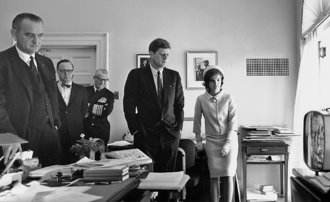 Shepard's flight watched on TV in the White House. May 1961.
 -
 John Glenn honored by the President. February 1962
 -
 USS Kearsarge with crew spelling Mercury-9. May 1963.
Uncrewed and chimpanzee flights
The 20 uncrewed flights used Little Joe, Redstone, and Atlas launch vehicles.138 They were used to develop the launch vehicles, launch escape system, spacecraft and tracking network.224 One flight of a Scout rocket attempted to launch a specialized satellite equipped with Mercury communications components for testing the ground tracking network, but the booster failed soon after liftoff. The Little Joe program used seven airframes for eight flights, of which three were successful. The second Little Joe flight was named Little Joe 6, because it was inserted into the program after the first 5 airframes had been allocated.242183 Production spacecraft and boilerplates were used for these test flights.225
| Missionn 32 | Spacecraft No. | Launch | Duration | Purpose | Result |
|---|---|---|---|---|---|
| Little Joe 1 | Boilerplate | August 21, 1959 | 20 s | Test of launch escape system during flight. | Failure |
| Big Joe 1 | Big Joe Boilerplate | September 9, 1959 | 13 m 00 s | Test of heat shield and Atlas/spacecraft interface. | Partial success |
| Little Joe 6 | Boilerplate | October 4, 1959 | 5 m 10 s | Test of spacecraft aerodynamics and integrity. | Partial success |
| Little Joe 1A | Boilerplate | November 4, 1959 | 8 m 11 s | Test of launch escape system during flight with boiler plate capsule. | Partial success |
| Little Joe 2 | Boilerplate | December 4, 1959 | 11 m 6 s | Escape system test with primate at high altitude. | Success |
| Little Joe 1B | Boilerplate | January 21, 1960 | 8 m 35 s | Maximum-q abort and escape test with primate with boiler plate capsule. | Success |
| Beach Abort | 1 | May 9, 1960 | 1 m 31 s | Test of the off-the-pad abort system. | Success |
| Mercury-Atlas 1 | 4 | July 29, 1960 | 3 m 18 s | Test of spacecraft / Atlas combination. | Failure |
| Little Joe 5 | 3 | November 8, 1960 | 2 m 22 s | First Little Joe escape system test with a production spacecraft, at max-q. | Failure |
| Mercury-Redstone 1 | 2 | November 21, 1960 | 2 s | Qualification of spacecraft / Redstone combination. | Failure |
| Mercury-Redstone 1A | 2 | December 19, 1960 | 15 m 45 s | Qualification of spacecraft / Redstone combination. | Success |
| Mercury-Redstone 2 | 5 | January 31, 1961 | 16 m 39 s | Qualification of spacecraft with chimpanzee named Ham. | Success |
| Mercury-Atlas 2 | 6 | February 21, 1961 | 17 m 56 s | Qualified Mercury/Atlas interface. | Success |
| Little Joe 5A | 14 | March 18, 1961 | 5 m 25 s | Second test of escape system with a production Mercury spacecraft. | Partial success |
| Mercury-Redstone BD | Boilerplate | March 24, 1961 | 8 m 23 s | Final Redstone test flight. | Success |
| Mercury-Atlas 3 | 8 | April 25, 1961 | 7 m 19 s | Orbital flight with robot astronaut.243244n 33 | Failure |
| Little Joe 5B | 14 | April 28, 1961 | 5 m 25 s | Third test of escape system with a production spacecraft. | Success |
| Mercury-Atlas 4 | 8 | September 13, 1961 | 1 h 49 m 20 s | Test of environmental control system with robot astronaut in orbit. | Success |
| Mercury-Scout 1 | - | November 1, 1961 | 44 s | Special satellite to test Mercury tracking network. | Failure |
| Mercury-Atlas 5 | 9 | November 29, 1961 | 3 h 20 m 59 s | Test of environmental control system in orbit with chimpanzee named Enos. | Success |
| Remarks | |
|---|---|
| Little Joe 1 | Due to an electrical malfunction, the escape tower ignited ½ hour before launch and took the spacecraft with it, leaving the rocket on the ground.246 |
| Big Joe 1 | Actually the first Mercury-Atlas flight.138 Recovered by USS Strong 2,407 km SE of Cape Canaveral.247 Altitude: 65 mi (105 km) Qualified ablative heatshield.104 |
| Little Joe 6 | No additional tests248 |
| Little Joe 1A | The rescue tower rocket ignited 10 seconds too late.249 Recovered by USS Opportune 11.5 mi (18.5 km) SE of Wallops Island.250 |
| Little Joe 2 | Carried Sam, a rhesus macaque.249 Recovered by USS Borie 194 mi (312 km) SE of Wallops Island, Virginia; altitude: 53 mi (85 km).251 |
| Little Joe 1B | Carried a female rhesus monkey named Miss Sam.252 |
| Beach Abort | A production spacecraft with minimal equipment was lifted from the ground by the launch escape system alone at Wallops Island. It reached an apogee of 0.751 kilometres (2,465 ft) and was recovered after landing. Top velocity: 436 metres per second (976 mph). Total payload: 1,154 kg. |
| Mercury-Atlas 1 | Exploded while passing through max-q.253 To save weight, the airframe had been made thinner since Big Joe, which led to a collapse. The next Atlas was strengthened by a temporary solution while the rest were made from the same specifications as Big Joe.254 |
| Little Joe 5 | The clamp holding the spacecraft was deflected by air pressure; due to this and incorrect wiring, the escape tower ignited too early and further failed to separate spacecraft from launch vehicle.43n 34 Altitude: 10 mi (16 km)255 |
| Mercury-Redstone 1 | Engine shutdown caused by improper separation of electrical cables;256 vehicle rose 4 in (10 cm) and settled back on the pad.257n 35 |
| Mercury-Redstone 1A | First flight of Mercury / Redstone. Recovered by USS Valley Forge.258 Altitude: 130 mi (210 km)109 |
| Mercury-Redstone 2 | Carried the chimpanzee Ham on suborbital flight. Recovered by USS Donner259 422 mi (679 km) SE of Cape Canaveral; altitude: 157 mi (253 km)260 |
| Mercury-Atlas 2 | Recovered by USS Donner261 1,432 mi (2,305 km) SE of Cape Canaveral. |
| Little Joe 5A | Tower fired 14 seconds too soon; it failed to separate the spacecraft from the rocket.262 |
| Mercury-Redstone BD | BD: Booster Development)263 |
| Mercury-Atlas 3 | Upgraded from suborbital flight. Was aborted when the Atlas continued to vertically climb instead of tilting toward orbit; escaping capsule was recovered and reused in Mercury-Atlas 4.264 |
| Little Joe 5B | Concluded Little Joe program. |
| Mercury-Atlas 4 | Completed one orbit and sent data to the ground; first orbital flight of the project.265 Recovery by USS Decatur 176 mi (283 km) east of Bermuda.266 |
| Mercury-Scout 1 | Was aborted after malfunction of booster's guidance system;267 results of Mercury-Atlas 4 and Mercury-Atlas 5 were used instead.268 |
| Mercury-Atlas 5 | Chimpanzee Enos completed a two-orbit flight, performing tasks to prove it possible for a person to function during a flight.269n 36 Last Mercury-Atlas test flight. Recovery by USS Stormes271 255 mi (410 km) SE of Bermuda.272 |
-
 Little Joe 1B at launch with Miss Sam, 1960
 -
 Mercury-Redstone 1: launch escape system lift-off after 4'' launch, 1960
 -
 Mercury-Redstone 2: Ham, 1961
 -
 Mercury-Atlas 5: Enos, 1961
Canceled

Nine of the planned flights were canceled.
Mercury-Jupiter was a proposed suborbital launch configuration consisting of a Jupiter missile carrying a Mercury capsule. Two flights were planned in support of Project Mercury. The Mercury-Jupiter 1 flight would have been a heat shield test. The Mercury-Jupiter 2 flight was planned as a maximum dynamic pressure qualification test of the production Mercury spacecraft with a chimpanzee on board.273 On July 1, 1959, less than a year after the October, 1958 program start date, the flights were canceled due to budget constraints.274
Suborbital flights were planned for four other astronauts but the number of flights was cut down gradually and finally all remaining were canceled after Titov's flight.275276n 37
Mercury-Atlas 9 was intended to be followed by more one-day flights and even a three-day flight but with the coming of the Gemini Project it seemed unnecessary. The Jupiter booster was, as mentioned above, intended to be used for different purposes.
| Mission | Pilot | Planned Launch | Cancellation |
|---|---|---|---|
| Mercury-Jupiter 1 | July 1, 1959278 | ||
| Mercury-Jupiter 2 | Chimpanzee | First quarter, 1960 | July 1, 1959278n 38 |
| Mercury-Redstone 5 | Glenn (likely) | March 1960276 | August 1961280 |
| Mercury-Redstone 6 | April 1960276 | July 1961281 | |
| Mercury-Redstone 7 | May 1960276 | ||
| Mercury-Redstone 8 | June 1960276 | ||
| Mercury-Atlas 10 | Shepard | October 1963 | June 13, 1963n 39 |
| Mercury-Atlas 11 | Grissom | Fourth quarter, 1963 | October 1962283 |
| Mercury-Atlas 12 | Schirra | Fourth quarter, 1963 | October 1962284 |
Legacy

Today the Mercury program is commemorated as the first American human space program.285 It did not win the race against the Soviet Union, but gave back national prestige and was scientifically a successful precursor of later programs such as Gemini, Apollo and Skylab.286n 40
During the 1950s, some experts doubted that human spaceflight was possible.n 41 Still, when John F. Kennedy was elected president, many, including him, had doubts about the project.289 As president he chose to support the programs a few months before the launch of Freedom 7,290 which became a public success.291n 42 Afterwards, a majority of the American public supported human spaceflight, and, within a few weeks, Kennedy announced a plan for a crewed mission to land on the Moon and return safely to Earth before the end of the 1960s.295

The six astronauts who flew were awarded medals,296 driven in parades and two of them were invited to address a joint session of the US Congress.297 Seeing as no women previously met the qualifications for the astronaut program, the question was raised as to whether or not they could. This led to the development of a project named Mercury 13 by the media, in which thirteen American women successfully underwent the tests. The Mercury 13 program was not officially conducted by NASA. It was created by NASA physician William Randolph Lovelace, who developed the physical and psychological tests used to select NASA's first seven male astronauts for Project Mercury. The women completed physical and psychological tests, but were never required to complete the training as the privately funded program was quickly cancelled. No female candidates adequately met the qualifications for the astronaut program until 1978, when a few finally qualified for the Space Shuttle program.298
Military Highway in Hampton, Virginia and Newport News, Virginia was renamed to Mercury Boulevard.299
On February 25, 2011, the Institute of Electrical and Electronics Engineers, the world's largest technical professional society, awarded Boeing (the successor company to McDonnell Aircraft) a Milestone Award for important inventions which debuted on the Mercury spacecraft.300n 43
Depictions on film
A short documentary, The John Glenn Story, was released in 1962.
On film the program was portrayed in The Right Stuff, a 1983 adaptation of Tom Wolfe's 1979 book of the same name,301 in the 1998 HBO miniseries From the Earth to the Moon, in the 2016 film Hidden Figures, and the 2020 Disney+ series The Right Stuff, which is also based on the Tom Wolfe book.
Commemorations
In 1964, a monument commemorating Project Mercury was unveiled near Launch Complex 14 at Cape Canaveral, featuring a metal logo combining the symbol of Mercury with the number 7.302 This design was first issued to the Mercury astronauts in 1960 as a lapel pin.303 In 1962, the United States Postal Service honored the Mercury-Atlas 6 flight with a Project Mercury commemorative stamp, the first US postal issue to depict a crewed spacecraft.304n 44
-
 Mercury monument at Launch Complex 14, 1964
 -
![Commemorative Project Mercury 4¢ US Postage stamp[n 45]](/api/ext/img?url=https%3A%2F%2Fupload.wikimedia.org%2Fwikipedia%2Fcommons%2Fthumb%2Fb%2Fba%2FProject_Mercury_4%25C2%25A2_US_Postage_stamp_February_20%252C_1962_FDC_Scott_-1193.jpg%2F330px-Project_Mercury_4%25C2%25A2_US_Postage_stamp_February_20%252C_1962_FDC_Scott_-1193.jpg&ttl=86400) Commemorative Project Mercury 4¢ US Postage stampn 45
Commemorative Project Mercury 4¢ US Postage stampn 45
Displays
The spacecraft that flew, together with some that did not, are on display in the United States. Friendship 7 (Spacecraft No. 13) went on a global tour, popularly known as its "fourth orbit".306
-
 Little Joe 5B (Spacecraft No 14), Virginia Air and Space Center
 -
 Big Joe Boilerplate, Steven F. Udvar-Hazy Center
 -

-
 Mercury-Redstone 2 (Spacecraft No. 5), California Science Center
 -
 Freedom 7 (Spacecraft No. 7) at the United States Naval Academy, 2010
 -
 Liberty Bell 7 (Spacecraft No. 11) at the Kansas Cosmosphere and Space Center, 2010
 -
 Friendship 7 (Spacecraft No. 13) at the National Air and Space Museum, 2009
 -
 Aurora 7 (Spacecraft No. 18) at the Museum of Science and Industry, 2009
 -
 Sigma 7 (Spacecraft No. 16) at the United States Astronaut Hall of Fame, 2011
 -
 Faith 7 (Spacecraft No. 20) at Space Center Houston, 2011
 -
 Unflown (Spacecraft No. 10), Evergreen Aviation & Space Museum
 -
 Mercury Procedures Trainer at the U.S. Space and Rocket Center, 2011
Patches
Commemorative patches were designed by entrepreneurs after the Mercury program to satisfy collectors.307n 46


Videos
-
John Glenn documentary from 50th Anniversary of Friendship 7, 2012.
Notes
Notes
- The project was delayed by 22 months, counting from the beginning until the first orbital mission.2 It had a dozen prime contractors, 75 major subcontractors, and about 7200 third-tier subcontractors.2 The cost estimate made by NASA in 1969 was $392.6 million, broken down as follows: Spacecraft: $135.3 million, launch vehicles: $82.9 million, operations: $49.3 million, tracking operations and equipment: $71.9 million and facilities: $53.2 million.34
- Man in Space Soonest was the first part of a four-phase Moon landing program estimated to finish in 1965, cost a total of $1.5 billion ($16.6 billion adjusted for inflation), and be launched by a "Super Titan" rocket.9
- The name Little Joe was adopted by its designers from the throw of a double deuce in a craps game since this resembled the four-rocket arrangement in the blueprints for the vehicle.34
- NASA's planning for recovery operations in the summer of 1960 was, according to the Navy, asking for the deployment of the whole Atlantic Fleet and might have cost more than the entire Mercury program.45
- The decision to eliminate the use of any gas but oxygen was crystalized when a serious accident occurred on April 21, 1960, in which McDonnell Aircraft test pilot G.B. North passed out and was seriously injured when testing a Mercury cabin/spacesuit atmosphere system in a vacuum chamber. The problem was found to be nitrogen-rich (oxygen-poor) air leaking from the cabin into his spacesuit feed.77
- Pilot and spacecraft data sent automatically to the ground is called telemetry.81
- The rocket plane approach to human space flight was pursued by the Air Force with their Dyna-Soar project, which was canceled in 1963.101 Toward the end of the 1960s, NASA began the development of a reusable space plane, which was ultimately developed into the Space Shuttle program.102 The first rocket plane to enter space was an X-15 in 1963.103
- Test and rework of Mercury-Redstone 2 at the Hangar required 110 days.109 Hangar S was also the place where the chimpanzees were trained.110
- They received a letter designation after their number, e.g., 2B, 15B.113 Some were modified twice: for example, spacecraft 15 became 15A and then 15B.114
- At the time, the word "booster" was sometimes used for the first stage of the launch stack. Later, "booster" came to refer to additional single-stage rockets attached to the sides of the main launch vehicle, as on the Space Shuttle.
- Due to manufacturing constraints, Slayton and Glenn wore work boots spray-painted silver for the promotional photo.156
- Armstrong left the Navy as a Lieutenant, Junior Grade in the US Naval Reserve, until resigning his commission 1960.160
- At the beginning of the project both President Eisenhower and NASA's first administrator, T. K. Glennan, believed that the US would put the first man in space, and that this would be the end of the Space Race.166
- With the exception of the 20 seconds of retrofire during which the pilot would experience g-force.
- Inside the spacecraft the other astronauts had usually prepared a practical joke, such as a sign saying "No handball playing".186
- Countdown was controlled from the blockhouse at the Launch Complex until 2 min. before launch then it was transferred to Mission Control Center. The countdown of the last 10 sec. before launch would be given to the astronaut by one of the others and included on TV transmissions which had already started.187
- In the event of a launch abort before this point, the launch escape system would fire its main rocket for one second, pulling the spacecraft and astronaut away from the launch vehicle and a possible explosion.70 At this point, the spacecraft could be separated from the launch vehicle and land using its parachute.190
- The direction of insertion was east and slightly to the north, meaning that, on a three-orbit flight, the tracking network was used optimally and a landing could take place in the North Atlantic Ocean.193
- The sustainer would disintegrate and fall down; after the launch of Friendship 7 a part of the sustainer was found in South Africa.195
- The capsule's tendency to drift was countered automatically by the attitude control system (ASCS) which used small hydrogen peroxide thrusters. To save fuel, however, the spacecraft would be allowed to drift from time to time, especially on longer missions.199
- Radar chaff and a SOFAR bomb which could be detected by the recovery ship's hydrophone were eliminated as unnecessary measures after the first orbital flight.206
- The collar was not ready for suborbital missions.207
- It was also possible to exit the capsule through the nose cylinder; only Carpenter did this.3067
- T. J. O'Malley pushed the button to launch Glenn209 while the Site Manager and Launch Conductor at Complex 14, Calvin D. Fowler, pushed the button to launch Carpenter, Schirra, and Cooper.210
- Occasionally this communication was broadcast on live TV while the spacecraft was passing over the United States.
- Alexander & al., 1966, pp. 638–641.
- It was recovered in 1999.112
- Launch of Friendship 7 was postponed repeatedly during two months; a frustrated politician compared the spacecraft-Atlas combination to "a Rube Goldberg device on top of a plumber's nightmare".230
- Carpenter's overshoot of the landing site was caused by a malfunction in the automatic stabilization, which meant that retrofire was out of line with the movement of the spacecraft233
- During Carpenter's mission a seaplane from the US Air Force got to the landing site about 1½ hour ahead of the Navy ships and offered to pick him up. This, however, was declined by the admiral in charge of Mercury recovery operations, which led to a Senate hearing about the incident.235
- Likely to be so according to Alexander & al.240
- Source: Alexander & al., 1966, pp. 638–641 when nothing else is mentioned.
- A machine that produced the same heat, vapor and CO2 as an astronaut.245
- The clamp was subsequently tested by a rocket sled.43
- Immediately after the Redstone's engine shut down, the capsule's escape rocket jettisoned itself, leaving the capsule attached to the booster. The escape rocket rose to an altitude of 4,000 ft (1,200 m) and landed about 400 yd (370 m) away. Three seconds after the escape rocket fired, the capsule deployed its drogue parachute; it then deployed the main and reserve parachutes.257
- Was given a reward in the form a banana pellet or a punishment in the form of mild electrical shocks depending on whether or not he gave the right response to a given signal; by mistake he was sometimes given shocks on right answers.270
- Within the Mercury Project organization the suborbital flights were from the start criticized as being of little value and even compared to a circus act.277
- Proposed maximum dynamic pressure test for capsule.279
- Mercury-Atlas 10 was intended to be a three-day mission in November 1962 with extra supplies attached to the heat shield. Call-sign Freedom 7-II. By January 1963, it was changed to a one-day back up mission for Mercury-Atlas 9. It was canceled after the success of the latter.282
- International rules required that a pilot must land safely with the spacecraft; in reality, Gagarin landed separately by parachute; however, the Soviet Union did not admit this until 1971 when their claim was no longer in danger of being challenged.287
- In May 1957, five months before Sputnik I, the president of McDonnell, later the prime contractor, predicted that human spaceflight would not take place before 1990.288
- Along the roads in the US, drivers stopped to follow Freedom 7 on the radio. Later, 100 millions saw or listened to Friendship 7, the first orbital flight, on TV or radio.292 The launch of Sigma 7 and Faith 7 were relayed live via communication satellite to television audiences in Western Europe.293 Two of the three major US networks covered Sigma 7 minute-by-minute, while the third was showing the opening of the World Series.294
- Boeing received the award in recognition of Project Mercury's pioneering "navigation and control instruments, autopilot, rate stabilization and control, and fly-by-wire systems."300
- The stamp first went on sale in Cape Canaveral, Florida on February 20, 1962, the same day as the first crewed orbital flight.304 On May 4, 2011, the Postal Service released a stamp commemorating the 50th anniversary of Freedom 7, the first flight of the project with people on board.305
- The stamp was issued February 20, 1962, the day of John Glenn's flight in Friendship 7. This one has a First day of issue postmark from Cape Canaveral post office.
- The only patches the Mercury astronauts wore were the NASA logo and a name tag.307 Each crewed Mercury spacecraft was painted black and decorated with a flight insignia, its call-sign, an American flag and the words United States.56
References
References
- Lafleur, Claude (March 8, 2010). "Costs of US piloted programs". The Space Review. Retrieved February 18, 2012.
- Alexander & al. 1966, p. 508.
- Wilford 1969, p. 67.
- Alexander & al. 1966, p. 643.
- Grimwood 1963, p. 12.
- Alexander & al. 1966, p. 132.
- Catchpole 2001, p. 92.
- Alexander & al. 1966, p. 102.
- Alexander & al. 1966, p. 91.
- Catchpole 2001, pp. 12–14.
- Catchpole 2001, p. 81.
- Alexander & al. 1966, pp. 28, 52.
- Catchpole 2001, p. 55.
- Alexander & al. 1966, p. 113.
- Catchpole 2001, pp. 57, 82.
- Catchpole 2001, p. 70.
- Alexander & al. 1966, p. 13.
- Alexander & al. 1966, p. 44.
- Alexander & al. 1966, p. 59.
- Catchpole 2001, p. 466.
- Alexander & al. 1966, p. 357.
- Alexander & al. 1966, pp. 35, 39–40.
- Alexander & al. 1966, p. 49.
- Alexander & al. 1966, pp. 37–38.
- Alexander & al. 1966, p. 61.
- Alexander & al. 1966, pp. 98–99.
- Catchpole 2001, p. 82.
- Alexander & al. 1966, pp. xiii, 134.
- Alexander & al. 1966, p. 134.
- Alexander & al. 1966, p. 143.
- Catchpole 2001, p. 157.
- Alexander & al. 1966, pp. 121, 191.
- Alexander & al. 1966, p. 137.
- Alexander & al. 1966, p. 124.
- Alexander & al. 1966, p. 216.
- Alexander & al. 1966, p. 21.
- Catchpole 2001, p. 158.
- Catchpole 2001, p. 89–90.
- Catchpole 2001, p. 86.
- Alexander & al. 1966, p. 141.
- Catchpole 2001, pp. 103–110.
- Alexander & al. 1966, p. 88.
- Catchpole 2001, p. 248.
- Catchpole 2001, pp. 172–173.
- Alexander & al. 1966, p. 265.
- "History-At-A-Glance". City of Cocoa Beach. Archived from the original on January 4, 2013. Retrieved June 24, 2013.
- Catchpole 2001, p. 150.
- Catchpole 2001, p. 131.
- Alexander & al. 1966, p. 47.
- Alexander & al. 1966, p. 245.
- Alexander & al. 1966, p. 490.
- Catchpole 2001, p. 136.
- Catchpole 2001, pp. 134–136.
- Alexander & al. 1966, pp. 140, 143.
- Catchpole 2001, pp. 132–134.
- Catchpole 2001, p. 132.
- Alexander & al. 1966, p. 188.
- Catchpole 2001, p. 134.
- Catchpole 2001, pp. 136–144.
- Catchpole 2001, pp. 136–137.
- Catchpole 2001, p. 138.
- Catchpole 2001, p. 139.
- Catchpole 2001, pp. 144–145.
- Catchpole 2001, p. 144.
- Catchpole 2001, p. 135.
- Catchpole 2001, pp. 145–148.
- Catchpole 2001, p. 147.
- Alexander & al. 1966, p. 199.
- Catchpole 2001, pp. 179–181.
- Catchpole 2001, p. 179.
- NASA (March 1988). "Computers in Spaceflight: The NASA Experience – Chapter One: The Gemini Digital Computer: First Machine in Orbit". NASA History. NASA. Retrieved September 15, 2016.
- Rutter, Daniel (October 28, 2004). "Computers in space". Dan's Data. Retrieved September 15, 2016.
- Catchpole 2001, p. 142.
- Catchpole 2001, p. 191.
- Gatland 1976, p. 264.
- Catchpole 2001, p. 410.
- Giblin 1998.
- Alexander & al. 1966, pp. 48–49.
- Alexander & al. 1966, p. 246.
- Catchpole 2001, pp. 191, 194.
- Alexander & al. 1966, p. 313.
- Catchpole 2001, pp. 343–344.
- Hollins 2013.
- "The History of Urinating in Space". ABC. Retrieved December 27, 2023.
- Alexander & al. 1966, p. 98.
- Alexander & al. 1966, p. 499.
- Catchpole 2001, p. 143.
- Catchpole 2001, p. 141.
- Catchpole 2001, pp. 98–99.
- Alexander & al. 1966, p. 501.
- Unknown 1962, p. 8.
- Catchpole 2001, p. 152.
- Catchpole 2001, p. 153.
- Catchpole 2001, p. 159.
- Catchpole 2001, p. 149.
- Alexander & al. 1966, p. 63.
- Alexander & al. 1966, p. 64.
- Alexander & al. 1966, p. 206.
- Alexander & al. 1966, pp. 78–80.
- Alexander & al. 1966, p. 72.
- Catchpole 2001, pp. 425, 428.
- "Introduction to future launch vehicle plans [1963–2001]. 3.The Space Shuttle (1968–72)". Retrieved February 3, 2014.
- Garber, Steve. "X – 15 Hypersonic Research at the Edge of Space". NASA History Homepage. NASA. Retrieved July 18, 2015.
- Catchpole 2001, p. 229.
- Catchpole 2001, p. 196.
- Alexander & al. 1966, p. 198.
- Catchpole 2001, pp. 132, 159.
- Catchpole 2001, pp. 184–188.
- Alexander & al. 1966, p. 310.
- Alexander & al. 1966, p. 312.
- Grimwood 1963, pp. 235–238.
- Catchpole 2001, pp. 402–405.
- Grimwood 1963, pp. 216–218.
- Grimwood 1963, p. 149.
- Alexander & al. 1966, pp. 126 & 138.
- Alexander & al. 1966, pp. 96, 105.
- Catchpole 2001, p. 107.
- McDonnell Douglas Logo History, McDonnell Douglas, archived from the original on June 5, 1997, retrieved November 29, 2020
- Catchpole 2001, p. 197.
- Alexander & al. 1966, p. 638.
- Catchpole 2001, p. 223.
- Catchpole 2001, p. 284.
- Catchpole 2001, p. 198.
- Alexander & al. 1966, p. 125.
- Alexander & al. 1966, pp. 392–397.
- Catchpole 2001, p. 206.
- Catchpole 2001, p. 207.
- Catchpole 2001, pp. 209, 214.
- Alexander & al. 1966, p. 151.
- Grimwood 1963, p. 69.
- Loyd S. Swenson Jr.; James M. Grimwood; Charles C. Alexander (1963). "Project Mercury – A Chronology (NASA SP-4001)" (PDF). NASA History Office. Retrieved August 8, 2025.
{{cite web}}: CS1 maint: multiple names: authors list (link) - Catchpole 2001, p. 211.
- Alexander & al. 1966, p. 22.
- Catchpole 2001, p. 212.
- Catchpole 2001, pp. 225, 250.
- Catchpole 2001, pp. 458–459.
- Alexander & al. 1966, p. 164.
- Alexander & al. 1966, p. 640.
- Alexander & al. 1966, p. 341.
- Catchpole 2001, p. 445.
- Dunbar, B. (May 11, 2011). "Who Was Alan Shepard? (Grades K-4) - NASA". Retrieved May 5, 2026.
- Catchpole 2001, p. 442.
- Documents – human Space Flight: A record of ACHIEVEMENT, 1961 – 1998. (n.d.). Retrieved April 22, 2021, from https://history.nasa.gov/SP-4225/documentation/hsf-record/hsf.htm#mercury
- Catchpole 2001, pp. 440, 441.
- Dunbar, B. (2016, December 05). Profile of John Glenn. Retrieved April 22, 2021, from https://www.nasa.gov/content/profile-of-john-glenn
- Fox, S. (2015, February 20). Scott carpenter, 1925–2013. Retrieved April 22, 2021, from https://www.nasa.gov/astronautprofiles/carpenter Archived November 4, 2021, at the Wayback Machine
- Catchpole 2001, pp. 446–447.
- 40Th anniversary of Mercury 7: WALTER Marty Schirra, jr. (n.d.). Retrieved April 22, 2021, from https://history.nasa.gov/40thmerc7/schirra.htm
- Administrator, N. (2015, February 27). Remembering Gordon Cooper. Retrieved April 22, 2021, from https://www.nasa.gov/multimedia/imagegallery/image_feature_218.html
- Alexander & al. 1966, pp. 640–641.
- Catchpole 2001, p. 99.
- Catchpole 2001, p. 96.
- Catchpole 2001, p. 100.
- Catchpole 2001, p. 97.
- Australian Broadcasting Corporation (February 15, 2008). "Moment in Time – Episode 1". Australian Broadcasting Corporation. Retrieved June 25, 2013.
- "The Mercury 7 Caper". Smithsonian Magazine. Retrieved December 27, 2023.
- Dunbar, Brian (March 17, 2015). "Project Mercury Overview – Astronaut Selection". nasa.gov. NASA. Retrieved April 24, 2018.
- Alexander & al. 1966, pp. 160–161.
- Hansen 2005, p. 173.
- Hansen 2005, p. 118.
- Hansen 2005, pp. 201–202.
- Nelson 2009, p. 17.
- Catchpole 2001, pp. 92–93.
- Cloer, Dan. "Alan B. Shepard, Jr.: Spam in a Can?". vision.org. Vision. Retrieved April 24, 2018.
- Catchpole 2001, p. 440.
- Catchpole 2001, p. 407.
- Catchpole 2001, p. 93.
- Catchpole 2001, p. 98.
- Minard, D. (1964). Work Physiology. Archives of Environmental Health. 8(3): 427–436.
- Catchpole 2001, p. 94.
- Catchpole 2001, p. 104.
- Catchpole 2001, p. 105.
- "Gimbal Rig Mercury Astronaut Trainer". NASA. June 9, 2008. Retrieved December 13, 2014.
- "Gimbal Rig" on YouTube
- Catchpole 2001, pp. 105, 109.
- Catchpole 2001, p. 111.
- Alexander & al. 1966, p. 346.
- Unknown 1961a, p. 7.
- Catchpole 2001, pp. 208, 250.
- Catchpole 2001, pp. 250, 308.
- Catchpole 2001, p. 475.
- Catchpole 2001, p. 110.
- Catchpole 2001, p. 278.
- Catchpole 2001, p. 280.
- Catchpole 2001, p. 188.
- Catchpole 2001, p. 281.
- Catchpole 2001, p. 282.
- Catchpole 2001, pp. 188, 242.
- Catchpole 2001, p. 340.
- Catchpole 2001, p. 180.
- Unknown 1962, p. 46.
- Catchpole 2001, pp. 188, 460.
- Alexander & al. 1966, p. 215.
- Catchpole 2001, p. 133.
- Grimwood 1963, p. 164.
- Unknown 1961, p. 10.
- Alexander & al. 1966, p. 333.
- Catchpole 2001, p. 120.
- Alexander & al. 1966, pp. 195, 450.
- Catchpole 2001, p. 462.
- Catchpole 2001, p. 324.
- Unknown 1961, p. 9.
- Alexander & al. 1966, p. 574.
- Unknown 1962, p. 9.
- Alexander & al. 1966, p. 356.
- Alexander & al. 1966, p. 445.
- Catchpole 2001, p. 166.
- Unknown 1962, p. 3.
- Hevesi, Dennis (November 12, 2009). "Thomas J. O'Malley, Who Helped Launch Glenn Into Orbit, Dies at 94". The New York Times.
- "Letter from General Ben I. Funk to Dr. Calvin D. Fowler (May 14, 1963)". University of Central Florida. Retrieved February 1, 2023.
- Catchpole 2001, pp. 124, 461–462.
- Catchpole 2001, p. 117.
- Catchpole 2001, pp. 121, 126.
- Alexander & al. 1966, p. 360.
- Alexander & al. 1966, p. 479.
- NASA (March 1988). "Computers in Spaceflight: The NASA Experience – Chapter Eight: Computers in Mission Control". NASA History. NASA. Retrieved June 27, 2021.
- Catchpole 2001, p. 118.
- Catchpole 2001, p. 409.
- Catchpole 2001, p. 88.
- Catchpole 2001, p. 128.
- Alexander & al. 1966, p. 332.
- Alexander & al. 1966, pp. 377, 422.
- Catchpole 2001, p. 476.
- Alexander & al. 1966, pp. 638–641.
- "Project Mercury - A Chronology. Appendix 6". history.nasa.gov. Retrieved October 20, 2023.
- Alexander & al. 1966, p. 373.
- Alexander & al. 1966, p. 375.
- Alexander & al. 1966, p. 422.
- Alexander & al. 1966, p. 432.
- Alexander & al. 1966, p. 409, 411.
- Alexander & al. 1966, p. 433.
- Alexander & al. 1966, p. 440.
- Alexander & al. 1966, p. 453-454.
- Alexander & al. 1966, p. 456.
- Alexander & al. 1966, p. 457.
- Alexander & al. 1966, p. 484.
- Alexander & al. 1966, p. 476.
- Alexander & al. 1966, p. 483.
- Alexander & al. 1966, p. 487.
- Alexander & al. 1966, p. 506.
- Alexander & al. 1966, pp. 353, 375, 433, 457, 483–484, 501.
- Catchpole 2001, p. 231.
- Alexander & al. 1966, p. 335.
- Catchpole 2001, p. 275.
- Catchpole 2001, p. 309.
- Alexander & al. 1966, p. 208.
- Alexander & al. 1966, pp. 203–204.
- Alexander & al. 1966, p. 209.
- Alexander & al. 1966, p. 210.
- Catchpole 2001, p. 232.
- Catchpole 2001, pp. 234, 474.
- Alexander & al. 1966, p. 212.
- Alexander & al. 1966, p. 276.
- Catchpole 2001, p. 243.
- Alexander & al. 1966, p. 291.
- Alexander & al. 1966, p. 298.
- Alexander & al. 1966, p. 294.
- Alexander & al. 1966, p. 297.
- Alexander & al. 1966, p. 316.
- Alexander & al. 1966, pp. 638–639.
- Alexander & al. 1966, pp. 321–322.
- Alexander & al. 1966, p. 327.
- Alexander & al. 1966, p. 330.
- Alexander & al. 1966, p. 337.
- Alexander & al. 1966, p. 386-387.
- Alexander & al. 1966, p. 389.
- Alexander & al. 1966, p. 397.
- Catchpole 2001, p. 312.
- Alexander & al. 1966, p. 404.
- Alexander & al. 1966, p. 405.
- Alexander & al. 1966, p. 406.
- Grimwood 1963, p. 169.
- "Mercury-Jupiter MJ-2". Encyclopedia Astronautica. Archived from the original on October 13, 2011.
- Grimwood, James M. "Project Mercury – A Chronology – PART II (A) Research and Development Phase of Project Mercury". NASA. NASA SP-4001. Retrieved March 1, 2024.
- Alexander & al. 1966, p. 377.
- Catchpole 2001, p. 474.
- Alexander & al. 1966, p. 100.
- Grimwood 1963, p. 81.
- "Mercury-Jupiter 2 (MJ-2)". Astronautix.com. Archived from the original on June 17, 2012. Retrieved May 24, 2012.
- Cassutt & Slayton 1994, p. 104.
- Cassutt & Slayton 1994, p. 101.
- Catchpole 2001, pp. 385–386.
- "Mercury MA-11". Encyclopedia Astronauticax. Archived from the original on August 23, 2013. Retrieved June 22, 2013.
- "Mercury MA-12". Encyclopedia Astronautica. Archived from the original on August 23, 2013. Retrieved June 22, 2013.
- Catchpole 2001, p. cover.
- Catchpole 2001, p. 417.
- Siddiqi 2000, p. 283.
- Alexander & al. 1966, p. 119.
- Alexander & al. 1966, p. 272.
- Alexander & al. 1966, p. 306.
- Alexander & al. 1966, p. 434.
- Alexander & al. 1966, p. 423.
- "Mercury Atlas 8". NASA. Retrieved June 22, 2013.
- Alexander & al. 1966, p. 472.
- Alexander & al. 1966, p. 363.
- Alexander & al. 1966, pp. 362, 435, 459, 486, 502, 584.
- Alexander & al. 1966, pp. 435, 501.
- Catchpole 2001, p. 448.
- "What's in a name? | Mercury Boulevard". The Virginian-Pilot. October 24, 2011. Retrieved August 17, 2024.
- "Boeing Press Release". Retrieved February 25, 2011.
- "The Right Stuff". IMdB. Retrieved October 4, 2011.
- "Mercury Monument Dedication at Launch Complex 14". Kennedy Space Center. Archived from the original on January 17, 2005. Retrieved June 29, 2013.
- Pearlman, Robert Z. (January 6, 2020). "'Pin'-nacle Achievement: The Story Behind NASA's Astronaut Pin". Space.com. Retrieved August 22, 2022.
- "Mystic stamp company". Archived from the original on March 26, 2014. Retrieved April 1, 2012.
- "Stamps Mark Shepard's 1961 Flight". US Postal Service. Archived from the original on April 6, 2012. Retrieved May 5, 2011.
- Alexander & al. 1966, p. 436.
- Dorr, Eugene. "History of Patches". Retrieved June 20, 2013.
Bibliography
Bibliography
- Alexander, C. C.; Grimwood, J. M.; Swenson, L. S. (1966). This New Ocean: a History of Project Mercury (PDF). US: NASA. ISBN 1934941875.
- Cassutt, Michael; Slayton, Donald K. "Deke" (1994). Deke! U.S. Manned Space: From Mercury to the Shuttle (1st ed.). New York, US: Forge (St. Martin's Press). ISBN 0-312-85503-6.
- Catchpole, John (2001). Project Mercury - NASA's First Manned Space Programme. Chichester, UK: Springer Praxis. ISBN 1-85233-406-1.
- Gatland, Kenneth (1976). Manned Spacecraft (Second ed.). New York: Macmillan. p. 304.
- Giblin, Kelly A. (Spring 1998). "Fire in the Cockpit!". American Heritage of Invention & Technology. 13 (4). American Heritage Publishing. Archived from the original on November 20, 2008. Retrieved March 23, 2011.
- Grimwood, James M. (1963). Project Mercury. A Chronology – NASA SP-4001. Washington DC, US: NASA. Retrieved November 8, 2015.
- Hansen, James R. (2005). First Man: The Life of Neil A. Armstrong. Simon & Schuster. ISBN 0-7432-5631-X.
- Hollins, Hunter (March 11, 2013). "Forgotten hardware: how to urinate in a spacesuit". Advances in Physiology Education. 37 (1). American Physilogy Society: 123–128. doi:10.1152/advan.00175.2012. PMID 23728129. Retrieved December 27, 2023.
- Kranz, Gene (2000). Failure Is Not an Option: Mission Control from Mercury to Apollo 13 and Beyond. New York: Berkley Books. ISBN 0-425-17987-7.
- Nelson, Craig (2009). Rocket Men: The Epic Story of the First Men on the Moon. New York, New York: Viking Penguin. ISBN 978-0-670-02103-1.
- Shesol, Jeff (2021). Mercury Rising: John Glenn, John Kennedy, and the New Battleground of the Cold War. New York: W.W. Norton. ISBN 978-1-324-00324-3.
- Siddiqi, Asif A. (2000). Challenge To Apollo: The Soviet Union and the Space Race, 1945-1974 (PDF). US: NASA. ISBN 1780393016. Archived from the original (PDF) on September 16, 2008.
- Unknown (1961). Results of the first U.S. manned suborbital space flight (PDF). US: NASA. Archived from the original (PDF) on January 31, 2014. Retrieved July 9, 2013.
- Unknown (1961a). Results of the second U.S. manned suborbital space flight (PDF). US: NASA.
- Unknown (1962). Results of the first United States manned orbital space flight, 20 February 1962 (PDF). US: NASA. Archived from the original (PDF) on November 2, 2021. Retrieved July 9, 2013.
- Wilford, John Noble (July 1969). We Reach the Moon. New York, US: Bantam Books.
- NASA (March 1988). "Computers in Spaceflight: The NASA Experience – Chapter One: The Gemini Digital Computer: First Machine in Orbit". NASA History. NASA. Retrieved September 15, 2016.
- Rutter, Daniel (October 28, 2004). "Computers in space". Dan's Data. Retrieved September 15, 2016.
- "Space flight chronology". IBM Archives. IBM. January 23, 2003. Archived from the original on January 19, 2005. Retrieved September 15, 2016.
External links
External links
- NASA Project Mercury images and videos Archived November 28, 2020, at the Wayback Machine
- Space Medicine In Project Mercury
- PDFs of historical Mercury documents including familiarization manuals.
- Project Mercury Drawings and Technical Diagrams Archived July 12, 2010, at the Wayback Machine
- The Astronauts: United States Project Mercury is available for free viewing and download at the Internet Archive