| Megaera | |
|---|---|
Goddess of jealousy and envy | |
| Member of The Erinyes | |
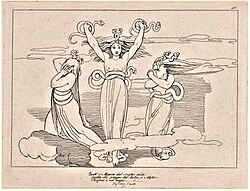 "Questa e megera dal sinistro canto", front the Divine Comedy, 1793 printing | |
| Genealogy | |
| Siblings | Alecto and Tisiphone |
Megaera (/məˈdʒɪərə/ mə-JEER-ə; Ancient Greek: Μέγαιρα, romanized: Mégaira, lit. 'the jealous one'1) is one of the Erinyes, Eumenides or "Furies" in classical mythology. Bibliotheca Classica states "According to the most received opinions, they were three in number, Tisiphone, "Megaera ... daughter of Nyx and Acheron",2 and Alecto".3
In other versions, she and her sisters, as well as the Meliae, were born of the blood of Uranus when Cronus castrated him.4
In modern French (mégère), Portuguese (megera), Modern Greek (μέγαιρα), Italian (megera), Polish (megiera), Russian (мегера), Ukrainian (меґера), Czech (megera) and Swedish (megära), this name denotes a jealous or spiteful woman. She is not to be confused with Megara, the wife of Heracles.
Namesakes
Minor planet 464 Megaira is named in her honour.5
References
References
- Related to μεγαίρω "to grudge, envy" from Proto-Indo-European *meǵh2- "great" (see Robert S. P. Beekes, Etymological Dictionary of Greek, Brill, 2009, p. 917).
- Lamprière's Classical Dictionary of Proper Names mentioned in Ancient Authors, 1949, p. 366
- Lamprière's Classical Dictionary of Proper Names mentioned in Ancient Authors, 1949, p. 234
- Graves, Robert (1960). The Greek Myths. London: Penguin Books. pp. 37. ISBN 9780140171990.
{{cite book}}: ISBN / Date incompatibility (help) - "(464) Megaira". (464) Megaira In: Dictionary of Minor Planet Names. Springer. 2003. p. 52. doi:10.1007/978-3-540-29925-7_465. ISBN 978-3-540-29925-7.