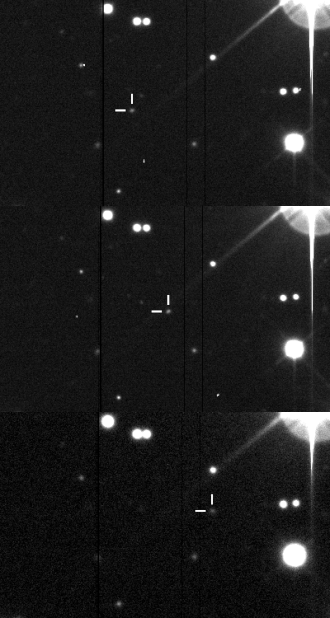
 Megaclite imaged by the Canada-France-Hawaii Telescope in December 2001 | |
| Discovery1 | |
|---|---|
| Discovered by | Scott S. Sheppard David C. Jewitt Yanga R. Fernandez Eugene A. Magnier |
| Discovery site | Mauna Kea Observatory |
| Discovery date | 25 November 2000 |
| Designations | |
Designation | Jupiter XIX |
| Pronunciation | /mɛɡəˈklaɪtiː/ |
Named after | Μεγακλειτή Megaclītē |
| S/2000 J 8 | |
| Adjectives | Megaclitean /ˌmɛɡəklɪˈtiːən/ |
| Orbital characteristics2 | |
| Epoch 2026-01-01 | |
| Observation arc | 25 years 2025-12-21 (last obs) |
| Periapsis | 13.1 million km |
| Apoapsis | 33.80 million km |
| 23.5 million km | |
| Eccentricity | 0.440 |
| –734.6 days | |
| 256° | |
| 0° 28m 54.732s / day | |
| Inclination | 147.7° (to ecliptic) |
| 22.8° | |
| 32.4° | |
| Satellite of | Jupiter |
| Group | Pasiphae group |
| Physical characteristics3 | |
| ≈ 6 km | |
| Albedo | 0.04 (assumed) |
| 21.74 | |
| 15.05 | |
Megaclite /mɛɡəˈklaɪtiː/, also known as Jupiter XIX, is one of Jupiter's smallest and outermost natural satellites.
Discovery and Naming
It was discovered by a team of astronomers from the University of Hawaiʻi led by Scott S. Sheppard in 2000, and given the temporary designation S/2000 J 8.617
It was named in October 2002 after Megaclite, mother by Zeus (Jupiter) of Thebe and Locrus in Greek mythology. It was initially erroneously named Magaclite, which was corrected in November 2002.89 Despite this correction, some earlier research still referred to the moon as Magaclite.10
Orbit
Megaclite orbits Jupiter (on average at 23.5 million km) on a high-eccentricity (0.440) and high-inclination (148° to ecliptic) retrograde orbit. The orbital elements are continuously changing due to solar and planetary perturbations.
It belongs to the Pasiphae group, a group of retrograde moons of Jupiter with semi-major axes spread over 22–25 million km, inclinations between 141° and 158°, and higher eccentricities between 0.22 and 0.44.


Physical characteristics
Megaclite's estimated diameter is 6 kilometers, assuming an albedo of 4%.
While Pasiphae belongs to the grey color class (B−V=0.74, V−R=0.38), Megaclite falls under the light red color class (B−V=0.94, V−R=0.41 ), similarly to Callirrhoe and Sinope.10
Origin
Megaclite probably did not form near Jupiter but was captured by Jupiter later. Megaclite is believed to be a fragment from a captured asteroid along with other Pasiphae group satellites.1112
However, it falls into a different color class than Pasiphae and could therefore have been captured by Jupiter independently of the Pasiphae group.
References
References
- MPEC 2001-A29: S/2000 J 7, S/2000 J 8, S/2000 J 9, S/2000 J 10, S/2000 J 11 2001 January 15 (discovery and ephemeris)
- Horizons output. "Jovian Osculating Orbital Elements for Megaclite (519)". Retrieved 18 December 2025.
- "Planetary Satellite Physical Parameters". Jet Propulsion Laboratory. 19 February 2015. Retrieved 26 November 2020.
- Sheppard, Scott. "Scott S. Sheppard - Jupiter Moons". Department of Terrestrial Magnetism. Carnegie Institution for Science. Retrieved 26 November 2020.
- "M.P.C. 115890" (PDF). Minor Planet Circular. Minor Planet Center. 27 August 2019.
- IAUC 7555: Satellites of Jupiter Archived 2002-09-16 at the Wayback Machine 2001 January 5 (discovery)
- MPEC 2001-T59: S/2000 J 8, S/2000 J 9, S/2000 J 10 2001 October 15 (revised ephemeris)
- IAUC 7998: Satellites of Jupiter 2002 October 22 (naming the moon "Magaclite")
- IAUC 8023: Satellites of Jupiter 2002 November 29 (correcting the name)
- Grav, Tommy; Holman, M. J.; Gladman, B. J.; Aksnes, K. (2003). "Photometric survey of the irregular satellites". Icarus. 166 (1): 33–45. arXiv:astro-ph/0301016. Bibcode:2003Icar..166...33G. doi:10.1016/j.icarus.2003.07.005. S2CID 7793999.
- Brown, M. E. (2000). "Near-Infrared Spectroscopy of Centaurs and Irregular Satellites". The Astronomical Journal. 119 (2). The American Astronomical Society: 977–983. Bibcode:2000AJ....119..977B. CiteSeerX 10.1.1.22.1349. doi:10.1086/301202. S2CID 15143844.
- Sheppard, S. S.; and Jewitt, D. C.; An Abundant Population of Small Irregular Satellites Around Jupiter Archived 5 August 2003 at the Wayback Machine, Nature, Vol. 423 (May 2003), pp. 261-263