| Matthias Corvinus | |
|---|---|
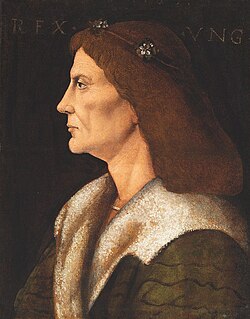 Portrait by Andrea Mantegna | |
| King of Hungary and Croatia | |
| Reign | 24 January 1458 – 6 April 1490 |
| Coronation | 29 March 1464 |
| Predecessor | Ladislaus V |
| Successor | Vladislaus II |
| Regent | Michael Szilágyi (1458) |
| King of Bohemia contested by George and Vladislaus II | |
| Reign | 1469–1490 |
| Predecessor | George |
| Successor | Vladislaus II |
| Archduke of Austria contested by Frederick V | |
| Reign | 1487–1490 |
| Predecessor | Frederick V |
| Successor | Frederick V |
| Born | 23 February 1443 Kolozsvár, Hungary (now Cluj-Napoca, Romania) |
| Died | 6 April 1490(1490-04-06) (aged 47) Vienna, Austria |
| Burial | |
| Spouse | |
| Issue Detail | John Corvinus (illegitimate) |
| House | Hunyadi |
| Father | John Hunyadi |
| Mother | Elizabeth Szilágyi |
| Religion | Roman Catholic |
| Signature |  |
Matthias Corvinus (Hungarian: Hunyadi Mátyás; Romanian: Matia/Matei Corvin; Croatian: Matija/Matijaš Korvin; Slovene: Matija Korvin/Kralj Matjaž; Slovak: Matej Korvín; Czech: Matyáš Korvín; 23 February 1443 – 6 April 1490) was King of Hungary and Croatia from 1458 to 1490, as Matthias I. He is often given the epithet "the Just". After conducting several military campaigns, he was elected King of Bohemia in 1469 and adopted the title Duke of Austria in 1487. He was the son of John Hunyadi, Regent of Hungary, who died in 1456. In 1457, Matthias was imprisoned along with his older brother, Ladislaus Hunyadi, on the orders of King Ladislaus the Posthumous. Ladislaus Hunyadi was executed, causing a rebellion that forced King Ladislaus to flee Hungary. After the King died unexpectedly, Matthias's uncle Michael Szilágyi persuaded the Estates to unanimously proclaim the 14-year-old Matthias as king on 24 January 1458. He began his rule under his uncle's guardianship, but he took effective control of government within two weeks.
As king, Matthias waged wars against the Czech mercenaries who dominated Upper Hungary (today parts of Slovakia and Northern Hungary) and against Frederick III, Holy Roman Emperor, who claimed Hungary for himself. In this period, the Ottoman Empire conquered Serbia and Bosnia, terminating the zone of buffer states along the southern frontiers of the Kingdom of Hungary. Matthias signed a peace treaty with Frederick III in 1463, acknowledging the Emperor's right to style himself King of Hungary. The Emperor returned the Holy Crown of Hungary with which Matthias was crowned on 29 March 1464.1 In this year, Matthias invaded the territories that had recently been occupied by the Ottomans and seized fortresses in Bosnia. He soon realized he could expect no substantial aid from the Christian powers and gave up his anti-Ottoman policy.
Matthias introduced new taxes and regularly set taxation at extraordinary levels. These measures caused a rebellion in Transylvania in 1467, but he subdued the rebels. The next year, Matthias declared war on George of Poděbrady, the Hussite King of Bohemia, and conquered Moravia, Silesia, and Lusatia, but he could not occupy Bohemia proper. The Catholic Estates proclaimed him King of Bohemia on 3 May 1469, but the Hussite lords refused to yield to him even after the death of their leader George of Poděbrady in 1471. Instead, they elected Vladislaus Jagiellon, the eldest son of Casimir IV of Poland. A group of Hungarian prelates and lords offered the throne to Vladislaus's younger brother Casimir, but Matthias overcame their rebellion. Having routed the united troops of Casimir IV and Vladislaus at Breslau in Silesia (now Wrocław in Poland) in late 1474, Matthias turned against the Ottomans, who had devastated the eastern parts of Hungary. He sent reinforcements to Stephen the Great, Prince of Moldavia, enabling Stephen to repel a series of Ottoman invasions in the late 1470s. In 1476, Matthias besieged and seized Šabac, an important Ottoman border fort. He concluded a peace treaty with Vladislaus Jagiellon in 1478, confirming the division of the Lands of the Bohemian Crown between them. Matthias waged a war against Emperor Frederick and occupied Lower Austria between 1482 and 1487.
Matthias established one of the earliest professional standing armies of medieval Europe (the Black Army of Hungary), reformed the administration of justice, reduced the power of the barons, and promoted the careers of talented individuals chosen for their abilities rather than their social statuses. Matthias patronized art and science; his royal library, the Bibliotheca Corviniana, was one of the largest collections of books in Europe. With his patronage, Hungary became the first country to embrace the Renaissance from Italy. As Matthias the Just, the monarch who wandered among his subjects in disguise, he remains a popular hero of Hungarian and Slovak2 folk tales.
Early life


Childhood (1443–1457)
Matthias was born in Kolozsvár (now Cluj-Napoca in Romania) on 23 February 1443.34 He was the second son of John Hunyadi and his wife, Elizabeth Szilágyi.35 Matthias' education was managed by his mother due to his father's absence.3 Many of the most learned men of Central Europe, including Gregory of Sanok and John Vitéz, frequented John Hunyadi's court when Matthias was a child.6 Gregory of Sanok, a former tutor of King Vladislaus III of Poland, was Matthias's only teacher whose name is known.7 Under these scholars' influences, Matthias became an enthusiastic supporter of Renaissance humanism.89
As a child, Matthias learnt many languages and read classical literature, especially military treatises.7 According to Antonio Bonfini, Matthias "was versed in all the tongues of Europe", with the exceptions of Turkish and Greek.10 Although this was an exaggeration, it is without doubt that Matthias spoke Hungarian, Latin, Italian, Polish, Czech, and German.711 Bonfini also wrote that he needed an interpreter to speak with a POW during his Moldavian campaign.12 On the other hand, the late 16th-century Polish historian Krzystoff Warszewiecki wrote that Matthias had been able to understand the Romanian language of the envoys of Stephen the Great, Prince of Moldavia.13
According to a treaty between John Hunyadi and Đurađ Branković, Despot of Serbia, Matthias and the Despot's granddaughter Elizabeth of Celje were engaged on 7 August 1451.1415 Elizabeth was the daughter of Ulrich II, Count of Celje, who was related to King Ladislaus the Posthumous and an opponent of Matthias's father.1617 Because of new conflicts between Hunyadi and Ulrich of Celje, the marriage of their children only took place in 1455.18 Elizabeth settled in the Hunyadis' estates, but Matthias was soon sent to the royal court, implying that their marriage was a hidden exchange of hostages between their families.16 Elizabeth died before the end of 1455.16
John Hunyadi died on 11 August 1456, less than three weeks after his greatest victory over the Ottomans in Belgrade.19 John's elder son, who was Matthias's brother, Ladislaus became the head of the family.1620 Ladislaus's conflict with Ulrich of Celje ended with Ulrich's capture and assassination on 9 November 1456.212223 Under duress, the King promised he would never take his revenge against the Hunyadis for Ulrich's killing.24 However, the murder turned most barons, including Palatine Ladislaus Garai, Judge royal Ladislaus Pálóci, and Nicholas Újlaki, Voivode of Transylvania, against Ladislaus Hunyadi.24 Taking advantage of their resentment, the King had the Hunyadi brothers imprisoned in Buda on 14 March 1457;2225 Ladislaus was beheaded two days later on 16 March after the royal council condemned him and his brother to death for high treason.26
Matthias was held in captivity in a small house in Buda.2427 His mother and her brother Michael Szilágyi staged a rebellion against the King and occupied large territories in the regions to the east of the river Tisza.2425 King Ladislaus fled to Vienna in mid-1457, and from Vienna to Prague in September, taking Matthias with him.222829 The civil war between the rebels and the barons loyal to the monarch continued until the sudden death of the young King on 23 November 1457.24 Thereafter the Hussite Regent of Bohemia, George of Poděbrady, held Matthias captive.30
Election as king (1457–1458)
King Ladislaus died childless in 1457.3132 His elder sister, Anna, and her husband, William III, Landgrave of Thuringia, laid claim to his inheritance but received no support from the Estates.31 The Diet of Hungary was convoked to Pest to elect a new king in January.33 Pope Calixtus III's legate Cardinal Juan Carvajal, who had been John Hunyadi's admirer, began openly campaigning for Matthias.3334
The election of Matthias as king was the only way of avoiding a protracted civil war.33 Ladislaus Garai was the first baron to yield.34 At a meeting with Matthias's mother and uncle, he promised that he and his allies would promote Matthias's election, and Michael Szilágyi promised that his nephew would never seek vengeance for Ladislaus Hunyadi's execution.3334 They also agreed that Matthias would marry the Palatine's daughter Anna, his executed brother's bride.3334
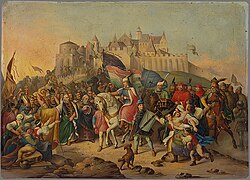
Michael Szilágyi arrived at the Diet with 15,000 troops, intimidating the barons who assembled in Buda.2233 Stirred up by Szilágyi, the noblemen gathered on the frozen River Danube and unanimously proclaimed the 14-year-old Matthias king on 24 January 1458.333536 At the same time, the Diet elected his uncle as regent.3436
Reign
Early rule and consolidation (1458–1464)

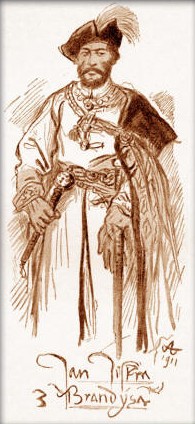
Matthias's election was the first time that a member of the nobility mounted the royal throne in Hungary.27 Michael Szilágyi sent John Vitéz to Prague to discuss the terms of Matthias's release with George of Poděbrady.37 Poděbrady, whose daughter Katalin Matthias promised to marry, agreed to release his future son-in-law for a ransom of 60,000 gold florins.3839 Matthias was surrendered to the Hungarian delegates in Strážnice on 9 February 1458.37 With Poděbrady's mediation, he was reconciled with John Jiskra of Brandýs, the commander of the Czech mercenaries who dominated most of Upper Hungary.4041
Matthias made his state entry into Buda five days later.4243 He ceremoniously sat on the throne in the Church of Our Lady, but was not crowned, because the Holy Crown of Hungary had been in the possession of Frederick III, Holy Roman Emperor for almost two decades.4244 The 14-year-old monarch administered state affairs independently from the outset, although he reaffirmed his uncle's position as Regent.4546 For instance, Matthias instructed the citizens of Nagyszeben (now Sibiu in Romania) to reconcile their differences with Vlad Dracula, Prince of Wallachia on 3 March 1458.46
Jiskra was the first baron who turned against Matthias.40 He offered the throne to Casimir IV of Poland, the husband of King Ladislaus V's younger sister Elisabeth, in late March but the General sejm of Poland rejected his offer.40 Matthias's commander Sebastian Rozgonyi defeated Jiskra's soldiers at Sárospatak but the Ottomans' invasion of Serbia in April forced Matthias to conclude an armistice with the Czechs.364748 They were allowed to keep Sáros Castle (now Šariš Castle, Slovakia) and other fortified places in Upper Hungary.49 Matthias sent two prelates, August Salánki, Bishop of Győr, and Vincent Szilasi, Bishop of Vác, to Prague to crown George of Poděbrady king.40 Upon their demand, the "heretic" Poděbrady swore loyalty to the Holy See.40

50 The Estates in Pest passed almost 50 decrees after assembling in May, and these were ratified by Matthias, instead of the Regent, on 8 June 1458.5150 One decree prescribed that the King "must call and hold, and order to be held, a diet of all the gentlemen of the realm in person"52 every year on Whitsunday.50 Matthias held more than 25 Diets during his reign and convoked the Estates more frequently than his predecessors, especially between 1458 and 1476.505354 The Diets were controlled by the barons, whom Matthias appointed and dismissed at will.5055 For instance, he dismissed Palatine Ladislaus Garai and persuaded Michael Szilágyi to resign from the Regency after they entered into a league in the summer of 1458.5639 The King appointed Michael Ország, who had been his father's close supporter, as the new Palatine.57 Most of Matthias's barons were descended from old aristocratic families but he also promoted the careers of members of the lesser nobility, or even of skilful commoners.5859 For instance, the noble Zápolya brothers Emeric and Stephen owed their fortunes to Matthias's favour.60
Matthias's ordinary revenues amounted around 250,000 golden florins per year when his reign began.61 A decree passed at the Diet of 1458 explicitly prohibited the imposition of extraordinary taxes.62 However, an extraordinary tax, one golden florin per each porta or peasant household, was levied late that year.6263 The Ottomans occupied the fort of Golubac in Serbia in August 1458; Matthias ordered the mobilization of all noblemen.6436 He made a raid into Ottoman territory and defeated the enemy forces in minor skirmishes.36 King Stephen Thomas of Bosnia accepted Matthias's suzerainty.64 Matthias authorized his new vassal's son Stephen Tomašević to take possession of the parts of Serbia that had not been occupied by the Ottomans.64
At the turn of 1458 and 1459, Matthias held a Diet at Szeged to prepare for a war against the Ottoman Empire.65 However, gossip about a conspiracy compelled him to return to Buda.66 The rumours proved to be true because at least 30 barons, including Ladislaus Garai, Nicholas Újlaki, and Ladislaus Kanizsai, met in Németújvár (now Güssing in Austria) and offered the throne to Emperor Frederick III on 17 February 1459.363967 Even George of Poděbrady turned against Matthias when Frederick promised him to make him governor of the Holy Roman Empire.68 Although the joint troops of the Emperor and the rebellious lords defeated a royal army at Körmend on 27 March, Garai had by that time died, Újlaki and Sigismund Szentgyörgyvölgyi soon entered into negotiations with Matthias' envoys. Újlaki became indifferent, Szentgyörgyvölgyi joined to Matthias.67 Skirmishes along the western borderlands lasted for several months, preventing Matthias from providing military assistance to Tomašević against the Ottomans.65 The latter took Smederevo on 29 June 1459, completing the conquest of Serbia.6970
Jiskra swore an oath of loyalty to Emperor Frederick on 10 March 1460.65 Pope Pius II offered to mediate a peace treaty between the Emperor and Matthias.39 George of Poděbrady also realised he need to support Matthias or at least had to be indifferent. He sent his daughter to Buda also offered his assistance.7172 The representatives of the Emperor and Matthias signed a truce in Olomouc in April 1460.36 The Pope soon offered financial support for an anti-Ottoman campaign.65 However, John Jiskra returned from Poland, renewing the armed conflicts with Czech mercenaries in early 1460.65 Matthias seized a newly-erected fort from the Czechs but he could not force them to obey him.65 The costs of his five-month-long campaign in Upper Hungary were paid for by an extraordinary tax.73
Matthias entered into an alliance with the Emperor's rebellious brother Albert VI, Archduke of Austria.74 George of Poděbrady sided with the Emperor although the marriage of his daughter, who became known as Catherine in Hungary, to Matthias was celebrated on 1 May 1461 (married 1461 to 1464).6275 Relations between Matthias and his father-in-law deteriorated because of the Czech mercenaries' continued presence in Upper Hungary.76 Matthias launched a new campaign against them after the Diet authorized him to collect an extraordinary tax in mid-1461.77 However, he did not defeat Jiskra, who even captured Késmárk (now Kežmarok, Slovakia).49
The envoys of Matthias and Emperor Frederick agreed the terms of peace treaty on 3 April 1462.36 According to the agreement, the Emperor was to return the Holy Crown of Hungary for 80,000 golden florins, but his right to use the title King of Hungary along with Matthias was confirmed.3671 In accordance with the treaty, the Emperor adopted Matthias, which granted him the right to succeed his "son" if Matthias died without a legitimate heir.7178 Within a month, Jiskra yielded to Matthias.78 He surrendered all the forts he held in Upper Hungary to the King's representatives; as compensation, he received a large domain near the Tisza and Arad and 25,000 golden florins. That happened before the peace treaty with Frederick.49 To pay the large amounts stipulated in his treaties with the Emperor and Jiskra, Matthias collected an extraordinary tax with the consent of the Royal Council.79 The Diet, which assembled in mid-1462, confirmed this decision but only after 9 prelates and 19 barons promised that no extraordinary taxes would be introduced thereafter.79 Through hiring mercenaries among Jiskra's companions, Matthias began organizing a professional army, which became known as the "Black Army" in following decades.80 The peace treaty made in Wiener-Neustadt 19 July 1463.81
Ottoman Sultan Mehmed II invaded Wallachia in early 1462.8270 He did not conquer the country but the Wallachian boyars dethroned the anti-Ottoman Vlad Dracula and replaced him with the Sultan's favorite, Radu the Fair.8283 The new Prince was willing to grant concessions to the Transylvanian Saxon merchants, who had come into bitter conflict with Vlad Dracula.84 The latter sought assistance from Matthias and they met in Brassó (now Brașov, Romania) in November.85 However, the Saxons presented Matthias with a letter that was allegedly written by Vlad Dracula to Sultan Mehmed in which the Prince offered his support to the Ottomans.8286 Convinced of Vlad Dracula's treachery, Matthias had him imprisoned.82
In preparation for a war against the Ottomans, Matthias held a Diet at Tolna in March 1463.87 Although the Estates authorized him to levy an extraordinary tax of one florin, he did not intervene when Mehmed II invaded Bosnia in June.88 In a month, the Ottomans murdered King Stephen Tomašević and conquered the whole country.3289 Matthias adopted an offensive foreign policy only after the terms of his peace with Emperor Frederick had been ratified in Wiener Neustadt on 19 July 1463.90 He led his troops to Bosnia and conquered Jajce and other forts in its northern parts.91 The conquered regions were organized into new defensive provinces, the banates of Jajce and Srebrenik.9192 Matthias was assisted by Stjepan Vukčić Kosača, Grand Duke of Bosnia, who controlled the area of modern and Old Hercegovina. A former vassal to the Bosnian kings, Stjepan accepted Matthias's suzerainty.9193
Queen Catherine died in early 1464 during preparations for her husband's coronation with the Holy Crown, which had been returned by Emperor Frederick.94 The ceremony was carried out in full accordance with the customary law of Hungary on 29 March 1464; Archbishop of Esztergom Dénes Szécsi ceremoniously put the Holy Crown on Matthias's head in Székesfehérvár.947895 At the Diet assembled on this occasion, the newly crowned King confirmed the liberties of the nobility.96 Hereafter the legality of Matthias's reign could not be questioned.95
First reforms and internal conflicts (1464–1467)

Political reforms
Matthias dismissed his Chief Chancellor Archbishop Szécsi, replacing him with Stephen Várdai, Archbishop of Kalocsa, and John Vitéz.97 Both prelates bore the title of Chief and Secret Chancellor, but Várdai was the actual leader of the Royal Chancery.9899 Around the same time, Matthias united the superior courts of justice, the Court of Royal Special Presence and the Court of Personal Presence, into one supreme court.97100 The new supreme court diminished the authority of the traditional courts presided over by the barons and contributed to the professionalization of the administration of justice.101 He appointed Albert Hangácsi, Bishop of Csanád as the first Chief Justice.102103
Sultan Mehmed II returned to Bosnia and laid siege to Jajce in July 1464.91104 Matthias began assembling his troops along the River Sava, forcing the Sultan to raise the siege on 24 August 1464.104 Matthias and his army crossed the river and seized Srebrenica.105 He also besieged Zvornik, but the arrival of a large Ottoman army forced him to withdraw to Hungary.106 The following year, Matthias forced Stefan Vukčić, who had transferred Makarska Krajina to the Republic of Venice, to establish Hungarian garrisons in his forts along the river Neretva.107
Dénes Szécsi died in 1465 and John Vitéz became the new Archbishop of Esztergom.108109 Matthias replaced the two Voivodes of Transylvania (Nicholas Újlaki and John Pongrác of Dengeleg) with Counts Sigismund and John Szentgyörgyi, and Bertold Ellerbach.110 Although Újlaki preserved his office of Ban of Macsó, the King appointed Peter Szokoli to administer the province together with the old Ban.111
Matthias convoked the Diet to make preparations for an anti-Ottoman campaign in 1466.111 For the same purpose, he received subsidies from Pope Paul II.112113 However, Matthias had realized that no substantial aid could be expected from the Christian powers and tacitly gave up his anti-Ottoman foreign policy.114 He did not invade Ottoman territory and the Ottomans did not make major incursions into Hungary, implying that he signed a peace treaty with Mehmed II's envoy who arrived in Hungary in 1465.115
Matthias visited Slavonia and dismissed the two Bans Nicholas Újlaki and Emeric Zápolya, replacing them with Jan Vitovec and John Tuz in 1466.110 Early the following year, he mounted a campaign in Upper Hungary against a band of Czech mercenaries who were under the command of Ján Švehla and had seized Kosztolány (now Veľké Kostoľany in Slovakia).79116 Matthias routed them and had Švehla and his 150 comrades hanged.7978
Economic reforms
At the Diet of March 1467, two traditional taxes were renamed; the chamber's profit was thereafter collected as tax of the royal treasury and the thirtieth as the Crown's customs.117 Because of this change, all previous tax exemptions became void, increasing state revenues.78118 Matthias set about centralizing the administration of royal revenues. He entrusted the administration of the Crown's customs to John Ernuszt, a converted Jewish merchant.119 Within two years, Ernuszt was responsible for the collection of all ordinary and extraordinary taxes, and the management of the salt mines.120
The Transylvanian revolt and Matthias's campaign in Moldavia
Matthias's tax reform caused a revolt in Transylvania.12197 The representatives of the "Three Nations" of the province (the noblemen, the Saxons and the Székelys) formed an alliance against the King in Kolozsmonostor (now Mănăștur district in Cluj-Napoca, Romania) on 18 August 1467, stating that they were willing to fight for the freedom of Hungary.97111 Matthias assembled his troops immediately and hastened to the province.122 The rebels surrendered without resistance but Matthias severely punished their leaders, many of whom were impaled, beheaded, or mercilessly tortured upon his orders.97123 Suspecting that Stephen the Great had supported the rebellion, Matthias invaded Moldavia.97124 On the night of December 15, the troops of Stephen the Great initiated a [surprise attack on the Hungarian forces encamped in the town of Baia. The initial phase of the attack resulted in significant casualties for the Hungarian forces.97124 However, Matthias counterattacked, forcing Stephen to retreat.125126127 Three days following the Battle of Baia, the Hungarian army returned to Hungary, due to Matthias's severe injury during combat.124128129
War for the Lands of the Bohemian Crown (1468–1479)

Matthias's former brother-in-law Victor of Poděbrady invaded Austria in early 1468.130131 Emperor Frederick appealed to Matthias for support, hinting at the possibility of Matthias's election as King of the Romans, the first step towards the imperial throne.130 Matthias declared war on Victor's father, King George of Bohemia, on 31 March 1468.131 He said he also wanted to help the Czech Catholic lords against their "heretic monarch", whom the Pope had excommunicated.132 Matthias expelled the Czech troops from Austria and invaded Moravia and Silesia.75131 He took an active part in the fighting; he was injured during the siege of Třebíč in May 1468 and was captured at Chrudim while spying out the enemy camp in disguise in February 1469.133 On the latter occasion, he was released because he made his custodians believe he was a local Czech groom.133
The Diet of 1468 authorized Matthias to levy an extraordinary tax to finance the new war but only after 8 prelates and 13 secular lords pledged on the King's behalf that he would not demand such charges in the future.134 Matthias also exercised royal prerogatives to increase his revenues.134 For instance, he ordered a Palatine's eyre in a county, the cost of which were to be covered by the local inhabitants, but he soon authorised the county to redeem the cancellation of the irksome duty.134
The Czech Catholics, who were led by Zdeněk of Šternberk, joined forces with Matthias in February 1469.135 Their united troops were encircled at Vilémov by George of Poděbrady's army.75136 In fear of being captured, Matthias opened negotiations with his former father-in-law.136 They met in a nearby hovel in which Matthias persuaded George of Poděbrady to sign an armistice promising that he would mediate a reconciliation between the moderate Hussites and the Holy See.75136 Their next meeting took place in Olomouc in April.135 Here the papal legates came forward with demands including the appointment of a Catholic Archbishop to the See of Prague, which could not be accepted by George of Poděbrady.136135
The Czech Catholic Estates elected Matthias King of Bohemia in Olomouc on 3 May 1469 but he was never crowned.137138 Moravia, Silesia and Lusatia soon accepted his rule but Bohemia proper remained faithful to George of Poděbrady.139140 The Estates of Bohemia even acknowledged the right of Vladislaus Jagiello, the eldest son of Casimir IV of Poland, to succeed king George of Poděbrady.13978
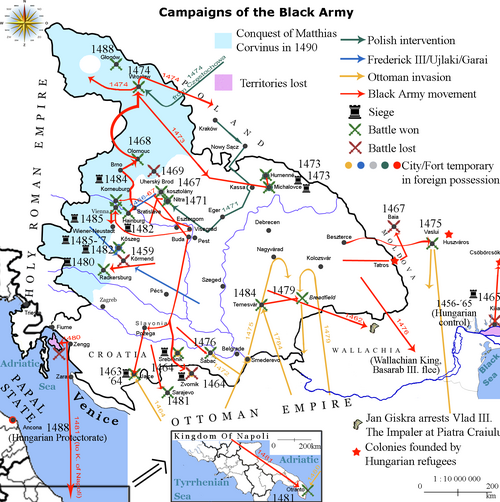
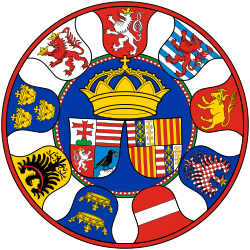
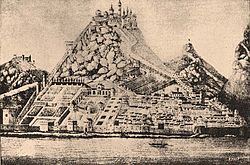
Matthias's relations with Frederick III had in the meantime deteriorated because the Emperor accused Matthias of allowing the Ottomans to march through Slavonia when raiding the Emperor's realms.140 The Frangepan family, whose domains in Croatia were exposed to Ottoman raids, entered into negotiations with the Emperor and the Republic of Venice.141142 In 1469, Matthias sent an army to Croatia to prevent the Venetians from seizing the Adriatic coastal town Senj.143
Matthias expelled George of Poděbrady's troops from Silesia.139 Matthias's army was encircled and routed at Uherský Brod on 2 November 1489, forcing him to withdraw to Hungary.78 Matthias soon ordered the collection of an extraordinary tax without holding a Diet, raising widespread discontent among the Hungarian Estates.144 He visited Emperor Frederick in Vienna on 11 February 1470, hoping the Emperor would contribute to the costs of the war against Poděbrady.145 Although the negotiations lasted for a month, no compromise was worked out.145 The Emperor also refused to commit himself to promoting Matthias's election as King of the Romans.145 After a month, Matthias left Vienna without taking formal leave of Frederick III.146
Having realised the Hungarian Estates' growing dissatisfaction, Matthias held a Diet in November 1470.144 The Diet again authorized him to levy an extraordinary tax, stipulating that the sum of all taxes payable per porta could not exceed one florin.144 The Estates also made it clear that they opposed the war in Bohemia.144 George of Poděbrady died on 22 March 1471.147 The Diet of Bohemia proper elected Vladislaus Jagiello king on 27 May 1471.148 The papal legate Lorenzo Roverella soon declared Vladislaus's election void and confirmed Matthias's position as King of Bohemia, but the Imperial Diet refused Matthias's claim.149150
Matthias was staying in Moravia when he was informed that a group of Hungarian prelates and barons had offered the throne to Casimir, a younger son of King Casimir IV of Poland.151 The conspiracy was initiated by Archbishop John Vitéz and his nephew Janus Pannonius, Bishop of Pécs, who opposed war against the Catholic Vladislaus Jagiellon.152 Initially, their plan was supported by the majority of the Estates, but nobody dared to rebel against Matthias, enabling him to return to Hungary without resistance.153 Matthias held a Diet and promised to refrain from levying taxes without the consent of the Estates and to convoke the Diet in each year.151 His promises remedied most of the Estates' grievances and almost 50 barons and prelates confirmed their loyalty to him on 21 September 1471.154155 Casimir Jagiellon invaded on 2 October 1471.78 With Bishop Janus Pannonius's support, he seized Nyitra (now Nitra in Slovakia), but only two barons, John Rozgonyi and Nicholas Perényi, joined him.155156157 Within five months Prince Casimir withdrew from Hungary, Bishop Janus Pannonius died while fleeing, and Archbishop John Vitéz was forbidden to leave his see.155156 Matthias appointed the Silesian Johann Beckensloer to administer the Archdiocese of Esztergom.155 Vitéz died and Beckensloer succeeded him in a year.156
The Ottomans had meanwhile seized the Hungarian forts along the river Nertva.158 Matthias nominated the wealthy baron Nicholas Újlaki as King of Bosnia in 1471, entrusting the defence of the province to him.156 Uzun Hassan, head of the Aq Qoyunlu Turkmens, proposed an anti-Ottoman alliance to Matthias but he refrained from attacking the Ottoman Empire.159 Matthias supported the Austrian noblemen who rebelled against Emperor Frederick in 1472.160 The following year, Matthias, Casimir IV and Vladislaus entered into negotiations on the terms of a peace treaty, but the discussions lasted for months.78157 Matthias tried to unify the government of Silesia, which consisted of dozens of smaller duchies, through appointing a captain-general.161 However, the Estates refused to elect his candidate Duke Frederick I of Liegnitz.161
Ali Bey Mihaloğlu, Bey of Smederevo, pillaged eastern parts of Hungary, destroyed Várad, and took 16,000 prisoners with him in January 1474.162 The next month, the envoys of Matthias and Casimir IV signed a peace treaty and a three-year truce between Matthias and Vladislaus Jagiellon was also declared.163 Within a month, however, Vladislaus entered into an alliance with Emperor Frederick and Casimir IV joined them.163157 Casimir IV and Vladislaus invaded Silesia and laid siege to Matthias in Breslau (now Wrocław in Poland) in October.157 He prevented the besiegers from accumulating provisions, forcing them to raise the siege.164 Thereafter the Silesian Estates willingly elected Matthias's new candidate Stephen Zápolya as captain-general.161 The Moravian Estates elected Ctibor Tovačovský as captain-general.165 Matthias confirmed this decision, although Tovačovský had been Vladislaus Jagiellon's partisan.165
The Ottomans invaded Wallachia and Moldavia at the end of 1474.166 Matthias sent reinforcements under the command of Blaise Magyar to Stephen the Great.167 Their united forces routed the invaders in the Battle of Vaslui on 10 January 1475.168 Fearing a new Ottoman invasion, the Prince of Moldavia swore fealty to Matthias on 15 August 1475.166 Sultan Mehmed II proposed peace but Matthias refused him.166 Instead, he stormed into Ottoman territory and captured Šabac, an important fort on the river Száva, on 15 February 1476.169170 During the siege, Matthias barely escaped capture while he was watching the fortress from a boat.171
For unknown reasons, Archbishop Johann Beckensloer left Hungary, taking the treasury of the Esztergom See with him in early 1476.164172 He fled to Vienna and offered his funds to the Emperor.173 Matthias accused the Emperor of having incited the Archbishop against him.173
Mehmed II launched a campaign against Moldavia in the summer.168 Although he won the Battle of Valea Albă on 26 July 1476, the lack of provisions forced him to retreat.174 Matthias sent auxiliary troops to Moldavia under the command of Vlad Dracula, whom he had released, and Stephen Báthory170175 The allied forces defeated an Ottoman army at the Siret River in August.176 With Hungarian and Moldavian support, Vlad Dracula was reinstalled as Prince of Wallachia but he was killed fighting against his opponent Basarab Laiotă.177178
Matthias's bride Beatrice of Naples arrived in Hungary in late 1476.179 Matthias married her in Buda on 22 December 1476.179 The Queen soon established a rigid etiquette, making direct contacts between the King and his subjects more difficult.180 According to Bonfini, Matthias also "improved his board and manner of life, introduced sumptuous banquets, disdaining humility at home and beautified the dining rooms" after his marriage.181 According to a contemporaneous record, around that time Matthias's revenues amounted about 500,000 florins, half of which derived from the tax of the royal treasury and the extraordinary tax.182
Matthias concluded an alliance with the Teutonic Knights and the Bishopric of Ermland against Poland in March 1477.164 However, instead of Poland, he declared war on Emperor Frederick after he learnt that the Emperor had confirmed Vladislaus Jagiellon's position as King of Bohemia and Prince-elector.164183 Matthias invaded Lower Austria and imposed a blockade on Vienna.184 Vladislaus Jagiellon denied to support the Emperor, forcing him to seek reconciliation with Matthias.184 With the mediation of Pope Sixtus IV, Venice, and Ferdinand I of Naples, Matthias concluded a peace treaty with Frederick III, which was signed on 1 December 1477.184185 The Emperor promised to confirm Matthias as the lawful ruler of Bohemia and to pay him an indemnity of 100,000 florins.183184186 They met in Korneuburg where Frederick III installed Matthias as King of Bohemia and Matthias swore loyalty to the Emperor.187
Negotiations between the envoys of Matthias and Vladislaus Jagiellon accelerated during the next few months.188 The first draft of a treaty was agreed upon on 28 March 1478, and the text was completed by the end of 1477.116 The treaty authorized both monarchs to use the title of King of Bohemia although Vladislaus could omit to style Matthias as such in their correspondence, and the Lands of the Bohemian Crown were divided between them. Vladislaus ruled in Bohemia proper and Matthias in Moravia, Silesia and Lusatia.164149 They solemnly ratified the peace treaty at their meeting in Olomouc on 21 July 1478.116
War for Austria (1479–1487)

Emperor Frederick only paid off half of the indemnity due to Matthias according to their treaty of 1477.187189 Matthias concluded a treaty with the Swiss Confederacy on 26 March 1479, hindering the recruitment of Swiss mercenaries by the Emperor.187 He also entered into an alliance with Archbishop of Salzburg Bernhard II of Rohr, who allowed him to take possession of the fortresses of the Archbishopric in Carinthia, Carniola and Styria.183190191
An Ottoman army supported by Basarab Țepeluș of Wallachia invaded Transylvania and set fire to Szászváros (now Orăștie in Romania) in late 1479.192167 Stephen Báthory and Paul Kinizsi annihilated the marauders in the Battle of Breadfield on 13 October 1479.167193 Matthias united the command of all forts along the Danube to the west of Belgrade in the hand of Paul Kinizsi to improve the defence of the southern frontier.80 Matthias sent reinforcements to Stephen the Great, who invaded pro-Ottoman Wallachia in early 1480; Matthias launched a campaign as far as Sarajevo in Bosnia in November.194167 He set up five defensive provinces, or banates, centred around the forts of Szörényvár (now Drobeta-Turnu Severin in Romania), Belgrade, Šabac, Srebrenik, and Jajce.80 The next year, Matthias initiated a criminal case against the Frankapans, the Zrinskis and other leading Croatian and Slavonian magnates for their alleged participation in the 1471 conspiracy.143 Most barons were pardoned as soon as they consented to the introduction of a new land tax.143 In 1481, for a loan of 100,000 florins, Matthias seized the town of Mautern in Styria and Sankt Pölten in Lower Austria from Friedrich Mauerkircher, one of the two candidates to the Bishopric of Passau.191
Sultan Mehmed II died on 3 May 1481.195 A civil war ensued in the Ottoman Empire between his sons Bayezid II and Cem.196 Defeated, Cem fled to Rhodes, where the Knights Hospitaller kept him in custody.196 Matthias claimed Cem's custody in the hope of using him to gain concessions from Bayezid, but Venice and Pope Innocent VIII strongly opposed this plan.196 In late 1481, Hungarian auxiliary troops supported Matthias's father-in-law Ferdinand I of Naples to reoccupy Otranto, which had been lost to the Ottomans the year before.197
Although the "Black Army" had already laid siege to Hainburg an der Donau in January 1482, Matthias officially declared a new war on Emperor Frederick three months later.183 He directed the siege in person from the end of June and the town fell to him in October.198 In the next three months, Matthias also captured Sankt Veit an der Glan, Enzersdorf an der Fischa, and Kőszeg.198 The papal legate, Bartolomeo Maraschi tried to mediate a peace treaty between Matthias and the Emperor, but Matthias refused.198 Instead, he signed a five-year truce with Sultan Bayezid.197
Matthias's marriage to Beatrice of Naples did not produce sons; he tried to strengthen the position of his illegitimate son John Corvinus.199 The child received Sáros Castle and inherited the extensive domains of his grandmother Elizabeth Szilágyi with his father's consent.199 Matthias also forced Victor of Poděbrady to renounce the Duchy of Troppau in Silesia in favour of John Corvinus in 1485.200 Queen Beatrice opposed Matthias's favouritism towards his son.200 Even so, Matthias nominated her eight-year-old nephew Ippolito d'Este Archbishop of Esztergom.201 The Pope refused to confirm the child's appointment for years.202 The "Black Army" encircled Vienna in January 1485.203 The siege lasted for five months and ended with the triumphal entry of Matthias, at the head of 8,000 veterans, into Vienna on 1 June 1485.203 The King soon moved the royal court to the newly conquered town.116 He summoned the Estates of Lower Austria to Vienna and forced them to swear loyalty to him.204
Matthias, by the grace of God, king of Hungary, Bohemia, Dalmatia, Croatia, Rama, Serbia, Galicia, Lodomeria, Cumania, and Bulgaria, Duke of Silesia and Luxemburg and Margrave of Moravia and Lusatia, for the everlasting memory of the matter. It is fitting that kings and princes who by heavenly decree are placed at the summit of the highest office, be adorned not only by arms but also by laws and that the people subjected to them, as well as the reins of authority, are restrained by the strength of good and stable institutions rather than by the harshness of absolute power and reprehensible abuse.
Upon the monarch's initiative, the Diet of 1485 passed the so-called Decretum maius, a systematic law-code which replaced many previous contradictory decrees.206207 The law-code introduced substantial reforms in the administration of justice; the Palatine's eyre and the extraordinary county assemblies were abolished, which strengthened the position of the county courts.206 Matthias also decreed that in cases of the monarch's absence or minority, the Palatine was authorized to rule as Regent.206
Emperor Frederick persuaded six of the seven Prince-electors of the Holy Roman Empire to proclaim his son Maximilian King of the Romans on 16 February 1486.208 The Emperor, however, had failed to invite the King of Bohemia, either Matthias or Vladislaus Jagiellon, to the assembly.208188 In an attempt to prevail on Vladislaus to protest, Matthias invited him to a personal meeting.188209 Although they formed an alliance in Jihlava in September, the Estates of Bohemia refused to confirm it and Vladislaus recognized Maximilian's election.209
In the meantime Matthias continued his war against the Emperor.210 The "Black Army" seized several towns in Lower Austria, including Laa an der Thaya, and Stein in 1485 and 1486.210 He set up his chancery for Lower Austria in 1486, but he never introduced a separate seal for this realm.204 Matthias assumed the title of Duke of Austria at the Diet of the Lower Austrian Estates in Ebenfurth in 1487.211 He appointed Stephen Zápolya captain-general, Urban Nagylucsei administrator of the Archdiocese of Vienna, and entrusted the defence of the occupied towns and forts to Hungarian and Bohemian captains, but otherwise continued to employ Emperor Frederick's officials who accepted his rule.211212 Wiener Neustadt, the last town resisting Matthias in Lower Austria, fell to him on 17 August 1487.183210
He started negotiations with Duke Albert III of Saxony, who arrived at the head of the imperial army to fight for Emperor Frederick III.210 They signed a six-month armistice in Sankt Pölten on 16 December 1487, which ended the war.210213 Matthias offered Emperor Frederick and his son prince Maximilian, the return of Austrian provinces and Vienna, if they would renounce the treaty of 1463 and accept Matthias as Frederick's designated heir and probable the inheritor of the title of Holy Roman Emperor. Before this was settled though, Matthias died in Vienna in 1490.214
King Matthias was happy to be described as "the second Attila".215 The Chronica Hungarorum by Johannes Thuróczy published in 1488, set the goal of glorifying Attila, which was undeservedly neglected, moreover, he introduced the famous "Scourge of God" characterization to the later Hungarian writers, because the earlier chronicles remained hidden for a long time. Thuróczy worked hard to endear Attila, the Hun king with an effort far surpassing his predecessor chroniclers. He made Attila a model for his victorious ruler, King Matthias who had Attila's abilities, with this he almost brought "the hammer of the world" to life.216
Last years (1487–1490)

According to the contemporaneous Philippe de Commines, Matthias's subjects feared their king in the last years of his life because he rarely showed mercy towards those he suspected of treachery.217 He had Archbishop Peter Váradi imprisoned in 1484 and ordered the execution of Chancellor of Bohemia Jaroslav Boskovic in 1485.218219 He also imprisoned Nicholas Bánfi, a member of a magnate family, in 1487, although he had earlier avoided punishing the old aristocracy.220 Bánfi's imprisonment seems to have been connected to his marriage to a daughter of John the Mad, Duke of Glogau because Matthias tried to seize this duchy for John Corvinus.220 John the Mad entered into an alliance with the Duke of Münsterberg Henry of Poděbrady, and declared a war on Matthias on 9 May.221222 Six months later, the Black Army invaded and occupied his duchy.221
In the meantime, the citizens of Ancona, a town in the Papal States, hoisted Matthias's flag in the hope he would protect them against Venice.223 Pope Innocent VIII soon protested, but Matthias refused to reject the overture and stated that the link between him and the town would never harm the interests of the Holy See.223 He also sent an auxiliary troop to his father-in-law, who was waging a war against the Holy See and Venice.224 The 1482 truce between Hungary and the Ottoman Empire was prolonged for two years in 1488.225221 On this occasion, it was stipulated that the Ottomans were to refrain from invading Wallachia and Moldavia.225 The following year, Matthias granted two domains to Stephen the Great of Moldavia in Transylvania.192
Matthias, who suffered from gout, could not walk and was carried in a litter after March 1489.226227 Hereafter, his succession caused bitter conflicts between Queen Beatrice and John Corvinus.227 Matthias asked Beatrice's brother Alfonso, Duke of Calabria, to persuade her not to strive for the Crown and stated that the "Hungarian people are capable of killing up unto the last man rather than submit to the government of a woman".228229 To strengthen his illegitimate son's position, Matthias even proposed withdrawing from Austria and confirming Emperor Frederick's right to succeed him if the Emperor was willing to grant Croatia and Bosnia to John Corvinus with the title of king.230229
Matthias participated in the lengthy Palm Sunday ceremony in Vienna in 1490 although he had felt so ill that morning that he could not eat breakfast.226231 Around noon, he tasted a fig that proved to be rotten and he became very agitated and suddenly felt faint.232 The next day he was unable to speak.232 After two days of suffering, Matthias died in the morning of 6 April.232231 According to Professor Frigyes Korányi, Matthias died of a stroke; Dr. Herwig Egert does not exclude the possibility of poisoning.232 Matthias's funeral was held in St. Stephen's Cathedral, Vienna and he was buried in Székesfehérvár Cathedral on 24 or 25 April 1490.233234
Patronage
Renaissance king
Matthias was the first non-Italian monarch promoting the spread of Renaissance style in his realm.89 His marriage to Beatrice of Naples strengthened the influence of contemporaneous Italian art and scholarship,235 and it was under his reign that Hungary became the first land outside Italy to embrace the Renaissance.236 The earliest appearance of Renaissance style buildings and works outside Italy were in Hungary.237238 The Italian scholar Marsilio Ficino introduced Matthias to Plato's ideas of a philosopher-king uniting wisdom and strength in himself, which fascinated Matthias.239 Matthias is the main character in Aurelio Lippo Brandolini's Republics and Kingdoms Compared, a dialogue on the comparison of the two forms of government.240241 According to Brandolini, Matthias said a monarch "is at the head of the law and rules over it" when summing up his own concepts of state.241
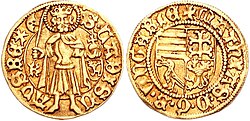
Matthias also cultivated traditional art.242 Hungarian epic poems and lyric songs were often sung at his court.242 He was proud of his role as the defender of Roman Catholicism against the Ottomans and the Hussites.243 He initiated theological debates, for instance on the doctrine of the Immaculate Conception, and surpassed both the Pope and his legate "with regard to religious observance", according to the latter.244 Matthias issued coins in the 1460s bearing an image of the Virgin Mary, demonstrating his special devotion to her cult.245
Upon Matthias's initiative, Archbishop John Vitéz and Bishop Janus Pannonius persuaded Pope Paul II to authorize them to set up a university in Pressburg (now Bratislava in Slovakia) on 29 May 1465.24678 The Academia Istropolitana was closed shortly after the Archbishop's death.247248 Matthias was contemplating establishing a new university in Buda but this plan was not accomplished.247
Building projects and arts
Matthias started at least two major building projects.249 The works in Buda and Visegrád began in about 1479.250 Two new wings and a hanging garden were built at the royal castle of Buda, and the palace at Visegrád was rebuilt in Renaissance style.250251 Matthias appointed the Italian Chimenti Camicia and the Dalmatian Giovanni Dalmata to direct these projects.250
Matthias commissioned the leading Italian artists of his age to embellish his palaces: for instance, the sculptor Benedetto da Majano and the painters Filippino Lippi and Andrea Mantegna worked for him.252 A copy of Mantegna's portrait of Matthias survived.253 In the spring of 1485, Matthias decided to commission Leonardo da Vinci to paint a Madonna to him.254 Matthias also hired the Italian military engineer Aristotele Fioravanti to direct the rebuilding of the forts along the southern frontier.255 He had new monasteries built in Late Gothic style for the Franciscans in Kolozsvár, Szeged and Hunyad, and for the Paulines in Fejéregyháza.243256
The court of Matthias had a musical establishment of high quality. The master of the Papal Chapel Bartolomeo Maraschi described Matthias's chapel choir as the best he had ever heard. Composers such as Josquin Dor and Johannes de Stokem spent time in Matthias's court,257 and numerous Italian musicians visited it.258 A late remark by Pal Várdai, Archbishop of Esztergom, implies that the influential composer Josquin des Prez was active in Matthias' court for years in the 1480s, but Várdai may have mistaken him for someone else, and there is no documentary evidence that places him there.259258
Royal library

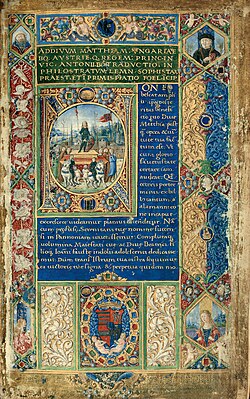
Matthias started the systematic collection of books after the arrival of his first librarian, Martius Galeotti, a friend of Janus Pannonius from Ferrara in around 1465.260261 The exchange of letters between Taddeo Ugoleto, who succeeded Marzio in 1471, and Francesco Bandini contributed to the development of the royal library because the latter regularly informed his friend of new manuscripts.260 Matthias also employed scriptors, illuminators, and book-binders.262 Although the exact number of his books is unknown, his Bibliotheca Corviniana was one of Europe's largest collections of books when he died.263
According to Marcus Tanner, the surviving 216 volumes of the King's library "show that Matthias had the literary tastes of a classic 'alpha male'", who preferred secular books to devotional works. For instance, a Latin translation of Xenophon's biography of Cyrus the Great, Quintus Curtius Rufus's book of Alexander the Great, and a military treatise by the contemporaneous Roberto Valturio survived. Matthias enjoyed reading, as demonstrated by a letter in which he thanked the Italian scholar Pomponio Leto who had sent him Silius Italicus's work of the Second Punic War.264
Patron of scholars
Matthias enjoyed the company of Humanists and had lively discussions on various topics with them.265 The fame of his magnanimity encouraged many scholars, mostly Italians, to settle in Buda.235 Antonio Bonfini, Pietro Ranzano, Bartolomeo Fonzio, and Francesco Bandini spent many years in Matthias's court.266265 This circle of educated men introduced the ideas of Neoplatonism to Hungary.267268
Like all intellectuals of his age, Matthias was convinced that the movements and combinations of the stars and planets exercised influence on individuals' life and on the history of nations.269 Martius Galeotti described him as "king and astrologer", and Antonio Bonfini said Matthias "never did anything without consulting the stars".270 Upon his request, the famous astronomers of the age, Johannes Regiomontanus and Marcin Bylica, set up an observatory in Buda and installed it with astrolabes and celestial globes.244 Regiomontanus dedicated his book on navigation that was used by Christopher Columbus to Matthias.235 The King appointed Bylica as his advisor in 1468.271 According to Scott E. Hendrix, "establishing a prominent astrologer as his political advisor provided an anxiety-reduction mechanism that boosted morale for the political elites within his realm while strengthening his sense of control in the face of the multiple adversities the Hungarians faced" in his reign.272
Family
| Ancestors of Matthias Corvinus273274275 | |||||||||||||||||||||||||||||||||||||||||||||||||||||||||||||||||||||||||||||||||||||||||||||||||||||||||||||||||||||||||||||||||||||||||||||||||||||||||||||||||||||||||||||||||||||||||||||||||||||||||||||||||||||||||||||||||||||||||||||||||||||||||||||||||||||||||||||||||||||||||||||||||||||||||||||||||||||||||||||||||||||||||||||||||||||||||||||||||||||||||||||||||||||||||||||||||||||||||||||||||||||||||||||||||||||||||||||||||||||||||||||||||||||||||||||||||||||||||||||||||||||||||||||||||||||||||||||||||||||||||||||||||||||||||||||
|---|---|---|---|---|---|---|---|---|---|---|---|---|---|---|---|---|---|---|---|---|---|---|---|---|---|---|---|---|---|---|---|---|---|---|---|---|---|---|---|---|---|---|---|---|---|---|---|---|---|---|---|---|---|---|---|---|---|---|---|---|---|---|---|---|---|---|---|---|---|---|---|---|---|---|---|---|---|---|---|---|---|---|---|---|---|---|---|---|---|---|---|---|---|---|---|---|---|---|---|---|---|---|---|---|---|---|---|---|---|---|---|---|---|---|---|---|---|---|---|---|---|---|---|---|---|---|---|---|---|---|---|---|---|---|---|---|---|---|---|---|---|---|---|---|---|---|---|---|---|---|---|---|---|---|---|---|---|---|---|---|---|---|---|---|---|---|---|---|---|---|---|---|---|---|---|---|---|---|---|---|---|---|---|---|---|---|---|---|---|---|---|---|---|---|---|---|---|---|---|---|---|---|---|---|---|---|---|---|---|---|---|---|---|---|---|---|---|---|---|---|---|---|---|---|---|---|---|---|---|---|---|---|---|---|---|---|---|---|---|---|---|---|---|---|---|---|---|---|---|---|---|---|---|---|---|---|---|---|---|---|---|---|---|---|---|---|---|---|---|---|---|---|---|---|---|---|---|---|---|---|---|---|---|---|---|---|---|---|---|---|---|---|---|---|---|---|---|---|---|---|---|---|---|---|---|---|---|---|---|---|---|---|---|---|---|---|---|---|---|---|---|---|---|---|---|---|---|---|---|---|---|---|---|---|---|---|---|---|---|---|---|---|---|---|---|---|---|---|---|---|---|---|---|---|---|---|---|---|---|---|---|---|---|---|---|---|---|---|---|---|---|---|---|---|---|---|---|---|---|---|---|---|---|---|---|---|---|---|---|---|---|---|---|---|---|---|---|---|---|---|---|---|---|---|---|---|---|---|---|---|---|---|---|---|---|---|---|---|---|---|---|---|---|---|---|---|---|---|---|---|---|---|---|---|---|---|---|---|---|---|---|---|---|---|---|---|---|---|---|---|---|---|---|---|---|---|---|---|---|---|---|---|---|---|---|---|---|---|---|---|---|---|---|---|---|---|---|---|---|---|---|---|---|---|---|---|---|---|---|---|---|---|---|---|---|---|---|---|---|---|---|---|---|---|---|---|---|---|---|---|---|---|---|---|---|---|---|---|---|---|---|---|---|---|---|---|---|---|---|---|---|---|---|---|---|---|---|---|---|---|---|
| |||||||||||||||||||||||||||||||||||||||||||||||||||||||||||||||||||||||||||||||||||||||||||||||||||||||||||||||||||||||||||||||||||||||||||||||||||||||||||||||||||||||||||||||||||||||||||||||||||||||||||||||||||||||||||||||||||||||||||||||||||||||||||||||||||||||||||||||||||||||||||||||||||||||||||||||||||||||||||||||||||||||||||||||||||||||||||||||||||||||||||||||||||||||||||||||||||||||||||||||||||||||||||||||||||||||||||||||||||||||||||||||||||||||||||||||||||||||||||||||||||||||||||||||||||||||||||||||||||||||||||||||||||||||||||||
When Matthias was 12, his family arranged for him to marry Elizabeth of Celje who was also a child when their marriage took place in 1455.16 She died in September before the marriage was consummated.16276 His second wife Catherine of Poděbrady was born in 1449.4 She died in childbirth in January or February 1464.462 The child did not survive.62
Matthias approached Emperor Frederick to suggest a new bride for him among Frederick's relatives.94 Frederick II, Elector of Brandenburg proposed one of his daughters to Matthias but the Hungarian Estates opposed this plan.94 In an attempt to enter into an alliance with King Casimir IV of Poland, Matthias proposed to the King's daughter Hedvig but he was refused.277278 During the 1470 meeting of Emperor Frederick and Matthias, a marriage between Matthias and the Emperor's five-year-old daughter Kunigunde of Austria was also discussed, but the Emperor was not willing to commit himself to the marriage.279
Matthias's third wife Beatrice of Naples was born in 1457.280 Their engagement was announced in Breslau on 30 October 1474, during the siege of the town by Casimir IV and Vladislaus Jagiellon.281 Her dowry amounted to 200,000 gold pieces.282 Beatrice survived her husband and returned to Naples where she died in 1508.283
Matthias's only known child John Corvinus was born out of wedlock in 1473.284285 His mother Barbara Edelpöck, the daughter of a citizen of Stein in Lower Austria, met the King in early 1470.284 John Corvinus died on 12 October 1504.4
Legacy

According to Marcus Tanner, Matthias ruled "a European superpower" at the end of his reign.286 His conquests, however, were lost within months of his death.287 The burghers of Breslau soon murdered his captain, Heinz Dompnig.204 The Emperor's rule in Vienna and Wiener Neustadt was restored without resistance.288
Stephen Zápolya said the King's death relieved "Hungary of the trouble and oppression from which it had suffered so far".289 Royal authority quickly diminished because various claimants (John Corvinus; Maximilian of the Romans; Vladislaus Jagiellon; and Vladislaus's younger brother, John Albert), who were fighting for the crown.290291 Vladislaus Jagiellon triumphed because the barons regarded him as a weak ruler and he gained the support of Matthias's wealthy widow by promising to marry her.290289 Vladislaus was elected king after he promised he would abolish all "harmful innovations" introduced by Matthias, especially the extraordinary tax.292 Vladislaus could not finance the maintenance of the Black Army and the unpaid mercenaries began plundering the countryside.290 A royal force led by Paul Kinizsi eliminated them on the river Száva in 1492.290293
The burden of Matthias's wars and splendid royal court mainly fell on the peasants, who paid at least 85% of the taxes.294295 The Chronicle of Dubnic, written in eastern Hungary in 1479, says "widows and orphans" cursed the King for the high taxes.296 However, stories about "Matthias the Just", who wandered in disguise throughout his realm to deliver justice to his subjects, seem to have spread during Matthias's reign.297 The saying "Dead is Matthias, lost is justice" became popular soon after his death, reflecting that commoners were more likely to have received a fair trial in Matthias's reign than under his successors.207298 Matthias is also the subject of popular folk tales in Croatia, Hungary, Serbia, and Slovenia.299 For instance, King Matjaž is one of the sleeping kings of Slovenian folklore.300299
Origin of the nickname Corvinus
As a king, Matthias had the nickname Corvinus, which comes from Corvus, Latin for raven. The image of the raven appeared on his coat of arms.1 The name Corvinus, as adopted by Matthias and used only by himself and his descendants, was likely based on his family's coat of arms. Through this name, chronicler Antonio Bonfini created a connection between the Hunyadi family and the Roman patrician family of Corvinus (gens Valeria, the Corvinus name originating from Marcus Valerius Corvus), thus Matthias could claim his descent from the legendary Roman noble Valerius Volusus. Using Bonfini's story, the king could turn to this ancient Roman descent whenever other noblemen mentioned his modest "Wallachian" origins.301
In popular culture
- Matthias Corvinus leads the Hungarian civilization in the Gathering Storm expansion of the 4X video game Civilization VI.302
- In the Turkish historical fiction TV series Mehmed: Fetihler Sultanı, King Matthias is portrayed by Turkish actor Recep Usta.303304
Gallery
-
 Matthias I (Chronica Hungarorum, 1488)
 -
 Matthias Corvinus depicted in Johannes de Thurocz's Chronica Hungarorum
 -
 Matthias as young monarch (after a contemporary miniature from the Corviniana collection of the British Museum)
 -
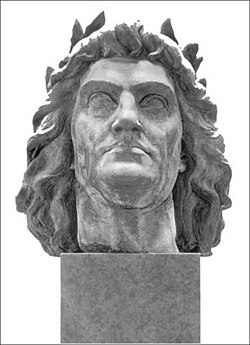 The roughly 50-year-old Matthias in the style of Constantine the Great (contemporary sculpture from Buda Castle)
 -
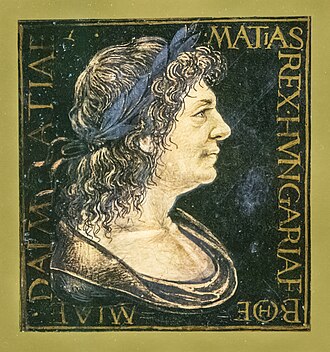 Matthias Corvinus from a Corvina Codex
 -
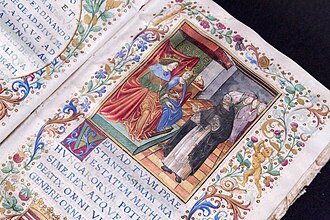 Italian humanist, Pietro Ranzano before King Matthias Corvinus and Queen Beatrice (Epitome rerum Hungarorum, 1490)
 -
 This stove tile depicts King Matthias (from Buda Castle, 1480)
 -

-
 King Matthias Corvinus (Nádasdy Mausoleum, 1664)
 -
 The triumphant Matthias (painting by Gyula Benczúr in 1919, Hungarian National Gallery, Budapest)
 -
 King Matthias receives the Papal Legates (painting by Gyula Benczúr in 1915)
 -
 King Matthias on the 1000 forint Hungarian banknote (1998–)
References
References
- "Matthias I | King of Hungary & Holy Roman Emperor | Britannica". www.britannica.com.
- "Stanislav Klíma: Povesti zo Slovenska (Kráľ Matej a bača) – elektronická knižnica".
- Kubinyi 2008, p. 23.
- E. Kovács 1990, p. 26.
- Mureşanu 2001, p. 49.
- Tanner 2009, pp. 27–28.
- Kubinyi 2008, p. 24.
- Kubinyi 2008, p. 161.
- Klaniczay 1992, p. 165.
- Tanner 2009, p. 28.
- Tanner 2009, p. 28, 86.
- Geréb, László (1959). "III". Mátyás király (in Hungarian). Magyar Helikon.
Tolmács útján megkérdezte: kicsoda, honnan jön, hová megy s mi okból van úton. Felelte erre: tolmácsra nincs szükség, mert ő magyar s Erdélyből való; azért jött Moldvába - az eseményekről mitsem tudva -, hogy fölkeresse földjeit, melyek felesége öröklött javai.
- Pop 2012, p. 5.
- Mureşanu 2001, p. 174.
- Engel 2001, p. 292.
- Kubinyi 2008, p. 25.
- Engel 2001, pp. 290–292.
- Kubinyi 2008, pp. 25–26.
- Engel 2001, pp. 280, 296.
- Engel 2001, p. 296.
- Fine 1994, p. 569.
- Cartledge 2011, p. 61.
- Kubinyi 2008, p. 26.
- Engel 2001, p. 297.
- Kubinyi 2008, p. 27.
- Tanner 2009, p. 49.
- Tanner 2009, p. 50.
- Kubinyi 2008, p. 28.
- E. Kovács 1990, p. 30.
- Kubinyi 2008, p. 30.
- Kubinyi 2008, p. 29.
- Magaš 2007, p. 75.
- Engel 2001, p. 298.
- Kubinyi 2008, p. 31.
- Kubinyi 2008, pp. 31–32.
- Bartl et al. 2002, p. 51.
- Kubinyi 2008, p. 54.
- Kubinyi 2008, pp. 53–54.
- Engel 2001, p. 299.
- Kubinyi 2008, p. 57.
- Engel 2001, p. 300.
- Kubinyi 2008, p. 55.
- E. Kovács 1990, p. 32.
- Engel 2001, pp. 282, 299.
- E. Kovács 1990, p. 33.
- Kubinyi 2008, p. 56.
- Kubinyi 2008, pp. 57–58.
- Fine 1994, p. 573.
- Kubinyi 2008, p. 58.
- Engel 2001, p. 315.
- Kubinyi 2008, p. 60.
- Bak et al. 1996, p. 7.
- Kubinyi 2008, pp. 125–126.
- E. Kovács 1990, p. 51.
- E. Kovács 1990, p. 49.
- Kubinyi 2008, p. 61.
- Markó 2006, p. 244.
- Engel 2001, pp. 311–313.
- Kubinyi 2008, pp. 122, 181.
- Engel 2001, pp. 311–312.
- Tanner 2009, p. 63.
- Kubinyi 2008, p. 67.
- Engel 2001, pp. 310–311.
- Fine 1994, p. 574.
- Kubinyi 2008, p. 65.
- Kubinyi 2008, pp. 63, 65.
- Kubinyi 2008, p. 63.
- Kisfaludy 35..p
- Fine 1994, p. 575.
- Engel 2001, p. 301.
- Cartledge 2011, p. 62.
- Kisfaludy 38.p
- Kubinyi 2008, p. 69.
- E. Kovács 1990, p. 37.
- Šmahel 2011, p. 167.
- Engel 2001, p. 303.
- Kubinyi 2008, pp. 58, 68–69.
- Bartl et al. 2002, p. 52.
- Kubinyi 2008, p. 59.
- Engel 2001, p. 309.
- Kisfaludy 207.p.
- Pop 2005, p. 264.
- Florescu & McNally 1989, pp. 150–152.
- Florescu & McNally 1989, p. 157.
- Florescu & McNally 1989, p. 156.
- Babinger 1978, p. 208.
- Kubinyi 2008, p. 68.
- Kubinyi 2008, pp. 68–69, 71.
- Fine 1994, pp. 584–585.
- E. Kovács 1990, p. 39.
- Fine 1994, p. 586.
- Babinger 1978, p. 229.
- Grgin 2003, p. 88.
- E. Kovács 1990, p. 161.
- Kubinyi 2008, p. 73.
- Kubinyi 2008, p. 302.
- Engel 2001, p. 302.
- Kubinyi 2008, p. 74.
- Kubinyi 2004, p. 29.
- Kubinyi 2008, pp. 75–76.
- Bak 1994, p. 73.
- Kubinyi 2004, p. 32.
- Bónis 1971, p. vi.
- Babinger 1978, p. 231.
- Babinger 1978, pp. 231–232.
- Babinger 1978, p. 232.
- Fine 1994, pp. 586–587.
- Kubinyi 2008, p. 80.
- Engel 2001, p. 449.
- Kubinyi 2008, p. 81.
- Kubinyi 2008, p. 82.
- Kubinyi 2008, pp. 81–82.
- E. Kovács 1990, p. 135.
- Magaš 2007, p. 76.
- Engel 2001, p. 307.
- Bartl et al. 2002, p. 53.
- Engel 2001, p. 310.
- Kubinyi 2008, pp. 77–78.
- Kubinyi 2008, p. 76.
- E. Kovács 1990, p. 61.
- Kubinyi 2008, pp. 78, 82.
- Kubinyi 2008, pp. 82–83.
- Kubinyi 2008, p. 83.
- Pop 2005, p. 266.
- "Joannes de Thurocz: Chronica Hungarorum" (PDF). upload.wikimedia.org. Retrieved 12 November 2025.
- Szokola László: Mátyás király 1467. évi moldvai hadjárata (King Matthias's Moldavian Campaign of 1467) In. Orpheus Noster 8/1 (2016.), pp. 38
- Bánlaky József: 16. Az 1467. évi moldvai hadjárat. A magyar nemzet hadtörténete Arcanum Adatbázis Kft. 2001
- Kubinyi 2008, p. 84.
- Szokola László: Mátyás király 1467. évi moldvai hadjárata (King Matthias's Moldavian Campaign of 1467) In. Orpheus Noster 8/1 (2016.), pp. 40
- Kubinyi 2008, p. 85.
- Engel 2001, p. 304.
- E. Kovács 1990, pp. 100, 103.
- Kubinyi 2008, p. 86.
- Kubinyi 2008, p. 88.
- E. Kovács 1990, p. 103.
- Tanner 2009, p. 65.
- Šmahel 2011, pp. 167–168.
- Tanner 2009, p. 66.
- E. Kovács 1990, p. 104.
- Kubinyi 2008, p. 87.
- Magaš 2007, pp. 76–77.
- Fine 1994, p. 590.
- Magaš 2007, p. 77.
- Kubinyi 2008, p. 90.
- Kubinyi 2008, p. 89.
- Tanner 2009, p. 79.
- Šmahel 2011, p. 168.
- Boubín 2011, pp. 173–174.
- Boubín 2011, p. 174.
- E. Kovács 1990, p. 108.
- Tanner 2009, p. 70.
- Kubinyi 2008, pp. 91–92.
- Kubinyi 2008, p. 92.
- Kubinyi 2008, pp. 92–93.
- E. Kovács 1990, p. 158.
- Kubinyi 2008, p. 93.
- Engel 2001, p. 305.
- Fine 1994, p. 588.
- Kubinyi 2008, p. 108.
- Kubinyi 2008, pp. 95–96.
- Kubinyi 2008, p. 101.
- Engel 2001, pp. 307–308.
- Kubinyi 2008, p. 96.
- Kubinyi 2008, p. 97.
- Kubinyi 2008, p. 100.
- Kubinyi 2008, p. 109.
- Engel 2001, p. 308.
- Pop 2005, p. 267.
- Babinger 1978, p. 325.
- Kubinyi 2008, p. 110.
- Kubinyi 2008, p. 176.
- Engel 2001, pp. 305–306.
- Tanner 2009, p. 92.
- Babinger 1978, pp. 351–352.
- Florescu & McNally 1989, pp. 170–171.
- Florescu & McNally 1989, p. 171.
- Florescu & McNally 1989, pp. 171–175.
- Pop 2005, pp. 264–265.
- Kubinyi 2008, p. 136.
- Kubinyi 2008, p. 137.
- Tanner 2009, p. 108.
- E. Kovács 1990, p. 67.
- Engel 2001, p. 306.
- Kubinyi 2008, p. 98.
- E. Kovács 1990, p. 118.
- E. Kovács 1990, p. 119.
- E. Kovács 1990, p. 120.
- E. Kovács 1990, p. 109.
- Cartledge 2011, p. 65.
- Kubinyi 2008, p. 99.
- E. Kovács 1990, p. 122.
- Dörner 2005, p. 318.
- Babinger 1978, pp. 374–376.
- E. Kovács 1990, p. 142.
- Babinger 1978, p. 404.
- E. Kovács 1990, p. 143.
- Kubinyi 2008, p. 112.
- E. Kovács 1990, p. 125.
- Engel 2001, p. 317.
- Kubinyi 2008, p. 143.
- Engel 2001, p. 313.
- Kubinyi 2008, p. 138.
- E. Kovács 1990, p. 127.
- Kubinyi 2008, p. 102.
- Bak et al. 1996, p. 41.
- Engel 2001, p. 316.
- Bak 1994, p. 74.
- Kubinyi 2008, p. 146.
- Kubinyi 2008, p. 147.
- E. Kovács 1990, p. 128.
- Kubinyi 2008, p. 103.
- Markó 2006, p. 242.
- Bartl et al. 2002, p. 54.
- Alexander Gillespie (2017). The Causes of War: Volume III: 1400 CE to 1650 CE. Bloomsbury Publishing. p. 66. ISBN 9781509917662.
- Malcolm, Noel (2019). Useful Enemies: Islam and The Ottoman Empire in Western Political Thought, 1450-1750. Oxford University Press. ISBN 978-0198830139.
- Dr. Szabados, György (1998). "A krónikáktól a Gestáig – Az előidő-szemlélet hangsúlyváltásai a 15–18. században" [From the chronicles to the Gesta - Shifts in emphasis of the pre-time perspective in the 15th–18th centuries]. Irodalomtörténeti Közlemények, 102 (5-6) (PDF) (in Hungarian). MTA Irodalomtudományi Intézet (Institute for Literary Studies of Hungarian Academy of Sciences). pp. 615–641. ISSN 0021-1486.
- Kubinyi 2008, p. 132.
- Kubinyi 2008, pp. 121, 132.
- Teke 1981, p. 310.
- Kubinyi 2008, p. 122.
- Teke 1981, p. 315.
- E. Kovács 1990, p. 110.
- E. Kovács 1990, p. 149.
- Teke 1981, p. 314.
- E. Kovács 1990, pp. 144–145.
- Kubinyi 2008, p. 149.
- Tanner 2009, p. 138.
- Tanner 2009, p. 137.
- Teke 1981, p. 316.
- Kubinyi 2008, p. 148.
- E. Kovács 1990, p. 187.
- Kubinyi 2008, p. 150.
- Kubinyi 2008, pp. 150–151.
- Teke 1981, p. 317.
- Cartledge 2011, p. 67.
- Waldman & Farbaky 2011, p. Abstract.
- Johnson 2007, p. 175.
- Kaufmann 1995, p. 30.
- Cacioppe 2007.
- Rubinstein 1991, p. 35.
- Kubinyi 2008, p. 164.
- Klaniczay 1992, p. 173.
- Klaniczay 1992, p. 168.
- Tanner 2009, p. 99.
- Kubinyi 2008, p. 184.
- E. Kovács 1990, p. 182.
- Kubinyi 2008, p. 169.
- Bak 1994, p. 75.
- E. Kovács 1990, pp. 177, 180–181.
- Engel 2001, p. 319.
- E. Kovács 1990, pp. 180–181.
- Kubinyi 2008, pp. 171–172.
- Kubinyi 2008, p. 172.
- Verspohl 2007, p. 151.
- E. Kovács 1990, p. 181.
- Kubinyi 2008, p. 183.
- Fallows 2020, pp. 112–113.
- Macey et al. 2011, §3 "Milan and elsewhere (1484–9)".
- Fallows 2020, p. 112.
- E. Kovács 1990, pp. 183–184.
- Tanner 2009, p. 52.
- Klaniczay 1992, pp. 166–167.
- Tanner 2009, pp. 8–10.
- Tanner 2009, p. 7.
- Klaniczay 1992, p. 166.
- E. Kovács 1990, p. 185.
- Klaniczay 1992, p. 167.
- Engel 2001, p. 321.
- Hendrix 2013, p. 59.
- Hendrix 2013, pp. 63, 65.
- Hendrix 2013, p. 57.
- Hendrix 2013, p. 58.
- E. Kovács 1990, p. 13.
- Kubinyi 2008, pp. 203–204.
- Mureşanu 2001, pp. 43–44.
- Tanner 2009, p. 48.
- E. Kovács 1990, p. 105.
- Teke 1981, p. 290.
- Tanner 2009, p. 78.
- Tanner 2009, p. 80.
- Teke 1981, p. 296.
- Tanner 2009, p. 88.
- Tanner 2009, p. 150.
- Kubinyi 2008, p. 134.
- Tanner 2009, p. 94.
- Tanner 2009, p. xi.
- Tanner 2009, p. xv.
- Tanner 2009, pp. 151–152.
- Engel 2001, p. 345.
- Cartledge 2011, p. 69.
- Engel 2001, p. 344.
- Bak 1994, p. 76.
- Teke 1981, p. 321.
- Cartledge 2011, pp. 66–67.
- Bak 1994, p. 71.
- Kubinyi 2008, p. 166.
- Kubinyi 2008, pp. 174–175.
- Cartledge 2011, p. 63.
- Kubinyi 2008, p. 177.
- Lukács 2010, pp. 371–379.
- Pop 2012, pp. 4–6.
- "Civilization® VI – the Official Site | News | Civilization VI: Gathering Storm – Matthias Corvinus Leads Hungary".
- "TRT'nin Sevilen Dönem Dizisi Mehmed: Fetihler Sultanı'na Sürpriz Oyuncu". 21 February 2026.
- "Recep Usta Mehmed Fetihler Sultanı dizisinin kadrosunda". 21 February 2026.
Sources
Sources
- Babinger, Franz (1978). Mehmed the Conqueror and His Time. Princeton University Press. ISBN 0-691-09900-6.
- Bak, János (1994). "The Late Medieval period (1382–1526)". In Sugar, Peter F.; Hanák, Péter; Frank, Tibor (eds.). A History of Hungary. Indiana University Press. pp. 54–82. ISBN 0-253-20867-X.
- Bak, János M.; Domonkos, Leslie S.; Harvey, Paul B.; Garay, Kathleen (1996). The Laws of the Medieval Kingdom of Hungary, 1458–1490 (The Laws of Hungary, Series I: Volume3). Charles Schlacks, Jr. ISBN 1-884445-26-8.
- Bartl, Július; Čičaj, Viliam; Kohútova, Mária; Letz, Róbert; Segeš, Vladimír; Škvarna, Dušan (2002). Slovak History: Chronology & Lexicon. Bolchazy-Carducci Publishers, Slovenské Pedegogické Nakladatel'stvo. ISBN 0-86516-444-4.
- Bónis, György (1971). A jogtudó értelmiség a Mohács előtti Magyarországon [Hungarian intelligentsia having legal expertise in the period before the battle of Mohács] (in Hungarian). Akadémiai Kiadó.
- Boubín, Jaroslav (2011). "The Bohemian Crownlands under the Jagiellons (1471–1526)". In Pánek, Jaroslav; Tůma, Oldřich (eds.). A History of the Czech Lands. Charles University in Prague. pp. 173–187. ISBN 978-80-246-1645-2.
- Cacioppe, Ron (2007). "Marsilio Ficino: Magnus of the Renaissance, Shaper of Leaders". Integral Leadership Review. 7 (2). Integral Publishers. ISSN 1554-0790.
- Cartledge, Bryan (2011). The Will to Survive: A History of Hungary. C. Hurst & Co. ISBN 978-1-84904-112-6.
- de Cevins, Marie-Madeleine (2016). Mathias Corvin, un roi pour l'Europe centrale (1458–1490) (in French). Les Indes Savantes. ISBN 978-2-84654-436-8.
- Dörner, Anton E. (2005). "Transylvania between stability and crisis (1457–1541)". In Pop, Ioan-Aurel; Nägler, Thomas (eds.). The History of Transylvania, Vol. I. (until 1541). Romanian Cultural Institute. pp. 299–348. ISBN 973-7784-04-9.
- Dvořáková, Daniela (2019). Barbara Celjska. Črna kraljica (1392–1451) (in Slovenian). Celjska Mohorjeva. ISBN 978-961-278-428-7.
- E. Kovács, Péter (1990). Matthias Corvinus (in Hungarian). Officina Nova. ISBN 963-7835-49-0.
- Engel, Pál (2001). The Realm of St Stephen: A History of Medieval Hungary, 895–1526. I.B. Tauris Publishers. ISBN 1-86064-061-3.
- Fallows, David (2020) [2009]. Josquin (2nd ed.). Turnhout: Brepols Publishers. ISBN 978-2-503-56674-0.
- Fine, John V. A (1994). The Late Medieval Balkans: A Critical Survey from the Late Twelfth Century to the Ottoman Conquest. The University of Michigan Press. ISBN 0-472-08260-4.
- Florescu, Radu R.; McNally, Raymond T. (1989). Dracula Prince of Many Faces: His Life and His Ties. Back Bay Books. ISBN 978-0-316-28656-5.
- Grgin, Borislav (2003). "The Ottoman influences on Croatia in the second half of the fifteenth century". Historical Contributions. 21 (23). Croatian Institute of History: 87–102.
- Gella, Aleksander (1989). Development of Class Structure in Eastern Europe: Poland and Her Southern Neighbors. SUNY Press. ISBN 978-1-4384-0392-2.
- Hendrix, Scott E. (2013). "Astrological forecasting and the Turkish menace in the Renaissance Balkans" (PDF). Anthropology. 13 (2). Universitatis Miskolciensis: 57–72. ISSN 1452-7243. Archived from the original (PDF) on 4 July 2022. Retrieved 7 July 2014.
- Johnson, Paul (2007). The Renaissance: A Short History. Random House. p. 175. ISBN 978-0-307-43255-1.
- Kaufmann, Thomas DeCosta (1995). Court, Cloister, and City: The Art and Culture of Central Europe, 1450–1800. University of Chicago Press. p. 30. ISBN 0-226-42729-3.
- Kisfaludy, Katalin: Matthias rex. Budapest 1983. Gondolat.
- Klaniczay, Tibor (1992). "The age of Matthias Corvinus". In Porter, Roy; Teich, Mikuláš (eds.). The Renaissance in National Context. Cambridge University Press. pp. 164–179. ISBN 0-521-36970-3.
- Kubinyi, András (2004). "Adatok a Mátyás-kori királyi kancellária és az 1464. évi kancelláriai reform történetéhez [On the history of the Royal Chancellery in the reign of Matthias Corvinus and of the 1464 reform of the chancellery]" (PDF). Publicationes Universitatis Miskolciensis. Sectio Philosophica (in Hungarian). IX (1). Universitatis Miskolciensis: 25–58. ISSN 1219-543X.
- Kubinyi, András (2008). Matthias Rex. Balassi Kiadó. ISBN 978-963-506-767-1.
- Lukács, István (2010). "King Matthias Corvinus in the Collective Memory of the Slovenian Nation". Studia Slavica 55 (2). Akadémiai Kiadó. pp. 371–379.
- Macey, Patrick; Noble, Jeremy; Dean, Jeffrey; Reese, Gustave (2011) [2001]. "Josquin (Lebloitte dit) des Prez". Grove Music Online. Oxford: Oxford University Press. doi:10.1093/gmo/9781561592630.article.14497. ISBN 978-1-56159-263-0. (subscription, Wikilibrary access, or UK public library membership required)
- Magaš, Branka (2007). Croatia Through History. SAQI. ISBN 978-0-86356-775-9.
- Markó, László (2006). A magyar állam főméltóságai Szent Istvántól napjainkig: Életrajzi Lexikon [Great Officers of State in Hungary from King Saint Stephen to Our Days: A Biographical Encyclopedia] (in Hungarian). Helikon Kiadó. ISBN 963-547-085-1.
- Mureşanu, Camil (2001). John Hunyadi: Defender of Christendom. The Center for Romanian Studies. ISBN 973-9432-18-2.
- Pop, Ioan-Aurel (2005). "The Romanians in the 14th–16th centuries from the "Christian Republic" to the "Restoration of Dacia"". In Pop, Ioan-Aurel; Bolovan, Ioan (eds.). History of Romania: Compendium. Romanian Cultural Institute (Center for Transylvanian Studies). pp. 209–314. ISBN 978-973-7784-12-4.
- Pop, Ioan-Aurel (2012). "The Names in the Family of King Matthias Corvinus: From Old Sources to Contemporary Historiography" (PDF). Ethnographica et Folkloristica Carpathica. 17 (35). Debreceni Egyetem Néprajzi Tanszék: 11–40. ISSN 0139-0600. Archived from the original (PDF) on 3 August 2020. Retrieved 5 May 2018.
- Rubinstein, Nicolai (1991). "Italian political thought, 1450–1530". In Burns, J. H.; Goldie, Mark (eds.). The Cambridge History of Political Thought, 1450–1700. Cambridge University Press. pp. 30–65. ISBN 0-521-24716-0.
- Šmahel, František (2011). "The Hussite Revolution (1419–1471)". In Pánek, Jaroslav; Tůma, Oldřich (eds.). A History of the Czech Lands. Charles University in Prague. pp. 149–169. ISBN 978-80-246-1645-2.
- Tanner, Marcus (2009). The Raven King: Matthias Corvinus and the Fate of his Lost Library. Yale University Press. ISBN 978-0-300-15828-1.
- Teke, Zsuzsa (1981). "A középkori magyar állam virágzása és bukása, 1301–1526: 1458–1490 [Flourishing and Fall of Medieval Hungary, 1301–1526: 1458–1490]". In Solymosi, László (ed.). Magyarország történeti kronológiája, I: a kezdetektől 1526-ig [Historical Chronology of Hungary, Volume I: From the Beginning to 1526] (in Hungarian). Akadémiai Kiadó. pp. 79–187. ISBN 963-05-2661-1.
- Verspohl, Franz-Joachim (2007). Michelangelo Buonarroti und Leonardo Da Vinci: Republikanischer Alltag und Künstlerkonkurrenz in Florenz zwischen 1501 und 1505 (in German). Wallstein Verlag. ISBN 978-3-8353-0216-7.
- Waldman, Louis Alexander; Farbaky, Péter (2011). Italy & Hungary: Humanism and Art in the Early Renaissance. Harvard University Graduate School of Design. ISBN 978-0-674-06346-4.
Further reading
Further reading
- Bain, Robert Nisbet (1911). . In Chisholm, Hugh (ed.). Encyclopædia Britannica. Vol. 17 (11th ed.). Cambridge University Press. pp. 900–901.
- Bárány, Attila; Györkös, Attila, eds. (2008). Matthias and his Legacy: Cultural and Political Encounters between East and West. University of Debrecen. ISBN 978-963-473-276-1.
- Birnbaum, Marianna D. (1996). The Orb and the Pen: Janus Pannonius, Matthias Corvinus and the Buda Court. Balassi Kiadó. ISBN 963-506-087-4.
- ANTONIUS DE BONFINIS:DE REGE MATHIA RERUM UNGARICARUM DECADES A LIBRO IX. DECADIS III.USQUE AD LIBRUM VIII. DECADIS IV. In: Rerum Ungaricum decades. https://vmek.oszk.hu/mobil/konyvoldal.phtml?id=20375#_home
- Farbaky, Péter; Spekner, Enikő; Szende, Katalin; et al., eds. (2008). Matthias Corvinus, the King: Tradition and Renewal in the Hungarian Royal Court 1458–1490. Budapest History Museum. ISBN 978-963-9340-69-5.
- Farbaky, Peter; Waldman, Louis A. (2011). Italy & Hungary: Humanism and Art in the Early Renaissance. Harvard University Press. ISBN 9780674063464.
- Feuer-Tóth, Rózsa (1990). Art and Humanism in Hungary in the Age of Matthias Corvinus. Akadémiai Kiadó. ISBN 963-05-5646-4.
- Gastgeber, Christian; Mitsiou, Ekaterini; Pop, Ioan-Aurel; Popović, Mihailo; Preiser-Kapeller, Johannes; Simon, Alexandru (2011). Matthias Corvinus und seine Zeit: Europa am Übergang vom Mittelalter zur Neuzeit zwischen Wien und Konstantinopel [Matthias Corvinus and His Time: Europe in Transition from the Middle Ages to Modern Times between Vienna and Constantinople] (in German). David Brown Book Company. ISBN 978-3-7001-6891-1.
- Klaniczay, Tibor; Jankovics, József (1994). Matthias Corvinus and the Humanism in Central Europe. Balassi Kiadó. ISBN 963-7873-72-4.
- Kropej, Monika (2014). "Narrative Tradition about King Matthias in the Process of Transformation". Slovenský národopis. 62 (2): 244–258.
External links
External links
- The Squash and the Colt, a folk tale reflecting Matthias' wisdom and sense of justice
- Bibliotheca Corviniana Digitalis – National Széchényi Library, Hungary
- Map of Europe in 1500.
- . Catholic Encyclopedia. 1913.