| Leiopelma markhami Temporal range: Holocene
| |
|---|---|
| |
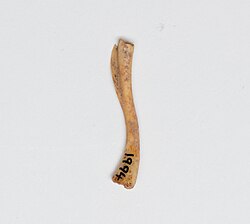
| Fossilised bone of a markham's frog. | |
Scientific classification 
| |
| Kingdom: | Animalia |
| Phylum: | Chordata |
| Class: | Amphibia |
| Order: | Anura |
| Family: | Leiopelmatidae |
| Genus: | Leiopelma |
| Species: | †L. markhami
|
| Binomial name | |
| †Leiopelma markhami | |

Markham's frog (Leiopelma markhami) is one of three extinct New Zealand frog species, the others being the Aurora frog (Leiopelma auroraensis) and Waitomo frog (Leiopelma waitomoensis).1 Subfossil bones used to describe the species were discovered at Honeycomb Hill Cave, South Island, New Zealand, but it once occurred on both South and North Islands. It is estimated that it grew between 50 and 60 mm from snout to vent and it appears to have been a very robust animal.23
References
References
- Burns, Rhys J.; Bell, Ben D.; Haigh, Amanda; Bishop, Phillip J.; Easton, Luke; Wren, Sally; Germano, Jennifer (August 2018). Conservation status of New Zealand amphibians, 2017 (PDF). Wellington, New Zealand: Department of Conservation. p. 5. ISBN 9781988514680. OCLC 1052880982.
- Worthy, Trevor H. (1987). "Osteology of Leiopelma (Amphibia: Leiopelmatidae) and descriptions of three new subfossil Leiopelma species". Journal of the Royal Society of New Zealand. 17 (3): 201–251. doi:10.1080/03036758.1987.10418160.
- Worthy, Trevor H. (1987). "Palaeoecological information concerning members of the frog genus Leiopelma: Leiopelmatidae in New Zealand". Journal of the Royal Society of New Zealand. 17 (4): 409–420. doi:10.1080/03036758.1987.10426482.