Article · Wikipedia archive · Last revised Jun 7, 2026

Map (graph theory)

In topology and graph theory, a map is a subdivision of a surface such as the Euclidean plane into interior-disjoint regions, formed by embedding a graph onto the surface and forming connected components (faces) of the complement of the graph. That is, it is a tessellation of the surface. A map graph is a graph derived from a map by creating a vertex for each face and an edge for each pair of faces that meet at a vertex or edge of the embedded graph.

Last revised
Jun 7, 2026
Read time
≈ 1 min
Length
110 w
Citations
1
Source
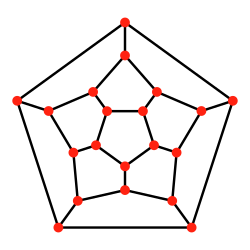
A map with twelve pentagonal faces source ↗

In topology and graph theory, a map is a subdivision of a surface such as the Euclidean plane into interior-disjoint regions, formed by embedding a graph onto the surface and forming connected components (faces) of the complement of the graph. That is, it is a tessellation of the surface. A map graph is a graph derived from a map by creating a vertex for each face and an edge for each pair of faces that meet at a vertex or edge of the embedded graph.1

References

References

  1. Gross, Jonathan; Yellen, Jay (1998), Graph Theory and its applications, CRC Press, p. 294, ISBN 0-8493-3982-0