| Asiatic pangolin | |
|---|---|
| |
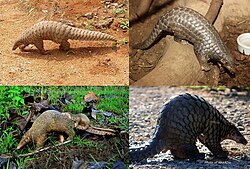
| Living pangolins from genus Manis | |
Scientific classification 
| |
| Kingdom: | Animalia |
| Phylum: | Chordata |
| Class: | Mammalia |
| Infraclass: | Placentalia |
| Order: | Pholidota |
| Family: | Manidae |
| Subfamily: | Maninae Gray, 1821 |
| Genus: | Manis Linnaeus, 1758 |
| Type species | |
| Manis pentadactyla Linnaeus, 1758
| |
| Species | |
| |

| |
| Synonyms23 | |
|
synonyms of subfamily:
synonyms of genus:
| |
Manis ("spirit") is a genus of South Asian and East Asian pangolins, the Asiatic pangolins, from the subfamily Maninae, within the family Manidae.56
Taxonomy
- Subfamily: Maninae (Asiatic pangolins)
- Genus: Manis (Asiatic pangolins)
- Manis crassicaudata (Indian pangolin)
- Manis pentadactyla (Chinese pangolin)
- Manis aurita7 (= Manis indoburmanica)8
- Manis mysteria (Cryptic pangolin)9
- †Manis hungarica
- †Manis lydekkeri
- Subgenus: Paramanis
- Manis culionensis (Philippine pangolin)
- Manis javanica (Sunda pangolin)
- †Manis palaeojavanica (Giant asian pangolin)
- Genus: Manis (Asiatic pangolins)
Phylogeny
Phylogenetic position of genus Manis within family Manidae.10111
| Pholidotamorpha |
| |||||||||||||||||||||
(Pholidota sensu lato)
|


References
References
- Philippe Gaubert, Agostinho Antunes, Hao Meng, Lin Miao, Stéphane Peigné, Fabienne Justy, Flobert Njiokou, Sylvain Dufour, Emmanuel Danquah, Jayanthi Alahakoon, Erik Verheyen, William T Stanley, Stephen J O’Brien, Warren E Johnson, Shu-Jin Luo (2018) "The Complete Phylogeny of Pangolins: Scaling Up Resources for the Molecular Tracing of the Most Trafficked Mammals on Earth" Journal of Heredity, Volume 109, Issue 4, Pages 347–359
- Palmer, Theodore Sherman (1904). Index Generum Mammalium: A List of the Genera and Families of Mammals. U. S. Government Printing Office. p. 822.
- "Taxonomic history of the genus Manis". Mikko's Phylogeny Archive. Retrieved 2019-09-18.
- J. E. Gray. (1825.) "An outline of an attempt at the disposition of Mammalia into Tribes and Families, with a list of genera apparently appertaining to each Tribe." Annals of Philosophy, new series 10:337-344
- "Oldstyle id: d36852dde74a91d7c965591b175947ec". Catalogue of Life. Species 2000: Leiden, the Netherlands.
- Schlitter, D.A. (2005). "Order Pholidota". In Wilson, D.E.; Reeder, D.M (eds.). Mammal Species of the World: A Taxonomic and Geographic Reference (3rd ed.). Johns Hopkins University Press. pp. 530–531. ISBN 978-0-8018-8221-0. OCLC 62265494.
- Zijlstra JS (25 April 2025). "Manis aurita Hodgson 1837 as a valid species of pangolin: a comment to Wangmo et al. (2025)". Mammalian Biology. 105 (5): 699–701. doi:10.1007/s42991-025-00495-x.
- Wangmo, L. K., Ghosh, A., Dolker, S., Joshi, B. D., Sharma, L. K., & Thakur, M. (2025). Indo-Burmese pangolin (Manis indoburmanica): a novel phylogenetic species of pangolin evolved in Asia. Mammalian Biology, 1-8.
- "DNA Study Reveals Cryptic New Species of Pangolin | Sci.News". 2 October 2023.
- Gaudin, Timothy (2009). "The Phylogeny of Living and Extinct Pangolins (Mammalia, Pholidota) and Associated Taxa: A Morphology Based Analysis" (PDF). Journal of Mammalian Evolution. 16 (4). Heidelberg, Germany: Springer Science+Business Media: 235–305. doi:10.1007/s10914-009-9119-9. S2CID 1773698. Archived from the original (PDF) on 2015-09-25. Retrieved 2020-11-19.
- Kondrashov, Peter; Agadjanian, Alexandre K. (2012). "A nearly complete skeleton of Ernanodon (Mammalia, Palaeanodonta) from Mongolia: morphofunctional analysis". Journal of Vertebrate Paleontology. 32 (5): 983–1001. Bibcode:2012JVPal..32..983K. doi:10.1080/02724634.2012.694319. ISSN 0272-4634. S2CID 86059673.