 | |
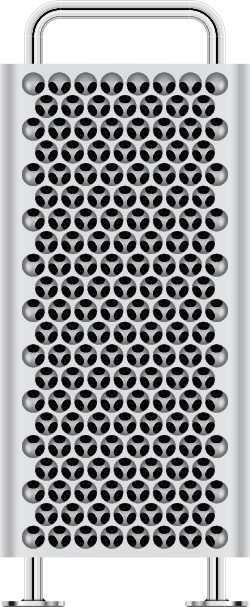 2023 Mac Pro | |
| Developer | Apple |
|---|---|
| Type | |
| Released | August 7, 2006 (2006-08-07) |
| Discontinued | March 26, 2026 (2026-03-26) |
| macOS | |
| Predecessor | Power Mac G5, Xserve |
| Successor | Mac Studio |
| Related | iMac, Mac Mini, Mac Studio, iMac Pro |
| Website | Mac Pro at the Wayback Machine (archived March 25, 2026) |
The Mac Pro is a discontinued series of workstation computer and servers made by Apple from 2006 to 2026. The Mac Pro served as the high-end personal computer in Apple's lineup. Introduced in August 2006, the Mac Pro is the successor of the Power Mac line, using Intel Xeon rather than PowerPC processors. It shipped in a tower case carried over from the Power Mac G5. Updates added faster processors, memory, and graphics, alongside changed I/O and built-to-order options. In 2013, Apple released a significant revision to the Mac Pro, housing the computer components in a smaller, cylindrical design that eschewed internal expansion. Limitations of the cylindrical design prevented Apple from upgrading the cylindrical Mac Pro with more powerful hardware. The 2019 Mac Pro returned to a tower form factor reminiscent of the first-generation model.
The 2023 Mac Pro was the last Apple computer to migrate from Intel processors to Apple's own M-series chips. It was criticized for its lack of GPU support or user-expandability compared to prior models, and for its high price premium compared to the similar performance configurations of the professional-oriented Mac Studio. Apple discontinued the Mac Pro line on March 26, 2026 and positioned the more compact Mac Studio as its successor.1
First tower series (2006–2012)
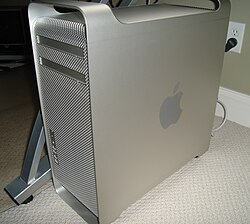
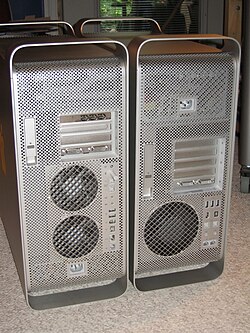
Apple announced their computers would transition from PowerPC processors to x86 processors in 2005. In June Apple released the Developer Transition Kit, a prototype Intel Pentium 4 Prescott–based Mac housed in a Power Mac G5 case, that was temporarily available to developers.2 The Mac Pro was formally announced on August 7, 2006, at the annual Apple Worldwide Developers Conference (WWDC), as the last Mac to transition to Intel processors.3
The first generation of the Mac Pro featured an aluminium case that was derived from that of the Power Mac G5; the few external differences included a second optical drive bay, new I/O port configurations, and a rearranged power supply and fan arrangement in the rear of the machine. The case is the same external dimensions, but is two pounds lighter.4 Internally, the machines are very different.5 Without the hot G5 processor to cool, the interior has room for four 3.5-inch hard drive bays and two optical bays—two and one more, respectively, than the Power Mac G5. Each hard drive is attached via screws to a sled, that slides into place and requires no cables. Random access memory (RAM) was installed in eight fully-buffered memory module (DIMM) slots distributed across two riser cards. Each DIMM came with its own heat sink.5 The 2008 model had two PCI Express (PCIe) 2.0 expansion slots and two PCI Express 1.1 slots, providing them with up to 300 W of power in total. The first slot was double wide and intended to hold the main video card, arranged with an empty area the width of a normal card beside it to leave room for the large coolers modern cards often use. In most machines, one slot would be blocked by the cooler. Instead of the tiny screws typically used to fasten the cards to the case, in the Mac Pro a single "bar" held the cards in place, which is itself held in place by two "captive" thumbscrews that can be loosened by hand without tools and will not fall out of the case. On the original Mac Pro introduced in August 2006 and the April 2007 refresh, the PCIe slots can be configured individually to give more bandwidth to devices that require it, with a total of 40 "lanes", or 13 GB/s total throughput.
For external connectivity, the Mac Pro includes five USB 2.0 ports, two FireWire 400 and two FireWire 800 ports. Networking was supported with two built-in Gigabit Ethernet ports. Wi-Fi and Bluetooth support requires an optional module. Digital (TOSlink optical) audio and analog 3.5 mm stereo mini jacks for sound in and out were included, the latter becoming available on both the front and back of the case.
The Mac Pro initially shipped in a single configuration, with consumers able to customize the machine when ordering online.5 This "suggested configuration" had two 2.66 GHz dual-core Xeon "Woodcrest" 5100 processors (CPUs), 1 GB of fully-buffered DDR2 memory (RAM), a Nvidia GeForce 7300 GT graphics card (GPU), and a 250 GB hard drive. The processor could be downgraded to slower-frequency chips, or upgraded to Xeons running at 3 GHz.54 In 2007, the line was updated with a higher-end 3.0 GHz Xeon 8-core processor option initially exclusive to Apple.6
In January 2008, Apple updated the Mac Pro. The new line featured quad-core Xeon "Harpertown" 5400 series CPUs as standard. Unlike the original Mac Pro, the 2008 revision could support two video cards running at x16 speeds, and locked the PCIe lane configurations. Bluetooth now came standard, and new video card options were offered.7
A more substantial redesign of the Mac Pro came in 2009.8
The Mac Pro line was updated in 2010 with "Westmere" Xeon processors. As the Xserve was discontinued, a Mac Pro Server model was also offered.
The Mac Pro line received a small update at the 2012 WWDC conference in June. The line received more default memory and increased processor speed but still used Intel's older Westmere processors instead of the newer Xeon E5 series.9 The line also lacked then-current technologies like SATA III, USB 3, and Thunderbolt, the last of which had been added to every other Macintosh at that point, and was criticized heavily by users, leading Apple to remove the "new" badge on the Mac Pro from the online store. An email from Apple CEO Tim Cook promised a more significant update to the line in 2013.10 Apple stopped shipping the Mac Pro in Europe on March 1, 2013 after an amendment to a safety regulation left the professional Mac non-compliant.11
Reception
Ars Technica reviewed the 2006 Mac Pro, calling it a solid "multiplatform device" and rating it 9 out of 10.12 CNET praised the design and value, although did not think it provided the flexibility of other systems. They gave it an 8 out of 10.13
Sound on Sound, an audio recording technology magazine, thought it was a "great machine" for musicians and audio engineers.14 Architosh, an online architectural design magazine focused on mac technology, would have scored it a perfect five except for a few issues with software compatibility and the high price for FB-DIMM memory.15
Specifications
| Model | Mid 200616 | Early 200817 | Early 200918 | Mid 201019 | Mid 201220 | |||||
|---|---|---|---|---|---|---|---|---|---|---|
| Released | August 7, 200621 April 4, 2007 |
January 8, 200822 | March 3, 200923 December 4, 2009 |
July 27, 201024 | June 11, 2012 | |||||
| Discontinued | January 8, 2008 | March 3, 2009 | July 27, 2010 | June 11, 2012 | October 22, 2013 | |||||
| Order number | MA356 | MA970 | MB871 | MB535 | MC560 | MC250 | MC561 | MD770 | MD772 (Server) | MD771 |
| Processor | Two 2.66 GHz 2-core Intel Xeon | Two 2.8 GHz 4-core Intel Xeon | One 2.66 GHz 4-core Intel Xeon | Two 2.26 GHz 4-core Intel Xeon | One 2.8 GHz 4-core Intel Xeon | Two 2.4 GHz 4-core Intel Xeon | Two 2.66 GHz 6-coreIntel Xeon | One 3.2 GHz 4-core Intel Xeon | Two 2.4 GHz 6-core Intel Xeon | |
| Cache | 4 MB L2 | 12 MB L2 | 8 MB L3 | 12 MB L3 | 8 MB L3 | 12 MB L3 | ||||
| Option | Configurable to 2.0 GHz, 2.66 GHz or 3.0 GHz 2-core or 3.0 GHz 4-core Xeon | Configurable to two 3.0 GHz or 3.2 GHz 4-core processors or one 2.8 GHz 4-core Xeon | Configurable to 2.93 GHz or 3.33 GHz 4-core Xeon processors or two 2.66 GHz or 2.93 GHz 4-core Xeon processors | Configurable to 3.2 GHz or 3.33 GHz 6-core Xeon processors or two 2.93 GHz 6-core Xeon processors | Configurable to 3.33 GHz 6-core Xeon, two 2.66 GHz 6-core Xeon or 2 3.06 GHz 6-core Xeon processors | |||||
| System bus | 1333 MHz | 1600 MHz | 4.8 GT/s (4-core models only) or 6.4 GT/s | 4.8 GT/s (4-core models only), 5.86 GT/s (8-core models only) or 6.4 GT/s | 4.8 GT/s (4-core models only), 5.86 GT/s (12-core models only) or 6.4 GT/s | |||||
| Memory | 1 GB 667 MHz DDR2 ECC FB-DIMM Expandable to 16 GB |
2 GB 800 MHz DDR2 ECC FB-DIMM Expandable to 32 GB |
3 GB 1066 MHz DDR3 ECC DIMM Expandable to 16 GB |
6 GB 1066 MHz DDR3 ECC DIMM Expandable to 32 GB |
3 GB 1066 or 1333 MHz ECC DDR3 SDRAM Expandable to 32 GB |
6 GB 1066 or 1333 MHz ECC DDR3 SDRAM Expandable to 64 GB |
6 GB 1066 or 1333 MHz ECC DDR3 SDRAM Expandable to 32 GB |
8 GB 1333 MHz ECC DDR3 SDRAM Expandable to 32 GB |
12 GB 1333 MHz ECC DDR3 SDRAM Expandable to 64 GB | |
| Graphics | Nvidia GeForce 7300 GT with 256 MB GDDR3 SDRAM Optional ATI Radeon X1900 XT with 512 MB GDDR3 SDRAM or Nvidia Quadro FX 4500 with 512 MB GDDR3 SDRAM |
ATI Radeon HD 2600 XT with 256 MB GDDR3 SDRAM (two dual-link DVI ports) Optional Nvidia GeForce 8800 GT with 512 MB GDDR3 SDRAM or Nvidia Quadro FX 5600 1.5 GB |
Nvidia GeForce GT 120 with 512 MB GDDR3 SDRAM Optional ATI Radeon HD 4870 with 512 MB GDDR5 SDRAM |
ATI Radeon HD 5770 with 1 GB GDDR5 memory Optional ATI Radeon HD 5870 with 1 GB GDDR5 memory | ||||||
| Storage | 250 GB with 8 MB cache Optional 500 GB with 8 MB cache or 750 GB with 16 MB cache 7200-rpm SATA Hard drive |
320 GB SATA with 8 MB cache Optional 500, 750 GB, or 1 TB SATA with 16 MB cache or 300 GB Serial Attached SCSI, 15,000-rpm with 16 MB cache 7200-rpm SATA Hard drive or 15k-rpm SAS hard drive |
640 GB with 16 MB cache Optional 1 TB or 2 TB with 32 MB cache 7200-rpm SATA hard drive |
1 TB SATA with 32 MB cache Optional 1 or 2 TB SATA with 32 MB cache or 256 or 512 GB solid-state drives 200-rpm SATA hard drive or solid-state Drive | ||||||
| Optical drive | 16× SuperDrive with double-layer support (DVD±R DL/DVD±RW/CD-RW) | 18× SuperDrive with double-layer support (DVD±R DL/DVD±RW/CD-RW) | ||||||||
| Connectivity | Optional Wi-Fi 4 (802.11a/b/g and draft-n, n disabled by default)25 2× Gigabit Ethernet Optional 56k V.92 USB modem Optional Bluetooth 2.0+EDR |
Optional Wi-Fi 4 (802.11a/b/g and draft-n, n-enabled) 2× Gigabit Ethernet Optional 56k V.92 USB modem Bluetooth 2.0+EDR |
Wi-Fi 4 (802.11a/b/g/n) 2× Gigabit Ethernet Bluetooth 2.1+EDR | |||||||
| Peripherals | 5× USB 2.0 2× FireWire 400 2× FireWire 800 Built-in mono speaker 1× Audio-in mini-jack 2× Audio-out mini-jack 1× Optical S/PDIF (Toslink) input 1× Optical S/PDIF (Toslink) output |
5× USB 2.0 4× FireWire 800 Built-in mono speaker 1× Audio-in mini-jack 2× Audio-out mini-jack 1× Optical S/PDIF (Toslink) input 1× Optical S/PDIF (Toslink) output | ||||||||
| Expansion slots | 4× PCIe 1.0 slots (3 single-wide slots, 1 double-wide slot)26 | 2× PCIe 1.1 single-wide 4x slots,
2× PCIe 2.0 16x slots (1 single-wide, 1 double-wide) |
4× PCIe 2.0 slots (2 single-wide 4x slots, 1 single-wide 16x slot, 1 double-wide 16x slot) | |||||||
| Dimensions | 20.1 in (51.1 cm) height x 8.1 in (20.6 cm) width x 18.7 in (47.5 cm) depth | |||||||||
| Weight | 42.4 lb (19.2 kg) | 39.9 lb (18.1 kg) (quad-core) 41.2 lb (18.7 kg) (8-core) | ||||||||
| Initial operating system | Mac OS X 10.4 Tiger | Mac OS X 10.5 Leopard | Mac OS X 10.6 Snow Leopard | OS X 10.8 Mountain Lion | ||||||
| Maximum operating system | Mac OS X 10.7 Lion if at least 2 GB RAM installed, otherwise Mac OS X 10.6 Snow Leopard | OS X 10.11 El Capitan | macOS 10.14 Mojave with a Metal-capable GPU, otherwise macOS 10.13 High Sierra27 | |||||||
Cylindrical Mac Pro (2013)
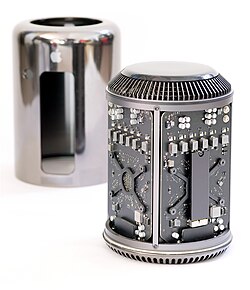
The minor 2012 update to the Mac Pro was received negatively, leading Apple to remove the "new" badge on the Apple Store denoting the update, and for Tim Cook to send an email to a customer promising Apple was "working on something really great for later next year."28 Apple senior vice president of marketing Phil Schiller presented a "sneak peek" of the completely redesigned Mac Pro during the 2013 Worldwide Developers Conference keynote. The video revealed an overhauled case design, featuring a cylindrical case much smaller than the previous Mac Pro. In the introduction, Schiller made reference to critics saying the company could not produce new products; "Can’t innovate anymore, my ass!" he quipped.29 The announcement six months prior to release was unusual for Apple, which typically announces products when they are ready for market.30
The cylindrical Mac Pro is one-fourth the weight and one-eighth the volume of the previous tower model, with a diameter of 6.6 inches (17 cm) and height of 9.9 inches (25 cm).31 It supports one central processing unit (CPU) (up to a 12-core Xeon E5 CPU), four 1866 MHz DDR3 slots, dual AMD FirePro D series GPUs (up to D700 with 6 GB VRAM each), and PCIe-based flash storage. There is a 3× MIMO antenna system for the unit's 802.11ac WiFi networking interface, Bluetooth 4.0 to facilitate close-range wireless functions such as music transfer, keyboards, mice, tablets, speakers, security, cameras, and printers. The system can simultaneously support six Apple Thunderbolt Displays, or three 4K resolution computer monitors.32

The cylindrical Mac Pro has a redesigned configuration of ports. It has a HDMI 1.4 port, dual Gigabit Ethernet ports, six Thunderbolt 2 ports, four USB 3 ports, and combined digital Mini-TOSlink optical / analog 3.5 mm stereo mini jack for audio output. It also has a headphones mini jack (the two are distinctly selectable within the Sound System Preference panel, Output tab). There is no dedicated port for inputting audio. The system has a low-fidelity internal mono speaker. The Thunderbolt 2 ports support up to thirty-six Thunderbolt devices (six per port) and can concurrently support up to three 4K displays. This design requires two GPUs to support the seven display outputs (HDMI and six Thunderbolt). The I/O panel illuminates itself when the unit senses it has been moved to make it easier for the user to see the ports. Unlike the previous model, it has no FireWire 800 ports, dedicated digital audio in/out ports, a SuperDrive, DVI port, 3.5-inch drive bays for replaceable storage drives, or changeable internal PCIe slots. Instead, there are six Thunderbolt 2 ports to connect high-speed external peripherals, including enclosures for internal PCIe cards.32
Apple's website mentions only RAM33 and flash storage34 as user-serviceable, though third party tear-downs show nearly all components can be removed and replaced. However, special tools only available from Apple are necessary for proper dismantling and reassembly.35 Apple has also specified mandatory and recommended tightening torque values for nearly every screw, with the most important being those securing the GPUs and CPU riser card to the thermal core.36 According to Apple, not tightening screws to the mandatory torque values may result in damage or malfunction.37 A lock switch on the aluminum housing allows for easy access to the internals, as well as fitting a security lock with its own cable, and components are secured with Torx screws. The flash storage and GPUs use proprietary connectors and are specially sized to fit into the enclosure.38 The CPU is not soldered to the riser card and can be replaced with another LGA 2011 socket processor, including processor options not offered by Apple.39 The type of RAM modules that Apple supplies with the late-2013 Mac Pro in the default configuration are ECC unbuffered (UDIMM) on the up to 8 GB modules (shown on each module as PC3-14900E). Apple offers as an optional upgrade 16 GB modules are ECC registered (RDIMM) modules (shown on each module as PC3-14900R). The higher-capacity 32 GB modules that some third-party vendors offer are also RDIMM. The UDIMM and RDIMM module types cannot be mixed. Apple publishes recommended configurations to use.4041
The model was assembled in Austin, Texas, by Apple's supplier Flextronics on a highly automated line.42 The move was made to counter American political complaints that it relied too heavily on outsourcing production; the Mac Pro, with its high margins and low production volumes was a low-risk model to produce domestically. The shift in production was described as a "fiasco" by one Apple engineer, as producing the cylinder's complicated design in America ultimately took Apple importing Chinese engineers from Foxconn.43
The Mac Pro was released on December 19, 2013. It shipped in two stock configurations. The entry model featured a quad-core CPU, 12 GB of RAM, and dual AMD FirePro D300 GPUs. The higher-end model had a six-core CPU, 16 GB of RAM, and dual AMD FirePro D500 GPUs. Configuration options included 8- or 12-core CPUs, up to 64 GB of RAM, up to a 1 TB SSD, and dual AMD FirePro D700 GPUs. The Mac Pro did not ship with a keyboard or mouse.31
Reception
Reception of the cylindrical Mac Pro was mixed, initially receiving positive reviews, but more negative in the long term, due to Apple's failure to upgrade the hardware specs. The performance had been widely lauded, especially handling video tasks on the dual GPU units, with some reviewers noting the ability to apply dozens of filters to realtime 4K resolution video in Final Cut Pro X.44 Drive performance, connected via PCIe, was also widely mentioned as a strong point. Technical reviewers praised the OpenCL API under which the machine's powerful twin GPUs and its multi-core CPU can be treated as a single pool of computing power. However, in late 2013 through early 2014, some reviewers had noted the lack of internal expandability, second CPU, serviceability, and questioned the then-limited offerings via Thunderbolt 2 ports.4546 By 2016, reviewers started to agree that the Mac Pro was now lacking in functionality and power, it having not been updated since 2013, and it was past time for Apple to update it.47 Apple later revealed in 2017 that the thermal core design had limited the ability to upgrade the Mac Pro's GPUs and that a new design was under development, to be released sometime after 2017.48
Sales for the new Mac Pro disappointed, and Apple quickly slashed production. Apple employees called it "the failed trash can"49
On February 5, 2016, Apple identified problems with FirePro D500 and D700 GPUs manufactured between February 8, 2015 and April 11, 2015. Issues included "distorted video, no video, system instability, freezing, restarts, shut downs, or may prevent system start up."50 Customers who owned a Mac Pro exhibiting those issues could take their affected machine to Apple or an authorized service provider to have both GPUs replaced for free. The repair program ended on May 30, 2018. Customers who owned Mac Pros with FirePro D300 GPUs also complained about problems, but those GPUs were not included in the repair program until July 2018.51 Customers with FirePro GPUs not manufactured between those dates have complained of issues including overheating and thermal throttling.52 It is believed Apple has not enabled a satisfactory cooling fan profile in order to properly remove heat from the system. Users have had to resort to using third-party apps to manually increase the fan speed to prevent the GPUs from overheating.53
The Mac Pro was left unchanged for over three years, leading Apple to make a rare admission of a product's failure in April 2017 when it detailed the issues surrounding the design and promised a totally redesigned Mac Pro. The design of the cylindrical Mac Pro has received mixed reviews, and has been compared to a trash can, rice cooker, Curta mechanical calculator, R2-D2, or Darth Vader's helmet.5455 On September 18, 2018, the Mac Pro surpassed the Macintosh Plus's production life record for an unchanged Mac model, with the Plus having remained on sale unchanged for 1,734 days. It was discontinued on December 10, 2019, after being on sale unchanged for a record 2,182 days.56
Specifications
| Model | Late 201357 | ||
|---|---|---|---|
| Announced | June 10, 201358 | ||
| Released | December 19, 201359 | ||
| Discontinued | April 4, 2017 | December 10, 2019 | |
| Processor (LGA 201160) |
3.7 GHz 4-core Intel Xeon E5 with 10 MB L3 cache
Configurable to 3.5 GHz 6-core Xeon E5 with 12 MB L3 cache, 3.0 GHz 8-core Xeon E5 with 25 MB L3 cache, or 2.7 GHz 12-core Xeon E5 with 30 MB L3 cache |
3.5 GHz 6-core Intel Xeon E5 with 12 MB L3 cache
Configurable to 3.0 GHz 8-core Xeon E5 with 25 MB L3 cache or 2.7 GHz 12-core Xeon E5 with 30 MB L3 cache |
3.0 GHz 8-core Intel Xeon E5 with 25 MB L3 cache
Configurable to 2.7 GHz 12-core Xeon E5 with 30 MB L3 cache |
| Memory | 12 GB of DDR3 ECC at 1866 MHz
Configurable up to 64 GB |
16 GB of DDR3 ECC 1866 MHz
Configurable up to 64 GB |
12 GB of DDR3 ECC 1866 MHz Configurable up to 64 GB from Apple, expandable to 128 GB using third-party modules61 |
| Graphics | Dual AMD FirePro D300 with 2 GB of GDDR5 VRAM each | Dual AMD FirePro D500 with 3 GB of GDDR5 VRAM each | Dual AMD FirePro D700 with 6 GB of GDDR5 VRAM each |
| Storage | 256 GB flash storage Optional 512 GB or 1 TB flash storage PCIe SSD | ||
| Connectivity | Built-in Wi-Fi 5 (802.11a/b/g/n/ac), up to 1.3 Gbit/s 2× Gigabit Ethernet Bluetooth 4.0 | ||
| Peripherals | 4× USB 3.0 6× Thunderbolt 2 HDMI 1.4 Built-in mono speaker Audio output/optical digital audio output Headphone mini-jack | ||
| Dimensions | 9.9 in (25.1 cm) height × 6.6 in (16.8 cm) diameter | ||
| Weight | 11 lb (4.99 kg) | ||
| Initial operating system | OS X 10.9 Mavericks | ||
| Maximum operating system | macOS 12 Monterey | ||
Lattice tower or rack (2019)
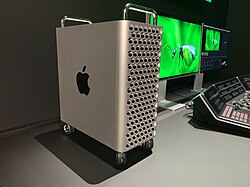
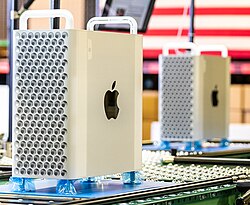
In April 2018, Apple confirmed that a redesigned Mac Pro would be released in 2019 to replace the 2013 model.62 Apple announced this new Mac Pro on June 3, 2019 at the Worldwide Developers Conference.6364 It returns to a tower design similar to the original Mac Pro models. The design also includes a new thermal architecture with three impeller fans, which promises to prevent the computer from having to throttle the processor so that it can always run at its peak performance level. The RAM is expandable to 1.5 TB using twelve 128 GB DIMMs. It can be configured with up to two AMD Radeon Pro GPUs, based on RDNA architecture, which come in a custom MPX module, which are fanless and use the chassis's cooling system. Apple's Afterburner card is a custom add-on, which adds hardware acceleration for ProRes codecs. Similar to the second generation, the cover can be removed to access the internals, which features eight PCIe 3.0 slots for expansion, making this the first Mac with six or more expansion slots since the Power Macintosh 9600 in 1997. It can also be purchased with wheels and in a rack mount configuration. Feet and wheels are not stated by Apple to be user-replaceable and require sending the machine to an Apple Store or authorized service provider, though teardowns show the feet are simply screwed on.6566 It was announced alongside the Pro Display XDR, a 6K display with the same finish and lattice pattern.
The 2019 Mac Pro is capable of lights-out management.67
After initial reports that the Mac Pro would be assembled in China, Apple confirmed in September 2019 it would be assembled in Austin, Texas, at the same facility as the previous-generation Mac Pro, making it the sole Apple product assembled in the United States. The production was the subject of a tariff dispute with US president Donald Trump in late 2019.6869 Trump toured the Mac Pro assembly line in November 2019.70
Radeon Pro W5700X and W5500X graphics cards were added as options in April and July 2020, respectively. In August 2021, options for RDNA 2–based Radeon Pro cards (W6800X, W6800X Duo and W6900X) were added. In March 2022, Apple upgraded the base model configuration with the Radeon Pro W5500X and 512 GB SSD, replacing the Radeon Pro 580X graphics and 256 GB SSD previously offered.71
The 2019 Mac Pro was discontinued in June 2023 following the announcement of the Apple silicon Mac Pro. The 2019 Mac Pro was the last Intel-based Mac sold by Apple.72
Design

The 2019 Mac Pro returns to a tower form factor and features a prominent lattice pattern on its front and rear. The lattice design was purportedly originally developed by Jony Ive for the Power Mac G4 Cube in 2000.73 It comes bundled with a new Magic Keyboard with black keys in a silver chassis, and a black Magic Mouse 2 or Magic Trackpad 2 with a silver underside.
Reception
Initial reviews were generally positive. The only pre-release review models of the Mac Pro and Pro Display XDR were provided to YouTube tech vloggers Justine Ezarik, Marques Brownlee, and Jonathan Morrison, rather than reviewers from traditional news outlets.74
iFixit gave it a repairability score of 9/10, noting that every part of the machine is user-replaceable. The SSD can also be replaced via Apple official parts, but require an Apple Configurator restore to re-pair it with the T2 chip.6675
Specifications
| Model | 201976 | ||||
|---|---|---|---|---|---|
| Released | December 10, 201977 | ||||
| Model numbers | A1991 (Desktop),78 A2304 (Rack Mount)79 | ||||
| Processor | 3.5 GHz 8-core Intel Xeon W with 24.5 MB cache 3.3 GHz 12-core Xeon W with 31.2 MB cache |
2.7 GHz 24-core Xeon W with 57 MB cache 2.5 GHz 28-core Xeon W with 66.5 MB cache | |||
| Memory | 32 GB DDR4 ECC RAM Expandable to 768 GB |
32 GB DDR4 ECC RAM Expandable to 1.5 TB | |||
| Graphics | AMD Radeon Pro W5500X with 8 GB of GDDR6 memory (available July 2020, standard since March 2022) Radeon Pro 580X with 8 GB of GDDR5 memory (discontinued March 2022) Single or dual Radeon Pro W5700X with 16/32 GB of GDDR6 memory (Available April 2020) Single or dual Radeon Pro Vega II with 32/64 GB of HBM2 memory Single or dual Radeon Pro Vega II Duo with 64/128 GB of HBM2 memory Radeon Pro W6600X with 8 GB of GDDR6 memory (available March 2022) Single or dual Radeon Pro W6800X with 32/64 GB of GDDR6 memory (available August 2021) Single or dual Radeon Pro W6800X Duo with 64/128 GB of GDDR6 memory (available August 2021) Single or dual Radeon Pro W6900X with 32/64 GB of GDDR6 memory (available August 2021) | ||||
| Storage | 256 GB (before March 2022) 512 GB Configurable up to 8 TB | ||||
| Networking | Built-in Wi-Fi 5 (802.11a/b/g/n/ac), up to 1.3 Gbit/s 2× 10 Gigabit Ethernet with Lights Out Management Bluetooth 5.0 | ||||
| Peripherals | Thunderbolt 3 (USB-C 3.1 Gen 2) supporting DisplayPort 2× top of case, 2× rear I/O card (all models) Additional 4× rear (single W5700X, Vega II/Vega II Duo) or 8× rear (dual W5700X, Vega II/Vega II Duo) | ||||
| Expansion slots | 8× PCIe 3.0 slots (3 double-wide x16 slots, 1 double-wide x8 slot, 1 single-wide x16 slot, 2 x8 single-wide slots, 1 half-length x4 slot preloaded with I/O card on all models)81 | ||||
| Audio | 3.5 mm headphone jack, Built-in mono speaker | ||||
| Dimensions | 20.8 in (52.9 cm) height x 8.6 in (21.8 cm) width x 17.7 in (45 cm) depth 8.67 in (22.0 cm) or 5U height x 19.0 in (48.2 cm) width x 21.2 in (54 cm) depth (rack mount) | ||||
| Weight | 39.7 lb (18 kg) | ||||
| Initial operating system | macOS 10.15 Catalina | ||||
| Maximum operating system | macOS 26 Tahoe82 | ||||
Apple silicon (2023)
On June 4, 2023, Apple announced the only Mac Pro model with an Apple silicon chip, based on the Apple M2 Ultra chip that was also featured in the highest-end second-generation Mac Studio. Externally, the M2 Ultra Mac Pro uses the same chassis as the 2019 Intel model. Internally, it features a redesigned Apple silicon logic board that includes six internal PCIe 4.0 slots for expansion. It does not support discrete GPUs over PCIe.8384 The internal SSD is upgradeable, but the GPU and memory are not.8586 According to Bloomberg's Mark Gurman, Apple developed a chip for the Mac Pro combining two M2 Ultra chips into one package but cancelled it because of cost and manufacturing concerns.87
Reception
The Verge's review of the Mac Pro praised its performance, saying it "vastly outperforms Intel models from 2019," but criticized the inability to upgrade memory and the lack of support for graphics cards. It also criticized the Mac Pro's $3,000 (+75%) price premium over a similarly configured Mac Studio with the same performance, with the Mac Pro's only advantage being the addition of PCIe slots and better cooling.88
YouTuber Marques Brownlee found the Mac Pro and Mac Studio performed almost identically in testing despite the Mac Pro's much larger cooling system in his video "Why Does the M2 Mac Pro Exist?".89
Specifications
| Model | 202390 |
|---|---|
| Chip | 24-core Apple M2 Ultra 60-core GPU 32-core Neural Engine Configurable to M2 Ultra with 24-core CPU, 76-core GPU, and 32-core Neural Engine |
| Memory | 64 GB unified memory Configurable to 128 or 192 GB |
| Storage | 1 TB SSD Configurable up to 8 TB |
| Networking | Wi-Fi 6E Bluetooth 5.3 2× 10GbE |
| Peripherals | 8× Thunderbolt 4 (USB-C) ports 2× USB-A ports 2x HDMI 3.5 mm headphone jack 1× USB-A port and 2× SATA ports (internal) |
| Expansion slots | 6× full-length PCIe Gen 4 slots 1× half-length PCIe Gen 3 slot with Apple I/O card installed |
| Dimensions | 20.8×8.58×17.7 inches (52.8×21.8×45.0 cm) |
| Weight | 37.2 pounds (16.9 kg) |
| Greenhouse gas emissions | 1572 kg CO2e (1 TB storage)91 |
Mac Pro Server
On November 5, 2010, Apple introduced the Mac Pro Server, which officially replaced the Xserve line of Apple servers as of January 31, 2011. The Mac Pro Server includes an unlimited92 Mac OS X Server license and an Intel Xeon 2.8 GHz quad-core processor, with 8 GB of DDR3 RAM.93 In mid-2012, the Mac Pro Server was upgraded to an Intel Xeon 3.2 GHz quad-core processor. The Mac Pro Server was discontinued on October 22, 2013, with the introduction of the cylindrical Mac Pro. However, the OS X Server software package could be purchased from the Mac App Store.94 The server software package was discontinued on April 21, 2022 and macOS Monterey was the last version to support this.95 The redesigned Mac Pro released on December 10, 2019 has a rack-mount version, available in the same configurations as the standard Mac Pro for a $500 premium.96 The rack-mounted Mac Pro comes with mounting rails to mount it in a server rack, and fits in a 5 Rack Unit (or "U") space.97 The Apple silicon Mac Pro also comes in a rack version.98
Discontinuation
On March 5, 2025, Apple announced new Mac Studio models with M4 Max and M3 Ultra chips.99 The Mac Pro did not receive an update,100 and in November 2025, reports circulated that Apple had cancelled plans for an M4 Ultra chip for the Mac Pro, and had "largely written off" the product.101 Apple discontinued the Mac Pro on March 26, 2026, saying that they had no plans to replace the product, leaving the Mac Studio the highest-end desktop model offered.102
Many publications considered the discontinuation of the product a long time coming,103104 with the pivot to Apple silicon removing the opportunity for the product to differentiate itself.104105
Podcaster and developer Marco Arment said that amid a shrinking demand for large desktops, Apple further shrunk the market for the Mac Pro by making it more expensive and serving fewer types of users. Arment and his fellow podcast host John Siracusa agreed that the last good Mac Pros were Intel-based.106
See also
See also
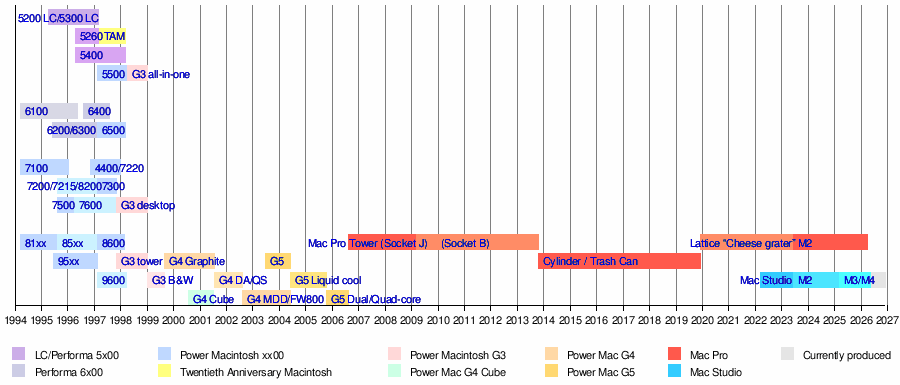
| Timeline of Power Macintosh, Pro, and Studio models |
|---|
 |
Explanatory notes
Notes
Notes
References
References
- Miller, Chance (March 26, 2026). "Apple discontinues the Mac Pro with no plans for future hardware". 9to5Mac. Retrieved March 26, 2026.
- ""This Is Not a Product": The Apple Developer Transition Kit". January 16, 2019. Archived from the original on November 10, 2020. Retrieved June 25, 2020.
- Smith, Kevin (June 9, 2012). "The Best Products Apple Has Ever Announced At Its Annual Summer Developers Conference". Business Insider Australia. Archived from the original on March 25, 2021. Retrieved January 22, 2020.
- Bangeman, Eric (August 10, 2006). "Mac Pro review". Ars Technica. Retrieved April 20, 2026.
- Seff, Jonathan; Snell, Jason (October 2006). "Macbeat; Mac Pro FAQs". Macworld. pp. 18–20. Archived from the original on August 10, 2006.
- Hattersly, Lucy (July 10, 2007). "Mac Pro 8-core (2007) Review". Macworld. Retrieved April 24, 2026.
- https://arstechnica.com/gadgets/2008/02/mac-pro-2g-review/
- https://arstechnica.com/gadgets/2009/04/266ghz-8-core-mac-pro-review/
- Chris Foresman, "Mac Pro gets minor update with standard 12-core option, no Xeon E5" Archived May 27, 2016, at the Wayback Machine, ArsTechnica, June 11, 2012
- Jordan Kahn, "Andy Hertzfield: The only thing that's still high-end about Mac Pro is the bloated price" Archived October 29, 2013, at the Wayback Machine, 9to5 Mac, June 11, 2012
- Haslam, Karen (January 13, 2013). "Apple confirms it will cease shipping Mac Pro in Europe on 1 March". MacWorld. Archived from the original on February 3, 2013.
- "Mac Pro review, 9 out of 10". Ars Technica. August 11, 2006. Archived from the original on March 12, 2017. Retrieved June 14, 2017.
- Brown, Rich. "Apple Mac Pro Dual-Core Xeon 5150 2.66 GHz review". CNET. Archived from the original on December 19, 2019. Retrieved January 22, 2020.
- Wherry, Mark. "Apple Mac Pro". www.soundonsound.com. Archived from the original on May 12, 2021. Retrieved January 22, 2020.
- Danaher, Tim (November 6, 2006). "Architosh: Feature Product Review: Apple Mac Pro". www.architosh.com. Archived from the original on August 8, 2020. Retrieved January 22, 2020.
- "Mac Pro – Technical Specifications". Apple Inc. Archived from the original on February 17, 2015. Retrieved March 3, 2009.
- "Mac Pro (Early 2008) – Technical Specifications". Apple Inc. Archived from the original on February 18, 2015. Retrieved March 3, 2009.
- "Mac Pro (Early 2009) – Technical Specifications". Apple Inc. Archived from the original on February 17, 2015. Retrieved March 3, 2009.
- "Mac Pro (Mid 2010) – Technical Specifications". Apple Inc. Archived from the original on August 19, 2010. Retrieved July 27, 2010.
- "Mac Pro (Mid 2012) – Technical Specifications". Apple Inc. Archived from the original on February 17, 2015. Retrieved July 28, 2012.
- "Apple Unveils New Mac Pro Featuring Quad 64-bit Xeon Processors". Apple. August 7, 2006. Archived from the original on January 15, 2021. Retrieved December 4, 2017.
- "Apple Introduces New Mac Pro". Apple. January 8, 2008. Archived from the original on December 5, 2017. Retrieved December 4, 2017.
- "Apple Introduces New Mac Pro". Apple. March 3, 2009. Archived from the original on December 5, 2017. Retrieved December 4, 2017.
- "Apple Unveils New Mac Pro With Up to 12 Processing Cores". Apple. July 27, 2010. Archived from the original on December 5, 2017. Retrieved December 4, 2017.
- Wireless-N functionality requires installing the wireless-N enabler software included with the AirPort Extreme Wireless-N Router or sold as a download on the Apple online store, or by upgrading to OS X 10.5 "Leopard" or later.
- "How to Install PCI Express Card (Mac Pro Models): EveryMac.com". everymac.com. Archived from the original on June 15, 2023. Retrieved June 7, 2023.
- Apple introduces macOS Mojave Archived June 5, 2018, at the Wayback Machine. Apple.
- Rodriguez, Salvador (June 12, 2012). "Apple CEO Tim Cook emails customer, promises 2013 Mac pro update". Los Angeles Times. Retrieved April 1, 2026.
- Cunningham, Andrew (June 10, 2013). "At long last! Apple announces new Mac Pro with cylindrical design". Archived from the original on June 13, 2013. Retrieved June 10, 2013.
- "Engadget gets a glimpse of the new Mac Pro". Engadget. June 11, 2013. Archived from the original on November 3, 2019. Retrieved November 3, 2019.
- Frakes, Dan (March 2014). "MacUser; New Mac Pro Really Is For Pros". Macworld. pp. 12–16.
- "Mac Pro — Tech Specs". Apple.com. Cupertino, California: Apple, Inc. Archived from the original on September 13, 2014. Retrieved September 14, 2014.
- "Mac Pro (Late 2013): Installing or replacing memory". Apple Support. Apple. October 17, 2019. Archived from the original on June 9, 2020. Retrieved June 9, 2020.
- "Mac Pro (Late 2013): Removing and installing flash storage". Apple Support. Apple. October 17, 2019. Archived from the original on June 9, 2020. Retrieved June 9, 2020.
- TP1074: Mac Pro (Late 2013): General Take Apart Information. Apple.
- Mac Pro (Late 2013): Screw Chart. Apple.
- TP1074: Mac Pro (Late 2013): General Take Apart Information. Apple.
- "iFixit Mac Pro Late 2013 Teardown" Archived January 4, 2014, at the Wayback Machine, iFixit
- "OWC Confirms Mac Pro 2013 Processor Upgradeable" Archived January 6, 2014, at the Wayback Machine, Other World Computing, January 3, 2014
- "Mac Pro (Late 2013) – Memory specifications – Apple Support". Apple. December 23, 2013. Archived from the original on February 4, 2023. Retrieved November 7, 2014.
- "Mac Pro (Late 2013) – Installing or replacing memory – Apple Support". Apple. September 4, 2014. Archived from the original on February 4, 2023. Retrieved November 7, 2014.
- Cheng, Roger. "A US-made Mac Pro is a token gesture". CNET. CBS Interactive Inc. Archived from the original on November 2, 2020. Retrieved November 7, 2014.
- McGee, Patrick (2026). Apple in China: The Capture of the World's Greatest Company. Scribner. pp. 345–347. ISBN 978-1-6680-5338-6.
- Wiggins, Peter. "The first 24 hours with Apple's new Mac Pro and Final Cut Pro 10.1". Archived from the original on June 2, 2018. Retrieved April 18, 2018.
- Dan Ackerman, "Apple's radically remained Mac Pro is a powerhouse performer" Archived January 27, 2014, at the Wayback Machine, cnet, December 20, 2013
- Jonathan Bray, "Mac Pro (late 2013) review" Archived January 24, 2014, at the Wayback Machine, PC Pro UK, January 24, 2014
- Byford, Sam. "The Mac Pro hasn't been updated in 1,000 days". The Verge. Archived from the original on February 22, 2017. Retrieved February 21, 2017.
- Smith, Ryan (April 4, 2017). "Apple to Redesign Mac Pro, Comments that GPU Cooling was a Roadblock". Anandtech. Archived from the original on April 4, 2017. Retrieved April 4, 2017.
- Mickle, Trip (2022). After Steve: How Apple Became a Trillion-Dollar Company and Lost Its Soul. HarperCollins. p. 163. ISBN 978-0-06-300983-7.
- "Apple Launches Repair Program for Late 2013 Mac Pro Video Issues". MacRumors. February 5, 2016. Archived from the original on June 9, 2020. Retrieved June 9, 2020.
- "2013 Mac Pro Freezes Continue – Owners Have Little Recourse – Apple is Helpless". the Mac Observer. June 1, 2016. Archived from the original on June 9, 2020. Retrieved June 9, 2020.
- "Mac Pro GPU Dual AMD FirePro D700 with Premiere". Adobe Support Community. Adobe. December 20, 2013. Archived from the original on June 9, 2020. Retrieved June 9, 2020.
- "Mac Pro with D500 and D700 overheating on exports". Reduser. Landmine Media, LLC. Archived from the original on June 9, 2020. Retrieved June 9, 2020.
- "Apple admits the Mac Pro was a mess". The Verge. April 4, 2017. Archived from the original on October 7, 2021. Retrieved December 13, 2017.
- "The Japanese Garbage Can That Inspired Apple's New Mac Pro [Humor] – Cult of Mac". June 13, 2013. Archived from the original on April 6, 2018. Retrieved April 18, 2018.
- "MacRumors Buyer's Guide: Know When to Buy iPhone, Mac, iPad". buyersguide.macrumors.com. Archived from the original on May 5, 2022. Retrieved December 11, 2019.
- "Mac Pro (Late 2013) - Technical Specifications". Apple Inc. Retrieved April 1, 2026.
- Patel, Nilay (June 13, 2013), 'Can't innovate anymore, my ass': Apple's bravado clouds the company's real challenges, archived from the original on April 19, 2022, retrieved April 19, 2022
- "All New Mac Pro Available Starting Tomorrow". Apple. December 18, 2013. Archived from the original on December 5, 2017. Retrieved December 4, 2017.
- "New Mac Pro 2013 Teardown". Other World Computing Blog. December 27, 2013. Archived from the original on April 10, 2019. Retrieved April 10, 2019.
- "Transcend Releases DDR3 RDIMM Modules to Maximize Mac Pro Memory up to 128 GB". Archived from the original on April 19, 2018. Retrieved April 18, 2018.
- "Apple's 2019 Mac Pro will be shaped by workflows". techcrunch.com. April 5, 2018. Archived from the original on April 5, 2018. Retrieved April 5, 2018.
- "Apple unveils powerful, all-new Mac Pro and groundbreaking Pro Display XDR" (Press release). Apple Inc. June 3, 2019. Archived from the original on June 6, 2019. Retrieved June 6, 2019.
- "Mac Pro". Archived from the original on May 19, 2022. Retrieved August 19, 2014.
- "You'll need Apple's help to install wheels on your new Mac Pro". iMore. December 11, 2019. Archived from the original on December 14, 2019. Retrieved December 13, 2019.
- "Mac Pro 2019 Teardown". iFixit. December 17, 2019. Archived from the original on March 30, 2021. Retrieved December 17, 2019.
- "Lights Out Management MDM payload settings for Apple devices". Apple Support (in Japanese). Archived from the original on November 7, 2021. Retrieved November 7, 2021.
- Kubota, Tripp Mickle and Yoko (June 28, 2019). "Apple Moves Mac Pro Production to China". Wall Street Journal. Archived from the original on November 22, 2019. Retrieved November 23, 2019.
- Kastrenakes, Jacob (September 23, 2019). "Apple will make its new Mac Pro in the US". The Verge. Archived from the original on November 23, 2019. Retrieved November 23, 2019.
- "Mac Pro in retail packaging spotted at Austin factory [u]". AppleInsider. November 20, 2019. Archived from the original on November 23, 2019. Retrieved November 23, 2019.
- "Mac Pro Now Starts With 512 GB of Storage and Radeon Pro W5500X Graphics". MacRumors. March 9, 2022. Archived from the original on March 9, 2022. Retrieved March 9, 2022.
- Kamps, Haje Jan (June 5, 2023). "Apple surprise-launches new Mac Pro with Apple Silicon". TechCrunch. Archived from the original on July 18, 2023. Retrieved June 5, 2023.
- Potuck, Michael (June 18, 2019). "Hands-on photos explore G4 Cube and the likely origin of the Mac Pro lattice design". 9to5Mac. Archived from the original on February 4, 2023. Retrieved November 2, 2019.
- "Why YouTubers MKBHD and iJustine Got the First Sneak Peek at the New Mac Pro". Fortune. Archived from the original on December 13, 2019. Retrieved December 13, 2019.
- "Install or replace SSD modules in your Mac Pro (2019)". Apple Support. June 23, 2020. Archived from the original on February 4, 2023. Retrieved May 19, 2022.
- "Mac Pro – Technical Specifications". Apple Inc. Archived from the original on July 28, 2022. Retrieved June 6, 2019.
- "Apple introduces 16-inch MacBook Pro, the world's best pro notebook". Apple Newsroom. Archived from the original on November 13, 2019. Retrieved November 13, 2019.
- Mayo, Benjamin (October 30, 2019). "The new Mac Pro gets FCC approval ahead of launch". 9to5Mac. Archived from the original on November 1, 2019. Retrieved November 1, 2019.
- Owen, Malcolm (December 9, 2019). "Apple gets FCC approval for Mac Pro tower, and rack-mount version". AppleInsider. Archived from the original on December 15, 2019. Retrieved December 15, 2019.
- Apple's new Mac Pro internal components – answers and lingering questions Archived November 7, 2020, at the Wayback Machine. Apple Insider. 4 June 2019.
- "Install PCIe cards in your Mac Pro (2019)". Apple Support. January 18, 2022. Retrieved June 7, 2023.
- Joseph, Jibin (June 10, 2025). "Apple Confirms End of Support for Intel Macs After macOS Tahoe". PCMAG. Retrieved May 12, 2026.
- "Apple Silicon Mac Pro does not support PCI-E video cards". AppleInsider. June 5, 2023. Retrieved June 6, 2023.
- "Apple unveils new Mac Studio and brings Apple silicon to Mac Pro". Apple Newsroom. Archived from the original on June 6, 2023. Retrieved June 5, 2023.
- "New Mac Pro Features Upgradeable SSD, Apple Selling 2TB, 4TB, and 8TB SSD Kits". MacRumors. June 5, 2023. Archived from the original on June 8, 2023. Retrieved June 7, 2023.
- Athow, Desire (June 12, 2023). "Here's why the 2023 Mac Pro doesn't have a discrete GPU". TechRadar. Retrieved June 24, 2023.
- "Apple Scales Back High-End Mac Pro Plans, Weighs Production Move to Asia". Bloomberg.com. December 18, 2022. Retrieved June 7, 2023.
- Chin, Monica (June 27, 2023). "Which professionals is the Mac Pro for? We couldn't find them". The Verge. Archived from the original on August 23, 2023. Retrieved July 1, 2023.
- Why Does the M2 Mac Pro Exist?, June 28, 2023, retrieved July 2, 2023
- "Mac Pro (2023) - Tech Specs". Apple, Inc. Retrieved April 1, 2026.
- "Product Environmental Report Mac Pro (2023)" (PDF). Apple. June 5, 2023. Retrieved August 3, 2024.
- "Mac Pro page at Apple's online store". Apple Inc. Archived from the original on December 19, 2011. Retrieved December 19, 2011.
- Robinson, Blake (November 5, 2010). "Apple Announces Mac Pro Server". Mashable. Archived from the original on July 1, 2013. Retrieved June 28, 2013.
- "OS X Server". Archived from the original on November 25, 2014. Retrieved January 10, 2014.
- "About macOS Server 5.7.1 and later – Apple Support (UK)". Apple Support. Retrieved March 20, 2026.
- Gartenberg, Chaim (January 14, 2020). "Apple's rack-mounted Mac Pro variant is now available to order". www.theverge.com. Vox Media. Archived from the original on February 15, 2020. Retrieved March 8, 2020.
- Bazoge, Mickaël (January 14, 2020). "Le Mac Pro format rack est disponible à partir de 7 199 €". MacGeneration (in French). Archived from the original on October 26, 2023. Retrieved October 17, 2023.
- Axon, Samuel (June 5, 2023). "This is the new Apple Silicon Mac Pro". Ars Technica. Retrieved October 17, 2023.
- Cunningham, Andrew (March 5, 2025). "Apple intros new Mac Studio models with M4 Max and… M3 Ultra?". Ars Technica. Retrieved March 5, 2025.
- Hall, Zac (March 5, 2025). "M3 Ultra gives Mac Studio a speed boost, but not the Mac Pro". 9to5Mac.
- Miller, Chance (November 16, 2025). "Apple has no plans to release a new Mac Pro anytime soon, report says". 9to5Mac.
- Gurman, Mark (March 26, 2026). "Apple Discontinues Mac Pro Desktop in Favor of Mac Studio". Bloomberg News.
- Lawler, Richard (March 26, 2026). "Apple's Mac Pro is dead, apparently for good this time". The Verge.
- Cunningham, Andrew (March 27, 2026). "Apple pulls the plug on its high-priced, oft-neglected Mac Pro desktop". Ars Technica.
- Campbell, Ian Carlos (March 26, 2026). "Apple discontinues the Mac Pro". Engadget.
- Arment, Marco; Liss, Casey; Siracusa, John (April 1, 2026). "685: The Ability to Be Hotter". Accidental Tech Podcast (Podcast). Event occurs at 1:10:00-1:14:00. Retrieved April 24, 2026.
{{cite podcast}}: CS1 maint: multiple names: authors list (link)