| Lycaste | |
|---|---|
| |
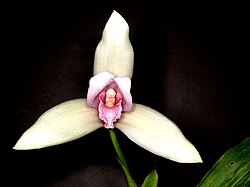
| Lycaste skinneri | |
Scientific classification 
| |
| Kingdom: | Plantae |
| Clade: | Embryophytes |
| Clade: | Tracheophytes |
| Clade: | Spermatophytes |
| Clade: | Angiosperms |
| Clade: | Monocots |
| Order: | Asparagales |
| Family: | Orchidaceae |
| Subfamily: | Epidendroideae |
| Tribe: | Cymbidieae |
| Subtribe: | Maxillariinae |
| Genus: | Lycaste Lindl., 1843 |
| Species | |
|
See text | |
| Synonyms1 | |
| |
Lycaste, abbreviated as Lyc. in horticultural trade, is a genus of orchids that contains about 30 species with egg-shaped pseudobulbs and thin, plicate (pleated) leaves.
Description
Lycaste flowers, like all orchid blooms, have three petals and three sepals. The petals are typically yellow, white, or orange, and the sepals are yellow, orange, green, or reddish brown. The petals and sepals may be marked sparsely or densely with red, reddish purple, purple, or reddish brown spots. The lip (ventral petal) may be very similar to the other two petals, as in Lycaste aromatica or Lycaste brevispatha, or colored quite distinctively, as in several subspecies and varieties of Lycaste macrophylla. Most Lycaste flowers are medium in size, averaging about 5 to 10 cm, but Lycaste schilleriana is 16–18 cm across. Some Lycaste blooms have a unique fragrance - the scent of Lycaste aromatica has been variously described as cinnamon or clove. The blooms of the species Lycaste cochleata, Lycaste consobrina, and Lycaste cruenta also have a pleasant scent.
Taxonomy
The World Checklist of Selected Plant Families, maintained by the Royal Botanic Gardens at Kew, is recognized by the American Orchid Society as the definitive authority on orchid taxonomy. The Checklist currently acknowledges 31 species of Lycaste, 3 natural hybrids, 2 subspecies (and 1 nominate subspecies), and 1 variety. Orchid growers and orchid collectors, who tend to be taxonomic splitters more often than lumpers, recognize additional subspecies and varieties of Lycaste, as well as alba (white) forms of several species.
Sections
The Lycastes are divided into four sections and two subsections:
- Section Deciduosae - deciduous, that is, they usually lose their leaves during an annual dormant period
- Subsection Xanthanthae - have yellow to orange blooms; the name comes from xantho (yellow) and anthos (flower)
- Subsection Paradeciduosae - have pink-marked white blooms; the name comes from para (similar or near) and deciduosae (deciduous)
- Section Longisepalae - has very long sepals
- Section Macrophyllae - keep their leaves during dormancy; the name comes from macro (large) and phyllae (leaves)
- Section Fimbriatae - typically have fringed lips
All but two of the Deciduosae have spines at the apices of their pseudobulbs, that become exposed when the leaves are dropped. The exceptions are the Xanthanthae species Lycaste lasioglossa and the Paradeciduosae species Lycaste tricolor. Both of these species lack spines, and may bloom when leaves are still present.
List of species by section
As of March 2026, Plants of the World Online accepted the following species:2
| Section | Image | Name | Distribution | Elevation (m) |
|---|---|---|---|---|
| Section Deciduosae | 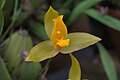 |
Lycaste aromatica (Graham ex Hooker) Lindley 1843 | Mexico, Guatemala, Nicaragua, Honduras and El Salvador | 500–2,000 metres (1,600–6,600 ft) |
| Lycaste bermudezii (Archila) J.M.H.Shaw 2014 | Guatemala | |||
 |
Lycaste bradeorum Schltr. 1923 | Guatemala, El Salvador, Honduras, Nicaragua and Costa Rica | 700–1,250 metres (2,300–4,100 ft) | |
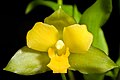 |
Lycaste campbelli C. Schweinf. 1949 | Colombia (Choco, Antioquia) | ||
| Lycaste chaconii (Archila) J.M.H.Shaw 2014 | Guatemala | |||
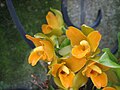 |
Lycaste cochleata Lindl. & Paxton 1850-1 | Mexico, Guatemala, El Salvador, Honduras and Nicaragua | ||
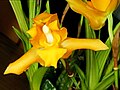 |
Lycaste consobrina Rchb.f 1852 | Mexico, Guatemala and Nicaragua | 200–1,000 metres (660–3,280 ft) | |
 |
Lycaste crinita Lindl. 1844 | Mexico (Nayarit, Jalisco, Michoacan, Guerrero, and Oaxaca ) | 300–1,700 metres (980–5,580 ft) | |
 |
Lycaste cruenta Lindl. 1843 | Mexico, Guatemala, Costa Rica and El Salvador | 1,800–2,200 metres (5,900–7,200 ft) | |
 |
Lycaste deppei (Lodd.)Lindley 1843 | Mexico (Tamaulipas, Puebla, Vera Cruz, Oaxaca and Chiapas), Guatemala, El Salvador, Honduras and Nicaragua | 1,100–1,700 metres (3,600–5,600 ft) | |
 |
Lycaste lasioglossa Rchb. f. 1872 | Guatemala, El Salvador, Honduras | 1,400–1,800 metres (4,600–5,900 ft) | |
 |
Lycaste macrobulbon Lindl. 1850-1 | Colombia, Venezuela, Brazil | 1,200–2,000 metres (3,900–6,600 ft) | |
| Lycaste angelae Oakley 2008 | Costa Rica, Panama | 1,000–1,700 metres (3,300–5,600 ft) | ||
 |
Lycaste brevispatha (Klotzsch) Lindl. & Paxton 1852 | Costa Rica, Nicaragua, Panama | 800–1,800 metres (2,600–5,900 ft) | |
| Lycaste luminosa Oakley 1991 | Central America | |||
| Lycaste suaveolens Summerh. 1931 | Mexico, Guatemala, Honduras, El Salvador and Nicaragua | 600–1,800 metres (2,000–5,900 ft) | ||
 |
Lycaste tricolor Rchb. f. 1863 | Costa Rica, Panama | 600–1,000 metres (2,000–3,300 ft) | |
| Section Lycaste | Lycaste annakamilae Archila, Szlachetko & Chiron 2015 | Guatemala (Purulha, Baja Verapaz,) | 1,200 metres (3,900 ft) | |
| Lycaste bruncana Bogarín 2007 | Costa Rica, Panama | 100–400 metres (330–1,310 ft) | ||
 |
Lycaste dowiana Endr. & Rchb.f. 1874 | Nicaragua, Costa Rica and Panama | 700–1,400 metres (2,300–4,600 ft) | |
| Lycaste fuscina Oakeley 2008 | Venezuela, Ecuador | |||
| Lycaste guatemalensis Archila 1999 | Guatemala, Honduras, El Salvador | 1,000–1,700 metres (3,300–5,600 ft) | ||
| Lycaste leucantha (Klotsch) Lindl. 1851 | Guatemala, Costa Rica, Panama | 600–2,000 metres (2,000–6,600 ft) | ||
 |
Lycaste macrophylla (Poepp. & Endl.) Lindl. 1842 | Costa Rica, Panama, Colombia, Ecuador, Peru, Bolivia and Venezuela | 400–2,400 metres (1,300–7,900 ft) | |
| Lycaste measuresiana (B.S.Williams) Oakeley 2007 | Nicaragua, Costa Rica, Colombia, Venezuela | 1,100–1,600 metres (3,600–5,200 ft) | ||
| Lycaste occulta Oakeley 2007 | Venezuela, Colombia, Ecuador | 2,600 metres (8,500 ft) | ||
| Lycaste panamanensis (Fowlie) Archila 2002 publ. 2008 | Colombia, Costa Rica, Panamá | 1,000 metres (3,300 ft) | ||
 |
Lycaste powellii Schltr. 1922 | Panama, Colombia | 50–800 metres (160–2,620 ft) | |
 |
Lycaste puntarenasensis (Fowlie) Oakeley 2007 | Costa Rica, Panama | 1,000 metres (3,300 ft) | |
| Lycaste sebastianii Archila 2011 | Guatemala (Alta Verapaz ) | 600–700 metres (2,000–2,300 ft) | ||
| Lycaste viridescens (Oakeley) Oakeley 2007 | Peru | |||
 |
Lycaste virginalis Scheidw.) Linden 1888 | Mexico, Guatemala, Honduras and El Salvador | 1,200–1,800 metres (3,900–5,900 ft) | |
| Lycaste xanthocheila (Fowlie) Archila 2002 publ. 2008 | Guatemala, Costa Rica | 800 metres (2,600 ft) | ||
 |
Lycaste xytriophora Linden & Rchb. f. 1872 | Costa Rica, Panama, Colombia (El Choco) and Ecuador | 600–1,800 metres (2,000–5,900 ft) | |
| Lycaste zacapana Archila 2010 | Guatemala (Alta Verapaz ) | 350–400 metres (1,150–1,310 ft) |
Natural hybrids
- Lycaste × groganii (Lycaste aromatica × Lycaste deppei)
- Lycaste × michelii (Lycaste cochleata × Lycaste lasioglossa)
- Lycaste × smeeana (Lycaste deppei × Lycaste skinneri)
Hybrids
- Angulocaste (Anguloa × Lycaste)
- Cochlecaste (Cochleanthes × Lycaste)
- Colaste (Colax × Lycaste)
- Lycasteria (Bifrenaria × Lycaste)
- Lycida (Ida × Lycaste)
- Maxillacaste (Lycaste × Maxillaria)
- Zygocaste (Lycaste × Zygopetalum)
A 2002 revision of the Lycaste genus moved many species of the section Fimbriatae to a new genus, Ida. The 34 species of Ida occur in South America and the Caribbean Islands (Ida barringtoniae), while true Lycastes occur mostly in Mexico and Central America. The genus Ida is recognized by the World Checklist of Monocotyledons.
References
References
- "Lycaste". World Checklist of Selected Plant Families (WCSP). Royal Botanic Gardens, Kew. Archived from the original on September 28, 2022.
- "Lycaste virginalis (Scheidw.) Linden". Plants of the World Online. 2017-03-23. Retrieved 2026-03-29.
- Well-written web site by Phil Tomlinson on Lycastes and the closely related genus Anguloa; the Lycaste information is based largely on the 1970 monograph by Dr. J. A. Fowlie.
- WCSP (2011), World Checklist of Selected Plant Families, Royal Botanic Gardens, Kew, retrieved 2011-10-23, search for "Lycaste"
- Fowlie, J. A., 1970: The Genus Lycaste; privately printed
- Dr. Henry F. Oakeley, 1993 : Lycaste Species: The Essential Guide
- Dr. Henry F. Oakeley, 2008 : Lycaste, Ida and Anguloa: The Essential Guide
- A.F.W. (Fred) Alcorn and Michael S. Hallett, 1993. Lycaste orchids : cultivation and hybridisation
External links
External links
- Media related to Lycaste at Wikimedia Commons
- Data related to Lycaste at Wikispecies
- Lycaste
- American Orchid Society culture sheet for Lycaste