 | |
 | |
| Clinical data | |
|---|---|
| Other names | 4-Hydroxy-N-methyl-(α,N-trimethylene)tryptamine; Lucigenol |
| ATC code |
|
| Legal status | |
| Legal status | |
| Identifiers | |
| |
| CAS Number | |
| PubChem CID | |
| ChemSpider |
|
| UNII | |
| CompTox Dashboard (EPA) | |
| Chemical and physical data | |
| Formula | C14H17N2O |
| Molar mass | 229.303 g·mol−1 |
| 3D model (JSmol) | |
| |
| |
 N N Y (what is this?) (verify) Y (what is this?) (verify) | |
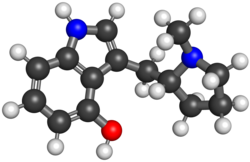
4-HO-MPMI, also known as 4-hydroxy-N-methyl-(α,N-trimethylene)tryptamine or as lucigenol, is a psychedelic drug of the pyrrolidinylmethylindole and cyclized tryptamine families.1
Interactions
Pharmacology
Pharmacodynamics

The affinity (Ki) of 4-HO-MPMI for the serotonin 5-HT2A receptor has been found to be 13 nM.1 It produces psychedelic-appropriate responding in animal tests with similar potency as DOI.1 The drug has two enantiomers, with only the (R)-enantiomer being active.1
Chemistry
Analogues
Analogues of 4-HO-MPMI include MPMI, 5-MeO-MPMI, 5F-MPMI, CP-135,807, 4-HO-McPeT, 4-HO-pyr-T, and SN-22, among others.
History
4-HO-MPMI was developed by the team led by David E. Nichols from Purdue University in the late 1990s.1
Society and culture
Legal status
Canada
4-HO-MPMI is not a controlled substance in Canada as of 2025.2
References
References
- Gerasimov M, Marona-Lewicka D, Kurrasch-Orbaugh DM, Qandil AM, Nichols DE (1999). "Further studies on oxygenated tryptamines with LSD-like activity incorporating a chiral pyrrolidine moiety into the side chain". Journal of Medicinal Chemistry. 42 (20): 4257–4263. CiteSeerX 10.1.1.690.4941. doi:10.1021/jm990325u. PMID 10514296.
- "Controlled Drugs and Substances Act". Department of Justice Canada. Retrieved 19 January 2026.