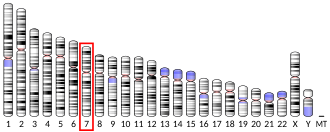
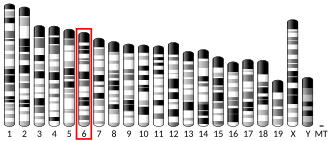
U6 snRNA-associated Sm-like protein LSm8 is a protein that in humans is encoded by the LSM8 gene.56
This gene is a member of the LSm family and encodes a protein with a closed barrel shape, made up of five anti-parallel beta strands and an alpha helix. The protein partners with six paralogs to form a heteroheptameric ring which transiently binds RNAs and is involved in the general maturation of RNA in the nucleus.6
Interactions
LSM8 has been shown to interact with LSM2.78
References
References
- GRCh38: Ensembl release 89: ENSG00000128534 – Ensembl, May 2017
- GRCm38: Ensembl release 89: ENSMUSG00000044155 – Ensembl, May 2017
- "Human PubMed Reference:". National Center for Biotechnology Information, U.S. National Library of Medicine.
- "Mouse PubMed Reference:". National Center for Biotechnology Information, U.S. National Library of Medicine.
- Achsel T, Brahms H, Kastner B, Bachi A, Wilm M, Luhrmann R (Dec 1999). "A doughnut-shaped heteromer of human Sm-like proteins binds to the 3'-end of U6 snRNA, thereby facilitating U4/U6 duplex formation in vitro". EMBO J. 18 (20): 5789–802. doi:10.1093/emboj/18.20.5789. PMC 1171645. PMID 10523320.
- "Entrez Gene: LSM8 LSM8 homolog, U6 small nuclear RNA associated (S. cerevisiae)".
- Lehner, Ben; Sanderson Christopher M (Jul 2004). "A protein interaction framework for human mRNA degradation". Genome Res. 14 (7): 1315–23. doi:10.1101/gr.2122004. ISSN 1088-9051. PMC 442147. PMID 15231747.
- Lehner, Ben; Semple Jennifer I; Brown Stephanie E; Counsell Damian; Campbell R Duncan; Sanderson Christopher M (Jan 2004). "Analysis of a high-throughput yeast two-hybrid system and its use to predict the function of intracellular proteins encoded within the human MHC class III region". Genomics. 83 (1): 153–67. doi:10.1016/S0888-7543(03)00235-0. ISSN 0888-7543. PMID 14667819.
Further reading
Further reading
- Khusial P, Plaag R, Zieve GW (2005). "LSm proteins form heptameric rings that bind to RNA via repeating motifs". Trends Biochem. Sci. 30 (9): 522–8. doi:10.1016/j.tibs.2005.07.006. PMID 16051491.
- Bonaldo MF, Lennon G, Soares MB (1997). "Normalization and subtraction: two approaches to facilitate gene discovery". Genome Res. 6 (9): 791–806. doi:10.1101/gr.6.9.791. PMID 8889548.
- Sanger Centre, The; Washington University Genome Sequencing Cente, The (1999). "Toward a complete human genome sequence". Genome Res. 8 (11): 1097–108. doi:10.1101/gr.8.11.1097. PMID 9847074.
- Salgado-Garrido J, Bragado-Nilsson E, Kandels-Lewis S, Séraphin B (1999). "Sm and Sm-like proteins assemble in two related complexes of deep evolutionary origin". EMBO J. 18 (12): 3451–62. doi:10.1093/emboj/18.12.3451. PMC 1171424. PMID 10369684.
- Eystathioy T, Peebles CL, Hamel JC, et al. (2002). "Autoantibody to hLSm4 and the heptameric LSm complex in anti-Sm sera". Arthritis Rheum. 46 (3): 726–34. doi:10.1002/art.10220. PMID 11920408.
- Strausberg RL, Feingold EA, Grouse LH, et al. (2003). "Generation and initial analysis of more than 15,000 full-length human and mouse cDNA sequences". Proc. Natl. Acad. Sci. U.S.A. 99 (26): 16899–903. Bibcode:2002PNAS...9916899M. doi:10.1073/pnas.242603899. PMC 139241. PMID 12477932.
- Scherer SW, Cheung J, MacDonald JR, et al. (2003). "Human chromosome 7: DNA sequence and biology". Science. 300 (5620): 767–72. Bibcode:2003Sci...300..767S. doi:10.1126/science.1083423. PMC 2882961. PMID 12690205.
- Hillier LW, Fulton RS, Fulton LA, et al. (2003). "The DNA sequence of human chromosome 7". Nature. 424 (6945): 157–64. Bibcode:2003Natur.424..157H. doi:10.1038/nature01782. PMID 12853948.
- Lehner B, Semple JI, Brown SE, et al. (2004). "Analysis of a high-throughput yeast two-hybrid system and its use to predict the function of intracellular proteins encoded within the human MHC class III region". Genomics. 83 (1): 153–67. doi:10.1016/S0888-7543(03)00235-0. PMID 14667819.
- Lehner B, Sanderson CM (2004). "A protein interaction framework for human mRNA degradation". Genome Res. 14 (7): 1315–23. doi:10.1101/gr.2122004. PMC 442147. PMID 15231747.
- Gerhard DS, Wagner L, Feingold EA, et al. (2004). "The status, quality, and expansion of the NIH full-length cDNA project: the Mammalian Gene Collection (MGC)". Genome Res. 14 (10B): 2121–7. doi:10.1101/gr.2596504. PMC 528928. PMID 15489334.
- Kimura K, Wakamatsu A, Suzuki Y, et al. (2006). "Diversification of transcriptional modulation: large-scale identification and characterization of putative alternative promoters of human genes". Genome Res. 16 (1): 55–65. doi:10.1101/gr.4039406. PMC 1356129. PMID 16344560.