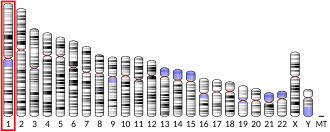
Loricrin is a protein that in humans is encoded by the LOR gene.345
Function
Loricrin is a major protein component of the cornified cell envelope found in terminally differentiated epidermal cells.5
Loricrin is expressed in the granular layer of all keratinized epithelial cells of mammals tested including oral, esophageal and stomach mucosa of rodents, tracheal squamous metaplasia of vitamin A deficient hamster and estrogen induced squamous vaginal epithelium of rats.6
Clinical significance
Mutations in the LOR gene are associated with Vohwinkel's syndrome and Camisa disease, both inherited skin diseases.
See also
See also
References
References
- GRCh38: Ensembl release 89: ENSG00000203782 – Ensembl, May 2017
- "Human PubMed Reference:". National Center for Biotechnology Information, U.S. National Library of Medicine.
- Hohl D, Mehrel T, Lichti U, Turner ML, Roop DR, Steinert PM (May 1991). "Characterization of human loricrin. Structure and function of a new class of epidermal cell envelope proteins". J Biol Chem. 266 (10): 6626–36. doi:10.1016/S0021-9258(18)38163-8. PMID 2007607.
- Yoneda K, Hohl D, McBride OW, Wang M, Cehrs KU, Idler WW, Steinert PM (Oct 1992). "The human loricrin gene". J Biol Chem. 267 (25): 18060–6. doi:10.1016/S0021-9258(19)37152-2. PMID 1355480.
- "Entrez Gene: LOR loricrin".
- Hohl D, Ruf Olano B, de Viragh PA, Huber M, Detrisac CJ, Schnyder UW, Roop DR (1993). "Expression patterns of loricrin in various species and tissues". Differentiation. 54 (1): 25–34. doi:10.1111/j.1432-0436.1993.tb01585.x. PMID 8405772.
Further reading
Further reading
- Ishida-Yamamoto A, Takahashi H, Iizuka H (1998). "Loricrin and human skin diseases: molecular basis of loricrin keratodermas". Histol. Histopathol. 13 (3): 819–26. PMID 9690138.
- Ishida-Yamamoto A (2003). "Loricrin keratoderma: a novel disease entity characterized by nuclear accumulation of mutant loricrin". J. Dermatol. Sci. 31 (1): 3–8. doi:10.1016/S0923-1811(02)00143-3. PMID 12615358.
- Candi E, Melino G, Mei G, et al. (1995). "Biochemical, structural, and transglutaminase substrate properties of human loricrin, the major epidermal cornified cell envelope protein". J. Biol. Chem. 270 (44): 26382–90. doi:10.1074/jbc.270.44.26382. PMID 7592852.
- Yoneda K, Steinert PM (1993). "Overexpression of human loricrin in transgenic mice produces a normal phenotype". Proc. Natl. Acad. Sci. U.S.A. 90 (22): 10754–8. Bibcode:1993PNAS...9010754Y. doi:10.1073/pnas.90.22.10754. PMC 47856. PMID 8248167.
- Ishida-Yamamoto A, Hohl D, Roop DR, et al. (1994). "Loricrin immunoreactivity in human skin: localization to specific granules (L-granules) in acrosyringia". Arch. Dermatol. Res. 285 (8): 491–8. doi:10.1007/BF00376822. PMID 8274037. S2CID 9857068.
- Maestrini E, Monaco AP, McGrath JA, et al. (1996). "A molecular defect in loricrin, the major component of the cornified cell envelope, underlies Vohwinkel's syndrome". Nat. Genet. 13 (1): 70–7. doi:10.1038/ng0596-70. PMID 8673107. S2CID 9108586.
- Steinert PM, Marekov LN (1997). "Direct evidence that involucrin is a major early isopeptide cross-linked component of the keratinocyte cornified cell envelope". J. Biol. Chem. 272 (3): 2021–30. doi:10.1074/jbc.272.3.2021. PMID 8999895.
- Ishida-Yamamoto A, McGrath JA, Lam H, et al. (1997). "The molecular pathology of progressive symmetric erythrokeratoderma: a frameshift mutation in the loricrin gene and perturbations in the cornified cell envelope". Am. J. Hum. Genet. 61 (3): 581–9. doi:10.1086/515518. PMC 1715943. PMID 9326323.
- Korge BP, Ishida-Yamamoto A, Pünter C, et al. (1997). "Loricrin mutation in Vohwinkel's keratoderma is unique to the variant with ichthyosis". J. Invest. Dermatol. 109 (4): 604–10. doi:10.1111/1523-1747.ep12337534. PMID 9326398.
- Candi E, Tarcsa E, Idler WW, et al. (1999). "Transglutaminase cross-linking properties of the small proline-rich 1 family of cornified cell envelope proteins. Integration with loricrin". J. Biol. Chem. 274 (11): 7226–37. doi:10.1074/jbc.274.11.7226. PMID 10066784.
- Richard G, Brown N, Smith LE, et al. (2000). "The spectrum of mutations in erythrokeratodermias--novel and de novo mutations in GJB3". Hum. Genet. 106 (3): 321–9. doi:10.1007/s004390051045 (inactive 12 July 2025). PMID 10798362.
{{cite journal}}: CS1 maint: DOI inactive as of July 2025 (link)
- Lee CH, Marekov LN, Kim S, et al. (2000). "Small proline-rich protein 1 is the major component of the cell envelope of normal human oral keratinocytes". FEBS Lett. 477 (3): 268–72. Bibcode:2000FEBSL.477..268L. doi:10.1016/S0014-5793(00)01806-8. PMID 10908733. S2CID 12228606.
- Candi E, Oddi S, Terrinoni A, et al. (2001). "Transglutaminase 5 cross-links loricrin, involucrin, and small proline-rich proteins in vitro". J. Biol. Chem. 276 (37): 35014–23. doi:10.1074/jbc.M010157200. PMID 11443109.
- Matsumoto K, Muto M, Seki S, et al. (2001). "Loricrin keratoderma: a cause of congenital ichthyosiform erythroderma and collodion baby". Br. J. Dermatol. 145 (4): 657–60. doi:10.1046/j.1365-2133.2001.04412.x. PMID 11703298. S2CID 32827034.
- O'Driscoll J, Muston GC, McGrath JA, et al. (2002). "A recurrent mutation in the loricrin gene underlies the ichthyotic variant of Vohwinkel syndrome". Clin. Exp. Dermatol. 27 (3): 243–6. doi:10.1046/j.1365-2230.2002.01031.x. PMID 12072018. S2CID 44453747.
- Jang SI, Steinert PM (2003). "Loricrin expression in cultured human keratinocytes is controlled by a complex interplay between transcription factors of the Sp1, CREB, AP1, and AP2 families". J. Biol. Chem. 277 (44): 42268–79. doi:10.1074/jbc.M205593200. PMID 12200429.
- Strausberg RL, Feingold EA, Grouse LH, et al. (2003). "Generation and initial analysis of more than 15,000 full-length human and mouse cDNA sequences". Proc. Natl. Acad. Sci. U.S.A. 99 (26): 16899–903. Bibcode:2002PNAS...9916899M. doi:10.1073/pnas.242603899. PMC 139241. PMID 12477932.