| Lophophora diffusa | |
|---|---|

| |
Scientific classification 
| |
| Kingdom: | Plantae |
| Clade: | Embryophytes |
| Clade: | Tracheophytes |
| Clade: | Spermatophytes |
| Clade: | Angiosperms |
| Clade: | Eudicots |
| Order: | Caryophyllales |
| Family: | Cactaceae |
| Subfamily: | Cactoideae |
| Genus: | Lophophora |
| Species: | L. diffusa
|
| Binomial name | |
| Lophophora diffusa | |

| |
| Synonyms | |
| |
Lophophora diffusa, commonly known as false peyote, is a species of plant in the family Cactaceae and one of the species in the Lophophora genus. It is endemic to Mexico in the outskirts of Querétaro.3 This species contains only trace amounts of the psychedelic alkaloid mescaline. Instead, the sedative pellotine is the principal alkaloid. The species name diffusa refers to the flat tubercles that are outspread without the plant having prominent ribs.4
Description
Lophophora diffusa typically grows as a solitary plant or in groups. Its yellow-green, soft, and somewhat flattened succulent stems reach heights of 2–7 cm (0.79–2.76 in) and diameters of 5–12 cm (2.0–4.7 in). The podaria are rarely elevated, but are broad and flat. The plant lacks ribs, and its wide, flat cusps have small areoles (2–3 mm) with no spines. It has a broad, shallow, tuber-like root, and tufts of hair are unevenly distributed. The flowers are white to slightly pink or yellowish-white, measuring 1.3–2.2 cm (0.51–0.87 in) in diameter.5
-
 Plant
Plant -
 Flower
Distribution
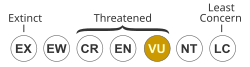
This species is the southernmost representative of the genus Lophophora, thriving in limestone soils within a small area of approximately 775 km2 (299 sq mi) between Vizarrón, Bucareli, and Tolimán in Querétaro, Mexico, with minor occurrences in Hidalgo. Its natural habitat is semi-deserts on slopes and river beds, and under the shade of various shrubs and nurse plants such as Larrea tridentata and Senegalia sororia.46 It grows at altitudes of 1,000–2,000 metres (3,280–6,560 ft) above sea level, forming isolated and self-regulated populations in the Estórax River depression.7 It is considered vulnerable due to a very small distribution range, small population of less than 3,000 individuals, and illegal collecting. It is collected illegally by people seeking peyote, and as an ornamental plant.1
-
 Blooming plant in habitat near Vizarron, Quéretaro, Mexico.
 -
 Plant growing under scrub in Pena Blanca, Queretaro
 -
 Cluster of plants growing in Pena Blanca, Queretaro
Taxonomy
Originally described as Lophophora echinata var. diffusa by Léon Croizat in 1944, it was elevated to species level in 1967 by Helia Bravo Hollis. The epithet diffusa derives from Latin, meaning "indistinct," referencing the plant's low, flat, and barely noticeable warts.
Constituents and effects
Lophophora diffusa contains 86% to more than 90% pellotine in terms of total alkaloid content and only trace amounts of mescaline (e.g., 1.2% of alkaloid content), whereas Lophophora williamsii (peyote) contains 30% mescaline and 17% pellotine with regard to total alkaloid content.891011 Mescaline is a psychedelic drug, whereas pellotine is a sedative and hypnotic.891011 However, pellotine was reported in one single study to additionally produce hallucinations at very high doses.81112 Further study of Lophophora diffusa and pellotine is needed to confirm or refute the preceding findings.811
Lophophora diffusa has reportedly been said to produce effects including feelings of clumsiness, confusion, and general discomfort, or by others a sense of mental clarity or tranquility.13 Unlike Lophophora williamsii, it is said to produce no or modest hallucinogenic effects.13 However, there have been several reports of Lophophora diffusa producing hallucinogenic effects.11 But this may have simply been due to misidentification of the cactus, which may have actually been Lophophora williamsii.11 In addition to the preceding, one study reported that Lophophora williamsii produced marked sleepiness but no hallucinogenic effects, which may have been due to misidentification and the cactus actually being Lophophora diffusa.81114
References
References
- Gómez-Hinostrosa, C.; Sánchez , E.; Guadalupe Martínez, J.; Terry, M. (2017) [amended version of 2013 assessment]. "Lophophora diffusa". IUCN Red List of Threatened Species. 2017 e.T40967A121501921. doi:10.2305/IUCN.UK.2017-3.RLTS.T40967A121501921.en. Retrieved 11 November 2021.
- Cact. Succ. Mex. 12: 13, 1967
- Valente, Frank. "Growers Notes... New Species or Not?? Lophophora Diffusa". MagiCactus.
- "Lophophora diffusa". CACTUS ART NURSERY. Retrieved 21 January 2014.
- Anderson, Edward F.; Eggli, Urs; Anderson, Edward F. (2005). Das große Kakteen-Lexikon (in German). Stuttgart (Hohenheim): Ulmer. p. 359. ISBN 3-8001-4573-1.
- Vallicelli, Valentino (2013-08-04). "Lophophora diffusa". LLIFLE. Retrieved 2024-12-21.
 This article incorporates text from this source, which is available under the CC BY-SA 3.0 license.
- Sánchez, E. (2006). Ficha técnica de Lophophora diffusa (Croizat) Bravo, 1967. Apuntes técnicos para el conocimiento de la situación de conservación de especies de la familia Cactaceae en el estado de Querétaro. Jardín Botánico Regional de Cadereyta "Ing. Manuel González de Cosío". D.F. México, CONABIO. 2008: 1-11.
- Bruhn, Jan G.; Holmstedt, Bo (1973). "Early peyote research an interdisciplinary study". Economic Botany. 28 (4): 353–390. doi:10.1007/BF02862854. ISSN 0013-0001.
Among the studies cited was the work by Jaensch, who experimented with the drug in eidetic subjects. Beringer reported that some of Jaensch's volunteers, instead of becoming excited and having hallucinations, grew very tired 21 after taking 1-2 g of the crude drug (Beringer, 1927). [...] So far we have not been able to find Jaensch's original paper, but if Beringer's citation is correct, a possible explanation of the tired volunteers could be the presence of Lophophora diffusa in the drug material. The amount of pellotine found by Jolly (1896a, 1896b) to produce sleep in his patients varied from 0.04 g to 0.08 g, and this amount could well be found in 1-2 g of dried L. diffusa (cf. Table I). [...] According to Heffter (1898a), pellotine in a dose of 0.24 g does not cause hallucinations. Robles and Gbmez Robleda (1931), using doses up to 0.30 g, observed disorientation in their subjects, who also reported hallucinations. [...] In discussing the possibility of a difference in "hallucinogenic value" between various Lophophora populations, one of us has said: "It would be an interesting problem, trying to verify whether Lophophora diffusa has been ritually employed or is regarded as inferior to the mescaline-producing northern "peyote" (Bruhn, 1973a, 1973b).
- Dinis-Oliveira RJ, Pereira CL, da Silva DD (2019). "Pharmacokinetic and Pharmacodynamic Aspects of Peyote and Mescaline: Clinical and Forensic Repercussions". Curr Mol Pharmacol. 12 (3): 184–194. doi:10.2174/1874467211666181010154139. PMC 6864602. PMID 30318013.
About a century ago, pellotine was marketed as a sedative/hypnotic by Boehringer & Sohn in Germany, but it was then discontinued after the advent of barbiturates. Worth to note that pellotine is the second most abundant alkaloid in Lophophora williamsii, but it is by far the most abundant alkaloid in the other Lophophora spp., accounting for 70- 90% of its total alkaloid content. In those species, mescaline is present only in trace concentrations, not necessarily high enough to produce pharmacological effects following ingestion of the cactus.
- Chan CB, Poulie CB, Wismann SS, Soelberg J, Kristensen JL (August 2021). "The Alkaloids from Lophophora diffusa and Other "False Peyotes"". J Nat Prod. 84 (8): 2398–2407. doi:10.1021/acs.jnatprod.1c00381. PMID 34264089.
- Keeper Trout & friends (2013). Trout's Notes on The Cactus Alkaloids Nomenclature, Physical properties, Pharmacology & Occurrences (Sacred Cacti Fourth Edition, Part C: Cactus Chemistry: Section 1) (PDF). Mydriatic Productions/Better Days Publishing.
A possible exception MAY be pellotine. Its primary action is as a sedative but in human trials using dosages as high as 300 mg some visual hallucinations were reported in ONE paper. This has neither been confirmed nor investigated further. Additionally, there have been several reports of hallucinogenic activity due to ingestion of L. diffusa which contains this as its main alkaloid. These stand at odds with all other evaluations of the pharmacological action of this alkaloid, as well as every other report on the ingestion of said cactus species. Most have dismissed the positive reports as using improperly identified specimens but we believe further study is called for. The only report of activity for peyotine was also the only report that evaluated dosages up to 300 mg. See under Pellotine. [...] Pellotine (Peyotline): [...] Jaensch 1920 observed some of his eidetic volunteers growing very tired after taking 1 to 2 grams of dried peyote. [Bruhn & Holmstedt got this from Beringer 1927] Bruhn & Holmstedt noted that 40 to 80 mg could be obtained from this amount if it was L. diffusa. [...] Heffter found a dose of 240 mg did not produce hallucinations [Heffter 1898a] [...] Robles & Gomez Robleda 1931 using doses of up to 300 mg observed disorientation and reported hallucinations were experienced by their subjects.
- Robles C, Gomez Robleda J (1931). "Trabajo inicial acerca de la accion fisiologica del clorhidrato de peyotina" [Preliminary study on the physiological action of peyotine hydrochloride]. Anales del Instituto de Biología, UNAM. 2 (1): 15–46.
Las dosis medias (hasta 0.30 gr.) fueron las que empleamos con mayor frecuencia, ya que nos permitieron hacer las observaciones que a continuación presentanos. [...]
- Ali, Ehsan; Azhar, Muhammad Farooq; Laila, Ume (23 January 2025). "False Peyote (Lophophora diffusa (Croizat) Bravo Cactaceae)". Comprehensive Guide to Hallucinogenic Plants. Boca Raton: CRC Press. p. 37–41. doi:10.1201/9781003460336-7. ISBN 978-1-003-46033-6. Retrieved 27 June 2026.
When we refer to 'True peyote', we are typically talking about L. williamsii specifically. On the other hand, all other cacti species related to peyote are considered 'false peyote'. Lophophora diffusa and Lophophora fricii are commonly referred to as 'false peyote', [...] In traditional situations, they have also been utilized as alternatives for peyote, albeit they often lack or have modest mescaline effects (Rätsch, 2005; Chaachouay et al., 2019).
- Jaensch, W. (1920). "Pharmakologische Versuche über die Beziehungen optischer Konstitutionsstigmen zu den Halluzinationen". Zentralblatt für die gesamte Neurologie und Psychiatrie. 23: 119–120.
External links
External links
- Media related to Lophophora diffusa at Wikimedia Commons
- Data related to Lophophora diffusa at Wikispecies