| Mammary alveolus | |
|---|---|
| Anatomical terminology |
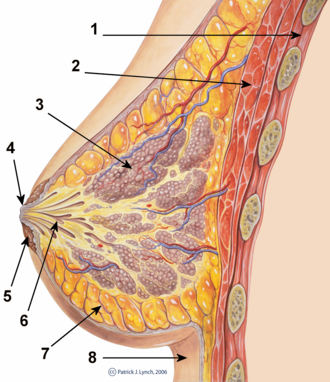
A mammary alveolus (pl.: alveoli, from Latin alveolus, "little cavity") is a small cavity or sac found in the mammary gland.12 Mammary alveoli are the site of milk production and storage in the mammary gland.12 They are formed by secretory cells surrounded by myoepithelial cells. In response to oxytocin stimulation, myoepithelium contracts, resulting in release of milk3. Mammary alveoli cluster into groups called mammary lobules, and each breast may contain 15 to 20 of these lobules.12 The lobules drain milk through the lactiferous ducts out of the nipples.12
References
References
- Susan Blackburn (14 April 2014). Maternal, Fetal, & Neonatal Physiology. Elsevier Health Sciences. p. 146. ISBN 978-0-323-29296-2.
- "SEER Training: Breast Anatomy". National Cancer Institute. Retrieved 9 May 2012.
- Biswas, Swarajit Kumar; Banerjee, Saswati; Baker, Ginger Wendolyn; Kuo, Chieh-Yin; Chowdhury, Indrajit (2022-03-31). "The Mammary Gland: Basic Structure and Molecular Signaling during Development". International Journal of Molecular Sciences. 23 (7): 3883. doi:10.3390/ijms23073883. ISSN 1422-0067. PMC 8998991. PMID 35409243.