| Lobes | |
|---|---|
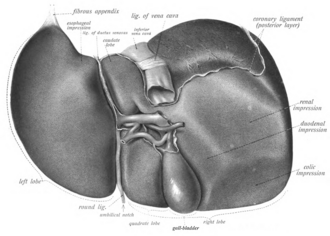 Visceral surface of the liver showing the four lobes | |
| Identifiers | |
| TA98 | A13.1.02.002 |
| FMA | 45728 |
| Anatomical terminology | |
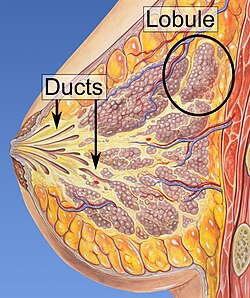
In anatomy, a lobe is a clear anatomical division or extension1 of an organ (as seen for example in the brain, lung, liver, or kidney) that can be determined without the use of a microscope at the gross anatomy level. This is in contrast to the much smaller lobule, which is a clear division only visible under the microscope.2
Interlobar ducts connect lobes and interlobular ducts connect lobules.
Examples of lobes
- The four main lobes of the brain
- the frontal lobe
- the parietal lobe
- the occipital lobe
- the temporal lobe
- The three lobes of the human cerebellum
- the flocculonodular lobe
- the anterior lobe
- the posterior lobe
- The two lobes of the thymus
- The two and three lobes of the lungs
- Left lung: superior and inferior
- Right lung: superior, middle, and inferior
- The four lobes of the liver
- The renal lobes of the kidney
- Earlobes
Examples of lobules
- the cortical lobules of the kidney
- the testicular lobules of the testis
- the lobules of the mammary gland
- the pulmonary lobules of the lung
- the lobules of the thymus
References
References
- "Types of lobes". eMedicine Dictionary. Archived from the original on 27 September 2017.
- "Histology of Glands". Southern Illinois University (SIU), Carbondale, Illinois. Archived from the original on 25 April 2022. Retrieved 25 April 2022.