| Languriini | |
|---|---|
| |
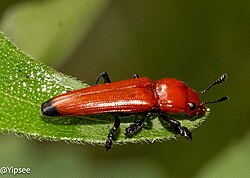
| Doubledaya ustulata in Mae On District, Thailand | |
Scientific classification 
| |
| Kingdom: | Animalia |
| Phylum: | Arthropoda |
| Clade: | Pancrustacea |
| Class: | Insecta |
| Order: | Coleoptera |
| Suborder: | Polyphaga |
| Infraorder: | Cucujiformia |
| Family: | Erotylidae |
| Subfamily: | Languriinae |
| Tribe: | Languriini Hope, 1840 ["1841"] |
| Synonyms | |
|
Cladoxenini Arrow, 1925 | |
Languriini is a tribe of pleasing fungus beetles (family Erotylidae) commonly known as the lizard beetles. They belong to subfamily Languriinae, formerly a distinct family (in which case the Languriini were up-ranked to subfamily and named Languriinae); sometimes the Languriinae are entirely merged into subfamily Erotylinae.1 The name Languriini was mistakenly attributed to George Robert Crotch for some time before the early 21st century.2
Lizard beetles are a mostly tropical group; while they are very common in temperate North America east of the Rocky Mountains, with less than 20 species in a mere handful of genera they are not particularly diverse there. Adults are generally narrow, parallel-sided or somewhat tapering towards the elytra tips, and often metallic and/or with a red thorax. Unlike other Erotylidae, they are commonly found on leaves or flowers, and their larvae bore into plant stems instead of eating fungi like most of their relatives.134
Genera
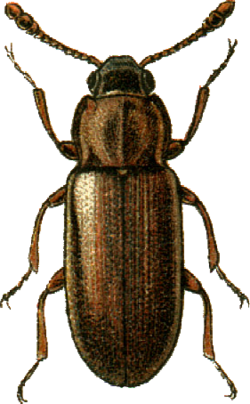
Languriini unite about 670 species in roughly 60 genera:15
Data sources: i = ITIS,2 c = Catalogue of Life,6 g = GBIF,7 b = Bugguide.net1
- Acropteroxys
- Amyduvea Zia, 1934
- Anadastus Gorham, 1887 g (=Neolanguria, Perilanguria, Stenodastus)
- Anisoderomorpha Arrow, 1925
- Anomalolanguria Villiers, 1943
- Apterodastus Arrow, 1925
- Basulanguria Sengupta & Mukherjee, 1977
- Brasilanguria Martins & Perreira, 1965
- Caenolanguria Gorham, 1887 g (=Acrolanguria, Coenolanguria (lapsus), Caenoelanguria (lapsus), Gurilana)
- Callilanguria Crotch, 1876
- Camptocarpus Gorham, 1887
- Celolanguria Arrow, 1925
- Chromauges Gorham, 1887
- Cladoxena Motschulsky, 1866
- Clerolanguria Villiers, 1943
- Compsolanguria Fowler, 1886
- Congodastus Villiers, 1961
- Crotchia Fowler, 1886 (=Croatchia (lapsus), Cladophila (nomen nudum), Deerratus)
- Dasydactylus
- Doubledaya White, 1850 g (=Coptolanguria, Cosmolanguria, Glyphilanguria, Languriosoma)
- Ectrapezidera Fowler, 1909
- Epilanguria Fowler, 1908 g (=Leptolanguria)
- Fatua Crotch, 1876 (=Macromelea)
- Ganluria Heller, 1918
- Goniolanguria Crotch, 1875 (="Goniocephala", nomen nudum)
- Idiolanguria Arrow, 1925
- Ischnolanguria Kraatz, 1900 (=Ischonolanguria (lapsus))
- Labidolanguria Fowler, 1908
- Languria (=Janessa)
- Languriomorpha (sometimes in Pachylanguria)
- Languriophasma Arrow, 1925
- Langurites
- Leucohimatium Rosenhauer, 1856
- Ligurana Chûjô, 1974 g
- Malleolanguria Martins & Perreira, 1965
- Megalanguria Arrow, 1925
- Meristobelus Gorham, 1887
- Microlanguria Lewis, 1884 (=Microcladoxena, Platycladoxena)
- Neanadastus Zia, 1959
- Neocladoxena Maeda, 1974 g
- Neoloberolus Leschen, 2003 i c g
- Nomotus Gorham, 1887
- Ortholanguria Crotch, 1875 (=Ortholanguroides)
- Oxylanguria Crotch, 1876
- Pachylanguria Crotch, 1876 g
- Paederolanguria Mader, 1939 g (=Sinolanguria)
- Paracladoxena Fowler, 1886 (=Parachladoxena (lapsus))
- Paulianus Villiers, 1943
- Penolanguria Kolbe, 1897
- Pentelanguria Crotch, 1876 (=Pentalanguria (lapsus))
- Promecolanguria Fowler, 1885 (=Barbaropus)
- Serralanguria Huang, 2025
- Slipinskiella Leschen & Węgrzynowicz, 1998 (=Promecolanguria auct. nec Fowler, 1885: preoccupied)
- Stenolanguria Fowler, 1885
- Teretilanguria Crotch, 1875
- Tetraphala Sturm, 1843 g (=Metabellus (lapsus), Metabelus, Tetralanguria g, Tetralanguroides)
- Tomolanguria Huang, 2020
- Trapezidera Motschulsky, 1860
- Trapezidistes Fowler, 1887 g (=Chirolanguria, Lacertobelus)
References
References
- "Languriini Tribe Information". BugGuide.net. Retrieved 2026-06-16.
- "Languriini Report". Integrated Taxonomic Information System. Retrieved 2018-03-26. This article incorporates text from this source, which is in the public domain.
- Borror, Donald J. and Richard E. White. A Field Guide to the Insects of America North of Mexico. Houghton Mifflin, Boston: 1970. p. 175
- "Tribus Languriini". iNaturalist. Retrieved 2026-06-16.
- "Languriini Hope, 1840". BioLib. Retrieved 2026-06-16.
- "Catalogue of Life". Retrieved 2018-03-26.
- "GBIF". Retrieved 2018-03-26.
Further reading
Further reading
- Leschen, Richard A. B. (2003). Erotylidae (Insecta: Coleoptera: Cucujoidea) phylogey and review. Fauna of New Zealand. Vol. 47. Manaaki Whenua Press. ISBN 978-0-478-09350-6. ISSN 0111-5383.
- Lobl, I.; Smetana, A., eds. (2007). Catalogue of Palaearctic Coleoptera, Volume 4: Elateroidea - Derodontoidea - Bostrichoidea - Lymexyloidea - Cleroidea - Cucujoidea. Apollo Books. ISBN 978-8788757675.
- LeConte, J. L. (1861). Classification of the Coleoptera of North America. Smithsonian Miscellaneous Collections. Vol. 3. Smithsonian Institution. doi:10.5962/bhl.title.38459. ISBN 978-0665100550.
{{cite book}}: ISBN / Date incompatibility (help)