 | |
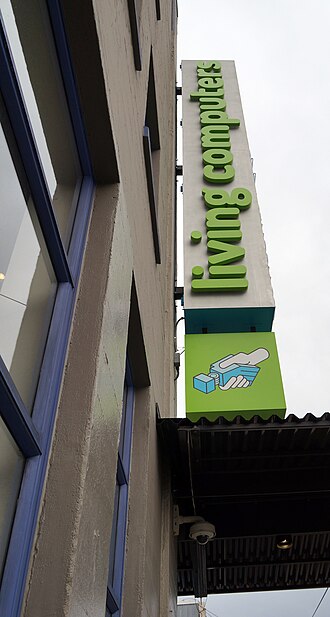 Exterior of the museum | |
 | |
| Established | October 25, 2012 (2012-10-25) |
|---|---|
| Dissolved | June 2024 (2024-06) |
| Location | 2245 1st Avenue South Seattle, Washington, U.S. |
| Coordinates | 47°34′57″N 122°20′05″W / 47.582487°N 122.334708°W / 47.582487; -122.334708 |
| Type | Computer museum |
| Key holdings | PDP-10, IBM Mainframes, Apple 1, PLATO |
| Founder | Paul Allen |
| Curator | Aaron Alcorn |
Public transit access | King County Metro, Link light rail |
| Parking | Onsite and Street Parking |
| Website | www |
Living Computers: Museum + Labs (LCM+L) was a computer and technology museum at 2245 1st Avenue South in the SoDo neighborhood of Seattle, Washington. Founded by Microsoft co-founder Paul Allen, it opened to the public on October 25, 2012, and was permanently closed by the Paul Allen Estate in June 2024.
The museum exhibited vintage computers spanning mainframes, minicomputers, and microcomputers, most configured for interactive use either through time-sharing operating systems or single-user interfaces. Remote users could Telnet into selected systems over the internet. A later expansion added hands-on displays covering self-driving cars, the Internet of things, big data, and robotics.
LCM+L suspended operations in February 2020 due to the COVID-19 pandemic1 and did not reopen. In June 2024 the estate announced permanent closure. A portion of the collection was auctioned by Christie's in August–September 2024, raising $3,635,982;2 the remainder was distributed to the Interim Computer Museum in Tukwila, Washington and the Mimms Museum of Technology and Art in Roswell, Georgia.34
Collections and exhibits
The collection consisted of publicly donated items and Paul Allen's personal collection. Working computers on display included one supercomputer, seven mainframes, 10 minicomputers, and over three dozen microcomputers.5
Various artifacts from the museum appeared in television productions including Mad Men6 and Halt and Catch Fire.7

Computers
| Manufacturer | Model | Type | Year Introduced | Available for public use | Telnet access8 |
|---|---|---|---|---|---|
| Amazon | Kindle 1 | hand-held | 2007 | Yes | No |
| Amiga | 500 | microcomputer | 1987 | Yes | No |
| Apple | Apple 1 | microcomputer | 1976 | Yes | No |
| Apple | II9 | microcomputer | 1977 | Yes | No |
| Apple | IIe9 | microcomputer | 1983 | Yes | No |
| Apple | III | microcomputer | 1980 | Yes | No |
| Apple | Lisa 29 | microcomputer | 1984 | Yes | No |
| Apple | iMac G3 | microcomputer | 1998 | Yes | No |
| Apple | Macintosh SE9 | microcomputer | 1987 | Yes | No |
| Apple | Power Mac G4 | microcomputer | 1999 | Yes | No |
| AT&T | DMD 5620 / 3B2 | minicomputer | 1983 | Yes | Yes |
| Atari | 2600 | video game console | 1977 | Yes | No |
| Atari | 4009 | microcomputer | 1979 | Yes | No |
| Atari | 1040 ST9 | microcomputer | 1985 | Yes | No |
| Columbia Data Products | MPC 1600 | microcomputer | 1982 | Yes | No |
| Commodore | PET9 | microcomputer | 1977 | Yes | No |
| Commodore | 649 | microcomputer | 1982 | Yes | No |
| Compaq | DeskPro 386S9 | microcomputer | 1989 | Yes | No |
| Compaq | Portable9 | microcomputer | 1983 | Yes | No |
| Control Data | CDC 65009 | mainframe | 1967 | No | Yes |
| Control Data | DD60 monitor | operator console | 1964 | No | No |
| Control Data | 405 card reader | peripheral | 1964 | No | No |
| Control Data | CDC 679-6 magnetic tape transport | peripheral | 1964 | No | No |
| Cray | Cray-110 | mainframe | 1975 | No | No |
| Cromemco | Z-2D9 | microcomputer | 1978 | Yes | No |
| Data General | Nova9 | minicomputer | 1969 | Yes | No |
| DEC | PDP-79 | minicomputer | 1964 | No | No |
| DEC | PDP-8/E9 | minicomputer | 1970 | Yes | No |
| DEC | PDP-10 KA10 (DECsystem-10)9 | mainframe | 196811 | No | No |
| DEC | PDP-10 KI10 (DECsystem-10)9 | mainframe | 1971 | No | No |
| DEC | PDP-10 KL10 (DECSYSTEM-2065)9 | mainframe | 1974 | Yes | Yes |
| DEC | PDP-10 KL10 (DECSYSTEM-1095)9 | mainframe | 1974 | Yes | Yes |
| DEC | PDP-10 KS10 (DECSYSTEM-2020)9 | mainframe | 1979 | Yes | Yes |
| DEC | PDP-11/709 | minicomputer | 1975 | Yes | Yes |
| DEC | PDP-129 | minicomputer | 1969 | No | No |
| DEC | VAX-11/780-59 | minicomputer | 1982 | Yes | Yes |
| DEC | VT131 | terminal | 1981 | Yes | No |
| Dell | Dimension XPS B7339 | microcomputer | 1999 | Yes | No |
| E.S.R. | Digi-Comp II reproduction | toy computer | 1965 (original patent); 2012 (reproduction) | Yes | No |
| Honeywell | 6180 DPS-8/M maintenance panel and Multics emulator9 | peripheral; emulation of mainframe | 1973 (mainframe) | No | No |
| IBM | System/360 Model 30 mainframe | mainframe | 1964 | No | No |
| IBM | System/360 Model 91 front panel | peripheral | 1966 | No | No |
| IBM | 029 card punch | peripheral | 1964 | Yes | No |
| IBM | 43619 | mainframe | 1983 | Yes | Yes |
| IBM | Personal Computer 51509 | microcomputer | 1981 | Yes | No |
| IBM | PCjr9 | microcomputer | 1984 | Yes | No |
| IBM | PC/AT9 | microcomputer | 1984 | Yes | No |
| IMLAC Corporation | PDS-1 "sImlac" emulator9 | emulation of minicomputer | 1970s (minicomputer); 2017 (emulator) | Yes | No |
| IMSAI | 80809 | microcomputer | 1975 | Yes | No |
| Interdata | 7/329 | minicomputer | 1974 | Yes | Yes |
| MITS | Altair 88009 | microcomputer | 1975 | Yes | No |
| Microsoft | PixelSense9 | microcomputer | 2007 | Yes | No |
| NeXT | NeXTcube | microcomputer | 1990 | Yes | No |
| Nintendo | NES-101 | video game console | 1993 | Yes | No |
| Osborne | Executive9 | microcomputer | 1982 | Yes | No |
| PLATO | Terminal V | microcomputer | 1976 | Yes | No |
| Processor Technology | Sol-209 | microcomputer | 1976 | Yes | No |
| Radio Shack | TRS-80 Model 49 | microcomputer | 1983 | Yes | No |
| Sun Microsystems | 3/1609 | microcomputer | 1986 | Yes | No |
| Tandy | 10009 | microcomputer | 1984 | Yes | No |
| Tandy | Color Computer 3 | microcomputer | 1986 | Yes | No |
| Teletype | Model 33 | terminal | 1963 | No | No |
| Teletype | Model 35 | terminal | 1963 | No | No |
| Teletype | Model 37 | terminal | 1968 | No | No |
| Texas Instruments | Speak & Spell Compact | hand-held | 1982 | Yes | No |
| Texas Instruments | TI-99/4A | microcomputer | 1981 | Yes | No |
| Xerox | Sigma 99 | mainframe | 1971 | Yes | Yes |
| Xerox | Alto9 | minicomputer | 1973 | Yes | No |
| Xerox | Alto "ContrAlto" simulator9 | emulation of minicomputer | 1973 (minicomputer); 2016 (emulator) | Yes | No |
| XKL | TOAD-19 | mainframe | 1995 | Yes | No |
| XKL | TOAD-29 | mainframe | 2005 | Yes | Yes |
History

LCM+L originated as PDPplanet.com, launched by Microsoft co-founder Paul Allen on January 9, 2006. The site allowed users to Telnet into vintage devices and experience timesharing computing on equipment from Digital Equipment Corporation (DEC) and XKL.12 Through the site, users around the world could request a login and Telnet into systems from XKL, DEC, IBM, Xerox Sigma, AT&T, and CDC.13
The museum opened to the public on October 25, 2012, under the name Living Computer Museum, at 2245 1st Avenue South in the SoDo neighborhood of Seattle.5 Visitors could interact with a collection of mainframes, minicomputers, microcomputers, and peripherals.14 On November 18, 2016, the institution renamed itself Living Computers: Museum + Labs and expanded its scope to include contemporary technologies alongside its vintage collection.15
The museum suspended public access in February 2020 due to the COVID-19 pandemic1 and remained closed through the lifting of pandemic-related restrictions.16 In June 2024, the Paul Allen Estate announced permanent closure and stated that most of the collection was owned by the estate rather than the museum.17 A portion of the collection was consigned to Christie's.18 The online auction, held August 23 to September 12, 2024 as part of the Gen One: Innovations from the Paul G. Allen Collection series,19 raised $3,635,982.2 The remainder of the collection was divided between the Interim Computer Museum in Tukwila, Washington3 and the Mimms Museum of Technology and Art in Roswell, Georgia.4
References
References
- "LIVING COMPUTERS: MUSEUM + LABS IS CLOSING FOR NOW". Archived from the original on March 15, 2024. Retrieved July 10, 2022.
- "Firsts: The History of Computing from the Paul G. Allen Collection". Christie's. Archived from the original on March 30, 2026. Retrieved July 29, 2025.
- "Frequently Asked Questions". Interim Computer Museum. Retrieved October 24, 2025.
- "Computer Museum of America Acquires Collection from Living Computers Museum and Estate of Paul G. Allen". Mimms Museum of Technology and Art. September 12, 2024. Retrieved October 24, 2025.
- "Home - Living Computer Museum". Archived from the original on July 2, 2018. Retrieved July 4, 2018.
- "Fashion and Style: Episode 704: Mad Men: The Monolith". AMC. Archived from the original on May 11, 2015.
- McCracken, Harry (August 27, 2016). "Welcome To 1986: Inside "Halt And Catch Fire's" High-Tech Time Machine". Fast Company. Archived from the original on August 29, 2016.
- "Request a login". Archived from the original on October 24, 2020. Retrieved October 31, 2017.
- "Vintage Computers". Archived from the original on January 2, 2020. Retrieved December 26, 2019.
- Miller, Michael J. (August 17, 2017), "Visiting the Living Computers Museum", PC Magazine
- "PDP10 manual" (PDF). December 1968.
- "Paul G. Allen Launches Web Site Dedicated to Early Computers; PDPplanet.com Site Celebrates Historic Mainframes and Minicomputers | Business Wire". www.businesswire.com (Press release). Archived from the original on March 4, 2016. Retrieved July 4, 2018.
- "Application for a Guest Account on the Living Computers: Museum + Labs". Archived from the original on November 30, 2018. Retrieved July 4, 2018.
- "Seattle's Living Computer Museum tempts tech tourists". USA Today. Retrieved August 17, 2016.
- Schlosser, Kurt (October 25, 2016). "Paul Allen's Living Computers: Museum + Labs rebranded and expanded to better 'ignite curiosity'". GeekWire. Archived from the original on September 14, 2025.
- Bumpus, Kayvon (September 25, 2022). "Paul Allen's Living Computers Museum remains closed after years, despite lifted COVID restrictions". The Seattle Collegian.
- Schlosser, Kurt (June 25, 2024). "Seattle's Living Computers Museum logs off for good as Paul Allen estate will auction vintage items". GeekWire. Archived from the original on March 4, 2026. Retrieved June 25, 2024.
- "Inside the historic computer collection of Microsoft co-founder Paul G. Allen". Christie's. July 8, 2024. Archived from the original on January 16, 2026.
- "Gen One: Innovations from the Paul G. Allen Collection". Christie's. Archived from the original on January 17, 2026. Retrieved July 29, 2025.
Further reading
Further reading
- Michael J. Miller (August 17, 2017), "Visiting the Living Computers Museum", PC Magazine
- USA Today - Seattle's Living Computer Museum Tempts Tech Tourists
- Forbes - Bill Gates and Paul Allen Reunite and Recreate Classic 1981 Microsoft Photo
- New York Times - A Place where Old Computers Go to Live
- Wall Street Journal - A Look Inside Paul Allen's Living Computer Museum