| Little bee-eater | |
|---|---|
| |
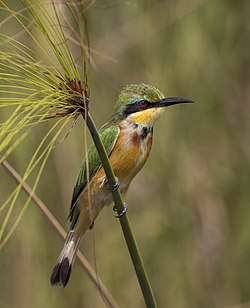
| M. p. argutus, Namibia | |
Scientific classification 
| |
| Kingdom: | Animalia |
| Phylum: | Chordata |
| Class: | Aves |
| Order: | Coraciiformes |
| Family: | Meropidae |
| Genus: | Merops |
| Species: | M. pusillus
|
| Binomial name | |
| Merops pusillus Müller, PLS, 1776
| |
| Synonyms | |
| |
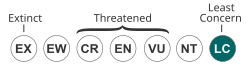
The little bee-eater (Merops pusillus) is a bird species in the bee-eater family, Meropidae.2 They are found in Sub-Saharan Africa.3 They should not be confused with the little green bee-eater (Merops orientalis). Migration is limited to seasonal movements depending on rainfall patterns. They inhabit various biomes, such as savanna, bushveld, and even marsh-like areas. 4
Description
Members of this species, like other bee-eaters, are rich and brightly coloured slender birds. They have green upper parts, yellow throats, black gorgets, and rich brown upper breasts fading to buffish ochre on the belly.5 Their wings are green and brown.6 Their beaks and legs are black.7 Tail is square in shape with a slight fork or v-shape at the end.4 They reach a length of 15–17 cm, which makes them the smallest African bee-eater. Sexes are alike. Often silent, their call is a soft "seep". They are often hard to spot since their green backs and wings act as camouflage.8
Ecology
These are abundant and tame birds, familiar throughout their range. There have been estimated to be between 60 and 80 million little bee-eaters. They breed in open country with bushes, preferably near water. Just as the name suggests, bee-eaters predominantly eat insects, especially bees, wasps and hornets, who are caught in the air by sorties from an open perch.4 This species often hunts from low perches, maybe only a metre or less high. Before eating their meal, a bee-eater removes the stinger by repeatedly hitting the insect on a hard surface.
Unlike most bee-eaters, these are solitary nesters, making a tunnel in sandy banks, or sometimes in the entrance to an Aardvark den. They lay 4 to 6 spherical white eggs. Both the male and the female take care of the eggs. These birds roost communally, lined up on a tree branch.4
Subspecies and plumages
-
 Male and juvenile female
 -
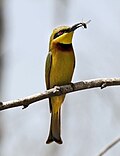 Hann Park, Dakar, Senegal
 -
 M. p. pusillus, Gambia
 -
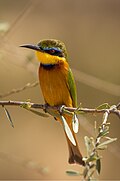 M. p. meridionalis
Samburu National Reserve, Kenya -
 At Maasai Mara, Kenya
References
References
- BirdLife International (2016). "Merops pusillus". IUCN Red List of Threatened Species. 2016 e.T22683688A92995977. doi:10.2305/IUCN.UK.2016-3.RLTS.T22683688A92995977.en. Retrieved 11 November 2021.
- Nigel Redman; Terry Stevenson; John Fanshawe (2010). Birds of the Horn of Africa: Ethiopia, Eritrea, Djibouti, Somalia and Socotra. Bloomsbury Publishing. p. 473. ISBN 978-1-4081-3576-1.
- Eugene M. McCarthy (2006). Handbook of Avian Hybrids of the World. Oxford University Press. p. 120. ISBN 978-0-19-518323-8.
- Kidson, Saartjie; Van Niekerk, Herman (2018). Sappi Voëls van Suid-Afrika [Sappi Birds of South Africa] (in Afrikaans) (1st, 5th printing ed.). South Africa: Briza. p. 205. ISBN 978 1 920217 32 7.
- Nigel Redman; Terry Stevenson; John Fanshawe (2020). Birds of the Horn of Africa: Ethiopia, Eritrea, Djibouti, Somalia and Socotra. A&C Black. p. 244. ISBN 978-1-4081-2580-9.
- "Little Bee-eater (Merops pusillus)". beautyofbirds.com. 2021-09-16. Retrieved 2023-01-26.
- The Ibis: journal of the British Ornithologists' Union. Vol. 4. Wiley-Blackwell. 1874. p. 363.
- Sinclair, Ian; Mendelsohn, John (2000). Algemene Gids tot Voëls van Suid-Afrika [General Guide to Birds of South Africa] (in Afrikaans) (3rd ed.). South Africa: Struik Publishers. p. 17. ISBN 1 86872 529 4.
- Fry, C. Hilary; Fry, Kathie (1992). Kingfishers, Bee-eaters and Rollers. Illustrated by Alan Harris. Christopher Helm. ISBN 0-7136-8028-8.
- Gosler, Andrew, ed. (1991). The Hamlyn photographic guide to birds of the world. Foreword by Christopher Perrins. London: Hamlyn. ISBN 0-600-57239-0.
External links
External links
- Media related to Merops pusillus at Wikimedia Commons
- Little bee-eater – Species text in The Atlas of Southern African Birds.