| Lithodes ferox | |
|---|---|
| |
| |
Scientific classification 
| |
| Kingdom: | Animalia |
| Phylum: | Arthropoda |
| Clade: | Pancrustacea |
| Class: | Malacostraca |
| Order: | Decapoda |
| Suborder: | Pleocyemata |
| Infraorder: | Anomura |
| Family: | Lithodidae |
| Genus: | Lithodes |
| Species: | L. ferox
|
| Binomial name | |
| Lithodes ferox Filhol, 1885
| |
| Synonyms1 | |
| |
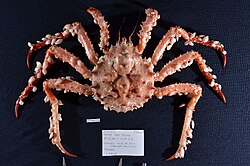
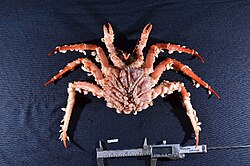
Lithodes ferox, also known as the fierce king crab,2 is a species of king crab.3 It has been found on the muddy bottoms of the southeastern Atlantic Ocean at depths from 160–1,013 m (525–3,323 ft).3 It is distributed between the Gulf of Guinea, the northwesternmost coast of South Africa, and the island of Saint Helena.3
References
References
- De Grave, Sammy (30 November 2021). "Lithodes ferox Filhol, 1885". WoRMS. World Register of Marine Species. Retrieved 25 October 2024.
- Muñoz, Isabel; García-Isarch, Eva; Sobrino, Ignacio; Burgos, Candelaria; Funny, Rita; González-Porto, Marcos (December 2011). "Distribution, abundance and assemblages of decapod crustaceans in waters off Guinea-Bissau (north-west Africa)". Journal of the Marine Biological Association of the United Kingdom. 92 (3): 475–494. doi:10.1017/S0025315411001895. S2CID 84600572 – via ResearchGate.
- Macpherson, Enrique (June 1988). Revision of the family Lithodidae Samouelle, 1819 (Crustacea, Decapoda, Anomura) in the Atlantic Ocean (PDF). Monografías de Zoología Marina. Vol. 2. pp. 64–68. doi:10.1163/9789004627369. hdl:10261/42482. ISBN 978-84-00-06807-3. S2CID 127331902. Archived (PDF) from the original on 2023-11-06 – via the Natural History Museum of Los Angeles County.