| Lithodes aotearoa | |
|---|---|
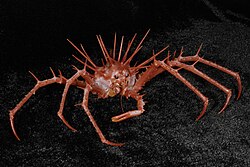
| |
| Juvenile above, adult specimen below | |

| |
Scientific classification 
| |
| Kingdom: | Animalia |
| Phylum: | Arthropoda |
| Clade: | Pancrustacea |
| Class: | Malacostraca |
| Order: | Decapoda |
| Suborder: | Pleocyemata |
| Infraorder: | Anomura |
| Family: | Lithodidae |
| Genus: | Lithodes |
| Species: | L. aotearoa
|
| Binomial name | |
| Lithodes aotearoa | |


Lithodes aotearoa is a species of king crab endemic to New Zealand.4 It had formerly been confused with L. longispina and L. murrayi, which until 2010 were thought to occur in the region.5 It is the second most widespread and common lithodid in New Zealand waters after Neolithodes brodiei,6 and the New Zealand Department of Conservation classifies it as "Not Threatened".1
Description
Lithodes aotearoa is deep-purplish red in colour and has a pyriform carapace.7 The carapace is covered with prominent, slender spines in juveniles and short, conical spines in adults.8 In between the spines are a smooth surface sparsely dotted with granules or small secondary spines.8 Its carapace has been measured as large as 195.0 mm (7.68 in) longa and 199.1 mm (7.84 in) wide in a male specimen.10 The largest known female carapace measures 190.5 mm (7.50 in) in postrostral length and 183.9 mm (7.24 in) in width.9a Its rearmost pair of walking legs is the longest, and its legspan can be over 130 cm (51 in).11 It is the largest lithodid known from New Zealand.10
Fisheries
Lithodes aotearoa are commercially fished in the waters around New Zealand.12 They are included, with Neolithodes brodiei, in the total allowable commercial catch of up to 90 t (200,000 lb; 99 short tons) for king crabs under New Zealand's Quota Management System.12
Notes
Notes
References
References
- Funnell et al. 2023, p. 36.
- Ahyong 2010, p. 16.
- Ahyong 2010, p. 18.
- Ahyong 2010, pp. 28, 29.
- Ahyong 2010, p. 26.
- Ahyong 2010, pp. 83, 185.
- Ahyong 2010, pp. 24, 26.
- Ahyong 2010, p. 24.
- Ahyong 2010, p. 20.
- Ahyong 2010, p. 28.
- Ahyong 2010, pp. 26, 28.
- Fisheries New Zealand 2024, p. 749.
Works cited
- Ahyong, Shane T. (2010). The Marine Fauna of New Zealand: King Crabs of New Zealand, Australia, and the Ross Sea (Crustacea: Decapoda: Lithodidae) (PDF). NIWA Biodiversity Memoirs. Vol. 123. National Institute of Water and Atmospheric Research. pp. 74–83. ISBN 978-0478232851. LCCN 2010497356. Archived (PDF) from the original on 15 February 2020.
- Funnell, Greig; et al. (January 2023). Todd, Amanda (ed.). Conservation status of indigenous marine invertebrates in Aotearoa New Zealand, 2021 (PDF) (Report). New Zealand Department of Conservation. p. 36. ISBN 978-1-99-118365-1. Retrieved 19 March 2023.
- "King Crab (KIC)". Fisheries New Zealand. May 2024. Archived from the original on 2 June 2025. Retrieved 31 May 2025.
External links
External links
- Media related to Lithodes aotearoa at Wikimedia Commons
- Data related to Lithodes aotearoa at Wikispecies
- Rural Delivery video about Lithodes aotearoa fishery