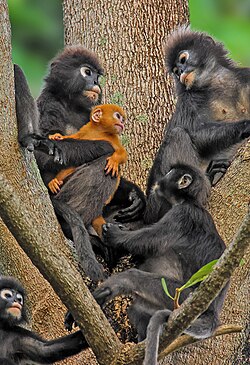
Cercopithecoidea is a superfamily of primates. Members of this family are called cercopithecoids, or Old World monkeys, and include baboons, colobuses, guenons, lutungs, macaques, and other types of monkeys. Cercopithecoidea contains only a single family, Cercopithecidae, and includes nearly half of the species in the suborder Haplorhini, itself one of two suborders in the order Primates. Cercopithecoids are found in Asia and Africa, generally in forests, though some species can be found in shrublands, wetlands, and caves. They range in size from the Gabon talapoin, at 23 cm (9 in) plus a 31 cm (12 in) tail, to the Chacma baboon, at 115 cm (45 in) plus a 72 cm (28 in) tail. Cercopithecoids primarily eat leaves, fruit, and seeds. Most cercopithecoids do not have population estimates, but the ones that do range from 30 mature individuals to 100,000. Forty-eight species are categorized as endangered, and a further twenty-six species are categorized as critically endangered.
The 158 extant species of Cercopithecidae are divided into two subfamilies: Cercopithecinae, containing 78 baboon, guenon, macaque, and other monkey species divided between thirteen genera, and Colobinae, containing 80 colobus, lutung, and other monkey species divided between ten genera. Dozens of extinct prehistoric cercopithecoid species have been discovered, though due to ongoing research and discoveries the exact number and categorization is not fixed.1
Conventions
| Conservation status | |
|---|---|
| EX | Extinct (0 species) |
| EW | Extinct in the wild (0 species) |
| CR | Critically endangered (26 species) |
| EN | Endangered (49 species) |
| VU | Vulnerable (39 species) |
| NT | Near threatened (17 species) |
| LC | Least concern (25 species) |
| Other categories | |
| DD | Data deficient (2 species) |
| NE | Not evaluated (0 species) |
The author citation for the species or genus is given after the scientific name; parentheses around the author citation indicate that this was not the original taxonomic placement. Conservation status codes listed follow the International Union for Conservation of Nature (IUCN) Red List of Threatened Species. Range maps are provided wherever possible; if a range map is not available, a description of the cercopithecoid's range is provided. Ranges are based on the IUCN Red List for that species unless otherwise noted. All extinct genera, species, or subspecies listed alongside extant species went extinct after 1500 CE, and are indicated by a dagger symbol "†".
Classification
The superfamily Cercopithecoidea consists of one extant family, Cercopithecidae, which itself consists of two extant subfamilies: Cercopithecinae, containing 78 species divided into thirteen genera, and Colobinae, containing 80 species divided into ten genera.
Subfamily Cercopithecinae
- Genus Allenopithecus (Allen's swamp monkey): one species
- Genus Allochrocebus (terrestrial guenons): three species
- Genus Cercocebus (white-eyelid mangabeys): seven species
- Genus Cercopithecus (guenons): nineteen species
- Genus Chlorocebus (vervet monkeys): seven species
- Genus Erythrocebus (patas monkeys): three species
- Genus Lophocebus (crested mangabeys): two species
- Genus Macaca (macaques): twenty-four species
- Genus Mandrillus (mandrills): two species
- Genus Miopithecus (talapoins): two species
- Genus Papio (baboons): six species
- Genus Rungwecebus (kipunji): one species
- Genus Theropithecus (gelada): one species
Subfamily Colobinae
- Genus Colobus (black-and-white colobuses): five species
- Genus Nasalis (proboscis monkey): one species
- Genus Piliocolobus (red colobuses): fifteen species
- Genus Presbytis (surilis): nineteen species
- Genus Procolobus (olive colobus): one species
- Genus Pygathrix (doucs): three species
- Genus Rhinopithecus (snub-nosed monkeys): five species
- Genus Semnopithecus (gray langurs): eight species
- Genus Simias (pig-tailed langur): one species
- Genus Trachypithecus (lutungs): twenty-one species
Cercopithecoids
The following classification is based on the taxonomy described by the reference work Mammal Species of the World (2005), with augmentation by generally accepted proposals made since using molecular phylogenetic analysis, as supported by both the IUCN and the American Society of Mammalogists.3
Subfamily Cercopithecinae
| Common name | Scientific name and subspecies | Range | Size and ecology | IUCN status and estimated population |
|---|---|---|---|---|
| Allen's swamp monkey
|
A. nigroviridis (Pocock, 1907) |
Central Africa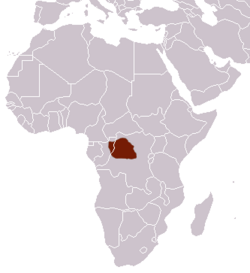
|
Size: 33–51 cm (13–20 in) long, plus 35–52 cm (14–20 in) tail4 Habitat: Forest5 Diet: Fruit, leaves, and small invertebrates6 |
LC
|

| Common name | Scientific name and subspecies | Range | Size and ecology | IUCN status and estimated population |
|---|---|---|---|---|
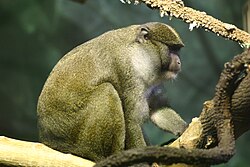
| L'Hoest's monkey
|
A. lhoesti P. L. Sclater, 1899 |
Central Africa
|
Size: 31–69 cm (12–27 in) long, plus 48–10 cm (19–4 in) tail7 Habitat: Forest8 Diet: Fruit, leaves, mushrooms, and invertebrates7 |
VU
|
| Preuss's monkey
|
A. preussi Matschie, 1898 Two subspecies
|
West-central Africa
|
Size: 45–61 cm (18–24 in) long, plus 49–69 cm (19–27 in) tail9 Habitat: Forest and grassland10 Diet: Fruit, seeds, shoots, leaves, buds, flowers, and mushrooms9 |
EN
|
| Sun-tailed monkey
|
A. solatus M. J. S. Harrison, 1988 |
West-central Africa
|
Size: 45–58 cm (18–23 in) long, plus 56–76 cm (22–30 in) tail11 Habitat: Forest12 Diet: Fruit, seeds, and invertebrates11 |
NT
|


| Common name | Scientific name and subspecies | Range | Size and ecology | IUCN status and estimated population |
|---|---|---|---|---|
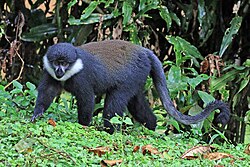
| Agile mangabey
|
C. agilis (H. Milne-Edwards, 1886) |
Central Africa
|
Size: 44–65 cm (17–26 in) long, plus 45–79 cm (18–31 in) tail13 Habitat: Forest14 Diet: Fruit, seeds and shoots, as well as small vertebrates14 |
LC
|
| Collared mangabey
|
C. torquatus (Kerr, 1792) |
Western Africa
|
Size: 45–67 cm (18–26 in) long, plus 60–75 cm (24–30 in) tail15 Habitat: Forest16 Diet: Fruit and nuts, as well as stems and roots15 |
EN
|
| Golden-bellied mangabey
|
C. chrysogaster Lydekker, 1900 |
Central Africa
|
Size: 40–80 cm (16–31 in) long, plus 45–100 cm (18–39 in) tail17 Habitat: Forest18 Diet: Invertebrates, fruit, seeds, and nectar17 |
EN
|
| Sanje mangabey
|
C. sanjei Mittermeier, 1986 |
East-central Africa
|
Size: 50–65 cm (20–26 in) long, plus 55–65 cm (22–26 in) tail19 Habitat: Forest20 Diet: Fruit, nuts, and seeds, as well as fungi, invertebrates, and plants20 |
EN
|
| Sooty mangabey
|
C. atys (Audebert, 1797) |
Western Africa | Size: 40–68 cm (16–27 in) long, plus 40–80 cm (16–31 in) tail21 Habitat: Forest and savanna22 Diet: Fruit and nuts, as well as swamp plants, grass, seeds, fungi, and invertebrates21 |
VU
|
| Tana River mangabey
|
C. galeritus Peters, 1879 |
Eastern Africa
|
Size: 44–63 cm (17–25 in) long, plus 50–68 cm (20–27 in) tail23 Habitat: Forest, shrubland, and inland wetlands24 Diet: Fruit and seeds, as well as stems, leaves, insects, and fungi23 |
CR
|
| White-naped mangabey
|
C. lunulatus (Temminck, 1853) |
Western Africa
|
Size: 52–73 cm (20–29 in) long, plus 68–74 cm (27–29 in) tail15 Habitat: Forest and inland wetlands25 Diet: Fruit, leaves, seeds, buds, and grass26 |
EN
|


| Common name | Scientific name and subspecies | Range | Size and ecology | IUCN status and estimated population |
|---|---|---|---|---|
| Blue monkey
|
C. mitis Wolf, 1822 Sixteen subspecies
|
Sub-Saharan Africa
|
Size: 31–70 cm (12–28 in) long, plus 55–109 cm (22–43 in) tail27 Habitat: Forest28 Diet: Fruit and leaves, as well as invertebrates29 |
LC
|
| Campbell's mona monkey
|
C. campbelli Waterhouse, 1838 |
Western Africa
|
Size: 36–55 cm (14–22 in) long, plus 49–85 cm (19–33 in) tail30 Habitat: Forest, savanna, and shrubland31 Diet: Fruit, leaves, seeds and grains, as well as birds, bird eggs, small reptiles, and insects30 |
NT
|
| Crested mona monkey
|
C. pogonias Bennett, 1833 Three subspecies
|
Central Africa
|
Size: 34–55 cm (13–22 in) long, plus 48–87 cm (19–34 in) tail32 Habitat: Forest33 Diet: Fruit and seeds, as well as leaves, flowers and insects33 |
NT
|
| De Brazza's monkey
|
C. neglectus Schlegel, 1876 |
Central Africa
|
Size: 39–60 cm (15–24 in) long, plus 47–79 cm (19–31 in) tail34 Habitat: Inland wetlands and forest35 Diet: Fruit, as well as leaves, flowers, mushrooms, beetles, termites, and worms36 |
LC
|
| Dent's mona monkey
|
C. denti Thomas, 1907 |
Central Africa
|
Size: 40–70 cm (16–28 in) long, plus 70–90 cm (28–35 in) tail37 Habitat: Forest38 Diet: Fruit and arthropods, as well as flowers, caterpillars, shoots, and leaves38 |
LC
|
| Diana monkey
|
C. diana (Linnaeus, 1758) |
Western Africa
|
Size: 40–55 cm (16–22 in) long, plus 50–75 cm (20–30 in) tail39 Habitat: Forest40 Diet: Fruit, flowers, leaves, insects, and other invertebrates39 |
EN
|
| Greater spot-nosed monkey
|
C. nictitans (Linnaeus, 1766) Five subspecies
|
Western Africa
|
Size: 40–57 cm (16–22 in) long, plus 56–100 cm (22–39 in) tail41 Habitat: Forest42 Diet: Fruits and seeds, as well as leaves and insects43 |
NT
|
| Hamlyn's monkey
|
C. hamlyni Pocock, 1907 Two subspecies
|
Central Africa
|
Size: 43–63 cm (17–25 in) long, plus 49–63 cm (19–25 in) tail44 Habitat: Forest45 Diet: Shoots, leaves, plants, and herbs, as well as fruit and seeds46 |
VU
|
| Lesser spot-nosed monkey
|
C. petaurista (Schreber, 1774) Two subspecies
|
Western Africa
|
Size: 29–53 cm (11–21 in) long, plus 57–78 cm (22–31 in) tail47 Habitat: Forest48 Diet: Fruit as well as insects47 |
NT
|
| Lesula
|
C. lomamiensis Hart et al., 2012 |
Central Africa
|
Size: 40–65 cm (16–26 in) long, plus 40–65 cm (16–26 in) tail49 Habitat: Forest50 Diet: Leaves, fruits and flowers51 |
VU
|
| Lowe's mona monkey
|
C. lowei Thomas, 1923 |
Western Africa (in green)
|
Size: 36–55 cm (14–22 in) long, plus 54–85 cm (21–33 in) tail52 Habitat: Forest and savanna53 Diet: Fruit and insects52 |
VU
|
| Mona monkey
|
C. mona (Schreber, 1774) |
Western Africa
|
Size: 32–53 cm (13–21 in) long, plus 67–90 cm (26–35 in) tail54 Habitat: Forest55 Diet: Fruit, sprouts, leaves, and invertebrates54 |
NT
|
| Moustached guenon
|
C. cephus (Linnaeus, 1758) Three subspecies
|
Western Africa
|
Size: 44–60 cm (17–24 in) long, plus 66–99 cm (26–39 in) tail56 Habitat: Forest57 Diet: Fruit, as well as seeds, leaves, insects, and eggs58 |
LC
|
| Red-eared guenon
|
C. erythrotis Waterhouse, 1838 Two subspecies
|
Western Africa
|
Size: 36–55 cm (14–22 in) long, plus 46–77 cm (18–30 in) tail59 Habitat: Forest60 Diet: Fruit, as well as leaves, shoots and arthropods60 |
VU
|
| Red-tailed monkey
|
C. ascanius (Audebert, 1799) Five subspecies
|
Central Africa
|
Size: 34–55 cm (13–22 in) long, plus 67–92 cm (26–36 in) tail61 Habitat: Forest62 Diet: Fruit, as well as leaves, insects, flowers, buds, and tree gum63 |
LC
|
| Roloway monkey
|
C. roloway (Schreber, 1774) |
Western Africa
|
Size: 44–62 cm (17–24 in) long, plus 70–91 cm (28–36 in) tail64 Habitat: Forest65 Diet: Insects, as well as seeds, fruit, and leaves64 |
CR
|
| Sclater's guenon
|
C. sclateri Pocock, 1904 |
Western Africa
|
Size: 32–38 cm (13–15 in) long, plus 61–85 cm (24–33 in) tail66 Habitat: Forest67 Diet: Fruit, as well as insects, flowers and leaves68 |
EN
|
| White-throated guenon
|
C. erythrogaster Gray, 1866 Two subspecies
|
Western Africa
|
Size: 38–46 cm (15–18 in) long, plus 58–70 cm (23–28 in) tail47 Habitat: Forest and inland wetlands69 Diet: Fruit69 |
EN
|
| Wolf's mona monkey
|
C. wolfi (Meyer, 1891) Three subspecies
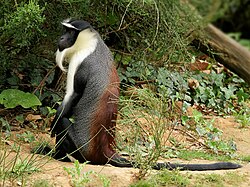
|
Central Africa | Size: 44–52 cm (17–20 in) long, plus 69–83 cm (27–33 in) tail70 Habitat: Forest71 Diet: Fruit, leaves, seeds, and flowers70 |
NT
|




| Common name | Scientific name and subspecies | Range | Size and ecology | IUCN status and estimated population |
|---|---|---|---|---|
| Bale Mountains vervet
|
C. djamdjamensis Neumann, 1902 Two subspecies
|
Eastern Africa
|
Size: 43–45 cm (17–18 in) long, plus 47–50 cm (19–20 in) tail72 Habitat: Forest73 Diet: Leaves and fruit, as well as flowers, small vertebrates, shoots, stems, and roots74 |
VU
|
| Dryas monkey
|
C. dryas (Schwarz, 1932) |
Central Africa
|
Size: 36–40 cm (14–16 in) long, plus 48–52 cm (19–20 in) tail75 Habitat: Forest76 Diet: Fruit, leaves, shoots, pith, seeds, insects, and mushrooms76 |
EN
|
| Green monkey
|
C. sabaeus (Linnaeus, 1766) |
Western Africa
|
Size: 42–46 cm (17–18 in) long, plus 42–72 cm (17–28 in) tail72 Habitat: Forest and savanna77 Diet: Fruit and leaves78 |
LC
|
| Grivet
|
C. aethiops (Linnaeus, 1758) Two subspecies
|
Eastern Africa
|
Size: 40–60 cm (16–24 in) long, plus 30–50 cm (12–20 in) tail79 Habitat: Savanna and shrubland80 Diet: Fruit, insects, and vegetable matter, as well as small mammals and birds79 |
LC
|
| Malbrouck
|
C. cynosuros (Scopoli, 1786) |
Southern Africa
|
Size: 34–70 cm (13–28 in) long, plus 44–79 cm (17–31 in) tail81 Habitat: Forest and savanna82 Diet: Fruit, as well as shoots, stems, gum, and seeds81 |
LC
|
| Tantalus monkey
|
C. tantalus (Ogilby, 1841) Three subspecies
|
Equatorial Africa
|
Size: 38–83 cm (15–33 in) long, plus 55–114 cm (22–45 in) tail83 Habitat: Forest and savanna84 Diet: Fruit, buds, seeds, roots, bark, and gum, as well as insects, small vertebrates and eggs83 |
LC
|
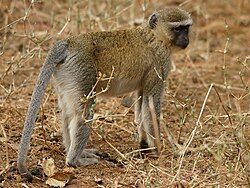
| Vervet monkey
|
C. pygerythrus F. Cuvier, 1821 Five subspecies
|
Eastern and southern Africa
|
Size: 42–57 cm (17–22 in) long, plus 48–75 cm (19–30 in) tail83 Habitat: Savanna, shrubland, and forest85 Diet: Leaves, flowers, fruit, seeds, arthropods, and gum86 |
LC
|




| Common name | Scientific name and subspecies | Range | Size and ecology | IUCN status and estimated population |
|---|---|---|---|---|
| Blue Nile patas monkey
|
E. poliophaeus Reichenbach, 1862 |
Eastern Africa | Size: 49–64 cm (19–25 in) long, plus 43–73 cm (17–29 in) tail87 Habitat: Forest, savanna, and shrubland88 Diet: Gum and arthropods, as well as flowers, fruit, seeds, leaves, stems, roots, and small vertebrates87 |
DD
|
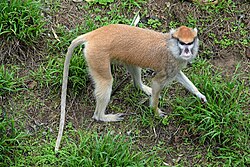
| Common patas monkey
|
E. patas (Schreber, 1775) Three subspecies
|
Equatorial Africa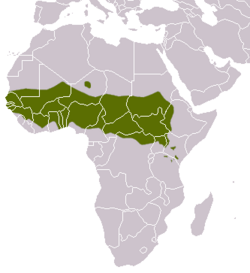
|
Size: 50–70 cm (20–28 in) long, plus 50–70 cm (20–28 in) tail89 Habitat: Forest, savanna, shrubland, and grassland90 Diet: Fruit and insects, as well as leaves, roots, and bird eggs89 |
NT
|
| Southern patas monkey | E. baumstarki Matschie, 1905 |
Eastern Africa | Size: 49–64 cm (19–25 in) long, plus 43–73 cm (17–29 in) tail87 Habitat: Forest, savanna, shrubland, and grassland91 Diet: Gum and arthropods, as well as flowers, fruit, seeds, leaves, stems, roots, and small vertebrates87 |
CR
|

| Common name | Scientific name and subspecies | Range | Size and ecology | IUCN status and estimated population |
|---|---|---|---|---|
| Black crested mangabey
|
L. aterrimus (Oudemans, 1890) Two subspecies
|
Central Africa
|
Size: 45–65 cm (18–26 in) long, plus 80–85 cm (31–33 in) tail92 Habitat: Forest93 Diet: Fruit92 |
VU
|
| Grey-cheeked mangabey
|
L. albigena (Gray, 1850) Four subspecies
|
Central Africa
|
Size: 44–75 cm (17–30 in) long, plus 57–94 cm (22–37 in) tail94 Habitat: Forest95 Diet: Fruit and seeds95 |
VU
|


| Common name | Scientific name and subspecies | Range | Size and ecology | IUCN status and estimated population |
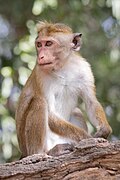
|---|---|---|---|---|
| Toque macaque
|
M. sinica (Linnaeus, 1771) Three subspecies
|
Sri Lanka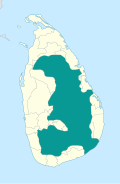
|
Size: 36–53 cm (14–21 in) long, plus at least 36–53 cm (14–21 in) tail96 Habitat: Forest97 Diet: Fruit as well as tree flowers, buds, and leaves98 |
EN
|
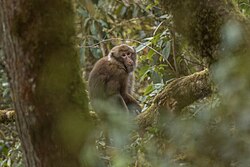
| Arunachal macaque
|
M. munzala Sinha, Datta, Madhusudan, Mishra, 2005 |
Eastern Himalayas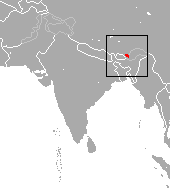
|
Size: 36–77 cm (14–30 in) long, plus about 9–20 cm (4–8 in) tail96 Habitat: Forest99 Diet: Fruit, leaves, grains, buds, seeds, flowers, and bark, as well as insects and small invertebrates96 |
EN
|
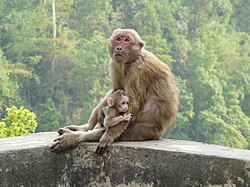
| Assam macaque
|
M. assamensis McClelland, 1840 Two subspecies
|
Southeastern Asia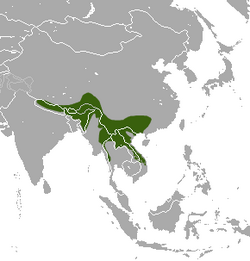
|
Size: 36–77 cm (14–30 in) long, plus about 9–20 cm (4–8 in) tail96 Habitat: Forest100 Diet: Fruit, leaves, grains, buds, seeds, flowers, and bark, as well as insects and small invertebrates96 |
NT
|
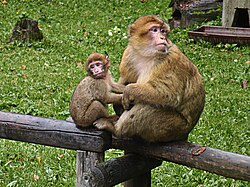
| Barbary macaque
|
M. sylvanus (Linnaeus, 1758) |
Northwestern Africa
|
Size: 45–60 cm (18–24 in) long, plus 1–2 cm (0–1 in) tail101 Habitat: Forest, shrubland, grassland, rocky areas, and caves102 Diet: Plants, caterpillars, fruit, seeds, roots, and fungi101 |
EN
|
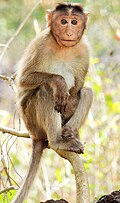
| Bonnet macaque
|
M. radiata (Geoffroy, 1812) Two subspecies
|
Southern India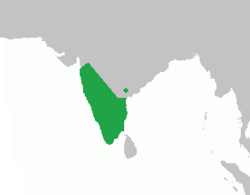
|
Size: 36–77 cm (14–30 in) long, plus about 9–20 cm (4–8 in) tail96 Habitat: Forest, savanna, and shrubland103 Diet: Fruit, foliage, and insects, as well as bird eggs and lizards104 |
VU
|
| Booted macaque
|
M. ochreata (Ogilby, 1841) |
Island of Sulawesi in Indonesia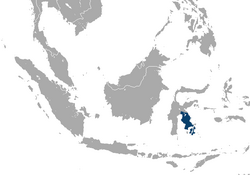
|
Size: 36–77 cm (14–30 in) long, plus about 1–15 cm (0–6 in) tail96 Habitat: Forest and savanna105 Diet: Fruit, leaves, grains, buds, seeds, flowers, and bark, as well as insects and small invertebrates96 |
VU
|
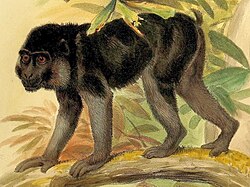
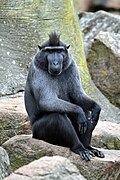
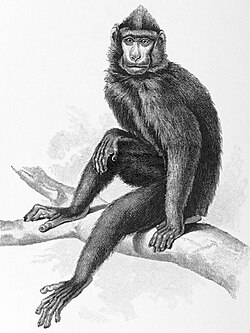
| Celebes crested macaque
|
M. nigra (Desmarest, 1822) |
Island of Sulawesi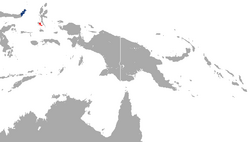
|
Size: 44–57 cm (17–22 in) long, plus about 2 cm (1 in) tail106 Habitat: Forest107 Diet: Fruit, as well as insects, shoots, leaves, and stems106 |
CR
|
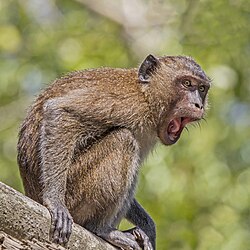
| Crab-eating macaque
|
M. fascicularis Raffles, 1821 Ten subspecies
|
Southeastern Asia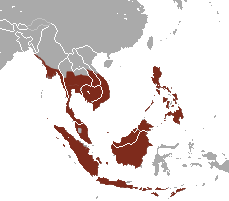
|
Size: 40–47 cm (16–19 in) long, plus 50–60 cm (20–24 in) tail Habitat: Forest, intertidal marine, caves, inland wetlands, grassland, shrubland, and savanna108 Diet: Fruit, crabs, flowers, insects, leaves, fungi, grasses, and clay109 |
EN
|
| Formosan rock macaque
|
M. cyclopis (Swinhoe, 1862) |
Taiwan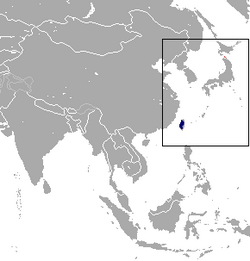
|
Size: 36–45 cm (14–18 in) long, plus 26–46 cm (10–18 in) tail110 Habitat: Forest111 Diet: Fruit, leaves, berries, seeds, insects, and small vertebrates, buds, and shoots110 |
LC
|
| Gorontalo macaque
|
M. nigrescens (Temminck, 1849) |
Island of Sulawesi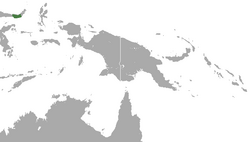
|
Size: 36–77 cm (14–30 in) long, plus about 1–15 cm (0–6 in) tail96 Habitat: Forest112 Diet: Fruit, leaves, grains, buds, seeds, flowers, and bark, as well as insects and small invertebrates96 |
VU
|
| Heck's macaque | M. hecki (Matschie, 1901) |
Island of Sulawesi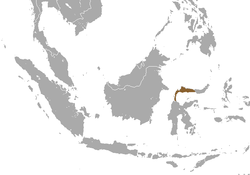
|
Size: 36–77 cm (14–30 in) long, plus about 1–15 cm (0–6 in) tail96 Habitat: Forest and grassland113 Diet: Fruit, leaves, grains, buds, seeds, flowers, and bark, as well as insects and small invertebrates96 |
VU
|
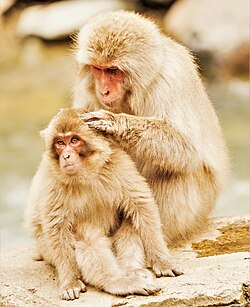
| Japanese macaque
|
M. fuscata Blyth, 1875 Two subspecies
|
Japan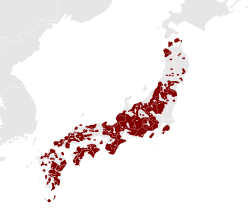
|
Size: 36–77 cm (14–30 in) long, plus about 1–15 cm (0–6 in) tail96 Habitat: Forest114 Diet: Fruit, seeds, flowers, nectar, leaves, and fungi115 |
LC
|
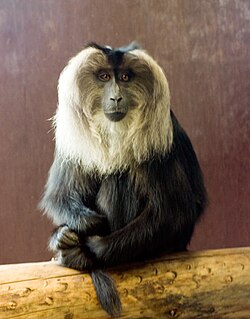
| Lion-tailed macaque
|
M. silenus (Linnaeus, 1758) |
Southwestern India
|
Size: 40–61 cm (16–24 in) long, plus 24–38 cm (9–15 in) tail116 Habitat: Forest117 Diet: Fruit, as well as leaves, stems, flowers, buds, fungi, insects, lizards, tree frogs, and small mammals116 |
EN
|
| Moor macaque
|
M. maura (Schinz, 1825) |
Island of Sulawesi
|
Size: 36–77 cm (14–30 in) long, plus about 1–15 cm (0–6 in) tail96 Habitat: Forest and grassland118 Diet: Fruit, leaves, grains, buds, seeds, flowers, and bark, as well as insects and small invertebrates96 |
EN
|
| Muna-Buton macaque | M. brunnescens (Matschie, 1901) |
Island of Sulawesi in Indonesia
|
Size: 36–77 cm (14–30 in) long, plus about 1–15 cm (0–6 in) tail96 Habitat: Forest119 Diet: Fruit, leaves, grains, buds, seeds, flowers, and bark, as well as insects and small invertebrates96 |
VU
|
| Northern pig-tailed macaque
|
M. leonina (Blyth, 1863) |
Southeastern Asia
|
Size: 36–77 cm (14–30 in) long, plus about 9–20 cm (4–8 in) tail96 Habitat: Forest120 Diet: Leaves, seeds, stems, roots, flowers, bamboo shoots, rice, gums, insects, larvae, termite eggs and spiders120 |
VU
|
| Pagai Island macaque
|
M. pagensis (Miller, 1903) |
Mentawai Islands in Indonesia
|
Size: 36–77 cm (14–30 in) long, plus about 9–20 cm (4–8 in) tail96 Habitat: Forest121 Diet: Fruit, leaves, grains, buds, seeds, flowers, and bark, as well as insects and small invertebrates96 |
CR
|
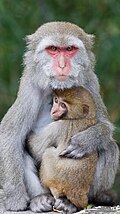
| Rhesus macaque
|
M. mulatta (Zimmermann, 1790) |
Southern and southeastern Asia
|
Size: 45–64 cm (18–25 in) long, plus 19–32 cm (7–13 in) tail122 Habitat: Forest, savanna, and shrubland123 Diet: Fish, crabs, shellfish, bird eggs, honeycombs, crayfish, crabs, spiders, plants, gums and pith123 |
LC
|
| Siberut macaque | M. siberu Fuentes, 1995 |
Siberut island in Indonesia
|
Size: 36–77 cm (14–30 in) long, plus about 9–20 cm (4–8 in) tail96 Habitat: Forest124 Diet: Fruit, as well as mushrooms, leaves, crabs, crayfish, pith, sap, shoots and flowers124 |
EN
|
| Southern pig-tailed macaque
|
M. nemestrina (Linnaeus, 1766) |
Southeastern Asia
|
Size: 46–57 cm (18–22 in) long, plus 13–26 cm (5–10 in) tail125 Habitat: Forest and shrubland126 Diet: Fruit, insects, seeds, leaves, dirt, and fungus, as well as birds, termite eggs and larvae, and river crabs125 |
EN
|
| Stump-tailed macaque
|
M. arctoides (Geoffroy, 1831) |
Southeastern Asia
|
Size: 48–65 cm (19–26 in) long, plus 3–7 cm (1–3 in) tail127 Habitat: Forest128 Diet: Fruit, seeds, flowers, roots, leaves, frogs, crabs, birds, and bird eggs127 |
VU
|
| Tibetan macaque
|
M. thibetana (H. Milne-Edwards, 1870) Four subspecies
|
East China
|
Size: 36–77 cm (14–30 in) long, plus about 1–15 cm (0–6 in) tail96 Habitat: Forest and caves129 Diet: Fruit, as well as flowers, berries, seeds, leaves, stems, stalks, and invertebrates129 |
NT
|
| Tonkean macaque
|
M. tonkeana (von Meyer, 1899) |
Island of Sulawesi
|
Size: 36–77 cm (14–30 in) long, plus about 1–15 cm (0–6 in) tail96 Habitat: Forest130 Diet: Fruit, leaves, grains, buds, seeds, flowers, and bark, as well as insects and small invertebrates96 |
VU
|
| White-cheeked macaque
|
M. leucogenys Li, Zhao, Fan, 2015 |
Northeastern India | Size: 36–77 cm (14–30 in) long, plus about 9–20 cm (4–8 in) tail96 Habitat: Forest131 Diet: Fruit, leaves, grains, buds, seeds, flowers, and bark, as well as insects and small invertebrates96 |
EN
|


| Common name | Scientific name and subspecies | Range | Size and ecology | IUCN status and estimated population |
|---|---|---|---|---|
| Drill
|
M. leucophaeus (F. Cuvier, 1807) Two subspecies
|
Western Africa
|
Size: 61–77 cm (24–30 in) long, plus 5–8 cm (2–3 in) tail132 Habitat: Forest, savanna, and rocky areas133 Diet: Omnivorous, primarily fruit and seeds133 |
EN
|
| Mandrill
|
M. sphinx (Linnaeus, 1758) |
Western Africa
|
Size: 55–95 cm (22–37 in) long, plus 7–10 cm (3–4 in) tail134 Habitat: Forest135 Diet: Fruit, seeds, fungi, roots, insects, snails, worms, frogs, and lizards, as well as snakes and small vertebrates136 |
VU
|


| Common name | Scientific name and subspecies | Range | Size and ecology | IUCN status and estimated population |
|---|---|---|---|---|
| Angolan talapoin
|
M. talapoin (Schreber, 1774) |
Western Africa
|
Size: 32–45 cm (13–18 in) long, plus 36–53 cm (14–21 in) tail137 Habitat: Forest and inland wetlands138 Diet: Insects, leaves, seeds, fruit, water plants, grubs, eggs, and small vertebrates137 |
VU
|
| Gabon talapoin
|
M. ogouensis Kingdon, 1997 |
Western Africa
|
Size: 23–36 cm (9–14 in) long, plus 31–45 cm (12–18 in) tail139 Habitat: Forest140 Diet: Fruit, seeds and insects140 |
NT
|


| Common name | Scientific name and subspecies | Range | Size and ecology | IUCN status and estimated population |
|---|---|---|---|---|
| Chacma baboon
|
P. ursinus (Kerr, 1792) Three subspecies
|
Southern Africa
|
Size: 50–115 cm (20–45 in) long, plus 45–72 cm (18–28 in) tail141 Habitat: Forest, savanna, shrubland, grassland, rocky areas, and desert142 Diet: Fruit, leaves, gum, insects, eggs, seeds, flowers, grass, roots, tubers, and small vertebrates141 |
LC
|
| Guinea baboon
|
P. papio (Desmarest, 1820) |
Western Africa
|
Size: 50–115 cm (20–45 in) long, plus 45–72 cm (18–28 in) tail143 Habitat: Forest, savanna, grassland, and inland wetlands144 Diet: Roots, tubers, bulbs, corms, small vertebrates, fruit, and seeds143 |
NT
|
| Hamadryas baboon
|
P. hamadryas (Linnaeus, 1758) |
Horn of Africa and southwestern Arabian Peninsula
|
Size: 61–77 cm (24–30 in) long, plus 38–61 cm (15–24 in) tail145 Habitat: Shrubland, grassland, and rocky areas146 Diet: Fruit, gum, insects, eggs, seeds, flowers, grass, rhizomes, corms, roots, tubers, and small vertebrates145 |
LC
|
| Kinda baboon
|
P. kindae Lönnberg, 1919 |
Central Africa (in green)
|
Size: 55–84 cm (22–33 in) long, plus 38–66 cm (15–26 in) tail147 Habitat: Forest, savanna, and shrubland148 Diet: Omnivorous; primarily fruit148 |
LC
|
| Olive baboon
|
P. anubis (Lesson, 1827) |
Equatorial Africa
|
Size: 61–84 cm (24–33 in) long, plus 31–60 cm (12–24 in) tail149 Habitat: Forest, savanna, shrubland, and grassland150 Diet: Fruit, gums, insects, eggs, seeds, flowers, grass, rhizomes, corms, roots, tubers, and small vertebrates151 |
LC
|
| Yellow baboon
|
P. cynocephalus (Linnaeus, 1766) Two subspecies
|
Eastern Africa (in red)
|
Size: 50–115 cm (20–45 in) long, plus 45–72 cm (18–28 in) tail152 Habitat: Shrubland, savanna, and forest153 Diet: Grass, sedges, seeds, fruit, roots, leaves, buds, bark, flowers, insects, and small vertebrates152 |
LC
|


| Common name | Scientific name and subspecies | Range | Size and ecology | IUCN status and estimated population |
|---|---|---|---|---|
| Kipunji
|
R. kipunji Jones et al., 2005 |
Southeastern Africa
|
Size: 85–90 cm (33–35 in) long, plus about 115 cm (45 in) tail154 Habitat: Forest155 Diet: Omnivorous, including bulbs, roots, shoots, seeds, and fruit154 |
EN
|

| Common name | Scientific name and subspecies | Range | Size and ecology | IUCN status and estimated population |
|---|---|---|---|---|
| Gelada
|
T. gelada (Rüppell, 1835) Two subspecies
|
Eastern Africa
|
Size: 50–75 cm (20–30 in) long, plus 32–55 cm (13–22 in) tail156 Habitat: Grassland and rocky areas157 Diet: Leaves and forbs, as well as roots, corms, tubers and rhizomes157 |
LC
|

Subfamily Colobinae
| Common name | Scientific name and subspecies | Range | Size and ecology | IUCN status and estimated population |
|---|---|---|---|---|
| Angola colobus
|
C. angolensis P. L. Sclater, 1860 Six subspecies
|
Central Africa
|
Size: 49–68 cm (19–27 in) long, plus 70–83 cm (28–33 in) tail158 Habitat: Forest159 Diet: Leaves, as well as stems, bark, flowers, buds, shoots, fruits, and insects158 |
VU
|
| Black colobus
|
C. satanas Waterhouse, 1838 Two subspecies
|
Western Africa
|
Size: 50–70 cm (20–28 in) long, plus 62–88 cm (24–35 in) tail160 Habitat: Forest161 Diet: Nuts and seeds, as well as unripe fruit and leaves160 |
VU
|
| King colobus
|
C. polykomos (Zimmermann, 1780) |
Western Africa
|
Size: 45–72 cm (18–28 in) long, plus 52–100 cm (20–39 in) tail162 Habitat: Forest and savanna163 Diet: Leaves, as well as fruit and flowers162 |
EN
|
| Mantled guereza
|
C. guereza Rüppell, 1835 Seven subspecies
|
Central Africa
|
Size: 45–72 cm (18–28 in) long, plus 52–100 cm (20–39 in) tail164 Habitat: Forest165 Diet: Leaves, as well as fruit, buds, and blossoms164 |
LC
|
| Ursine colobus
|
C. vellerosus (Geoffroy, 1834) |
Western Africa
|
Size: 60–67 cm (24–26 in) long, plus 73–93 cm (29–37 in) tail166 Habitat: Forest167 Diet: Leaves and seeds, as well as fruit, insects, and clay168 |
CR
|


| Common name | Scientific name and subspecies | Range | Size and ecology | IUCN status and estimated population |
|---|---|---|---|---|
| Proboscis monkey
|
N. larvatus Wurmb, 1787 |
Borneo
|
Size: 61–76 cm (24–30 in) long, plus 50–75 cm (20–30 in) tail169 Habitat: Forest170 Diet: Fruit, seeds, leaves, and shoots, as well as caterpillars and larvae171 |
EN
|

| Common name | Scientific name and subspecies | Range | Size and ecology | IUCN status and estimated population |
|---|---|---|---|---|
| Bouvier's red colobus | P. bouvieri (Rochebrune, 1887) |
Congo (in purple on left)
|
Size: 41–70 cm (16–28 in) long, plus 42–80 cm (17–31 in) tail172 Habitat: Forest173 Diet: Fruit, seeds, and leaves172 |
EN
|
| Foa's red colobus | P. foai (Pousargues, 1899) |
Congo (in black, bottom right)
|
Size: 41–70 cm (16–28 in) long, plus 42–80 cm (17–31 in) tail172 Habitat: Forest174 Diet: Fruit, seeds, and leaves172 |
EN
|
| Lomami red colobus | P. parmentieri (Colyn, Verheyen, 1987) |
Congo
|
Size: 41–70 cm (16–28 in) long, plus 42–80 cm (17–31 in) tail172 Habitat: Forest175 Diet: Fruit, seeds, and leaves172 |
EN
|
| Lang's red colobus | P. langi (J. A. Allen, 1925) |
Congo
|
Size: 41–70 cm (16–28 in) long, plus 42–80 cm (17–31 in) tail172 Habitat: Forest176 Diet: Fruit, seeds, and leaves172 |
EN
|
| Miss Waldron's red colobus | P. waldronae (Hayman, 1936) |
Western Africa
|
Size: 47–63 cm (19–25 in) long, plus 52–75 cm (20–30 in) tail177 Habitat: Forest178 Diet: Fruit, seeds, leaves, buds, and flowers177 |
CR
|
| Niger Delta red colobus | P. epieni (Grubb, Powell, 1999) |
Western Africa | Size: 41–70 cm (16–28 in) long, plus 42–80 cm (17–31 in) tail172 Habitat: Forest179 Diet: Fruit, seeds, and leaves172 |
CR
|
| Oustalet's red colobus | P. oustaleti (Trouessart, 1906) |
Congo (in green)
|
Size: 41–70 cm (16–28 in) long, plus 42–80 cm (17–31 in) tail172 Habitat: Forest180 Diet: Fruit, seeds, and leaves172 |
VU
|
| Pennant's colobus
|
P. pennantii (Waterhouse, 1838) |
Western Africa
|
Size: 53–63 cm (21–25 in) long, plus 60–70 cm (24–28 in) tail181 Habitat: Forest182 Diet: Leaves and shoots, as well as seeds and fruit181 |
CR
|
| Preuss's red colobus
|
P. preussi (Matschie, 1900) |
Western Africa
|
Size: 41–70 cm (16–28 in) long, plus 42–80 cm (17–31 in) tail172 Habitat: Forest183 Diet: Fruit, seeds, and leaves172 |
CR
|
| Semliki red colobus | P. semlikiensis (Colyn, 1991) |
Congo (in dark blue on right)
|
Size: 41–70 cm (16–28 in) long, plus 42–80 cm (17–31 in) tail172 Habitat: Forest184 Diet: Fruit, seeds, and leaves172 |
VU
|
| Tana River red colobus
|
P. rufomitratus (Peters, 1879) |
Kenya | Size: 45–67 cm (18–26 in) long, plus 52–80 cm (20–31 in) tail185 Habitat: Forest, shrubland, and inland wetlands186 Diet: Leaves, fruit, and seeds, as well as flowers185 |
CR
|
| Thollon's red colobus | P. tholloni (A. Milne-Edwards, 1886) |
Congo (in orange)
|
Size: 41–70 cm (16–28 in) long, plus 42–80 cm (17–31 in) tail172 Habitat: Forest187 Diet: Leaves, fruit, and seeds, as well as flowers187 |
VU
|
| Udzungwa red colobus
|
P. gordonorum (Matschie, 1900) |
Southeastern Africa
|
Size: 41–70 cm (16–28 in) long, plus 42–80 cm (17–31 in) tail172 Habitat: Forest188 Diet: Fruit, seeds, and leaves172 |
VU
|
| Ugandan red colobus
|
P. tephrosceles Elliot, 1907 |
Eastern Africa
|
Size: 41–70 cm (16–28 in) long, plus 42–80 cm (17–31 in) tail172 Habitat: Forest and savanna189 Diet: Fruit, seeds, and leaves172 |
EN
|
| Western red colobus
|
P. badius (Kerr, 1792) Three subspecies
|
Western Africa
|
Size: 45–67 cm (18–26 in) long, plus 52–80 cm (20–31 in) tail Habitat: Forest and savanna190 Diet: Leaves, seeds, unripe fruit, and shoots191 |
EN
|
| Zanzibar red colobus
|
P. kirkii (Gray, 1868) |
Eastern Africa
|
Size: 41–70 cm (16–28 in) long, plus 42–80 cm (17–31 in) tail172 Habitat: Forest and shrubland192 Diet: Leaves, fruit, and seeds, as well as flowers193 |
EN
|


| Common name | Scientific name and subspecies | Range | Size and ecology | IUCN status and estimated population |
|---|---|---|---|---|
| Black Sumatran langur | P. sumatranus (S. Müller, Schlegel, 1841) |
Island of Sumatra in Indonesia | Size: 42–61 cm (17–24 in) long, plus 50–85 cm (20–33 in) tail194 Habitat: Forest195 Diet: Fruit, leaves, seeds and flowers195 |
EN
|
| Black-and-white langur | P. bicolor Aimi, Bakar, 1992 |
Island of Sumatra | Size: 42–61 cm (17–24 in) long, plus 50–85 cm (20–33 in) tail194 Habitat: Forest196 Diet: Fruit, seeds, and leaves194 |
DD
|
| Black-crested Sumatran langur
|
P. melalophos (Raffles, 1821) |
Island of Sumatra
|
Size: 42–61 cm (17–24 in) long, plus 50–85 cm (20–33 in) tail194 Habitat: Forest and shrubland197 Diet: Fruits and leaves, as well as seeds and flowers198 |
EN
|
| East Sumatran banded langur | P. percura Lyon, 1908 |
Island of Sumatra | Size: 42–61 cm (17–24 in) long, plus 50–85 cm (20–33 in) tail194 Habitat: Forest199 Diet: Fruit, seeds, and leaves194 |
CR
|
| Hose's langur
|
P. hosei (Thomas, 1889) |
Borneo
|
Size: 42–61 cm (17–24 in) long, plus 50–85 cm (20–33 in) tail194 Habitat: Forest200 Diet: Leaves, unripe fruits, seeds, flowers, bird eggs and nestlings200 |
VU
|
| Javan surili
|
P. comata (Desmarest, 1822) Two subspecies
|
Island of Java in Indonesia
|
Size: 42–61 cm (17–24 in) long, plus 50–85 cm (20–33 in) tail194 Habitat: Forest201 Diet: Leaves, as well as fruits, flowers, and seeds201 |
VU
|
| Maroon leaf monkey
|
P. rubicunda (Müller, 1838) Five subspecies
|
Borneo
|
Size: 42–61 cm (17–24 in) long, plus 50–85 cm (20–33 in) tail194 Habitat: Forest and inland wetlands202 Diet: Leaves, seeds, and fruit, as well as flowers and pith202 |
VU
|
| Siberut langur
|
P. siberu (Chasen, Kloss, 1928) |
Island of Siberut in Indonesia
|
Size: 42–61 cm (17–24 in) long, plus 50–85 cm (20–33 in) tail194 Habitat: Forest203 Diet: Fruit, seeds, and leaves194 |
EN
|
| Mentawai langur | P. potenziani (Bonaparte, 1856) |
Mentawai islands in Indonesia
|
Size: 42–61 cm (17–24 in) long, plus 50–85 cm (20–33 in) tail194 Habitat: Forest204 Diet: Fruit, seeds, and leaves194 |
CR
|
| Miller's langur
|
P. canicrus G. S. Miller, 1934 |
Eastern Borneo (in light green)
|
Size: 42–61 cm (17–24 in) long, plus 50–85 cm (20–33 in) tail194 Habitat: Forest205 Diet: Fruit, seeds, and leaves194 |
EN
|
| Mitered langur | P. mitrata Eschscholtz, 1821 |
Island of Sumatra | Size: 42–61 cm (17–24 in) long, plus 50–85 cm (20–33 in) tail194 Habitat: Forest206 Diet: Fruit, seeds, and leaves194 |
VU
|
| Natuna Island surili | P. natunae (Thomas, Hartert, 1894) |
Island of Natuna Besar in Indonesia
|
Size: 42–61 cm (17–24 in) long, plus 50–85 cm (20–33 in) tail194 Habitat: Forest207 Diet: Fruit, seeds, and leaves194 |
VU
|
| Raffles' banded langur
|
P. femoralis (Martin, 1838) |
Singapore and southern Peninsular Malaysia
|
Size: 42–61 cm (17–24 in) long, plus 50–85 cm (20–33 in) tail194 Habitat: Forest208 Diet: Fruit, seeds, and leaves194 |
CR
|
| Robinson's banded langur
|
P. robinsoni Thomas, 1910 |
Southern Malay Peninsula
|
Size: 42–61 cm (17–24 in) long, plus 50–85 cm (20–33 in) tail194 Habitat: Forest209 Diet: Fruit, seeds, and leaves194 |
NT
|
| Sabah grizzled langur | P. sabana (Thomas, 1893) |
Eastern Borneo (in dark brown)
|
Size: 42–61 cm (17–24 in) long, plus 50–85 cm (20–33 in) tail194 Habitat: Forest210 Diet: Fruit, seeds, and leaves194 |
EN
|
| Sarawak surili
|
P. chrysomelas (Müller, 1838) Two subspecies
|
Northern Borneo
|
Size: 42–61 cm (17–24 in) long, plus 50–85 cm (20–33 in) tail194 Habitat: Forest211 Diet: Fruit, seeds, and leaves194 |
CR
|
| Thomas's langur
|
P. thomasi (Collett, 1893) |
Northern island of Sumatra in Indonesia
|
Size: 42–62 cm (17–24 in) long, plus 50–85 cm (20–33 in) tail212 Habitat: Forest213 Diet: Fruit, leaves, and seeds, as well as flowers, bark, twigs, stalks, birds, bird eggs, algae, and insects212 |
VU
|
| White-fronted surili
|
P. frontata (Müller, 1838) |
Borneo
|
Size: 42–61 cm (17–24 in) long, plus 50–85 cm (20–33 in) tail194 Habitat: Forest214 Diet: Fruit, seeds, and leaves194 |
VU
|
| White-thighed surili
|
P. siamensis (Müller, Schlegel, 1838) Four subspecies
|
Southeastern Asia
|
Size: 42–61 cm (17–24 in) long, plus 50–85 cm (20–33 in) tail194 Habitat: Forest215 Diet: Fruit, seeds, and leaves194 |
NT
|


| Common name | Scientific name and subspecies | Range | Size and ecology | IUCN status and estimated population |
|---|---|---|---|---|
| Olive colobus
|
P. verus (Van Beneden, 1838) |
Western Africa
|
Size: 43–50 cm (17–20 in) long, plus 57–64 cm (22–25 in) tail216 Habitat: Forest217 Diet: Leaves and flowers218 |
VU
|

| Common name | Scientific name and subspecies | Range | Size and ecology | IUCN status and estimated population |
|---|---|---|---|---|
| Black-shanked douc
|
P. nigripes H. Milne-Edwards, 1871 |
Southeastern Asia
|
Size: 60–76 cm (24–30 in) long, plus 56–76 cm (22–30 in) tail219 Habitat: Forest220 Diet: Leaves, as well as seeds, fruit and flowers220 |
CR
|
| Gray-shanked douc
|
P. cinerea (Nadler, 1997) |
Southeastern Asia
|
Size: About 60 cm (24 in) long, plus 59–68 cm (23–27 in) tail219 Habitat: Forest221 Diet: Leaves, as well as buds, fruit, seeds, and flowers222 |
CR
|
| Red-shanked douc
|
P. nemaeus (Linnaeus, 1771) |
Southeastern Asia
|
Size: 61–77 cm (24–30 in) long, plus 55–77 cm (22–30 in) tail223 Habitat: Forest224 Diet: Leaves, as well as unripe fruit, seeds, and flowers223 |
CR
|


| Common name | Scientific name and subspecies | Range | Size and ecology | IUCN status and estimated population |
|---|---|---|---|---|
| Black-and-white snub-nosed monkey
|
R. bieti (A. Milne-Edwards, 1897) |
Southern China
|
Size: 74–83 cm (29–33 in) long, plus 51–72 cm (20–28 in) tail225 Habitat: Forest226 Diet: Leaves, fruit, and lichen225 |
EN
|
| Golden snub-nosed monkey
|
R. roxellana A. Milne-Edwards, 1870 Three subspecies
|
Central China
|
Size: 57–76 cm (22–30 in) long, plus 51–72 cm (20–28 in) tail227 Habitat: Forest228 Diet: Leaves, bark, and lichen, as well as buds and fruit seeds227 |
EN
|
| Gray snub-nosed monkey
|
R. brelichi Thomas, 1903 |
Central China
|
Size: 64–73 cm (25–29 in) long, plus 70–97 cm (28–38 in) tail229 Habitat: Forest230 Diet: Leaves, buds, fruit, seeds and bark, as well as insect larvae229 |
CR
|
| Myanmar snub-nosed monkey
|
R. strykeri Geissmann et al., 2010 |
Northern Myanmar
|
Size: About 56 cm (22 in) long, plus 78 cm (31 in) tail231 Habitat: Forest232 Diet: Leaves, fruit, seeds, buds, flowers, twigs, and bark233 |
CR
|
| Tonkin snub-nosed monkey
|
R. avunculus (Dollman, 1912) |
Northern Vietnam
|
Size: 51–65 cm (20–26 in) long, plus 66–92 cm (26–36 in) tail234 Habitat: Forest235 Diet: Leaves, fruit, flowers, and seeds234 |
CR
|


| Common name | Scientific name and subspecies | Range | Size and ecology | IUCN status and estimated population |
|---|---|---|---|---|
| Black-footed gray langur
|
S. hypoleucos Blyth, 1841 Three subspecies
|
Southern India
|
Size: 41–78 cm (16–31 in) long, plus 69–108 cm (27–43 in) tail236 Habitat: Forest and shrubland237 Diet: Leaves, fruit, and flowers236 |
LC
|
| Kashmir gray langur | S. ajax Pocock, 1928 |
Himalayas
|
Size: 41–78 cm (16–31 in) long, plus 69–108 cm (27–43 in) tail236 Habitat: Forest238 Diet: Leaves, bark, and seeds238 |
EN
|
| Nepal gray langur
|
S. schistaceus Hodgson, 1840 |
Himalayas
|
Size: 41–78 cm (16–31 in) long, plus 69–108 cm (27–43 in) tail236 Habitat: Forest, shrubland, and rocky areas239 Diet: Leaves and fruit, as well as seeds, roots, flowers, bark, twigs, coniferous cones, moss, lichens, ferns, shoots, rhizomes, grass, and invertebrate animals239 |
LC
|
| Nilgiri langur
|
S. johnii (J. Fischer, 1829) |
Southern India
|
Size: 41–78 cm (16–31 in) long, plus 69–108 cm (27–43 in) tail236 Habitat: Forest240 Diet: Leaves, fruit, and flowers236 |
VU
|
| Northern plains gray langur
|
S. entellus (Dufresne, 1797) |
India
|
Size: 41–78 cm (16–31 in) long, plus 69–108 cm (27–43 in) tail236 Habitat: Forest, savanna, and shrubland241 Diet: Leaves, fruit, and flowers, as well as insects, bark, gum, and soil242 |
LC
|
| Tarai gray langur
|
S. hector Pocock, 1928 |
Himalayas
|
Size: 41–78 cm (16–31 in) long, plus 69–108 cm (27–43 in) tail236 Habitat: Forest243 Diet: Leaves, fruit, and flowers236 |
NT
|
| Tufted gray langur
|
S. priam Blyth, 1844 Three subspecies
|
Southern India and Sri Lanka
|
Size: 41–78 cm (16–31 in) long, plus 69–108 cm (27–43 in) tail236 Habitat: Forest and shrubland244 Diet: Leaves and fruit244 |
NT
|
| Purple-faced langur
|
S. vetulus (Erxleben, 1777) Four subspecies
|
Sri Lanka
|
Size: 41–78 cm (16–31 in) long, plus 69–108 cm (27–43 in) tail236 Habitat: Forest245 Diet: Leaves, fruit, flowers, and seeds245 |
EN
|


| Common name | Scientific name and subspecies | Range | Size and ecology | IUCN status and estimated population |
|---|---|---|---|---|
| Pig-tailed langur
|
S. concolor Miller, 1903 Three subspecies
|
Islands near Sumatra in Indonesia
|
Size: 45–53 cm (18–21 in) long, plus 13–18 cm (5–7 in) tail246 Habitat: Forest247 Diet: Leaves, fruit, and berries248 |
CR
|

| Common name | Scientific name and subspecies | Range | Size and ecology | IUCN status and estimated population |
|---|---|---|---|---|
| Annamese langur
|
T. margarita (Elliot, 1909) |
Southeastern Asia
|
Size: 40–76 cm (16–30 in) long, plus 57–110 cm (22–43 in) tail249 Habitat: Forest250 Diet: Leaves, flowers, and fruit249 |
EN
|
| Capped langur
|
T. pileatus (Blyth, 1843) Three subspecies
|
Southern Asia
|
Size: 40–76 cm (16–30 in) long, plus 57–110 cm (22–43 in) tail249 Habitat: Forest251 Diet: Leaves, seeds, and fruit, as well as flowers, buds, bark, and caterpillars251 |
VU
|
| Cat Ba langur
|
T. poliocephalus (Pousargues, 1898) |
Cát Bà Island, Vietnam (in purple)
|
Size: 40–76 cm (16–30 in) long, plus 57–110 cm (22–43 in) tail249 Habitat: Forests and caves252 Diet: Leaves, flowers, and fruit249 |
CR
|
| Delacour's langur
|
T. delacouri (Osgood, 1911) |
Northern Vietnam
|
Size: 40–76 cm (16–30 in) long, plus 57–110 cm (22–43 in) tail249 Habitat: Forest, rocky areas, and caves253 Diet: Leaves, flowers, and fruit249 |
CR
|
| Dusky leaf monkey
|
T. obscurus (Reid, 1837) Seven subspecies
|
Southeastern Asia
|
Size: 42–61 cm (17–24 in) long, plus 50–85 cm (20–33 in) tail254 Habitat: Forest255 Diet: Leaves, shoots, fruit, and seedlings254 |
EN
|
| East Javan langur
|
T. auratus Geoffroy, 1812 |
Java and nearby islands in Indonesia
|
Size: 44–65 cm (17–26 in) long, plus 61–87 cm (24–34 in) tail256 Habitat: Forest257 Diet: Leaves and flowers, as well as fruit and insect larvae256 |
VU
|
| François' langur
|
T. francoisi (Pousargues, 1898) |
Southern Asia
|
Size: 40–76 cm (16–30 in) long, plus 57–110 cm (22–43 in) tail249 Habitat: Forest, rocky areas, and caves258 Diet: Leaves, fruit, and seeds, as well as insects259 |
EN
|
| Gee's golden langur
|
T. geei (Khajuria, 1956) |
Southern Asia
|
Size: 50–75 cm (20–30 in) long, plus 70–100 cm (28–39 in) tail260 Habitat: Forest261 Diet: Fruit, leaves, flowers, seeds, and twigs260 |
EN
|
| Germain's langur
|
T. germaini (H. Milne-Edwards, 1876) |
Southeastern Asia
|
Size: 40–76 cm (16–30 in) long, plus 57–110 cm (22–43 in) tail249 Habitat: Forest and rocky areas262 Diet: Leaves, fruit, and flowers262 |
EN
|
| Hatinh langur
|
T. hatinhensis (Dao, 1970) |
Vietnam
|
Size: 40–76 cm (16–30 in) long, plus 57–110 cm (22–43 in) tail249 Habitat: Forest, rocky areas, and caves263 Diet: Leaves, as well as fruit, vines, and flowers263 |
EN
|
| Indochinese black langur | T. ebenus Brandon-Jones, 1995 |
Southeastern Asia | Size: 40–76 cm (16–30 in) long, plus 57–110 cm (22–43 in) tail249 Habitat: Forest, rocky areas, and caves264 Diet: Leaves, as well as fruit, vines, and flowers264 |
EN
|
| Indochinese grey langur
|
T. crepuscula (Elliot, 1909) |
Southeast Asia (in red)
|
Size: 40–76 cm (16–30 in) long, plus 57–110 cm (22–43 in) tail249 Habitat: Forest, inland wetlands, and rocky areas265 Diet: Leaves, flowers, and fruit249 |
EN
|
| Laotian langur
|
T. laotum (Thomas, 1911) |
Laos
|
Size: 40–76 cm (16–30 in) long, plus 57–110 cm (22–43 in) tail249 Habitat: Forest and rocky areas266 Diet: Leaves, flowers, and fruit249 |
EN
|
| Phayre's leaf monkey
|
T. phayrei (Blyth, 1847) Two subspecies
|
Southeast Asia (in green)
|
Size: 40–76 cm (16–30 in) long, plus 57–110 cm (22–43 in) tail249 Habitat: Forest267 Diet: Leaves, as well as bamboo shoots268 |
EN
|
| Popa langur | T. popa Roos et al., 2020 |
Myanmar
|
Size: 40–76 cm (16–30 in) long, plus 57–110 cm (22–43 in) tail249 Habitat: Forest269 Diet: Leaves, flowers, and fruit249 |
CR
|
| Shortridge's langur
|
T. shortridgei Wroughton, 1915 |
Southern Asia
|
Size: 40–76 cm (16–30 in) long, plus 57–110 cm (22–43 in) tail249 Habitat: Forest270 Diet: Leaves, flowers, and fruit249 |
EN
|
| Selangor silvered langur
|
T. selangorensis Roos, Nadler, Walter, 2008 |
Peninsular Malaysia | Size: 40–76 cm (16–30 in) long, plus 57–110 cm (22–43 in) tail249 Habitat: Forest271 Diet: Leaves, flowers, and fruit249 |
NT
|
| Silvery lutung
|
T. cristatus Raffles, 1821 Two subspecies
|
Southeastern Asia
|
Size: 46–56 cm (18–22 in) long, plus 63–84 cm (25–33 in) tail272 Habitat: Forest273 Diet: Leaves, as well as fruit, seeds, shoots, flowers, and buds272 |
VU
|
| Tenasserim lutung | T. barbei (Blyth, 1847) |
Southeastern Asia
|
Size: 40–76 cm (16–30 in) long, plus 57–110 cm (22–43 in) tail249 Habitat: Forest274 Diet: Leaves, flowers, and fruit249 |
VU
|
| West Javan langur
|
T. mauritius (Griffith, 1821) |
Island of Java | Size: 40–76 cm (16–30 in) long, plus 57–110 cm (22–43 in) tail249 Habitat: Forest275 Diet: Leaves, flowers, and fruit249 |
VU
|
| White-headed langur
|
T. leucocephalus Tan, 1957 |
Southern China | Size: 40–76 cm (16–30 in) long, plus 57–110 cm (22–43 in) tail249 Habitat: Rocky areas276 Diet: Leaves, flowers, and fruit249 |
CR
|


References
References
- "Fossilworks: Cercopithecoidea". Paleobiology Database. University of Wisconsin–Madison. Archived from the original on August 11, 2023. Retrieved August 10, 2023.
- Perelman, P.; Johnson, W. E.; Roos, C.; Seuánez, H. N.; Horvath, J. E.; Moreira, M. A. M.; Kessing, B.; Pontius, J.; Roelke, M.; Rumpler, Y.; Schneider, M. P. C.; Silva, A.; O'Brien, S. J.; Pecon-Slattery, J. (2011). "A Molecular Phylogeny of Living Primates". PLOS Genetics. 7 (3) e1001342. doi:10.1371/journal.pgen.1001342. PMC 3060065. PMID 21436896.
- Wilson, Reeder, pp. 152–177
- Kingdon 2015, p. 143
- Maisels, F.; Mittermeier, R. A.; Oates, J. F.; Hart, J. (2020) [amended version of 2019 assessment]. "Allenopithecus nigroviridis". IUCN Red List of Threatened Species. 2020 e.T865A166606573. doi:10.2305/IUCN.UK.2020-1.RLTS.T865A166606573.en.
- Sides, Corey (2023). "Allenopithecus nigroviridis". Animal Diversity Web. University of Michigan. Archived from the original on July 24, 2023. Retrieved July 24, 2023.
- Ferguson, Bess (2011). "Cercopithecus lhoesti". Animal Diversity Web. University of Michigan. Archived from the original on July 24, 2023. Retrieved July 24, 2023.
- Ukizintambara, T.; Olupot, W.; Hart, J. (2019). "Allochrocebus lhoesti". IUCN Red List of Threatened Species. 2019 e.T4220A92345122. doi:10.2305/IUCN.UK.2019-3.RLTS.T4220A92345122.en.
- Kingdon 2015, p. 156
- Cronin, D. T.; Maisels, F.; Ndeloh, D.; Gadsby, E. (2019) [errata version of 2019 assessment]. "Allochrocebus preussi". IUCN Red List of Threatened Species. 2019 e.T4227A161178708. doi:10.2305/IUCN.UK.2019-2.RLTS.T4227A161178708.en.
- Kingdon 2015, p. 157
- Abernethy, K.; Maisels, F.; Coad, L. (2019) [errata version of 2019 assessment]. "Allochrocebus solatus". IUCN Red List of Threatened Species. 2019 e.T4230A154209091. doi:10.2305/IUCN.UK.2019-1.RLTS.T4230A154209091.en.
- Kingdon 2015, p. 136
- Maisels, F.; Hicks, T. C.; Hart, J.; Shah, N. (2020) [amended version of 2019 assessment]. "Cercocebus agilis". IUCN Red List of Threatened Species. 2020 e.T136615A167735266. doi:10.2305/IUCN.UK.2020-1.RLTS.T136615A167735266.en.
- Kingdon 2015, p. 134
- Maisels, F.; Oates, J. F.; Linder, J.; Ikemeh, R.; Imong, I.; Etiendem, D. (2019) [errata version of 2019 assessment]. "Cercocebus torquatus". IUCN Red List of Threatened Species. 2019 e.T4201A154210757. doi:10.2305/IUCN.UK.2019-1.RLTS.T4201A154210757.en.
- Patterson, Haley (2017). "Cercocebus chrysogaster". Animal Diversity Web. University of Michigan. Archived from the original on August 12, 2023. Retrieved July 24, 2023.
- Hart, J. A.; Thompson, J. (2020). "Cercocebus chrysogaster". IUCN Red List of Threatened Species. 2020 e.T4207A17956177. doi:10.2305/IUCN.UK.2020-2.RLTS.T4207A17956177.en.
- Kingdon 2015, p. 137
- McCabe, G; Rovero, F.; Fernández, D.; Butynski, T. M.; Struhsaker, T. T. (2019). "Cercocebus sanjei". IUCN Red List of Threatened Species. 2019 e.T4203A17955753. doi:10.2305/IUCN.UK.2019-3.RLTS.T4203A17955753.en.
- Lee, Scarlett (2012). "Cercocebus atys". Animal Diversity Web. University of Michigan. Archived from the original on July 24, 2023. Retrieved July 24, 2023.
- Koné, I.; McGraw, S.; Gonedelé Bi, S.; Barrie, A. (2020). "Cercocebus atys". IUCN Red List of Threatened Species. 2020 e.T136933A92248451. doi:10.2305/IUCN.UK.2020-2.RLTS.T136933A92248451.en.
- Mittl, Gregory (2011). "Cercocebus galeritus". Animal Diversity Web. University of Michigan. Archived from the original on August 12, 2023. Retrieved July 24, 2023.
- Butynski, T. M.; de Jong, Y. A.; Wieczkowski, J.; King, J. (2020). "Cercocebus galeritus". IUCN Red List of Threatened Species. 2020 e.T4200A17956330. doi:10.2305/IUCN.UK.2020-2.RLTS.T4200A17956330.en.
- Dempsey, A.; Gonedelé Bi, S.; Matsuda Goodwin, R.; Koffi, A. (2020). "Cercocebus lunulatus". IUCN Red List of Threatened Species. 2020 e.T4206A92247733. doi:10.2305/IUCN.UK.2020-2.RLTS.T4206A92247733.en.
- Kingdon 2014, p. 184
- Kingdon 2015, p. 175
- Butynski, T. M.; de Jong, Y. A. (2021) [errata version of 2019 assessment]. "Cercopithecus mitis". IUCN Red List of Threatened Species. 2019 e.T4221A196007901. doi:10.2305/IUCN.UK.2019-3.RLTS.T4221A196007901.en.
- Strawder, Nicole (2001). "Cercopithecus mitis". Animal Diversity Web. University of Michigan. Archived from the original on August 12, 2023. Retrieved July 24, 2023.
- Leinberger, Kaitlynn (2022). "Cercopithecus campbelli". Animal Diversity Web. University of Michigan. Archived from the original on August 12, 2023. Retrieved July 24, 2023.
- Matsuda Goodwin, R.; Gonedelé Bi, S.; Koné, I. (2020). "Cercopithecus campbelli". IUCN Red List of Threatened Species. 2020 e.T136930A92374066. doi:10.2305/IUCN.UK.2020-2.RLTS.T136930A92374066.en.
- Kingdon 2015, p. 168
- Maisels, F.; Cronin, D. T.; Hart, J.; Etiendem, D.; Oates, J. F.; Butynski, T. M.; Linder, J. (2021) [errata version of 2020 assessment]. "Cercopithecus pogonias". IUCN Red List of Threatened Species. 2020 e.T92411527A197301301. doi:10.2305/IUCN.UK.2020-1.RLTS.T92411527A197301301.en.
- Kingdon 2015, p. 161
- Mwenja, I.; Maisels, F.; Hart, J. A. (2019). "Cercopithecus neglectus". IUCN Red List of Threatened Species. 2019 e.T4223A17947167. doi:10.2305/IUCN.UK.2019-3.RLTS.T4223A17947167.en.
- Stein, Joshua (2002). "Cercopithecus neglectus". Animal Diversity Web. University of Michigan. Archived from the original on June 26, 2023. Retrieved August 16, 2023.
- Kingdon 2015, p. 166
- Detwiler, K. M.; Hart, J. A.; Hicks, T. C. (2020). "Cercopithecus denti". IUCN Red List of Threatened Species. 2020 e.T136885A92413658. doi:10.2305/IUCN.UK.2020-2.RLTS.T136885A92413658.en.
- Kennedy, Karen (2023). "Cercopithecus diana". Animal Diversity Web. University of Michigan. Archived from the original on March 6, 2016. Retrieved July 24, 2023.
- Koné, I.; McGraw, S.; Gonedelé Bi, S.; Oates, J. F. (2019). "Cercopithecus diana". IUCN Red List of Threatened Species. 2019 e.T4245A92384250. doi:10.2305/IUCN.UK.2019-3.RLTS.T4245A92384250.en.
- Kingdon 2015, p. 174
- Cronin, D. T.; Maisels, F.; Gadsby, E. L.; Gonedelé Bi, S.; Ikemeh, R.; Imong, I. (2022) [errata version of 2020 assessment]. "Cercopithecus nictitans". IUCN Red List of Threatened Species. 2020 e.T4224A222904443. doi:10.2305/IUCN.UK.2020-1.RLTS.T4224A222904443.en.
- Neinast, Alexandra (2012). "Cercopithecus nictitans". Animal Diversity Web. University of Michigan. Archived from the original on July 26, 2023. Retrieved August 16, 2023.
- Kingdon 2015, p. 170
- Hart, J.; Maisels, F. (2020) [amended version of 2019 assessment]. "Cercopithecus hamlyni". IUCN Red List of Threatened Species. 2020 e.T4219A166615690. doi:10.2305/IUCN.UK.2020-1.RLTS.T4219A166615690.en.
- Bharti, Nita (2000). "Cercopithecus hamlyni". Animal Diversity Web. University of Michigan. Archived from the original on July 24, 2023. Retrieved July 24, 2023.
- Kingdon 2015, p. 179
- Matsuda Goodwin, R.; Segniagbeto, G.; Wiafe, E.; Osei, D.; Koné, I.; Gonedelé Bi, S.; Oates, J. F. (2020). "Cercopithecus petaurista". IUCN Red List of Threatened Species. 2020 e.T4225A17945536. doi:10.2305/IUCN.UK.2020-2.RLTS.T4225A17945536.en.
- Kingdon 2015, p. 171
- Detwiler, K. M.; Hart, J. A. (2020). "Cercopithecus lomamiensis". IUCN Red List of Threatened Species. 2020 e.T92401376A92401776. doi:10.2305/IUCN.UK.2020-2.RLTS.T92401376A92401776.en.
- Antosh, Bonnie (2013). "Cercopithecus lomamiensis". Animal Diversity Web. University of Michigan. Archived from the original on August 16, 2023. Retrieved August 16, 2023.
- Kingdon 2015, p. 165
- Wiafe, E.; Oates, J. F.; Gonedelé Bi, S.; Koné, I.; Matsuda Goodwin, R.; Osei, D. (2019). "Cercopithecus lowei". IUCN Red List of Threatened Species. 2019 e.T136931A92373680. doi:10.2305/IUCN.UK.2019-1.RLTS.T136931A92373680.en.
- Liu, Sonia (2000). "Cercopithecus mona". Animal Diversity Web. University of Michigan. Archived from the original on February 20, 2023. Retrieved July 24, 2023.
- Matsuda Goodwin, R.; Segniagbeto, G.; Nobimè, G.; Imong, I. (2020). "Cercopithecus mona". IUCN Red List of Threatened Species. 2020 e.T4222A17946672. doi:10.2305/IUCN.UK.2020-2.RLTS.T4222A17946672.en.
- Kingdon 2015, p. 181
- Abernethy, K.; Maisels, F. (2020) [amended version of 2019 assessment]. "Cercopithecus cephus". IUCN Red List of Threatened Species. 2020 e.T4214A166614362. doi:10.2305/IUCN.UK.2020-1.RLTS.T4214A166614362.en.
- Miretti, Juan (2006). "Cercopithecus cephus". Animal Diversity Web. University of Michigan. Archived from the original on July 24, 2023. Retrieved July 24, 2023.
- Kingdon 2015, p. 182
- Hofner, A.; Cronin, D. T.; Imong, I.; Gadsby, E. L.; Ndeloh, D. (2020). "Cercopithecus erythrotis". IUCN Red List of Threatened Species. 2020 e.T4218A17946043. doi:10.2305/IUCN.UK.2020-2.RLTS.T4218A17946043.en.
- Kingdon 2015, p. 183
- de Jong, Y. A.; Butynski, T. M. (2019). "Cercopithecus ascanius". IUCN Red List of Threatened Species. 2019 e.T4212A17947340. doi:10.2305/IUCN.UK.2019-3.RLTS.T4212A17947340.en.
- Davis, Sarah (2002). "Cercopithecus ascanius". Animal Diversity Web. University of Michigan. Archived from the original on April 1, 2023. Retrieved July 24, 2023.
- Johnson, Kelsey (2015). "Cercopithecus roloway". Animal Diversity Web. University of Michigan. Archived from the original on June 18, 2021. Retrieved July 24, 2023.
- Koné, I.; Oates, J. F.; Dempsey, A.; Gonedelé Bi, S.; McGraw, S.; Wiafe, E. (2019). "Cercopithecus roloway". IUCN Red List of Threatened Species. 2019 e.T4232A92384429. doi:10.2305/IUCN.UK.2019-1.RLTS.T4232A92384429.en.
- Kingdon 2015, p. 180
- Baker, L.; Oates, J. F.; Ikemeh, R.; Gadsby, E. (2019). "Cercopithecus sclateri". IUCN Red List of Threatened Species. 2019 e.T4229A17945814. doi:10.2305/IUCN.UK.2019-1.RLTS.T4229A17945814.en.
- Law, Jason (2004). "Cercopithecus sclateri". Animal Diversity Web. University of Michigan. Archived from the original on July 26, 2023. Retrieved August 16, 2023.
- Matsuda Goodwin, R.; Oates, J. F.; Nobimè, G.; Segniagbeto, G. H.; Ikemeh, R.; Mittermeier, R. A. (2020). "Cercopithecus erythrogaster". IUCN Red List of Threatened Species. 2020 e.T4217A17946182. doi:10.2305/IUCN.UK.2020-2.RLTS.T4217A17946182.en.
- Platter, Branden (2008). "Cercopithecus wolfi". Animal Diversity Web. University of Michigan. Archived from the original on July 24, 2023. Retrieved July 24, 2023.
- Hart, J. A.; Detwiler, K. M.; Maisels, F. (2020) [amended version of 2019 assessment]. "Cercopithecus wolfi". IUCN Red List of Threatened Species. 2020 e.T92466239A166601223. doi:10.2305/IUCN.UK.2020-1.RLTS.T92466239A166601223.en.
- Kingdon 2015, p. 152
- Butynski, T. M.; Mekonnen, A.; De Jong, Y. A. (2022). "Chlorocebus djamdjamensis". IUCN Red List of Threatened Species. 2022 e.T4240A205910680. doi:10.2305/IUCN.UK.2022-1.RLTS.T4240A205910680.en.
- Kingdon 2014, p. 289
- Kingdon 2015, p. 158
- Hart, J. A.; Detwiler, K. M.; Alempijevic, D.; Lokasola, A.; Rylands, A. B. (2022) [amended version of 2021 assessment]. "Cercopithecus dryas". IUCN Red List of Threatened Species. 2022 e.T4216A210337242. doi:10.2305/IUCN.UK.2022-1.RLTS.T4216A210337242.en.
- Gonedelé Bi, S.; Galat, G.; Galat-Luong, A.; Koné, I.; Osei, D.; Wallis, J.; Wiafe, E.; Zinner, D. (2020). "Chlorocebus sabaeus". IUCN Red List of Threatened Species. 2020 e.T136265A17958099. doi:10.2305/IUCN.UK.2020-2.RLTS.T136265A17958099.en.
- Keller, Matthew (2010). "Chlorocebus sabaeus". Animal Diversity Web. University of Michigan. Archived from the original on July 24, 2023. Retrieved July 24, 2023.
- Rochester, Melissa Jill (2023). "Chlorocebus aethiops". Animal Diversity Web. University of Michigan. Archived from the original on April 1, 2023. Retrieved August 16, 2023.
- Butynski, T. M.; De Jong, Y. A. (2022). "Chlorocebus aethiops". IUCN Red List of Threatened Species. 2022 e.T4233A214886892. doi:10.2305/IUCN.UK.2022-1.RLTS.T4233A214886892.en.
- Kingdon 2014, p. 286
- Wallis, J. (2019). "Chlorocebus cynosuros". IUCN Red List of Threatened Species. 2019 e.T136291A17957592. doi:10.2305/IUCN.UK.2019-3.RLTS.T136291A17957592.en.
- Kingdon 2015, p. 151
- Wallis, J. (2020). "Chlorocebus tantalus". IUCN Red List of Threatened Species. 2020 e.T136208A17958272. doi:10.2305/IUCN.UK.2020-2.RLTS.T136208A17958272.en.
- Butynski, T. M.; De Jong, Y. A. (2022). "Chlorocebus pygerythrus". IUCN Red List of Threatened Species. 2022 e.T136271A205998680. doi:10.2305/IUCN.UK.2022-1.RLTS.T136271A205998680.en.
- Kingdon 2014, p. 279
- Kingdon 2014, pp. 259, 264
- Gippoliti, S.; Rylands, A. B. (2020). "Erythrocebus poliophaeus". IUCN Red List of Threatened Species. 2020 e.T164377509A164377626. doi:10.2305/IUCN.UK.2020-2.RLTS.T164377509A164377626.en.
- Bonadio, Christopher (2000). "Erythrocebus patas". Animal Diversity Web. University of Michigan. Archived from the original on August 12, 2023. Retrieved July 24, 2023.
- De Jong, Y. A.; Rylands, A. B.; Butynski, T. M. (2022) [amended version of 2020 assessment]. "Erythrocebus patas". IUCN Red List of Threatened Species. 2022 e.T174391079A217739569. doi:10.2305/IUCN.UK.2022-1.RLTS.T174391079A217739569.en.
- de Jong, Y. A.; Butynski, T. M. (2020). "Erythrocebus baumstarki". IUCN Red List of Threatened Species. 2020 e.T92252436A92252442. doi:10.2305/IUCN.UK.2020-2.RLTS.T92252436A92252442.en.
- Kingdon 2015, p. 126
- Maisels, F.; Hart, J.; Laudisoit, A. (2020) [amended version of 2019 assessment]. "Lophocebus aterrimus". IUCN Red List of Threatened Species. 2020 e.T12310A166607638. doi:10.2305/IUCN.UK.2020-1.RLTS.T12310A166607638.en.
- Kingdon 2015, p. 125
- Maisels, F.; Hart, J.; Olupot, W.; Oates, J. F. (2020) [amended version of 2019 assessment]. "Lophocebus albigena". IUCN Red List of Threatened Species. 2020 e.T12309A166607033. doi:10.2305/IUCN.UK.2020-1.RLTS.T12309A166607033.en.
- Nowak 1999b, pp. 140, 142
- Dittus, W.; Watson, A. C. (2020). "Macaca sinica". IUCN Red List of Threatened Species. 2020 e.T12560A17951229. doi:10.2305/IUCN.UK.2020-2.RLTS.T12560A17951229.en.
- Kanelos, Matthew (2009). "Macaca sinica". Animal Diversity Web. University of Michigan. Archived from the original on June 7, 2023. Retrieved July 24, 2023.
- Kumar, A.; Sinha, A.; Kumar, S. (2020). "Macaca munzala". IUCN Red List of Threatened Species. 2020 e.T136569A17948833. doi:10.2305/IUCN.UK.2020-2.RLTS.T136569A17948833.en.
- Boonratana, R.; Chalise, M.; Htun, S.; Timmins, R. J. (2020). "Macaca assamensis". IUCN Red List of Threatened Species. 2020 e.T12549A17950189. doi:10.2305/IUCN.UK.2020-2.RLTS.T12549A17950189.en.
- Jinn, Judy (2011). "Macaca sylvanus". Animal Diversity Web. University of Michigan. Archived from the original on July 24, 2023. Retrieved July 24, 2023.
- Wallis, J.; Benrabah, M. E.; Pilot, M.; Majolo, B.; Waters, S. (2020). "Macaca sylvanus". IUCN Red List of Threatened Species. 2020 e.T12561A50043570. doi:10.2305/IUCN.UK.2020-2.RLTS.T12561A50043570.en.
- Singh, M.; Kumara, H. N.; Kumar, A. (2020). "Macaca radiata". IUCN Red List of Threatened Species. 2020 e.T12558A17951596. doi:10.2305/IUCN.UK.2020-2.RLTS.T12558A17951596.en.
- Brown, Monica (2008). "Macaca radiata". Animal Diversity Web. University of Michigan. Archived from the original on April 1, 2023. Retrieved August 16, 2023.
- Riley, E.; Lee, R.; Sangermano, F.; Cannon, C.; Shekelle, M. (2021). "Macaca ochreata". IUCN Red List of Threatened Species. 2021 e.T39793A17985872. doi:10.2305/IUCN.UK.2021-1.RLTS.T39793A17985872.en.
- Bichell, Rae Ellen (2011). "Macaca nigra". Animal Diversity Web. University of Michigan. Archived from the original on July 24, 2023. Retrieved July 24, 2023.
- Lee, R.; Riley, E.; Sangermano, F.; Cannon, C.; Shekelle, M. (2020). "Macaca nigra". IUCN Red List of Threatened Species. 2020 e.T12556A17950422. doi:10.2305/IUCN.UK.2020-3.RLTS.T12556A17950422.en.
- Hansen, M. F.; Ang, A.; Trinh, T. T. H.; Sy, E.; Paramasivam, S.; Ahmed, T.; Dimalibot, J.; Jones-Engel, L.; Ruppert, N.; Griffioen, C.; Lwin, N.; Phiapalath, P.; Gray, R.; Kite, S.; Doak, N.; Nijman, V.; Fuentes, A.; Gumert, M. D. (2022) [amended version of 2022 assessment]. "Macaca fascicularis". IUCN Red List of Threatened Species. 2022 e.T12551A221666136. doi:10.2305/IUCN.UK.2022-2.RLTS.T12551A221666136.en.
- Bonadio, Christopher (2000). "Macaca fascicularis". Animal Diversity Web. University of Michigan. Archived from the original on August 12, 2023. Retrieved July 24, 2023.
- Chiu, Crystal (2001). "Macaca cyclopis". Animal Diversity Web. University of Michigan. Archived from the original on August 30, 2023. Retrieved July 24, 2023.
- Wu, H.; Long, Y. (2020). "Macaca cyclopis". IUCN Red List of Threatened Species. 2020 e.T12550A17949875. doi:10.2305/IUCN.UK.2020-2.RLTS.T12550A17949875.en.
- Lee, R.; Riley, E.; Sangermano, F.; Cannon, C.; Shekelle, M. (2020). "Macaca nigrescens". IUCN Red List of Threatened Species. 2020 e.T12568A17948400. doi:10.2305/IUCN.UK.2020-3.RLTS.T12568A17948400.en.
- Lee, R.; Riley, E.; Sangermano, F.; Cannon, C.; Shekelle, M. (2020). "Macaca hecki". IUCN Red List of Threatened Species. 2020 e.T12570A17948969. doi:10.2305/IUCN.UK.2020-3.RLTS.T12570A17948969.en.
- Watanabe, K.; Tokita, K. (2021) [errata version of 2020 assessment]. "Macaca fuscata". IUCN Red List of Threatened Species. 2020 e.T12552A195347803. doi:10.2305/IUCN.UK.2020-2.RLTS.T12552A195347803.en.
- hardman, brandon (2011). "Macaca fuscata". Animal Diversity Web. University of Michigan. Archived from the original on August 12, 2023. Retrieved July 24, 2023.
- Strawder, Nicole (2001). "Macaca silenus". Animal Diversity Web. University of Michigan. Archived from the original on August 12, 2023. Retrieved July 24, 2023.
- Singh, M.; Kumar, A.; Kumara, H. N. (2020). "Macaca silenus". IUCN Red List of Threatened Species. 2020 e.T12559A17951402. doi:10.2305/IUCN.UK.2020-2.RLTS.T12559A17951402.en.
- Riley, E.; Lee, R.; Sangermano, F.; Cannon, C.; Shekelle, M. (2021) [errata version of 2020 assessment]. "Macaca maura". IUCN Red List of Threatened Species. 2020 e.T12553A197831931. doi:10.2305/IUCN.UK.2020-3.RLTS.T12553A197831931.en.
- Lee, R.; Riley, E.; Sangermano, F.; Cannon, C.; Shekelle, M. (2021). "Macaca brunnescens". IUCN Red List of Threatened Species. 2021 e.T12569A17985924. doi:10.2305/IUCN.UK.2021-1.RLTS.T12569A17985924.en.
- Boonratana, R.; Chetry, D.; Yongcheng, L.; Jiang, X.-L.; Htun, S.; Timmins, R. J. (2022) [amended version of 2020 assessment]. "Macaca leonina". IUCN Red List of Threatened Species. 2022 e.T39792A217754289. doi:10.2305/IUCN.UK.2022-1.RLTS.T39792A217754289.en.
- Setiawan, A.; Mittermeier, R. A.; Whittaker, D. (2020). "Macaca pagensis". IUCN Red List of Threatened Species. 2020 e.T39794A17949995. doi:10.2305/IUCN.UK.2020-2.RLTS.T39794A17949995.en.
- Seinfeld, Joshua (2000). "Macaca mulatta". Animal Diversity Web. University of Michigan. Archived from the original on August 16, 2023. Retrieved August 16, 2023.
- Singh, M.; Kumar, A.; Kumara, H. N. (2020). "Macaca mulatta". IUCN Red List of Threatened Species. 2020 e.T12554A17950825. doi:10.2305/IUCN.UK.2020-2.RLTS.T12554A17950825.en.
- Traeholt, C.; Setiawan, A.; Quinten, M; Cheyne, S. M.; Whittaker, D.; Mittermeier, R. A. (2020). "Macaca siberu". IUCN Red List of Threatened Species. 2020 e.T39795A17949710. doi:10.2305/IUCN.UK.2020-2.RLTS.T39795A17949710.en.
- Ayers, Kayla; Vanderpoel, Candace (2009). "Macaca nemestrina". Animal Diversity Web. University of Michigan. Archived from the original on April 15, 2023. Retrieved August 16, 2023.
- Ruppert, N.; Holzner, A.; Hansen, M. F.; Ang, A.; Jones-Engel, L. (2022). "Macaca nemestrina". IUCN Red List of Threatened Species. 2022 e.T12555A215350982. doi:10.2305/IUCN.UK.2022-1.RLTS.T12555A215350982.en.
- Erfurth, Charlotte (2008). "Macaca arctoides". Animal Diversity Web. University of Michigan. Archived from the original on July 24, 2023. Retrieved July 24, 2023.
- Chetry, D.; Boonratana, R.; Das, J.; Long, Y.; Htun, S.; Timmins, R. J. (2020). "Macaca arctoides". IUCN Red List of Threatened Species. 2020 e.T12548A185202632. doi:10.2305/IUCN.UK.2020-3.RLTS.T12548A185202632.en.
- Yongcheng, L.; Richardson, M. (2020). "Macaca thibetana". IUCN Red List of Threatened Species. 2020 e.T12562A17948236. doi:10.2305/IUCN.UK.2020-2.RLTS.T12562A17948236.en.
- Riley, E.; Lee, R.; Sangermano, F.; Cannon, C.; Shekelle, M. (2020). "Macaca tonkeana". IUCN Red List of Threatened Species. 2020 e.T12563A17947990. doi:10.2305/IUCN.UK.2020-3.RLTS.T12563A17947990.en.
- Fan, P. F.; Ma, C. (2022). "Macaca leucogenys". IUCN Red List of Threatened Species. 2022 e.T205889816A205890248. doi:10.2305/IUCN.UK.2022-1.RLTS.T205889816A205890248.en.
- Briercheck, Ken (2023). "Mandrillus leucophaeus". Animal Diversity Web. University of Michigan. Archived from the original on July 18, 2023. Retrieved August 16, 2023.
- Gadsby, E. L.; Cronin, D. T.; Astaras, C.; Imong, I. (2020). "Mandrillus leucophaeus". IUCN Red List of Threatened Species. 2020 e.T12753A17952490. doi:10.2305/IUCN.UK.2020-2.RLTS.T12753A17952490.en.
- Kingdon 2015, p. 129
- Abernethy, K.; Maisels, F. (2019). "Mandrillus sphinx". IUCN Red List of Threatened Species. 2019 e.T12754A17952325. doi:10.2305/IUCN.UK.2019-3.RLTS.T12754A17952325.en.
- Ingmarsson, Lisa (2023). "Mandrillus sphinx". Animal Diversity Web. University of Michigan. Archived from the original on May 15, 2023. Retrieved August 16, 2023.
- Frederick, Bridget (2002). "Miopithecus talapoin". Animal Diversity Web. University of Michigan. Archived from the original on November 4, 2022. Retrieved July 24, 2023.
- Maisels, F.; Hart, J.; Ron, T.; Svensson, M.; Thompson, J. (2020) [amended version of 2019 assessment]. "Miopithecus talapoin". IUCN Red List of Threatened Species. 2020 e.T13572A166605916. doi:10.2305/IUCN.UK.2020-1.RLTS.T13572A166605916.en.
- Kingdon 2015, p. 145
- Maisels, F. (2019). "Miopithecus ogouensis". IUCN Red List of Threatened Species. 2019 e.T41570A17953573. doi:10.2305/IUCN.UK.2019-3.RLTS.T41570A17953573.en.
- Shefferly, Nancy (2004). "Papio ursinus". Animal Diversity Web. University of Michigan. Archived from the original on July 13, 2023. Retrieved July 24, 2023.
- Sithaldeen, R. (2020) [errata version of 2019 assessment]. "Papio ursinus". IUCN Red List of Threatened Species. 2019 e.T16022A168568698. doi:10.2305/IUCN.UK.2019-3.RLTS.T16022A168568698.en.
- Shefferly, Nancy (2004). "Papio papio". Animal Diversity Web. University of Michigan. Archived from the original on February 10, 2019. Retrieved July 24, 2023.
- Wallis, J.; Alonso, C.; Barlow, C.; Brito, J.; Ferreira da Silva, M. J.; Hernansaiz, A.; Kopp, G. H.; Vale, C.; Zinner, D. (2021) [amended version of 2020 assessment]. "Papio papio". IUCN Red List of Threatened Species. 2021 e.T16018A190269269. doi:10.2305/IUCN.UK.2021-1.RLTS.T16018A190269269.en.
- Shefferly, Nancy (2004). "Papio hamadryas". Animal Diversity Web. University of Michigan. Archived from the original on April 1, 2023. Retrieved July 24, 2023.
- Gippoliti, S. (2019). "Papio hamadryas". IUCN Red List of Threatened Species. 2019 e.T16019A17953082. doi:10.2305/IUCN.UK.2019-3.RLTS.T16019A17953082.en.
- Kingdon 2014, p. 232
- Wallis, J.; Petersdorf, M.; Weyher, A. H.; Jolly, C. J. (2021) [amended version of 2020 assessment]. "Papio kindae". IUCN Red List of Threatened Species. 2021 e.T136848A190319676. doi:10.2305/IUCN.UK.2021-1.RLTS.T136848A190319676.en.
- Kingdon 2015, p. 120
- Wallis, J. (2020). "Papio anubis". IUCN Red List of Threatened Species. 2020 e.T40647A17953200. doi:10.2305/IUCN.UK.2020-2.RLTS.T40647A17953200.en.
- Shefferly, Nancy (2004). "Papio anubis". Animal Diversity Web. University of Michigan. Archived from the original on August 12, 2023. Retrieved July 24, 2023.
- Shefferly, Nancy (2004). "Papio cynocephalus". Animal Diversity Web. University of Michigan. Archived from the original on August 12, 2023. Retrieved July 24, 2023.
- Wallis, J. (2020). "Papio cynocephalus". IUCN Red List of Threatened Species. 2020 e.T92250442A92251260. doi:10.2305/IUCN.UK.2020-2.RLTS.T92250442A92251260.en.
- Kingdon 2015, p. 123
- Davenport, T. (2019). "Rungwecebus kipunji". IUCN Red List of Threatened Species. 2019 e.T136791A17961368. doi:10.2305/IUCN.UK.2019-3.RLTS.T136791A17961368.en.
- Kingdon 2015, p. 127
- Gippoliti, S.; Mekonnen, A.; Burke, R.; Nguyen, N.; Fashing, P. J. (2022) [amended version of 2019 assessment]. "Theropithecus gelada". IUCN Red List of Threatened Species. 2022 e.T21744A217754712. doi:10.2305/IUCN.UK.2022-1.RLTS.T21744A217754712.en.
- Thompson, Brandon (2002). "Colobus angolensis". Animal Diversity Web. University of Michigan. Archived from the original on August 12, 2023. Retrieved July 24, 2023.
- de Jong, Y. A.; Cunneyworth, P.; Butynski, T. M.; Maisels, F.; Hart, J. A.; Rovero, F. (2020). "Colobus angolensis". IUCN Red List of Threatened Species. 2020 e.T5142A17945007. doi:10.2305/IUCN.UK.2020-2.RLTS.T5142A17945007.en.
- Lane, Whitney (2011). "Colobus satanas". Animal Diversity Web. University of Michigan. Archived from the original on August 12, 2023. Retrieved July 24, 2023.
- Maisels, F.; Cronin, D. T. (2020). "Colobus satanas". IUCN Red List of Threatened Species. 2020 e.T5145A17944405. doi:10.2305/IUCN.UK.2020-2.RLTS.T5145A17944405.en.
- Landes, Devon (2000). "Colobus polykomos". Animal Diversity Web. University of Michigan. Archived from the original on August 12, 2023. Retrieved July 24, 2023.
- Gonedelé Bi, S.; Koné, I.; Matsuda Goodwin, R.; Alonso, C.; Hernansaiz, A.; Oates, J. F. (2020). "Colobus polykomos". IUCN Red List of Threatened Species. 2020 e.T5144A17944855. doi:10.2305/IUCN.UK.2020-2.RLTS.T5144A17944855.en.
- Kim, Kenneth (2002). "Colobus guereza". Animal Diversity Web. University of Michigan. Archived from the original on August 12, 2023. Retrieved July 24, 2023.
- de Jong, Y. A.; Butynski, T. M.; Oates, J. F. (2019). "Colobus guereza". IUCN Red List of Threatened Species. 2019 e.T5143A17944705. doi:10.2305/IUCN.UK.2019-3.RLTS.T5143A17944705.en.
- Kingdon 2015, p. 114
- Matsuda Goodwin, R.; Gonedelé Bi, S.; Nobimè, G.; Koné, I.; Osei, D.; Segniagbeto, G.; Oates, J. F. (2020). "Colobus vellerosus". IUCN Red List of Threatened Species. 2020 e.T5146A169472127. doi:10.2305/IUCN.UK.2020-2.RLTS.T5146A169472127.en.
- Walker, Shannon (2009). "Colobus vellerosus". Animal Diversity Web. University of Michigan. Archived from the original on August 4, 2020. Retrieved July 24, 2023.
- Nowak 1999b, p. 155
- Boonratana, R.; Cheyne, S. M.; Traeholt, C.; Nijman, V.; Supriatna, J. (2021) [amended version of 2020 assessment]. "Nasalis larvatus". IUCN Red List of Threatened Species. 2021 e.T14352A195372486. doi:10.2305/IUCN.UK.2021-1.RLTS.T14352A195372486.en.
- Woltanski, Amy (2004). "Nasalis larvatus". Animal Diversity Web. University of Michigan. Archived from the original on July 23, 2023. Retrieved July 24, 2023.
- Kingdon 2015, p. 103
- Maisels, F.; Devreese, L. (2022) [amended version of 2020 assessment]. "Piliocolobus bouvieri". IUCN Red List of Threatened Species. 2022 e.T18250A210339606. doi:10.2305/IUCN.UK.2022-1.RLTS.T18250A210339606.en.
- Hart, J.; Ting, N.; Maisels, F. (2020). "Piliocolobus foai". IUCN Red List of Threatened Species. 2020 e.T18252A92659769. doi:10.2305/IUCN.UK.2020-1.RLTS.T18252A92659769.en.
- Hart, J. A.; Detwiler, K. M. (2020) [amended version of 2019 assessment]. "Piliocolobus parmentieri". IUCN Red List of Threatened Species. 2020 e.T40648A166604269. doi:10.2305/IUCN.UK.2020-1.RLTS.T40648A166604269.en.
- Hart, J.; Laudisoit, A.; Struhsaker, T. T.; Oates, J. F. (2020) [amended version of 2019 assessment]. "Piliocolobus langi". IUCN Red List of Threatened Species. 2020 e.T18261A166605018. doi:10.2305/IUCN.UK.2020-1.RLTS.T18261A166605018.en.
- Kingdon 2015, p. 110
- Oates, J. F.; Koné, I.; McGraw, S.; Osei, D. (2020) [amended version of 2019 assessment]. "Piliocolobus waldroni". IUCN Red List of Threatened Species. 2020 e.T18248A166620835. doi:10.2305/IUCN.UK.2020-1.RLTS.T18248A166620835.en.
- Ikemeh, R.; Oates, J. F.; Inaoyom, I. (2019). "Piliocolobus epieni". IUCN Red List of Threatened Species. 2019 e.T41024A92656391. doi:10.2305/IUCN.UK.2019-3.RLTS.T41024A92656391.en.
- Hart, J.; Maisels, F.; Oates, J. F.; Laudisoit, A.; Hicks, T. C.; Struhsaker, T. T. (2020) [amended version of 2019 assessment]. "Piliocolobus oustaleti". IUCN Red List of Threatened Species. 2020 e.T18255A166598553. doi:10.2305/IUCN.UK.2020-1.RLTS.T18255A166598553.en.
- Gilbert, Kasi (2011). "Piliocolobus pennantii". Animal Diversity Web. University of Michigan. Archived from the original on July 24, 2023. Retrieved July 24, 2023.
- Cronin, D. T. (2019). "Piliocolobus pennantii". IUCN Red List of Threatened Species. 2019 e.T41025A92653653. doi:10.2305/IUCN.UK.2019-3.RLTS.T41025A92653653.en.
- Linder, J.; Morgan, B. J.; Abwe, E. E.; Jost Robinson, C. A.; Imong, I.; Oates, J. F. (2019). "Piliocolobus preussi". IUCN Red List of Threatened Species. 2019 e.T41026A92633245. doi:10.2305/IUCN.UK.2019-3.RLTS.T41026A92633245.en.
- Maisels, F.; Ting, N. (2020). "Piliocolobus semlikiensis". IUCN Red List of Threatened Species. 2020 e.T92657343A92657454. doi:10.2305/IUCN.UK.2020-1.RLTS.T92657343A92657454.en.
- Jones, Jeremy (2002). "Piliocolobus rufomitratus". Animal Diversity Web. University of Michigan. Archived from the original on August 12, 2023. Retrieved July 24, 2023.
- Butynski, T. M.; de Jong, Y. A.; King, J. (2020) [amended version of 2019 assessment]. "Piliocolobus rufomitratus". IUCN Red List of Threatened Species. 2020 e.T136939A166599765. doi:10.2305/IUCN.UK.2020-1.RLTS.T136939A166599765.en.
- Detwiler, K. M.; Hart, J. A.; Maisels, F.; Thompson, J.; Reinartz, G.; Struhsaker, T. T. (2020) [amended version of 2019 assessment]. "Piliocolobus tholloni". IUCN Red List of Threatened Species. 2020 e.T18257A166598109. doi:10.2305/IUCN.UK.2020-1.RLTS.T18257A166598109.en.
- Rovero, F.; Barelli, C; Butynski, T. M.; Marshall, A. J.; Struhsaker, T. T. (2019). "Piliocolobus gordonorum". IUCN Red List of Threatened Species. 2019 e.T40015A92629595. doi:10.2305/IUCN.UK.2019-3.RLTS.T40015A92629595.en.
- Struhsaker, T. T.; Ting, N. (2020) [errata version of 2020 assessment]. "Piliocolobus tephrosceles". IUCN Red List of Threatened Species. 2020 e.T18256A171760021. doi:10.2305/IUCN.UK.2020-1.RLTS.T18256A171760021.en.
- McGraw, S.; Minhós, T.; Bersacola, E.; Ferreira da Silva, M. J.; Galat, G.; Galat-Luong, A.; Gonedelé Bi, S.; Mayhew, M.; Oates, J. F.; Starin, E. D. (2020). "Piliocolobus badius". IUCN Red List of Threatened Species. 2020 e.T161247840A161259430. doi:10.2305/IUCN.UK.2020-1.RLTS.T161247840A161259430.en.
- Vasselin, Kathleen (2011). "Piliocolobus badius". Animal Diversity Web. University of Michigan. Archived from the original on August 12, 2023. Retrieved July 24, 2023.
- Davenport, T. (2020) [errata version of 2019 assessment]. "Piliocolobus kirkii". IUCN Red List of Threatened Species. 2019 e.T39992A168568335. doi:10.2305/IUCN.UK.2019-3.RLTS.T39992A168568335.en.
- Smit, Josephine (2012). "Piliocolobus kirkii". Animal Diversity Web. University of Michigan. Archived from the original on August 12, 2023. Retrieved July 24, 2023.
- Nowak 1999a, pp. 599–600
- Traeholt, C.; Setiawan, A. (2020). "Presbytis sumatranus". IUCN Red List of Threatened Species. 2020 e.T136912A17986913. doi:10.2305/IUCN.UK.2020-2.RLTS.T136912A17986913.en.
- Nijman, V. (2021). "Presbytis bicolor". IUCN Red List of Threatened Species. 2021 e.T39812A206547286. doi:10.2305/IUCN.UK.2021-3.RLTS.T39812A206547286.en.
- Nijman, V.; Setiawan, A.; Traeholt, C.; Manullang, B. (2020). "Presbytis melalophos". IUCN Red List of Threatened Species. 2020 e.T39811A17954271. doi:10.2305/IUCN.UK.2020-2.RLTS.T39811A17954271.en.
- Tedesco, Dana (2006). "Presbytis melalophos". Animal Diversity Web. University of Michigan. Archived from the original on August 12, 2023. Retrieved July 24, 2023.
- Rizaldi, Ang; A., Kurnia; I., Prasetio; I., Nijman; V., Setiawan; A., Boonratana; R. (2021). "Presbytis percura". IUCN Red List of Threatened Species. 2021 e.T39805A205841390. doi:10.2305/IUCN.UK.2021-3.RLTS.T39805A205841390.en.
- Nijman, V.; Traeholt, C.; Setiawan, A.; Cheyne, S. (2021) [amended version of 2020 assessment]. "Presbytis hosei". IUCN Red List of Threatened Species. 2021 e.T175648870A195370322. doi:10.2305/IUCN.UK.2021-1.RLTS.T175648870A195370322.en.
- Nijman, V.; Setiawan, A.; Ang, A. (2022). "Presbytis comata". IUCN Red List of Threatened Species. 2022 e.T210369485A210370097. doi:10.2305/IUCN.UK.2022-1.RLTS.T210369485A210370097.en.
- Cheyne, S.; Ehlers-Smith, D. A.; Nijman, V.; Traeholt, C. (2020). "Presbytis rubicunda". IUCN Red List of Threatened Species. 2020 e.T18131A17953935. doi:10.2305/IUCN.UK.2020-2.RLTS.T18131A17953935.en.
- Quinten, M; Setiawan, A.; Traeholt, C.; Cheyne, S. M.; Whittaker, D. (2020). "Presbytis siberu". IUCN Red List of Threatened Species. 2020 e.T39816A17986963. doi:10.2305/IUCN.UK.2020-2.RLTS.T39816A17986963.en.
- Setiawan, A.; Quinten, M; Cheyne, S.; Traeholt, C.; Whittaker, D. (2020). "Presbytis potenziani". IUCN Red List of Threatened Species. 2020 e.T39815A17954456. doi:10.2305/IUCN.UK.2020-2.RLTS.T39815A17954456.en.
- Cheyne, S.; Setiawan, A.; Traeholt, C. (2021) [amended version of 2021 assessment]. "Presbytis canicrus". IUCN Red List of Threatened Species. 2021 e.T39808A200247353. doi:10.2305/IUCN.UK.2021-2.RLTS.T39808A200247353.en.
- Nijman, V.; Setiawan, A.; Traeholt, C.; Manullang, B. (2020). "Presbytis mitrata". IUCN Red List of Threatened Species. 2020 e.T39813A17986718. doi:10.2305/IUCN.UK.2020-2.RLTS.T39813A17986718.en.
- Setiawan, A.; Cheyne, S.; Traeholt, C. (2020). "Presbytis natunae". IUCN Red List of Threatened Species. 2020 e.T136500A17955492. doi:10.2305/IUCN.UK.2020-2.RLTS.T136500A17955492.en.
- Ang, A.; Boonratana, R.; Nijman, V. (2022). "Presbytis femoralis". IUCN Red List of Threatened Species. 2022 e.T39801A215090780. doi:10.2305/IUCN.UK.2022-1.RLTS.T39801A215090780.en.
- Ang, A.; Boonratana, R.; Nijman, V. (2021). "Presbytis robinsoni". IUCN Red List of Threatened Species. 2021 e.T39806A205875703. doi:10.2305/IUCN.UK.2021-3.RLTS.T39806A205875703.en.
- Setiawan, A.; Traeholt, C. (2020). "Presbytis sabana". IUCN Red List of Threatened Species. 2020 e.T39810A17987041. doi:10.2305/IUCN.UK.2020-2.RLTS.T39810A17987041.en.
- Nijman, V.; Cheyne, S.; Traeholt, C.; Setiawan, A. (2020). "Presbytis chrysomelas". IUCN Red List of Threatened Species. 2020 e.T39803A17955321. doi:10.2305/IUCN.UK.2020-2.RLTS.T39803A17955321.en.
- Matthews, Mika (2004). "Presbytis thomasi". Animal Diversity Web. University of Michigan. Archived from the original on August 12, 2023. Retrieved July 24, 2023.
- Setiawan, A.; Traeholt, C. (2020). "Presbytis thomasi". IUCN Red List of Threatened Species. 2020 e.T18132A17954139. doi:10.2305/IUCN.UK.2020-2.RLTS.T18132A17954139.en.
- Cheyne, S.; Traeholt, C.; Setiawan, A.; Nijman, V.; Meijaard, E. (2020). "Presbytis frontata". IUCN Red List of Threatened Species. 2020 e.T18127A17954836. doi:10.2305/IUCN.UK.2020-2.RLTS.T18127A17954836.en.
- Ang, A.; Traeholt, C. (2020). "Presbytis siamensis". IUCN Red List of Threatened Species. 2020 e.T18134A17953755. doi:10.2305/IUCN.UK.2020-2.RLTS.T18134A17953755.en.
- Kingdon 2015, p. 102
- Oates, J. F.; Gonedelé Bi, S.; Ikemeh, R.; Koné, I.; McGraw, S.; Nobimè, G.; Osei, D.; Wiafe, E. (2020) [amended version of 2019 assessment]. "Procolobus verus". IUCN Red List of Threatened Species. 2020 e.T18245A166610679. doi:10.2305/IUCN.UK.2020-1.RLTS.T18245A166610679.en.
- Thompson, Leah (2002). "Procolobus verus". Animal Diversity Web. University of Michigan. Archived from the original on August 12, 2023. Retrieved July 24, 2023.
- Petter; Desbordes, p. 118
- Duc, H.; Quyet, L. K.; Rawson, B. M.; O'Brien, J.; Covert, H. (2021) [amended version of 2020 assessment]. "Pygathrix nigripes". IUCN Red List of Threatened Species. 2021 e.T39828A196138291. doi:10.2305/IUCN.UK.2021-1.RLTS.T39828A196138291.en.
- Long, H. T.; Duc, H.; Quyet, L. K.; Rawson, B. M.; Nadler, T.; Covert, H. (2020). "Pygathrix cinerea". IUCN Red List of Threatened Species. 2020 e.T39827A17941672. doi:10.2305/IUCN.UK.2020-2.RLTS.T39827A17941672.en.
- Berger, Matt (2009). "Pygathrix cinerea". Animal Diversity Web. University of Michigan. Archived from the original on January 24, 2023. Retrieved July 24, 2023.
- Hara, Carla (2003). "Pygathrix nemaeus". Animal Diversity Web. University of Michigan. Archived from the original on August 12, 2023. Retrieved July 24, 2023.
- Coudrat, C. N. Z.; Quyet, L. K.; Duc, H.; Phiaphalath, P.; Rawson, B. M.; Nadler, T.; Ulibarri, L.; Duckworth, J. W. (2020). "Pygathrix nemaeus". IUCN Red List of Threatened Species. 2020 e.T39826A17941247. doi:10.2305/IUCN.UK.2020-2.RLTS.T39826A17941247.en.
- Deng, Xin (2020). "Rhinopithecus bieti". Animal Diversity Web. University of Michigan. Archived from the original on August 12, 2023. Retrieved July 24, 2023.
- Long, Y.; Bleisch, W. V.; Richardson, M. (2020). "Rhinopithecus bieti". IUCN Red List of Threatened Species. 2020 e.T19597A17943738. doi:10.2305/IUCN.UK.2020-2.RLTS.T19597A17943738.en.
- Munoz, Peter (2023). "Rhinopithecus roxellana". Animal Diversity Web. University of Michigan. Archived from the original on August 12, 2023. Retrieved July 24, 2023.
- Yongcheng, L.; Richardson, M. (2021) [amended version of 2020 assessment]. "Rhinopithecus roxellana". IUCN Red List of Threatened Species. 2021 e.T19596A196491153. doi:10.2305/IUCN.UK.2021-1.RLTS.T19596A196491153.en.
- "Grey snub-nosed monkey (Rhinopithecus brelichi)". ARKive. Wildscreen. Archived from the original on September 9, 2015. Retrieved December 16, 2013.
- Long, Y.; Li, B.; Zhou, J.; Ren, B.; Garber, A. (2022). "Rhinopithecus brelichi". IUCN Red List of Threatened Species. 2022 e.T19595A215621115. doi:10.2305/IUCN.UK.2022-1.RLTS.T19595A215621115.en.
- Geissmann, T.; Lwin, N.; Aung, S. S.; Aung, T. N.; Aung, Z. M.; Hla, T. H.; Grindley, M.; Momberg, F. (2011). "A new species of snub-nosed monkey, genus Rhinopithecus Milne-Edwards, 1872 (Primates, Colobinae), from northern Kachin state, northeastern Myanmar". American Journal of Primatology. 73 (1): 96–107. doi:10.1002/ajp.20894. PMID 20981682. S2CID 467234.
- Geissmann, T.; Momberg, F.; Whitten, T. (2020). "Rhinopithecus strykeri". IUCN Red List of Threatened Species. 2020 e.T13508501A17943490. doi:10.2305/IUCN.UK.2020-2.RLTS.T13508501A17943490.en.
- Yang, Y.; Groves, C.; Garber, P.; Wang, X.; Li, H.; Long, Y.; Li, G.; Tian, Y.; Dong, S. (2019). "First insights into the feeding habits of the Critically Endangered black snub-nosed monkey, Rhinopithecus strykeri (Colobinae, Primates)". Primates. 60 (2): 143–153. doi:10.1007/s10329-019-00717-0. PMID 30847671. S2CID 71145324.
- Cherka, Rachel (2014). "Rhinopithecus avunculus". Animal Diversity Web. University of Michigan. Archived from the original on August 12, 2023. Retrieved July 24, 2023.
- Quyet, L. K.; Rawson, B. M.; Duc, H.; Nadler, T.; Covert, H.; Ang, A. (2020). "Rhinopithecus avunculus". IUCN Red List of Threatened Species. 2020 e.T19594A17944213. doi:10.2305/IUCN.UK.2020-2.RLTS.T19594A17944213.en.
- Nowak 1999b, p. 160
- Singh, M.; Kumara, H. N.; Kumar, A.; Nag, C. (2020). "Semnopithecus hypoleucos". IUCN Red List of Threatened Species. 2020 e.T167543916A17942313. doi:10.2305/IUCN.UK.2020-2.RLTS.T167543916A17942313.en.
- Kumar, A.; Singh, M.; Anandam, M.; Ahuja, V.; Kumara, H. N.; Molur, S. (2020). "Semnopithecus ajax". IUCN Red List of Threatened Species. 2020 e.T39833A17943210. doi:10.2305/IUCN.UK.2020-2.RLTS.T39833A17943210.en.
- Singh, M.; Kumara, H. N.; Long, Y.; Chetry, D.; Kumar, A. (2020). "Semnopithecus schistaceus". IUCN Red List of Threatened Species. 2020 e.T39840A17942792. doi:10.2305/IUCN.UK.2020-2.RLTS.T39840A17942792.en.
- Singh, M.; Kumara, H. N.; Kumar, A. (2020). "Semnopithecus johnii". IUCN Red List of Threatened Species. 2020 e.T44694A17958623. doi:10.2305/IUCN.UK.2020-2.RLTS.T44694A17958623.en.
- Kumara, H. N.; Kumar, A.; Singh, M. (2020). "Semnopithecus entellus". IUCN Red List of Threatened Species. 2020 e.T39832A17942050. doi:10.2305/IUCN.UK.2020-2.RLTS.T39832A17942050.en.
- Semke, Rebecca (2011). "Semnopithecus entellus". Animal Diversity Web. University of Michigan. Archived from the original on July 24, 2023. Retrieved July 24, 2023.
- Singh, M.; Kumar, A.; Kumara, H. N.; Ahuja, V. (2020). "Semnopithecus hector". IUCN Red List of Threatened Species. 2020 e.T39837A17942651. doi:10.2305/IUCN.UK.2020-2.RLTS.T39837A17942651.en.
- Singh, M.; Kumara, H. N.; Dittus, W.; Kumar, A.; Nag, C. (2020). "Semnopithecus priam". IUCN Red List of Threatened Species. 2020 e.T167546892A17942964. doi:10.2305/IUCN.UK.2020-2.RLTS.T167546892A17942964.en.
- Rudran, R.; Dittus, W.; Gamage, S. N.; Nekaris, K. A. I. (2020). "Semnopithecus vetulus". IUCN Red List of Threatened Species. 2020 e.T22042A17959452. doi:10.2305/IUCN.UK.2020-2.RLTS.T22042A17959452.en.
- Nowak 1999b, p. 156
- Quinten, M; Setiawan, A.; Cheyne, S.; Traeholt, C.; Whittaker, D. (2020). "Simias concolor". IUCN Red List of Threatened Species. 2020 e.T20229A17953422. doi:10.2305/IUCN.UK.2020-2.RLTS.T20229A17953422.en.
- Rankin, Lyndsay (2006). "Simias concolor". Animal Diversity Web. University of Michigan. Archived from the original on August 12, 2023. Retrieved July 24, 2023.
- Nowak 1999a, p. 602
- Hoang Minh Duc, Nadler; T., Coudrat; C. N. Z., Rawson; B. M., Covert; H., Moody; J., Ang; A. (2022) [amended version of 2021 assessment]. "Trachypithecus margarita". IUCN Red List of Threatened Species. 2022 e.T39875A210372003. doi:10.2305/IUCN.UK.2022-1.RLTS.T39875A210372003.en.
- Das, J.; Chetry, D.; Choudhury, A.; Bleisch, W. (2021) [errata version of 2020 assessment]. "Trachypithecus pileatus". IUCN Red List of Threatened Species. 2020 e.T22041A196580469. doi:10.2305/IUCN.UK.2020-3.RLTS.T22041A196580469.en.
- Rawson, B. M.; Leonard, N.; Covert, H.; Nadler, T. (2020). "Trachypithecus poliocephalus". IUCN Red List of Threatened Species. 2020 e.T39871A17959804. doi:10.2305/IUCN.UK.2020-2.RLTS.T39871A17959804.en.
- Nadler, T.; Quyet, L. K.; Rawson, B. M.; Coudrat, C. N. Z. (2020). "Trachypithecus delacouri". IUCN Red List of Threatened Species. 2020 e.T22043A17958988. doi:10.2305/IUCN.UK.2020-2.RLTS.T22043A17958988.en.
- Viswanathan, Lata (2002). "Trachypithecus obscurus". Animal Diversity Web. University of Michigan. Archived from the original on July 9, 2023. Retrieved July 24, 2023.
- Boonratana, R.; Ang, A.; Traeholt, C.; Thant, N. M. L. (2020). "Trachypithecus obscurus". IUCN Red List of Threatened Species. 2020 e.T22039A17960562. doi:10.2305/IUCN.UK.2020-2.RLTS.T22039A17960562.en.
- Cannon, William; Vos, Abby (2009). "Trachypithecus auratus". Animal Diversity Web. University of Michigan. Archived from the original on July 24, 2023. Retrieved July 24, 2023.
- Nijman, V. (2021). "Trachypithecus auratus". IUCN Red List of Threatened Species. 2021 e.T39848A17988500. doi:10.2305/IUCN.UK.2021-1.RLTS.T39848A17988500.en.
- Nadler, T.; Quyet, L. K.; Covert, H.; Long, Y. (2020). "Trachypithecus francoisi". IUCN Red List of Threatened Species. 2020 e.T39853A17958817. doi:10.2305/IUCN.UK.2020-3.RLTS.T39853A17958817.en.
- Ris, Lauren (2004). "Trachypithecus francoisi". Animal Diversity Web. University of Michigan. Archived from the original on August 12, 2023. Retrieved July 24, 2023.
- Raval, Shivani (2004). "Trachypithecus geei". Animal Diversity Web. University of Michigan. Archived from the original on April 7, 2019. Retrieved July 24, 2023.
- Das, J.; Chetry, D.; Medhi, R.; Choudhury, A. (2020). "Trachypithecus geei". IUCN Red List of Threatened Species. 2020 e.T22037A17960997. doi:10.2305/IUCN.UK.2020-3.RLTS.T22037A17960997.en.
- Duc, H.; Covert, H.; Ang, A.; Moody, J. (2022) [amended version of 2021 assessment]. "Trachypithecus germaini". IUCN Red List of Threatened Species. 2022 e.T39874A217754957. doi:10.2305/IUCN.UK.2022-1.RLTS.T39874A217754957.en.
- Quyet, L. K.; Coudrat, C. N. Z.; Phiaphalath, P.; Nadler, T.; Covert, H. (2021) [amended version of 2020 assessment]. "Trachypithecus hatinhensis". IUCN Red List of Threatened Species. 2021 e.T40789A196139355. doi:10.2305/IUCN.UK.2021-1.RLTS.T40789A196139355.en.
- Quyet, L. K.; Coudrat, C. N. Z.; Phiaphalath, P.; Nadler, T.; Covert, H. (2021) [amended version of 2020 assessment]. "Trachypithecus hatinhensis". IUCN Red List of Threatened Species. 2021 e.T40789A196139355. doi:10.2305/IUCN.UK.2021-1.RLTS.T40789A196139355.en.
- Yongcheng, L.; Nadler, T.; Quyet, L. K. (2021) [amended version of 2020 assessment]. "Trachypithecus crepusculus". IUCN Red List of Threatened Species. 2021 e.T136920A204397334. doi:10.2305/IUCN.UK.2021-2.RLTS.T136920A204397334.en.
- Coudrat, C. N. Z.; Nadler, T.; Phiaphalath, P.; Duckworth, J. W. (2020). "Trachypithecus laotum". IUCN Red List of Threatened Species. 2020 e.T22044A17959133. doi:10.2305/IUCN.UK.2020-3.RLTS.T22044A17959133.en.
- Chetry, D.; Ahmed, T. (2021). "Trachypithecus phayrei". IUCN Red List of Threatened Species. 2021 e.T175862145A175862149. doi:10.2305/IUCN.UK.2021-2.RLTS.T175862145A175862149.en.
- cantwell, wayne (2011). "Trachypithecus phayrei". Animal Diversity Web. University of Michigan. Archived from the original on August 12, 2023. Retrieved July 24, 2023.
- Matauschek, C.; Meyer, D.; Lwin, N.; Ko Lin, A.; Lin, A.; Momberg, F.; Roos, C. (2022). "Trachypithecus popa". IUCN Red List of Threatened Species. 2022 e.T196344474A196344962. doi:10.2305/IUCN.UK.2022-1.RLTS.T196344474A196344962.en.
- Long, Y.; Htun, S. (2020). "Trachypithecus shortridgei". IUCN Red List of Threatened Species. 2020 e.T39869A17961202. doi:10.2305/IUCN.UK.2020-2.RLTS.T39869A17961202.en.
- Ang, A.; Nijman, V.; Traeholt, C. (2021). "Trachypithecus selangorensis". IUCN Red List of Threatened Species. 2021 e.T205911038A205911065. doi:10.2305/IUCN.UK.2021-3.RLTS.T205911038A205911065.en.
- Bedore, Christine (2005). "Trachypithecus cristatus". Animal Diversity Web. University of Michigan. Archived from the original on August 12, 2023. Retrieved July 24, 2023.
- Meijaard, E.; Nijman, V. (2020). "Trachypithecus cristatus". IUCN Red List of Threatened Species. 2020 e.T22035A17959977. doi:10.2305/IUCN.UK.2020-2.RLTS.T22035A17959977.en.
- Nadler, T. (2021). "Trachypithecus barbei". IUCN Red List of Threatened Species. 2021 e.T41554A17960144. doi:10.2305/IUCN.UK.2021-1.RLTS.T41554A17960144.en.
- Setiawan, A.; Traeholt, C.; Nijman, V.; Supriatna, J. (2021) [amended version of 2020 assessment]. "Trachypithecus mauritius". IUCN Red List of Threatened Species. 2021 e.T39849A196325582. doi:10.2305/IUCN.UK.2021-1.RLTS.T39849A196325582.en.
- Bleisch, B.; Long, Y. (2020). "Trachypithecus leucocephalus". IUCN Red List of Threatened Species. 2020 e.T39872A17988378. doi:10.2305/IUCN.UK.2020-2.RLTS.T39872A17988378.en.
Sources
Sources
- Groves, Colin P. (2005). Wilson, Don E.; Reeder, DeeAnn M. (eds.). Mammal Species of the World. Vol. 1 (3rd ed.). Johns Hopkins University Press. ISBN 978-0-8018-8221-0.
- Kingdon, Jonathan (2014). Mammals of Africa. Vol. II: Primates. A & C Black. ISBN 978-1-4081-8991-7.
- Kingdon, Jonathan (2015). The Kingdon Field Guide to African Mammals (Second ed.). Bloomsbury Publishing. ISBN 978-1-4729-2531-2.
- Nowak, Ronald M. (1999a). Walker's Mammals of the World. Vol. 1. Johns Hopkins University Press. ISBN 978-0-8018-5789-8.
- Nowak, Ronald M. (1999b). Walker's Primates of the World. Johns Hopkins University Press. ISBN 978-0-8018-6251-9.
- Petter, Jean-Jacques; Desbordes, François (2013). Primates of the World: An Illustrated Guide. Princeton University Press. ISBN 978-0-691-15695-8.