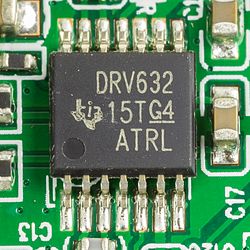
A line driver is an electronic amplifier circuit designed for driving a load such as a transmission line. The amplifier's output impedance may be matched to the characteristic impedance of the transmission line.
Line drivers are commonly used within digital systems, e.g. to communicate digital signals across circuit-board traces and cables.1
In analog audio, a line driver is typically used to drive line-level analog signal outputs, for example to connect a CD player to an amplified speaker system.1
References
References
- Bishop, Owen (2011). Electronics - Circuits and Systems. Routledge. p. 250. ISBN 9781136440434. Retrieved 18 April 2016.