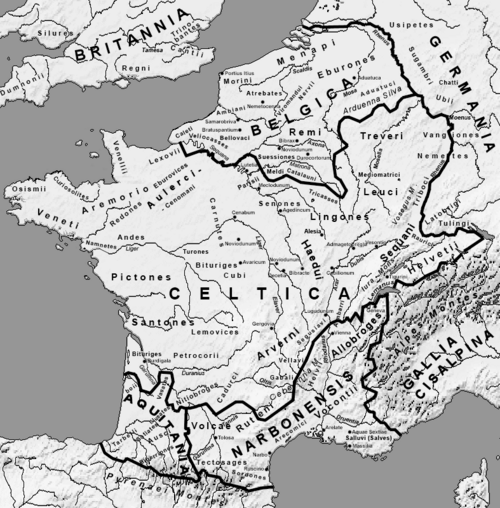

The Leucī (Gaulish: Leucoi, 'the bright, lightning ones') were a Belgic tribe dwelling in the southern part of the modern Lorraine region during the Iron Age and the Roman period.
Name
They are mentioned as Leucos (acc.) by Caesar (mid-1st c. BC),1 Leūkoi (Λευ̃κοι) by Strabo (early 1st c. AD),2 Leuci by Pliny (1st c. AD),3 and as Leukoì (Λευκοὶ) by Ptolemy (2nd c. AD).45
The ethnonym Leucī is a latinized form of Gaulish Leucoi (sing. Leucos), which literally means 'the bright ones, the lightning ones'. It stems from Proto-Celtic *lowkos ('light, bright'; cf. Mid. Irish luach 'glowing white', Middle Welsh llug 'eyesight, perception'), itself from Proto-Indo-European *leukós ('bright, shining'; cf. Lat. lūx 'light', Grk leukós 'white', Toch. lyūke 'light').67
Geography
Territory
The territory of the Leuci extended in the east and the southeast up to the Vosges mountains, between the Marne and Moselle rivers.8 They were located north-west of the Sequani, and southwest of the Mediomatrici.8
Settlements
During the Roman era, their capital was Tullum (modern Toul).98 Ptolemy (2nd c. AD), who normally gives one capital for each civitas, also lists Nasium (present-day Naix-aux-Forges) as a capital of the Leuci.10
Hillforts held by the Leuci included a large oppidum at Boviolles (Ornain valley), west of their territory, and some smaller ones located in the Vosges. The Roman-era successor of Boviolles was more imposing than the central city Tullum, since the Ornain river served as an important trade route between Champagne and the plateau of Langres, on the territory of the Lingones. Another possible oppidum was located at Geneviève (Essey).9
Religion
During the Roman era, the Leuci worshipped Apollo (at Graux and Malaincourt) or Apollo Grannus (at Tullum, Nasium, and Grand) around a spring and healing cult.8
History
They are mentioned by Julius Caesar as a people supplying wheat to the Roman army in 58 BC, along with the Lingones and Sequani.11
References
References
- Caesar. Commentarii de Bello Gallico, 1:40.
- Strabo. Geōgraphiká, 4:3:4.
- Pliny. Naturalis Historia, 4:106.
- Ptolemy. Geōgraphikḕ Hyphḗgēsis, 2:9:7.
- Falileyev 2010, s.v. Leuci.
- Delamarre 2003, p. 200.
- Matasović 2009, p. 245.
- Schön 2006.
- Wightman 1985, p. 32.
- Wightman 1985, p. 76.
- Gallic Wars, I.40
Bibliography
- Delamarre, Xavier (2003). Dictionnaire de la langue gauloise: Une approche linguistique du vieux-celtique continental. Errance. ISBN 9782877723695.
- Falileyev, Alexander (2010). Dictionary of Continental Celtic Place-names: A Celtic Companion to the Barrington Atlas of the Greek and Roman World. CMCS. ISBN 978-0955718236.
- Matasović, Ranko (2009). Etymological Dictionary of Proto-Celtic. Brill. ISBN 9789004173361.
- Schön, Franz (2006). "Leuci". Brill's New Pauly. doi:10.1163/1574-9347_bnp_e702460.
- Wightman, Edith M. (1985). Gallia Belgica. University of California Press. ISBN 978-0-520-05297-0.
Further reading
- Burnand, Yves (2008). "Une nouvelle inscription de "Nasium" (Naix-aux-Forges, Meuse) et le droit latin des Leuques". Latomus. 67 (4): 940–948. ISSN 0023-8856. JSTOR 41547639.
- Hornung, Sabine (2016). "Die Leuker – Verbündete Roms?". Siedlung und Bevölkerung in Ostgallien zwischen Gallischem Krieg und der Festigung der Römischen Herrschaft. Eine Studie auf Basis landschaftsarchäologischer Forschungen im Umfeld des Oppidums "Hunnenring" von Otzenhausen (Lkr. St. Wendel) (in German). Philipp von Zabern. pp. 411–428.