| Lesser dwarf shrew | |
|---|---|
Scientific classification 
| |
| Kingdom: | Animalia |
| Phylum: | Chordata |
| Class: | Mammalia |
| Infraclass: | Placentalia |
| Order: | Eulipotyphla |
| Family: | Soricidae |
| Genus: | Suncus |
| Species: | S. varilla
|
| Binomial name | |
| Suncus varilla (Thomas, 1895)
| |
| |
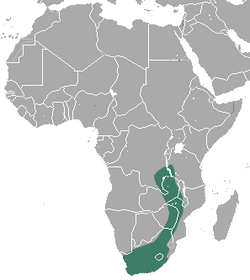
| Lesser dwarf shrew range | |
The lesser dwarf shrew (Suncus varilla) is a species of mammal in the genus Soricidae. It is found in Botswana, Democratic Republic of the Congo, Lesotho, Malawi, Mozambique, South Africa, Tanzania, Zambia, and Zimbabwe. 2 It has a total length of only 9cm, making it one of the smallest shrews. Most of its fur is grey and its lower body is off-white. Not much is known about its behavior and habitat, since it is hard to capture. It's often found in and near termite mounds, where it nests in and probably also forages. It feeds on insects.3
References
References
- Cassola, F. (2017). "Suncus varilla". IUCN Red List of Threatened Species. 2017 e.T41442A22288989. doi:10.2305/IUCN.UK.2017-2.RLTS.T41442A22288989.en. Retrieved 16 November 2021.
- Francesca Cassola (Global Mammal Assessment) (2016-09-02). "IUCN Red List of Threatened Species: Suncus varilla". IUCN Red List of Threatened Species. Archived from the original on 2025-04-30.
- Stuart, Chris; Stuart, Tilde (2007). Field Guide to Mammals of Southern Africa (4th, revised ed.). South Africa: Struik Publishers. p. 44. ISBN 978 1 77007 404 0.