 | |
| Identifiers | |
|---|---|
3D model (JSmol)
|
|
| ChemSpider | |
PubChem CID
|
|
CompTox Dashboard (EPA)
|
|
| |
| |
| Properties | |
| PbPo | |
| Molar mass | 416 g·mol−1 |
| Appearance | black crystals |
| Density | 9.64 g·cm−31 |
| Melting point | 550–630 °C(decomposes)2 |
| Related compounds | |
Other anions
|
|
Other cations
|
|
Except where otherwise noted, data are given for materials in their standard state (at 25 °C [77 °F], 100 kPa).
| |

Lead polonide is the polonide of lead, with the chemical formula of PbPo. It occurs naturally, as lead is produced in the alpha decay of polonium.3
Preparation
Lead polonide can be formed by reacting polonium vapour and lead under a vacuum.4
Properties
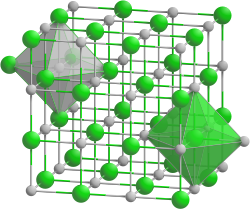
Lead polonide has a sodium chloride structure, which is the same as lead telluride. It has a cubic crystal structure, with the space group Fm3m (No. 225), with lattice constant a = 6.59 Å.5
References
References
- Moyer, Harvey V. (1956), Chemical Properties of Polonium, p. 96, doi:10.2172/4367751, OSTI 4367751
- Miura, Terumitsu; Obara, Toru; Sekimoto, Hiroshi (Nov 2007), "Experimental verification of thermal decomposition of lead polonide", Annals of Nuclear Energy, vol. 34, no. 11, pp. 926–930, Bibcode:2007AnNuE..34..926M, doi:10.1016/j.anucene.2007.05.009
- Weigel, F. (1959). "Chemie des Poloniums". Angewandte Chemie. 71 (9): 289–316. Bibcode:1959AngCh..71..289W. doi:10.1002/ange.19590710902.
- Witteman, W. G.; Giorgi, A. L.; Vier, D. T. (1960). "THE PREPARATION AND IDENTIFICATION OF SOME INTERMETALLIC COMPOUNDS OF POLONIUM1". The Journal of Physical Chemistry. 64 (4): 434–440. doi:10.1021/j100833a014. ISSN 0022-3654.
- Dalven, Richard (Dec 1973), Recent Studies Of Lead Polonide (PbPo), Lawrence Berkeley National Laboratory, archived from the original on 2021-06-28