 | |
 | |
| Names | |
|---|---|
| Preferred IUPAC name
2-Hydroxy-3-(3-methylbut-2-en-1-yl)naphthalene-1,4-dione | |
| Identifiers | |
| |
3D model (JSmol)
|
|
| ChEBI | |
| ChEMBL | |
| ChemSpider |
|
| ECHA InfoCard | 100.001.421 |
| EC Number |
|
PubChem CID
|
|
| UNII | |
CompTox Dashboard (EPA)
|
|
| |
| |
| Properties | |
| C15H14O3 | |
| Molar mass | 242.27 |
| Appearance | Yellow crystals |
| Melting point | 140 °C (284 °F; 413 K) |
Except where otherwise noted, data are given for materials in their standard state (at 25 °C [77 °F], 100 kPa).
| |


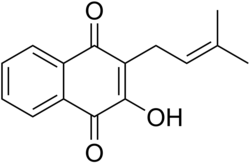
Lapachol is a natural phenolic compound isolated from the bark of the lapacho tree.3 This tree is known botanically as Handroanthus impetiginosus, but was formerly known by various other botanical names such as Tabebuia avellanedae.4 Lapachol is also found in other species of Handroanthus.
Lapachol is usually encountered as a yellow, skin-irritating powder from wood. Chemically, it is a derivative of vitamin K.5
Once studied as a possible treatment for some types of cancer, the levels of lapachol required for cancer treatment are considered too toxic for use as an in vivo chemotherapy treatment.6789
In 2024, A clinical trial published in the Journal of Cosmetic Dermatology determined that lower concentrations of lapachol were safe and efficacious in Facial Redness Reduction.10
References
References
- [1] Lapochol at R&D Chemicals.
- "ChromaDex Incorporated General Product Information for LAPACHOL(RG)". Archived from the original on 2007-09-28. Retrieved 2007-07-06. Lapochol at CromaDex.
- Record, Samuel J.. "Lapachol" pages 17-19. In: Tropical Woods (1925).
- Grose SO, Olmstead RG (2007). "Evolution of a Charismatic Neotropical Clade: Molecular Phylogeny of Tabebuia s.l., Crescentieae, and Allied Genera (Bignoniaceae)". Systematic Botany. 32 (3): 650–659. Bibcode:2007SysBo..32..650G. doi:10.1600/036364407782250553. S2CID 8824926.
- Louis F.Fieser. The Scientific Method pages 163-191. Reinhold Publishing Corporation, New York, 1964
- Felício AC, Chang CV, Brandão MA, Peters VM, Guerra Mde O (2002). "Fetal growth in rats treated with lapachol". Contraception. 66 (4): 289–93. doi:10.1016/S0010-7824(02)00356-6. PMID 12413627.
- Oral toxicology studies with lapachol. Morrison, Robert K.; Brown, Donald Emerson; Oleson, Jerome J.; Cooney, David A. Toxicology and Applied Pharmacology (1970), 17(1), 1-11.
- Guerra Mde O, Mazoni AS, Brandão MA, Peters VM (2001). "Toxicology of Lapachol in rats: embryolethality". Brazilian Journal of Biology. 61 (1): 171–4. doi:10.1590/s0034-71082001000100021. PMID 11340475.
- de Cássia da Silveira E, Sá R, de Oliveira Guerra M (2007). "Reproductive toxicity of lapachol in adult male Wistar rats submitted to short-term treatment". Phytotherapy Research. 21 (7): 658–62. doi:10.1002/ptr.2141. PMID 17421057.
{{cite journal}}: CS1 maint: multiple names: authors list (link) - Draelos Z (2024). "The Clinical Efficacy of Lapachol in Facial Redness Reduction". Journal of Cosmetic Dermatology. 23 (11): 3662–3666. doi:10.1111/jocd.16602. PMID 39328086.