| Incision and drainage | |
|---|---|
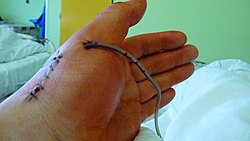 Hand with sutures and surgical drain | |
| Other names | Clinical lancing |
| Incision and drainage | |
|---|---|
| ICD-10-PCS | 0?9 |
| MeSH | D004322 |
Incision and drainage (I&D), also known as clinical lancing, are minor surgical procedures to release pus or pressure built up under the skin, such as from an abscess, boil, or infected paranasal sinus. It is performed by treating the area with an antiseptic, such as iodine-based solution, and then making a small incision to puncture the skin using a sterile instrument such as a sharp needle or a pointed scalpel. This allows the pus to escape by draining out through the incision.
Good medical practice for large abdominal abscesses requires insertion of a drainage tube, preceded by insertion of a peripherally inserted central catheter line to enable readiness of treatment for possible septic shock.
Adjunct antibiotics
Uncomplicated cutaneous abscesses do not necessarily require antibiotics after successful drainage.123 Adjunct antibiotics for uncomplicated cutaneous abscesses have a minimal increase in the resolution rate, while significantly increasing the prevalence of adverse medication side effects.4
It is reasonable to forego antibiotics in patients who meet all of the following criteria567:
- Single abscess
- Abscess less than 2 centimeters
- No or minimal surrounding cellulitis
- No systemic signs of toxicity (fever greater than 100.4 Fahrenheit, hypotension, sustained tachycardia)
- No immunosuppression or risk factors for infective endocarditis
- No indwelling medical devices
- No exposure to situations that could increase spread to others (e.g. contact sports, military barracks)
In incisional abscesses
For incisional abscesses, it is recommended that incision and drainage is followed by covering the area with a thin layer of gauze followed by sterile dressing. The dressing should be changed and the wound irrigated with normal saline at least twice each day.8 In addition, it is recommended to administer an antibiotic active against staphylococci and streptococci, preferably vancomycin when there is a risk of methicillin-resistant Staphylococcus aureus.8 The wound can be allowed to close by secondary intention. Alternatively, if the infection is cleared and healthy granulation tissue is evident at the base of the wound, the edges of the incision may be reapproximated, such as by using butterfly stitches, staples or sutures.8
References
References
- Macfie J, Harvey J (1977). "The treatment of acute superficial abscesses: a prospective clinical trial". The British Journal of Surgery. 64 (4): 264–6. doi:10.1002/bjs.1800640410. PMID 322789. S2CID 13519212.
- Llera JL, Levy RC (1985). "Treatment of cutaneous abscess: a double-blind clinical study". Annals of Emergency Medicine. 14 (1): 15–9. doi:10.1016/S0196-0644(85)80727-7. PMID 3880635.
- Lee MC, Rios AM, Aten MF, et al. (2004). "Management and outcome of children with skin and soft tissue abscesses caused by community-acquired methicillin-resistant Staphylococcus aureus". Pediatr. Infect. Dis. J. 23 (2): 123–7. doi:10.1097/01.inf.0000109288.06912.21. PMID 14872177. S2CID 32423795.
- Ting, Rhonda; Yang, Peter Ran; Mannarino, Marco; Lindblad, Adrienne J. (April 2019). "Adding antibiotics for abscess management". Canadian Family Physician Medecin de Famille Canadien. 65 (4): 267. ISSN 1715-5258. PMC 6467667. PMID 30979759.
- Rajendran, Priya M.; Young, David; Maurer, Toby; Chambers, Henry; Perdreau-Remington, Francoise; Ro, Peter; Harris, Hobart (November 2007). "Randomized, double-blind, placebo-controlled trial of cephalexin for treatment of uncomplicated skin abscesses in a population at risk for community-acquired methicillin-resistant Staphylococcus aureus infection". Antimicrobial Agents and Chemotherapy. 51 (11): 4044–4048. doi:10.1128/AAC.00377-07. ISSN 0066-4804. PMC 2151464. PMID 17846141.
- Duong, Myto; Markwell, Stephen; Peter, John; Barenkamp, Stephen (May 2010). "Randomized, controlled trial of antibiotics in the management of community-acquired skin abscesses in the pediatric patient". Annals of Emergency Medicine. 55 (5): 401–407. doi:10.1016/j.annemergmed.2009.03.014. ISSN 1097-6760. PMID 19409657.
- Schmitz, Gillian R.; Bruner, David; Pitotti, Rebecca; Olderog, Cameron; Livengood, Timothy; Williams, Justin; Huebner, Kermit; Lightfoot, Jeffrey; Ritz, Brandon; Bates, Christopher; Schmitz, Matthew; Mete, Mihriye; Deye, Gregory (September 2010). "Randomized controlled trial of trimethoprim-sulfamethoxazole for uncomplicated skin abscesses in patients at risk for community-associated methicillin-resistant Staphylococcus aureus infection". Annals of Emergency Medicine. 56 (3): 283–287. doi:10.1016/j.annemergmed.2010.03.002. ISSN 1097-6760. PMID 20346539.
- Duff, Patrick (2009). "Diagnosis and Management of Postoperative Infection". The Global Library of Women's Medicine. doi:10.3843/GLOWM.10032. ISSN 1756-2228.