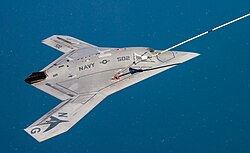
A lambda wing is a wing whose trailing edge resembles the Greek uppercase letter lambda (Λ). A lambda wing has a dramatically smaller radar cross section than a delta wing, and so is commonly featured on stealth aircraft—for example, the Northrop B-2 Spirit and Northrop Grumman B-21 Raider.1 Like these strategic bombers, aircraft with lambda wings are often tailless.1

An early experiment with a lambda wing on smaller aircraft was the McDonnell Douglas X-36, which first flew in 1997.2 Similar designs have been used on unmanned combat aerial vehicles (UCAVs), including the Boeing X-45, Northrop Grumman X-47B, Dassault nEUROn, and BAE Systems Taranis.3
The UK-Italian-Japanese Global Combat Air Programme considered but abandoned a lambda wing design.4 The wing is used in Lockheed Martin's "Vectis" proposal for the Collaborative Combat Aircraft program.5
In 2023, Beihang University researchers proposed moving wingtips as a solution to the wing’s aerodynamic instabilities, which caused the 2008 Andersen Air Force Base B-2 crash. The Chinese Shenyang J-50, known to be flight testing since 2024, is reported to use a lambda wing with moving wingtips.6 A tailless lambda wing UCAV dubbed "Type A" was displayed during the 2025 China Victory Day Parade.
The Boeing F-47 has been speculated to use a wing that resembles those of the X-36, the Boeing Bird of Prey, and IAIO Qaher-313.7
See also
See also
References
References
- Yuan, Chengen; Ma, Dongli; Jia, Yuhong; Yang, Muqing; Zhang, Liang (2023-10-01). "Numerical analysis of pitch-break and all moving wingtip aileron of lambda wing configuration". Aerospace Science and Technology. 141 108508. doi:10.1016/j.ast.2023.108508. ISSN 1270-9638.
- "Which Experimental Aircraft Might the F-47 Resemble: X-36 and Bird of Prey, or Why It Reflects McDonnell Douglas's Legacy? | Defense Express". en.defence-ua.com. Archived from the original on 2025-11-14. Retrieved 2025-11-21.
- Nangia, R. K.; Coppin, Joe; Ghoreyshi, Mehdi, "A UCAV Wing Design, Assessment and Comparisons.", 2018 Applied Aerodynamics Conference, American Institute of Aeronautics and Astronautics, doi:10.2514/6.2018-2842, retrieved 2025-11-21
- "Japan unveils concept of next-gen fighter". Defence Blog – Military and Defense News. 2024-10-18. Archived from the original on 2025-12-25. Retrieved 2025-11-21.
- "Lockheed Martin's Skunk Works Aims Vectis CCA at International Market". Aviation International News (AIN). Archived from the original on 2025-12-03. Retrieved 2025-11-21.
- Rogoway, Thomas Newdick, Tyler (2025-01-27). "China's Mysterious Tailless Stealth Fighter Has Swiveling Wingtips". The War Zone. Archived from the original on 2025-06-13. Retrieved 2025-11-21.
{{cite web}}: CS1 maint: multiple names: authors list (link) - Rogoway, Tyler (2025-03-24). "What The F-47's Canards Say About The Rest Of Its Design". The War Zone. Archived from the original on 2025-11-12. Retrieved 2025-11-21.