  | |
| Observation data Epoch J2000.0 Equinox J2000.0 | |
|---|---|
| Constellation | Ursa Minor |
| Right ascension | 17h 16m 56.4107s1 |
| Declination | +89° 02′ 15.734″1 |
| Apparent magnitude (V) | +6.382 |
| Characteristics | |
| Evolutionary stage | AGB3 |
| Spectral type | M3+ IIIa4 |
| U−B color index | +1.795 |
| B−V color index | +1.575 |
| Variable type | SRb6 |
| Astrometry | |
| Radial velocity (Rv) | +0.191 km/s |
| Proper motion (μ) | RA: −23.9891 mas/yr Dec.: 3.4631 mas/yr |
| Parallax (π) | 3.7084±0.1329 mas1 |
| Distance | 880 ± 30 ly (270 ± 10 pc) |
| Absolute magnitude (MV) | −0.857 |
| Details | |
| Radius | 641 R☉ |
| Luminosity | 7411 L☉ |
| Temperature | 3,7721 K |
| Other designations | |
| HR 7394, HD 183030, BD+88°112, FK5 914, HIP 84535, SAO 3020 | |
| Database references | |
| SIMBAD | data |
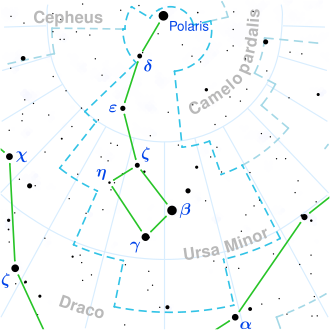
Lambda Ursae Minoris (λ UMi, λ Ursae Minoris) is a star in the constellation Ursa Minor. It is an M-type red giant with an apparent magnitude of +6.38, making it very faintly visible to the naked eye under the best observing conditions. It is approximately 880 light years from Earth.

Lambda Ursae Minoris is an asymptotic giant branch (AGB) star, a star that has exhausted its core hydrogen and helium and is now fusing material in shells outside its core.3 AGB stars are often unstable and tend to pulsate, and Lambda Ursae Minoris is classified as a semiregular variable star and its brightness varies by about 0.1 magnitudes.6 Its variability was discovered by the Hipparcos satellite and it was entered into the General Catalogue of Variable Stars in 1999.9
This star was used from 1882 as a reference to measure the magnitudes of stars in the northern hemisphere for the 1908 Revised Harvard Photometry catalogue. Sigma Octantis was used for the southern hemisphere. It was then noted that "Neither of these stars appears to vary perceptibly" but that, due to the procedures used "if they did, the variation would have no effect on the final measures."10
References
References
- Brown, A. G. A.; et al. (Gaia collaboration) (August 2018). "Gaia Data Release 2: Summary of the contents and survey properties". Astronomy & Astrophysics. 616. A1. arXiv:1804.09365. Bibcode:2018A&A...616A...1G. doi:10.1051/0004-6361/201833051. Gaia DR2 record for this source at VizieR.
- Ducati, J. R. (2002). "VizieR On-line Data Catalog: Catalogue of Stellar Photometry in Johnson's 11-color system". VizieR On-line Data Catalog. 2237. Bibcode:2002yCat.2237....0D.
- Eggen, Olin J. (1992). "Asymptotic Giant Branch Stars Near the Sun". The Astronomical Journal. 104: 275. Bibcode:1992AJ....104..275E. doi:10.1086/116239.
- Yamashita, Y. (1967). "MK Spectral Types of Bright M-Type Stars". Publications of the Dominion Astrophysical Observatory Victoria. 13: 47. Bibcode:1967PDAO...13...47Y.
- Hoffleit, Dorrit; Jaschek, Carlos (1991). The Bright star catalogue. Bibcode:1991bsc..book.....H.
- Samus, N. N.; Durlevich, O. V.; et al. (2009). "VizieR Online Data Catalog: General Catalogue of Variable Stars (Samus+ 2007-2013)". VizieR On-line Data Catalog: B/GCVS. Originally Published in: 2009yCat....102025S. 1: B/GCVS. Bibcode:2009yCat....102025S.
- Anderson, E.; Francis, Ch. (2012). "XHIP: An extended hipparcos compilation". Astronomy Letters. 38 (5): 331. arXiv:1108.4971. Bibcode:2012AstL...38..331A. doi:10.1134/S1063773712050015. S2CID 119257644.
- "/ftp/cats/more/HIP/cdroms/cats". Centre de Données astronomiques de Strasbourg. Strasbourg astronomical Data Center. Retrieved 15 October 2022.
- Kazarovets, E. V.; Samus, N. N.; Durlevich, O. V.; Frolov, M. S.; Antipin, S. V.; Kireeva, N. N.; Pastukhova, E. N. (1999). "The 74th Special Name-list of Variable Stars". Information Bulletin on Variable Stars. 4659: 1. Bibcode:1999IBVS.4659....1K.
- Pickering, Edward Charles (1908). "Revised Harvard Photometry". Annals of the Astronomical Observatory of Harvard College. 50: 2. Bibcode:1908AnHar..50....1P.
External links
External links
- Lambda Ursae Minoris on WikiSky: DSS2, SDSS, GALEX, IRAS, Hydrogen α, X-Ray, Astrophoto, Sky Map, Articles and images
- LAMBDA UMI (Lambda Ursae Minoris) – Jim Kaler