  | |
| Observation data Epoch J2000 Equinox J2000 | |
|---|---|
| Constellation | Scorpius |
| Pronunciation | /ˈʃɔːlə/12 |
| Right ascension | 17h 33m 36.520s3 |
| Declination | −37° 06′ 13.76″3 |
| Apparent magnitude (V) | 1.634 |
| Characteristics | |
| Evolutionary stage | Main sequence (A and B)5 + pre-main sequence (a)6 |
| Spectral type | B1.5IV + B2IV57 |
| U−B color index | −0.8808 |
| B−V color index | −0.2408 |
| Variable type | Beta Cephei (Aa1)6 + Algol (Aa1/2) 9 |
| Astrometry | |
| Radial velocity (Rv) | −3.0010 km/s |
| Proper motion (μ) | RA: −8.903 mas/yr3 Dec.: −29.95 mas/yr3 |
| Parallax (π) | 5.71±0.90 mas3 |
| Distance | approx. 570 ly (approx. 180 pc) |
| Absolute magnitude (MV) | −3.7011 |
| Orbit12 | |
| Primary | Aa |
| Name | Ab |
| Period (P) | 2.8825 yr |
| Semi-major axis (a) | 49.3 mas |
| Eccentricity (e) | 0.121 |
| Inclination (i) | 77.2° |
| Orbit12 | |
| Primary | Aa1 |
| Name | Aa2 |
| Period (P) | 5.9520 d |
| Eccentricity (e) | 0.26 |
| Semi-amplitude (K1) (primary) | 39.3 km/s |
| Details | |
| λ Sco Aa1 (A) | |
| Mass | 10.45 M☉ |
| Radius | 8.8±1.26 R☉ |
| Luminosity | 36,3006 L☉ |
| Surface gravity (log g) | 3.87 cgs |
| Temperature | 25,000±1,0006 K |
| Rotation | 3.4±0.56 days |
| Rotational velocity (v sin i) | 1506 km/s |
| λ Sco Aa2 (a) | |
| Mass | 2.0±0.26 M☉ |
| Radius | 1.5±0.26 R☉ |
| λ Sco Ab (B) | |
| Mass | 8.15 M☉ |
| Radius | 4.7±1.06 R☉ |
| Surface gravity (log g) | 4.07 cgs |
| Temperature | 25,000±1,0006 K |
| Other designations | |
| Shaula, 35 Scorpii, 35 Sco, CD−37 11673, FK5 652, HD 158926, HIP 85927, HR 6527, SAO 208954, CCDM J17336-3706A | |
| Database references | |
| SIMBAD | data |
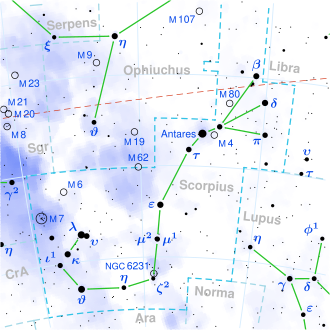
Lambda Scorpii is a triple star system and the second-brightest object in the constellation of Scorpius. It is formally named Shaula; Lambda Scorpii is its Bayer designation, which is Latinised from λ Scorpii and abbreviated Lambda Sco or λ Sco. With an apparent visual magnitude of 1.63, it is one of the brightest stars in the night sky.
Nomenclature
λ Scorpii (Latinised to Lambda Scorpii) is the star system's Bayer designation.
It bore the traditional name Shaula, which comes from the Arabic الشولاء al-šawlā´ meaning 'the raised [tail]', as it is found in the tail of Scorpius, the scorpion. In 2016, the International Astronomical Union organized a Working Group on Star Names (WGSN)13 to catalog and standardize proper names for stars. The WGSN's first bulletin of July 201614 included a table of the first two batches of names approved by the WGSN, which included Shaula for the star λ Scorpii Aa1.
In Indian astronomy, it is part of the asterism Mula with other stars in the tail of Scorpius. Mūla ("root") (Devanagari मूल/मूळ) (Tamil: மூலம்) is the 19th nakshatra or "lunar mansion" in Vedic astrology. The symbol of Mula is a bunch of roots tied together (reticulated roots) or an 'elephant goad' (ankusha).15
In Chinese, 尾宿 (Wěi Xiù), meaning Tail, refers to an asterism consisting of λ Scorpii, ε Scorpii, ζ1 Scorpii, ζ2 Scorpii, η Scorpii, θ Scorpii, ι1 Scorpii, ι2 Scorpii, κ Scorpii, μ1 Scorpii, and υ Scorpii.16 Consequently, the Chinese name for λ Scorpii itself is 尾宿八 (Wěi Xiù bā), "the Eighth Star of Tail".17
Together with υ Scorpii (Lesath), Shaula is listed in the Babylonian compendium MUL.APIN as dSharur4 u dShargaz, meaning "Sharur and Shargaz".18 In Coptic, these two stars were called Minamref.19
The indigenous Boorong people of northwestern Victoria (Australia) named it (together with Upsilon Scorpii) Karik Karik,20 "the Falcons".21
Properties

Lambda Scorpii is located approximately 570 light-years away from the Sun.
Spectroscopic and interferometric observations have shown that it is actually a triple star system consisting of two B-type stars and a pre-main-sequence star.6 The primary star is a Beta Cephei variable star with rapid brightness changes of about a hundredth of a magnitude.75 The pre-main-sequence star has an orbital period of 6 days and the B-type companion has a period of 1,053 days. The three stars lie in the same orbital plane, strongly suggesting that they were formed at the same time. The masses of the primary, pre-main-sequence star and the B-type companion are 14.5, 2.0 and 10.6 solar masses, respectively. The age of the system is estimated to be in the range 10–13 million years. Shaula Aa1 has sufficient mass to explode as a supernova.23
A 15th-magnitude star has a separation of 42 arcseconds, whereas a 12th-magnitude star is 95 arcseconds away. It is not known whether or not these components are physically associated with Lambda Scorpii. If they both were, the first would have a projected linear separation of approximately 7,500 astronomical units (AU) and the second approximately 17,000 AU (0.27 light-years) away. Gaia Data Release 3 reports that the fainter of these two stars is a little larger and brighter than the sun and about 420 light years away,24 while the brighter star is a background object.25
In culture
Shaula appears on the flag of Brazil, symbolizing the state of Rio Grande do Norte.
USS Shaula (AK-118) was a U.S. Navy Crater-class cargo ship named after the star.
Shaula is the namesake of a character in Re:Zero, a Japanese web/light novel series by Tappei Nagatsuki.
References
References
- Kunitzsch, Paul; Smart, Tim (2006). A Dictionary of Modern star Names: A Short Guide to 254 Star Names and Their Derivations (2nd rev. ed.). Cambridge, Massachusetts: Sky Pub. ISBN 978-1-931559-44-7.
- "IAU Catalog of Star Names". Retrieved 28 July 2016.
- Van Leeuwen, F. (2007). "Validation of the new Hipparcos reduction". Astronomy and Astrophysics. 474 (2): 653–664. arXiv:0708.1752. Bibcode:2007A&A...474..653V. doi:10.1051/0004-6361:20078357. S2CID 18759600.
- Høg, E.; Fabricius, C.; Makarov, V. V.; Urban, S.; Corbin, T.; Wycoff, G.; Bastian, U.; Schwekendiek, P.; Wicenec, A. (2000). "The Tycho-2 catalogue of the 2.5 million brightest stars". Astronomy and Astrophysics. 355. Bibcode:2000A&A...355L..27H.
- Tango, W. J.; Davis, J.; Ireland, M. J.; Aerts, C.; Uytterhoeven, K.; Jacob, A. P.; Mendez, A.; North, J. R.; Seneta, E. B.; Tuthill, P. G. (2006). "Orbital elements, masses and distance of λ Scorpii a and B determined with the Sydney University Stellar Interferometer and high-resolution spectroscopy". Monthly Notices of the Royal Astronomical Society. 370 (2): 884–890. arXiv:astro-ph/0605311. Bibcode:2006MNRAS.370..884T. doi:10.1111/j.1365-2966.2006.10526.x. S2CID 13971499.
- Handler, G.; Schwarzenberg-Czerny, A. (2013). "Time-resolved multicolour photometry of bright B-type variable stars in Scorpius". Astronomy & Astrophysics. 557: A1. arXiv:1307.2733. Bibcode:2013A&A...557A...1H. doi:10.1051/0004-6361/201321886. S2CID 56403146.
- Uytterhoeven, K.; Willems, B.; Lefever, K.; Aerts, C.; Telting, J. H.; Kolb, U. (2004). "Interpretation of the variability of the β Cephei star λ Scorpii". Astronomy and Astrophysics. 427 (2): 581–592. Bibcode:2004A&A...427..581U. doi:10.1051/0004-6361:20041223. hdl:2066/60554.
- Hamdy, M. A.; Abo Elazm, M. S.; Saad, S. M. (1993). "A catalogue of spectral classification and photometric data of B-type stars". Astrophysics and Space Science. 203 (1): 53–107. Bibcode:1993Ap&SS.203...53H. doi:10.1007/BF00659414. S2CID 122459090.
- "Lambda Sco". International Variable Star Index. AAVSO. Retrieved 2025-08-20.
- Gontcharov, G. A. (2006). "Pulkovo Compilation of Radial Velocities for 35 495 Hipparcos stars in a common system". Astronomy Letters. 32 (11): 759–771. arXiv:1606.08053. Bibcode:2006AstL...32..759G. doi:10.1134/S1063773706110065. S2CID 119231169.
- Balona, L. A.; Feast, M. W. (1975). "The luminosities of the beta Canis Majoris variables, the zero age main sequence and the distance of the Sco-Cen association". Monthly Notices of the Royal Astronomical Society. 172 (1): 191–203. Bibcode:1975MNRAS.172..191B. doi:10.1093/mnras/172.1.191.
- Tokovinin, Andrei (2018-03-01). "The Updated Multiple Star Catalog". The Astrophysical Journal Supplement Series. 235 (1): 6. arXiv:1712.04750. Bibcode:2018ApJS..235....6T. doi:10.3847/1538-4365/aaa1a5. ISSN 0067-0049. S2CID 119047709.
- "IAU Working Group on Star Names (WGSN)". Archived from the original on 15 July 2018. Retrieved 22 May 2016.
- "Bulletin of the IAU Working Group on Star Names, No. 1" (PDF). Retrieved 28 July 2016.
- "Mula". All Skies Encyclopaedia. IAU Working Group on Star Names. Retrieved 20 August 2025.
- (in Chinese) 中國星座神話, written by 陳久金. Published by 台灣書房出版有限公司, 2005, ISBN 978-986-7332-25-7.
- (in Chinese) 香港太空館 - 研究資源 - 亮星中英對照表 Archived 2008-10-25 at the Wayback Machine, Hong Kong Space Museum. Accessed on line November 23, 2010.
- Rogers, J. H. (February 1998). "Origins of the ancient constellations: I. The Mesopotamian traditions". Journal of the British Astronomical Association. 108 (1): 9–28. Bibcode:1998JBAA..108....9R.
- Robert Burnham (1978). Burnham's Celestial Handbook: An Observer's Guide to the Universe Beyond the Solar System. New York: Courier Corporation. p. 1678. ISBN 978-0-486-23673-5.
- Hamacher, Duane W.; Frew, David J. (2010). "An Aboriginal Australian Record of the Great Eruption of Eta Carinae". Journal of Astronomical History and Heritage. 13 (3): 220–34. arXiv:1010.4610. Bibcode:2010JAHH...13..220H. doi:10.3724/SP.J.1440-2807.2010.03.06. S2CID 118454721.
- Stanbridge, William Edward (1857). "On the astronomy and mythology of the Aborigines of Victoria". Proceedings of the Philosophical Institute of Victoria. 2: 137. Bibcode:1857PPIVT...2..137S.
- "MAST: Barbara A. Mikulski Archive for Space Telescopes". Space Telescope Science Institute. Retrieved 8 December 2021.
- "Shaula". stars.astro.illinois.edu. Retrieved 2026-05-09.
- Vallenari, A.; et al. (Gaia collaboration) (2023). "Gaia Data Release 3. Summary of the content and survey properties". Astronomy and Astrophysics. 674: A1. arXiv:2208.00211. Bibcode:2023A&A...674A...1G. doi:10.1051/0004-6361/202243940. S2CID 244398875. Gaia DR3 record for this source at VizieR.
- Vallenari, A.; et al. (Gaia collaboration) (2023). "Gaia Data Release 3. Summary of the content and survey properties". Astronomy and Astrophysics. 674: A1. arXiv:2208.00211. Bibcode:2023A&A...674A...1G. doi:10.1051/0004-6361/202243940. S2CID 244398875. Gaia DR3 record for this source at VizieR.