  | |
| Observation data Epoch J2000.0 Equinox J2000.0 (ICRS) | |
|---|---|
| Constellation | Libra |
| Right ascension | 15h 53m 20.05463s1 |
| Declination | −20° 10′ 01.4177″1 |
| Apparent magnitude (V) | 5.032 |
| Characteristics | |
| Spectral type | B3 V3 |
| U−B color index | −0.5842 |
| B−V color index | −0.0232 |
| Variable type | Rotating ellipsoidal4 |
| Astrometry | |
| Radial velocity (Rv) | −2.0±0.55 km/s |
| Proper motion (μ) | RA: −9.811 mas/yr Dec.: −26.851 mas/yr |
| Parallax (π) | 10.54±0.91 mas1 |
| Distance | 310 ± 30 ly (95 ± 8 pc) |
| Absolute magnitude (MV) | 0.566 |
| Orbit7 | |
| Period (P) | 14.4829±0.0004 d |
| Eccentricity (e) | 0.27±0.09 |
| Periastron epoch (T) | 2435172.380 ± 0.664 JD |
| Argument of periastron (ω) (secondary) | 217±17° |
| Semi-amplitude (K1) (primary) | 28.5±3.3 km/s |
| Details | |
| Mass | 5.01±0.268 M☉ |
| Radius | 3.99 R☉ |
| Luminosity | 7438 L☉ |
| Surface gravity (log g) | 4.75 cgs |
| Temperature | 18,7008 K |
| Metallicity [Fe/H] | −0.27 dex |
| Rotational velocity (v sin i) | 15510 km/s |
| Age | 2826 Myr |
| Other designations | |
| λ Lib, 45 Lib, BD−19°4249, FK5 1415, HD 142096, HIP 77811, HR 5902, SAO 183895.11 | |
| Database references | |
| SIMBAD | data |
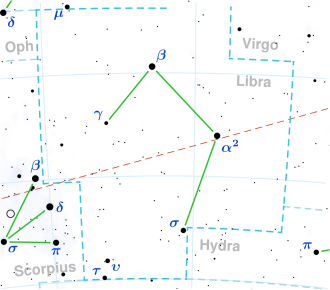
λ Librae (Latinised as Lambda Librae) is the Bayer designation for a binary star system in the zodiac constellation of Libra. It can be faintly seen with the naked eye, having an apparent visual magnitude of 5.03.2 With an annual parallax shift of 10.54 mas,1 it is roughly 310 light years from the Sun. At that distance, the visual magnitude of this system is diminished by an extinction factor of 0.22 due to interstellar dust.6 It is 0.1 degree north of the ecliptic.

This is a single-lined spectroscopic binary star system with an orbital period of 14.48 days and an eccentricity of 0.27.7 The visible component is a B-type main sequence star with a stellar classification of B3 V.3 It is a helium-weak chemically peculiar star13 and a rotating ellipsoidal variable.4 The star has an estimated 3.99 times the radius of the Sun and five times the Sun's mass.8 This is a candidate Vega-like star, meaning that it shows an infrared excess characteristic of a circumstellar debris disk.14 The system is a source of X-ray emission.15
References
References
- van Leeuwen, F. (2007), "Validation of the new Hipparcos reduction", Astronomy and Astrophysics, 474 (2): 653–664, arXiv:0708.1752, Bibcode:2007A&A...474..653V, doi:10.1051/0004-6361:20078357, S2CID 18759600.
- Gutierrez-Moreno, Adelina; Moreno, Hugo (June 1968), "A photometric investigation of the Scorpio-Centaurus association", Astrophysical Journal Supplement, 15: 459, Bibcode:1968ApJS...15..459G, doi:10.1086/190168.
- Houk, Nancy; Smith-Moore, M. (1978), Michigan catalogue of two-dimensional spectral types for the HD stars, vol. 4, Ann Arbor: Dept. of Astronomy, University of Michigan, Bibcode:1988mcts.book.....H.
- Hoffleit, Dorrit (1996), "A Catalogue of Correlations Between Eclipsing Binaries and Other Categories of Double Stars", The Journal of the American Association of Variable Star Observers, 24 (2): 105–116, Bibcode:1996JAVSO..24..105H.
- de Bruijne, J. H. J.; Eilers, A.-C. (October 2012), "Radial velocities for the HIPPARCOS-Gaia Hundred-Thousand-Proper-Motion project", Astronomy & Astrophysics, 546: 14, arXiv:1208.3048, Bibcode:2012A&A...546A..61D, doi:10.1051/0004-6361/201219219, S2CID 59451347, A61.
- Gontcharov, G. A. (November 2012), "Spatial distribution and kinematics of OB stars", Astronomy Letters, 38 (11): 694–706, arXiv:1606.09028, Bibcode:2012AstL...38..694G, doi:10.1134/S1063773712110035, S2CID 119108982.
- Pourbaix, D.; Tokovinin, A. A.; Batten, A. H.; Fekel, F. C.; Hartkopf, W. I.; et al. (2004), "SB9: The ninth catalogue of spectroscopic binary orbits", Astronomy & Astrophysics, 424 (2): 727–732, arXiv:astro-ph/0406573, Bibcode:2004A&A...424..727P, doi:10.1051/0004-6361:20041213, S2CID 119387088.
- Hohle, M. M.; Neuhäuser, R.; Schutz, B. F. (April 2010), "Masses and luminosities of O- and B-type stars and red supergiants", Astronomische Nachrichten, 331 (4): 349, arXiv:1003.2335, Bibcode:2010AN....331..349H, doi:10.1002/asna.200911355, S2CID 111387483.
- Pasinetti Fracassini, L. E.; et al. (February 2001), "Catalogue of Apparent Diameters and Absolute Radii of Stars (CADARS) – Third edition – Comments and statistics", Astronomy and Astrophysics, 367 (2): 521–524, arXiv:astro-ph/0012289, Bibcode:2001A&A...367..521P, doi:10.1051/0004-6361:20000451, S2CID 425754.
- Abt, Helmut A.; et al. (2002), "Rotational Velocities of B Stars", The Astrophysical Journal, 573 (1): 359–365, Bibcode:2002ApJ...573..359A, doi:10.1086/340590.
- "lam Lib -- Spectroscopic binary", SIMBAD Astronomical Database, Centre de Données astronomiques de Strasbourg, retrieved 2017-01-30.
- Wraight, K. T.; Fossati, L.; Netopil, M.; Paunzen, E.; Rode-Paunzen, M.; Bewsher, D.; Norton, A. J.; White, Glenn J. (February 2012). "A photometric study of chemically peculiar stars with the STEREO satellites – I. Magnetic chemically peculiar stars". Monthly Notices of the Royal Astronomical Society. 420 (1): 757–772. arXiv:1110.6283. Bibcode:2012MNRAS.420..757W. doi:10.1111/j.1365-2966.2011.20090.x.
- Renson, P.; Manfroid, J. (May 2009), "Catalogue of Ap, HgMn and Am stars", Astronomy and Astrophysics, 498 (3): 961–966, Bibcode:2009A&A...498..961R, doi:10.1051/0004-6361/200810788.
- Saffe, C.; Gómez, M.; Pintado, O.; González, E. (October 2008), "Spectroscopic metallicities of Vega-like stars", Astronomy and Astrophysics, 490 (1): 297–305, arXiv:0805.3936, Bibcode:2008A&A...490..297S, doi:10.1051/0004-6361:200810260, S2CID 15059920.
- Berghoefer, T. W.; Schmitt, J. H. M. M.; Cassinelli, J. P. (September 1996), "The ROSAT all-sky survey catalogue of optically bright OB-type stars", Astronomy and Astrophysics Supplement, 118 (3): 481–494, Bibcode:1996A&AS..118..481B, doi:10.1051/aas:1996213.