  | |
| Observation data Epoch J2000.0 Equinox J2000.0 (ICRS) | |
|---|---|
| Constellation | Eridanus |
| Right ascension | 05h 09m 08.78315s1 |
| Declination | −08° 45′ 14.6908″1 |
| Apparent magnitude (V) | 4.272 |
| Characteristics | |
| Spectral type | B2 IVne3 or B2 III(e)p4 |
| U−B color index | −0.902 |
| B−V color index | −0.192 |
| Variable type | λ Eri5 |
| Astrometry | |
| Radial velocity (Rv) | −2.51±5.436 km/s |
| Proper motion (μ) | RA: +0.251 mas/yr Dec.: −1.971 mas/yr |
| Parallax (π) | 4.02±0.18 mas1 |
| Distance | 810 ± 40 ly (250 ± 10 pc) |
| Absolute magnitude (MV) | −3.753 |
| Details | |
| Mass | 9.27 M☉ |
| Radius | 7.318 R☉ |
| Luminosity | 14,6899 L☉ |
| Surface gravity (log g) | 4.3210 cgs |
| Temperature | 22,36210 K |
| Metallicity [Fe/H] | −2.010 dex |
| Rotation | 1.40346 d3 |
| Rotational velocity (v sin i) | 3189 km/s |
| Age | 21.07 Myr |
| Other designations | |
| λ Eridani, 69 Eridani, BD−08°1040, FK5 190, HD 33328, HIP 23972, HR 1679, SAO 13182411 | |
| Database references | |
| SIMBAD | data |
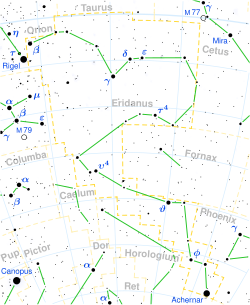
Lambda Eridani (λ Eri) is a star in the constellation Eridanus. It is visible to the naked eye on a dark night with an apparent visual magnitude of 4.27. The distance to this star, based upon an annual parallax shift of 0.00402 arcseconds, is roughly 810 light years.

λ Eri is classified in the General Catalogue of Variable Stars as a Beta Cephei variable.13 The AAVSO International Variable Star Index defines a LERI type of variation. λ Eri is classified as LERI + GCAS since it shows both short term periodic variations and longer timescale eruptive variation.5 It was one of the first stars where short-period variations were found.3 The line profile variability periods are 0.702d and 0.269d, with intermittently present periods of 0.6d and 0.75d. The photometric amplitude of the variation is 0.010 magnitude.4
This is a giant or subgiant Be star with a stellar classification of B2 IVne3 or B2 III(e)p,4 depending on the source. It is spinning rapidly with a projected rotational velocity of 327 km/s.6 Compare this to the estimated break-up velocity of 440 km/s.14 This rotation is giving the star an oblate shape with an equatorial bulge that is 25% larger than the polar radius.15 The most likely rotation period is deemed to be twice the period of variation, or 1.4 days.3 The star also possesses a rotating circumstellar disc, seen edge on, which makes Lambda Eri a "shell star", where the disk appears more opaque than usual. 16
Like most Be stars, Lambda Eridani emits soft X-rays. In 1993, a giant X-ray flare was observed in which the X-ray luminosity increased by a factor of six over a 39-hour period.3 Lambda Eridani has about nine times the mass of the Sun, and seven times the Sun's radius. It radiates 14,700 times the solar luminosity from its outer atmosphere at an effective temperature of 22,362 K.
References
References
- van Leeuwen, F. (2007). "Validation of the new Hipparcos reduction". Astronomy and Astrophysics. 474 (2): 653–664. arXiv:0708.1752. Bibcode:2007A&A...474..653V. doi:10.1051/0004-6361:20078357. S2CID 18759600.
- Hoffleit, D.; Warren, W. H. (1995). "Bright Star Catalogue". VizieR On-line Data Catalog: V/50. Originally Published in: 1964BS....C......0H. 5050 (5th Revised ed.). Bibcode:1995yCat.5050....0H.
- Balona, L. A.; James, D. J. (May 2002). "Short-period line profile and light variations in the Be star λ Eridani". Monthly Notices of the Royal Astronomical Society. 332 (3): 714–722. Bibcode:2002MNRAS.332..714B. doi:10.1046/j.1365-8711.2002.05336.x.
- Rivinius, Th.; et al. (November 2003). "Non-radially pulsating Be stars". Astronomy and Astrophysics. 411 (2): 229–247. Bibcode:2003A&A...411..229R. doi:10.1051/0004-6361:20031285.
- Otero, S. A.; et al. "Variable Star Type Designations in the VSX". AAVSO Website. American Association of Variable Star Observers. Retrieved 19 July 2014.
- Becker, Juliette C.; et al. (April 2015). "Extracting Radial Velocities of A- and B-type Stars from Echelle Spectrograph Calibration Spectra". The Astrophysical Journal Supplement Series. 217 (2): 13. arXiv:1503.03874. Bibcode:2015ApJS..217...29B. doi:10.1088/0067-0049/217/2/29. S2CID 33968873. 29.
- Tetzlaff, N.; et al. (January 2011). "A catalogue of young runaway Hipparcos stars within 3 kpc from the Sun". Monthly Notices of the Royal Astronomical Society. 410 (1): 190–200. arXiv:1007.4883. Bibcode:2011MNRAS.410..190T. doi:10.1111/j.1365-2966.2010.17434.x. S2CID 118629873.
- Arcos, C.; et al. (March 2018). "Stellar parameters and H α line profile variability of Be stars in the BeSOS survey". Monthly Notices of the Royal Astronomical Society. 474 (4): 5287–5299. arXiv:1711.08675. Bibcode:2018MNRAS.474.5287A. doi:10.1093/mnras/stx3075.
- Zorec, J.; Frémat, Y.; Domiciano De Souza, A.; Royer, F.; Cidale, L.; Hubert, A.-M.; Semaan, T.; Martayan, C.; Cochetti, Y. R.; Arias, M. L.; Aidelman, Y.; Stee, P. (2017). "Critical study of the distribution of rotational velocities of Be stars". Astronomy & Astrophysics. 595: A132. arXiv:1702.07684. Bibcode:2016A&A...595A.132Z. doi:10.1051/0004-6361/201628760.
- Cardiel, Nicolás; Zamorano, Jaime; Bará, Salvador; Sánchez De Miguel, Alejandro; Cabello, Cristina; Gallego, Jesús; García, Lucía; González, Rafael; Izquierdo, Jaime; Pascual, Sergio; Robles, José; Sánchez, Ainhoa; Tapia, Carlos (2021). "Synthetic RGB photometry of bright stars: Definition of the standard photometric system and UCM library of spectrophotometric spectra". Monthly Notices of the Royal Astronomical Society. 504 (3): 3730. arXiv:2103.17009. Bibcode:2021MNRAS.504.3730C. doi:10.1093/mnras/stab997.
- "lam Eri". SIMBAD. Centre de données astronomiques de Strasbourg. Retrieved 2016-11-01.
- "MAST: Barbara A. Mikulski Archive for Space Telescopes". Space Telescope Science Institute. Retrieved 8 December 2021.
- Samus, N. N.; Durlevich, O. V.; et al. (2009). "VizieR Online Data Catalog: General Catalogue of Variable Stars (Samus+ 2007-2013)". VizieR. 1. Bibcode:2009yCat....102025S.
- Frémat, Y.; et al. (2005). "Effects of gravitational darkening on the determination of fundamental parameters in fast-rotating B-type stars". Astronomy and Astrophysics. 440 (1): 305–320. arXiv:astro-ph/0503381. Bibcode:2005A&A...440..305F. doi:10.1051/0004-6361:20042229. S2CID 19016751.
- van Belle, Gerard T. (March 2012). "Interferometric observations of rapidly rotating stars". The Astronomy and Astrophysics Review. 20 (1): 51. arXiv:1204.2572. Bibcode:2012A&ARv..20...51V. doi:10.1007/s00159-012-0051-2. S2CID 119273474.
- "Lambda Eridani". stars.astro.illinois.edu. Retrieved 2018-08-20.