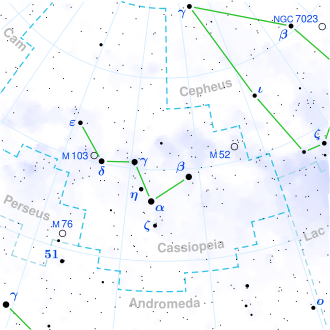
  | |
| Observation data Epoch J2000.0 Equinox ICRS | |
|---|---|
| Constellation | Cassiopeia1 |
| Right ascension | 00h 31m 46.35935s2 |
| Declination | +54° 31′ 20.2257″2 |
| Apparent magnitude (V) | 4.7723 (5.33 / 5.62)4 |
| Characteristics | |
| Spectral type | B8 Vnn1 |
| U−B color index | −0.355 |
| B−V color index | −0.105 |
| Astrometry | |
| Radial velocity (Rv) | −12.20±1.36 km/s |
| Proper motion (μ) | RA: +41.20±0.292 mas/yr2 Dec.: −16.54±0.35 mas/yr2 |
| Parallax (π) | 8.64±0.43 mas2 |
| Distance | 380 ± 20 ly (116 ± 6 pc) |
| Absolute magnitude (MV) | −0.571 |
| Orbit4 | |
| Period (P) | 245.70±35.96 yr |
| Semi-major axis (a) | 0.448±0.028″ |
| Eccentricity (e) | 0.689±0.119 |
| Inclination (i) | 53.6±5.2° |
| Longitude of the node (Ω) | 17.6±9.6° |
| Periastron epoch (T) | 2025.54±4.56 |
| Argument of periastron (ω) (secondary) | 301.0±2.6° |
| Details | |
| λ Cas A | |
| Mass | 2.9+0.45 −0.407 M☉ |
| Radius | 3.508 R☉ |
| Luminosity | 2551 L☉ |
| Surface gravity (log g) | 4.0±0.257 cgs |
| Temperature | 12,000±1,0007 K |
| Rotational velocity (v sin i) | 2539 km/s |
| Age | 58+104 −487 Myr |
| Other designations | |
| λ Cas, 14 Cassiopeiae, BD+53°82, HD 2772, HIP 2505, HR 123, SAO 21489, ADS 434, CCDM J00318+5431, WDS J00318+5431AB10 | |
| Database references | |
| SIMBAD | λ Cas |
| λ Cas A | |
| λ Cas B | |
Lambda Cassiopeiae is a binary star system in the northern constellation of Cassiopeia. Its name is a Bayer designation that is Latinized from λ Cassiopeiae, and abbreviated Lambda Cas or λ Cas. The system has a combined apparent magnitude of +4.74, making it faintly visible to the naked eye. With an annual parallax shift of 8.64 mas,2 it is approximately 380 light years from Earth. The system is moving closer to the Sun with a radial velocity of −12 km/s.6
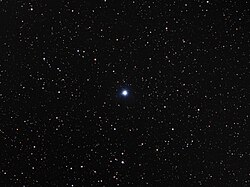
Both components are blue-white B-type main-sequence stars. The brighter member, component A, has an apparent magnitude of +5.5, while its companion, component B, has an apparent magnitude of +5.8. The two stars are separated by 0.6 arcseconds and complete one orbit around their common centre of mass about once every 250 years.4 The primary displays an infrared excess, possibly due to a debris disk or other orbiting material.8
References
References
- Anderson, E.; Francis, Ch. (2012). "XHIP: An extended hipparcos compilation". Astronomy Letters. 38 (5): 331. arXiv:1108.4971. Bibcode:2012AstL...38..331A. doi:10.1134/S1063773712050015. XHIP record for this object at VizieR.
- van Leeuwen, F. (2007). "Validation of the new Hipparcos reduction". Astronomy and Astrophysics. 474 (2): 653–664. arXiv:0708.1752. Bibcode:2007A&A...474..653V. doi:10.1051/0004-6361:20078357. S2CID 18759600.Vizier catalog entry
- Høg, E.; et al. (2000). "The Tycho-2 catalogue of the 2.5 million brightest stars". Astronomy and Astrophysics. 355: L27–L30. Bibcode:2000A&A...355L..27H.
- "Sixth Catalog of Orbits of Visual Binary Stars". United States Naval Observatory. Archived from the original on 1 August 2017. Retrieved 16 May 2017.
- Mermilliod, J.-C. (1986). "Compilation of Eggen's UBV data, transformed to UBV (unpublished)". Catalogue of Eggen's UBV Data. Bibcode:1986EgUBV........0M.
- Kharchenko, N. V.; et al. (2007). "Astrophysical supplements to the ASCC-2.5: Ia. Radial velocities of ~55000 stars and mean radial velocities of 516 Galactic open clusters and associations". Astronomische Nachrichten. 328 (9): 889. arXiv:0705.0878. Bibcode:2007AN....328..889K. doi:10.1002/asna.200710776. S2CID 119323941.
- Gullikson, Kevin; et al. (August 2016). "The Close Companion Mass-ratio Distribution of Intermediate-mass Stars". The Astronomical Journal. 152 (2): 13. arXiv:1604.06456. Bibcode:2016AJ....152...40G. doi:10.3847/0004-6256/152/2/40. S2CID 119179065. 40.
- Cotten, Tara H.; Song, Inseok (July 2016), "A Comprehensive Census of Nearby Infrared Excess Stars", The Astrophysical Journal Supplement Series, 225 (1): 24, arXiv:1606.01134, Bibcode:2016ApJS..225...15C, doi:10.3847/0067-0049/225/1/15, S2CID 118438871, 15
- Zorec, J.; Royer, F. (January 2012). "Rotational velocities of A-type stars. IV. Evolution of rotational velocities". Astronomy & Astrophysics. 537: A120. arXiv:1201.2052. Bibcode:2012A&A...537A.120Z. doi:10.1051/0004-6361/201117691. S2CID 55586789.
- "lam Cas". SIMBAD. Centre de données astronomiques de Strasbourg.