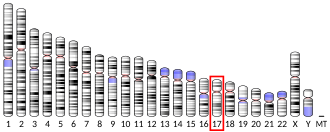
| KRT14 |
|---|
|
|
| Identifiers |
|---|
| Aliases | KRT14, CK14, EBS3, EBS4, K14, NFJ, keratin 14, EBS1D, EBS1, EBS1B, EBS1A, EBS1C |
|---|
| External IDs | OMIM: 148066; MGI: 96688; HomoloGene: 110439; GeneCards: KRT14; OMA:KRT14 - orthologs |
|---|
|
| Gene location (Mouse) |
|---|
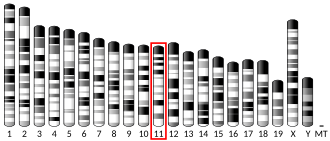 | | Chr. | Chromosome 11 (mouse)2 |
|---|
| | Band | 11 63.43 cM|11 D | Start | 100,093,988 bp2 |
|---|
| End | 100,098,374 bp2 |
|---|
|
|
|
|
| Wikidata |
|
Keratin 14 is a member of the type I keratin family of intermediate filament proteins. Keratin 14 was the first type I keratin sequence determined.5
Keratin 14 is also known as cytokeratin-14 (CK-14) or keratin-14 (KRT14). In humans it is encoded by the KRT14 gene.678
Keratin 14 is usually found as a heterodimer with type II keratin 5 and form the cytoskeleton of epithelial cells.
Pathology
Mutations in the genes for these keratins are associated with epidermolysis bullosa simplex9 and dermatopathia pigmentosa reticularis, both of which are autosomal dominant mutations.10
See also
See also
References
References
- GRCh38: Ensembl release 89: ENSG00000186847 – Ensembl, May 2017
- GRCm38: Ensembl release 89: ENSMUSG00000045545 – Ensembl, May 2017
- "Human PubMed Reference:". National Center for Biotechnology Information, U.S. National Library of Medicine.
- "Mouse PubMed Reference:". National Center for Biotechnology Information, U.S. National Library of Medicine.
- Hanukoglu I, Fuchs E (November 1982). "The cDNA sequence of a human epidermal keratin: divergence of sequence but conservation of structure among intermediate filament proteins". Cell. 31 (1): 243–52. doi:10.1016/0092-8674(82)90424-X. PMID 6186381. S2CID 35796315.
- Coulombe PA, Hutton ME, Letai A, Hebert A, Paller AS, Fuchs E (September 1991). "Point mutations in human keratin 14 genes of epidermolysis bullosa simplex patients: genetic and functional analyses". Cell. 66 (6): 1301–11. doi:10.1016/0092-8674(91)90051-Y. PMID 1717157. S2CID 11965913.
- Schweizer J, Bowden PE, Coulombe PA, Langbein L, Lane EB, Magin TM, et al. (July 2006). "New consensus nomenclature for mammalian keratins". The Journal of Cell Biology. 174 (2): 169–74. doi:10.1083/jcb.200603161. PMC 2064177. PMID 16831889.
- "Entrez Gene: KRT14 keratin 14 (epidermolysis bullosa simplex, Dowling-Meara, Koebner)".
- Bardhan A, Bruckner-Tuderman L, Chapple IL, Fine JD, Harper N, Has C, et al. (September 2020). "Epidermolysis bullosa". Nature Reviews. Disease Primers. 6 (1): 78. doi:10.1038/s41572-020-0210-0. PMID 32973163. S2CID 221861310.
- Lugassy J, Itin P, Ishida-Yamamoto A, Holland K, Huson S, Geiger D, et al. (October 2006). "Naegeli-Franceschetti-Jadassohn syndrome and dermatopathia pigmentosa reticularis: two allelic ectodermal dysplasias caused by dominant mutations in KRT14". American Journal of Human Genetics. 79 (4): 724–30. doi:10.1086/507792. PMC 1592572. PMID 16960809.
Further reading
Further reading
- Schuilenga-Hut PH, van der Vlies P, Jonkman MF, Waanders E, Buys CH, Scheffer H (April 2003). "Mutation analysis of the entire keratin 5 and 14 genes in patients with epidermolysis bullosa simplex and identification of novel mutations". Human Mutation. 21 (4): 447. doi:10.1002/humu.9124. PMID 12655565. S2CID 20859513.
- Rosenberg M, Fuchs E, Le Beau MM, Eddy RL, Shows TB (1991). "Three epidermal and one simple epithelial type II keratin genes map to human chromosome 12". Cytogenetics and Cell Genetics. 57 (1): 33–8. doi:10.1159/000133109. PMID 1713141.
- Bonifas JM, Rothman AL, Epstein EH (November 1991). "Epidermolysis bullosa simplex: evidence in two families for keratin gene abnormalities". Science. 254 (5035): 1202–5. Bibcode:1991Sci...254.1202B. doi:10.1126/science.1720261. PMID 1720261.
- Albers K, Fuchs E (August 1987). "The expression of mutant epidermal keratin cDNAs transfected in simple epithelial and squamous cell carcinoma lines". The Journal of Cell Biology. 105 (2): 791–806. doi:10.1083/jcb.105.2.791. PMC 2114764. PMID 2442174.
- Rosenberg M, RayChaudhury A, Shows TB, Le Beau MM, Fuchs E (February 1988). "A group of type I keratin genes on human chromosome 17: characterization and expression". Molecular and Cellular Biology. 8 (2): 722–36. doi:10.1128/mcb.8.2.722. PMC 363198. PMID 2451124.
- Marchuk D, McCrohon S, Fuchs E (March 1985). "Complete sequence of a gene encoding a human type I keratin: sequences homologous to enhancer elements in the regulatory region of the gene". Proceedings of the National Academy of Sciences of the United States of America. 82 (6): 1609–13. Bibcode:1985PNAS...82.1609M. doi:10.1073/pnas.82.6.1609. PMC 397321. PMID 2580298.
- Marchuk D, McCrohon S, Fuchs E (December 1984). "Remarkable conservation of structure among intermediate filament genes". Cell. 39 (3 Pt 2): 491–8. doi:10.1016/0092-8674(84)90456-2. PMID 6210150. S2CID 32897738.
- Rugg EL, Morley SM, Smith FJ, Boxer M, Tidman MJ, Navsaria H, et al. (November 1993). "Missing links: Weber-Cockayne keratin mutations implicate the L12 linker domain in effective cytoskeleton function". Nature Genetics. 5 (3): 294–300. doi:10.1038/ng1193-294. PMID 7506097. S2CID 155219.
- Chen MA, Bonifas JM, Matsumura K, Blumenfeld A, Epstein EH (November 1993). "A novel three-nucleotide deletion in the helix 2B region of keratin 14 in epidermolysis bullosa simplex: delta E375". Human Molecular Genetics. 2 (11): 1971–2. doi:10.1093/hmg/2.11.1971. PMID 7506606.
- Chan Y, Anton-Lamprecht I, Yu QC, Jäckel A, Zabel B, Ernst JP, Fuchs E (November 1994). "A human keratin 14 "knockout": the absence of K14 leads to severe epidermolysis bullosa simplex and a function for an intermediate filament protein". Genes & Development. 8 (21): 2574–87. doi:10.1101/gad.8.21.2574. PMID 7525408.
- Yamanishi K, Matsuki M, Konishi K, Yasuno H (July 1994). "A novel mutation of Leu122 to Phe at a highly conserved hydrophobic residue in the helix initiation motif of keratin 14 in epidermolysis bullosa simplex". Human Molecular Genetics. 3 (7): 1171–2. doi:10.1093/hmg/3.7.1171. PMID 7526926.
- Hovnanian A, Pollack E, Hilal L, Rochat A, Prost C, Barrandon Y, Goossens M (April 1993). "A missense mutation in the rod domain of keratin 14 associated with recessive epidermolysis bullosa simplex". Nature Genetics. 3 (4): 327–32. doi:10.1038/ng0493-327. PMID 7526933. S2CID 20287067.
- Chen H, Bonifas JM, Matsumura K, Ikeda S, Leyden WA, Epstein EH (October 1995). "Keratin 14 gene mutations in patients with epidermolysis bullosa simplex". The Journal of Investigative Dermatology. 105 (4): 629–32. doi:10.1111/1523-1747.ep12323846. PMID 7561171.
- Humphries MM, Sheils DM, Farrar GJ, Kumar-Singh R, Kenna PF, Mansergh FC, et al. (1993). "A mutation (Met-->Arg) in the type I keratin (K14) gene responsible for autosomal dominant epidermolysis bullosa simplex". Human Mutation. 2 (1): 37–42. doi:10.1002/humu.1380020107. PMID 7682883. S2CID 8054726.
- Stephens K, Sybert VP, Wijsman EM, Ehrlich P, Spencer A (August 1993). "A keratin 14 mutational hot spot for epidermolysis bullosa simplex, Dowling-Meara: implications for diagnosis". The Journal of Investigative Dermatology. 101 (2): 240–3. doi:10.1111/1523-1747.ep12365079. PMID 7688405.
- Chan YM, Cheng J, Gedde-Dahl T, Niemi KM, Fuchs E (February 1996). "Genetic analysis of a severe case of Dowling-Meara epidermolysis bullosa simplex". The Journal of Investigative Dermatology. 106 (2): 327–34. doi:10.1111/1523-1747.ep12342985. PMID 8601736.
- Paladini RD, Takahashi K, Bravo NS, Coulombe PA (February 1996). "Onset of re-epithelialization after skin injury correlates with a reorganization of keratin filaments in wound edge keratinocytes: defining a potential role for keratin 16". The Journal of Cell Biology. 132 (3): 381–97. doi:10.1083/jcb.132.3.381. PMC 2120730. PMID 8636216.
External links
External links