| Khuman
1300 BCE-1800 CE | |||
|---|---|---|---|
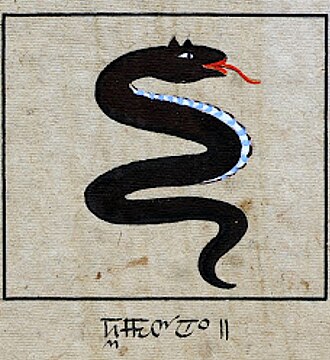 A Classical Meitei illuminated manuscript painting, depicting a “Paphal” of the Khuman totem of a Meitei dragon, from the “Pakhangba Lambuba”, an Ancient Meitei language text, engraved in traditional Meetei Mayek script | |||
| Profile | |||
| Country | Kangleipak (historic)
India (present) | ||
| Region | Manipur | ||
| District | Thoubal district | ||
| Ethnicity | Meitei people | ||
| Chief | |||
| Khuman Iputhou | |||
| Khuman Ningthou | |||
| Historic seat | Mayang Imphal | ||
| Died | 1760 CE | ||
| |||
| |||
Khuman (Meitei: ꯈꯨꯃꯟ) is a group of people, which is recognized as one of the seven Yek Salai clans of the composite Meitei confederacy. Historically, they ruled parts of Kangleipak (present day Indian state of Manipur)1 prior to subjugation by the Ningthouja dynasty (Mangang) c. 13th century.23 The Khuman-Lon Puya records information about their rule.4 The Meitei language meaning of Khuman is a narrowed darkness.

Number of families
| Meitei sub-groups | Romanisation | Number of families/surnames (according to N. Monihar5) | Number of families/surnames (according to Khomdon Lisam6) | Number of families/surnames (according to T.C. Hodson7) | Number of families/surnames (according to Manipur Mirror) | Number of families/surnames (according to MASTEC)8 |
|---|---|---|---|---|---|---|
| ꯈꯨꯃꯟ | Khuman | 176 | 199 | 103 | 2049 | 67 |
Mythology
Khuman was the son of Iputhou Pakhangba and Loikhumpi Mawai Thoungailenpi. He was born inside Kangla Palace, Imphal at evening when sunset sky is somewhat dark in colour. He ruled the Mayang Imphal province of Kangleipak kingdom as the Khuman province for several years.10 Khuman Khamba, one of legendary powerful hero from Moirang was amongst Khuman Salai(clan).11
See also
See also
References
References
- Session, North East India History Association (1991). Proceedings of North East India History Association. The Association.
- Momin, Mignonette; Mawlong, Cecile A.; Qādrī, Fuz̤ail Aḥmad (2006). Society and Economy in North-East India. Regency Publications. ISBN 978-81-89233-40-2.
- Bhattacharjee, J.B.; Bhattacharya, J.B. (2003). "'Loiyamba Shinyen': A Landmark in Meitei State Formation in Medieval Manipur". Proceedings of the Indian History Congress. 64: 362–368. ISSN 2249-1937. JSTOR 44145476.
- "Proceedings of the Session". 1971.
- Monihar, N. (2000). Sagei Salai Apoklon (in Manipuri). India: Internet Archive; Digital Library of India.
- "Who are the Indigenous People of Manipur Part 2 By Khomdon Lisam". e-pao.net. Retrieved 15 February 2025.
- Hodson, Thomas Callan. The Meitheis. India: D. Nutt, 1908.
- "The People - Manipur Science and Technology Council (MASTEC)". mastec.nic.in. Retrieved 18 February 2025.
- "KHUMAN SURNAME LIST – Manipur Mirror". Retrieved 16 February 2025.
- "Wakoklon Heelel Thilel Salai Ama-Ilon Pukok Puya". Paochelsalaitaret.net. Retrieved 13 November 2018.
- Mangi Singh, laishram (13 November 1980). "Moirang Kangleiron Khuman Khamba Seitharol". Archive.org. Retrieved 13 November 2018.