 | |
 | |
| Names | |
|---|---|
| Preferred IUPAC name
Potassium 1,1,1-trimethyl-N-(trimethylsilyl)silanaminide | |
| Other names
Potassium hexamethyldisilazide
Potassium hexamethylsilazane1
| |
| Identifiers | |
3D model (JSmol)
|
|
| Abbreviations | KHMDS |
| ChemSpider |
|
| ECHA InfoCard | 100.102.263 |
PubChem CID
|
|
| UNII | |
| UN number | 3263 |
CompTox Dashboard (EPA)
|
|
| |
| |
| Properties | |
| KSi 2C 6NH 18 | |
| Molar mass | 199.4831 g mol−1 |
| Appearance | White, opaque crystals |
| Reacts | |
| Hazards | |
| GHS labelling: | |

| |
| Danger | |
| H3142 | |
| P280, P305+P351+P338, P3102 | |
| Related compounds | |
Other cations
|
Lithium bis(trimethylsilyl)amide |
Except where otherwise noted, data are given for materials in their standard state (at 25 °C [77 °F], 100 kPa).
| |


Potassium bis(trimethylsilyl)amide (commonly abbreviated as KHMDS, Potassium(K) HexaMethylDiSilazide) or potassium hexamethyldisilazane1 is the chemical compound with the formula ((CH3)3Si)2NK. It is a strong, non-nucleophilic base with an approximate pKa of 26 (compare to lithium diisopropylamide, at 36).
Structure
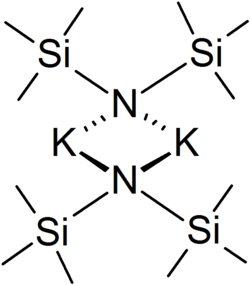
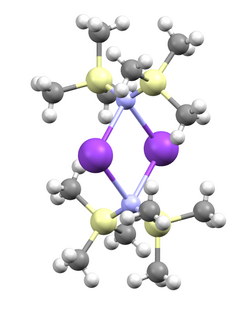
The methylsilyl groups give KHMDS good solubility in most organic solvents. Solution structures are either solvated monomers or dimers (or mixtures thereof) with this depending on the coordinating power, concentration, and temperature of the solvent.3 In general, weakly coordinating solvents such as toluene and N,N-dimethylethylamine give dimers, where as THF and diglyme gave monomers at high dilution.3 In the solid state, the unsolvated compound is dimeric, with two potassium and two nitrogen atoms forming a square.4 KHMDS conducts electricity poorly in solution and in the melt, which is attributed to very strong ion pairing.
References
References
- "Potassium Hexamethyldisilazane". sigmaaldrich.com. Retrieved 1 April 2023.
- Potassium bis(trimethylsilyl)amide, Sigma-Aldrich
- Spivey, Jesse A.; Collum, David B. (20 June 2024). "Potassium Hexamethyldisilazide (KHMDS): Solvent-Dependent Solution Structures". Journal of the American Chemical Society. 146 (26): 17827–17837. Bibcode:2024JAChS.14617827S. doi:10.1021/jacs.4c03418. PMC 11373885. PMID 38901126.
- Tesh, Kris F.; Hanusa, Timothy P.; Huffman, John C. (1990). "Ion pairing in [bis(trimethylsilyl)amido]potassium: The x-ray crystal structure of unsolvated [KN(SiMe3)2]2". Inorg. Chem. 29 (8): 1584–1586. doi:10.1021/ic00333a029.