| Observation data Epoch J2000 Equinox J2000 | |
|---|---|
| Constellation | Lyra1 |
| Right ascension | 19h 06m 33.2141s2 |
| Declination | +39° 29′ 16.359″2 |
| Apparent magnitude (V) | 10.623±0.0533 |
| Characteristics | |
| Evolutionary stage | main sequence2 |
| Spectral type | F4 |
| Apparent magnitude (B) | 11.337±0.0163 |
| Variable type | Planetary transit variable |
| Astrometry | |
| Proper motion (μ) | RA: −0.303(14) mas/yr2 Dec.: 6.109(13) mas/yr2 |
| Parallax (π) | 4.1456±0.0113 mas2 |
| Distance | 787 ± 2 ly (241.2 ± 0.7 pc) |
| Details | |
| Mass | 1.159+0.040 −0.0515 M☉ |
| Radius | 1.297±0.0155 R☉ |
| Luminosity | 2.406+0.126 −0.1285 L☉ |
| Surface gravity (log g) | 4.275+0.007 −0.0085 cgs |
| Temperature | 6270±796 K |
| Metallicity [Fe/H] | −0.05±0.106 dex |
| Rotation | 23.147±0.039 days7 |
| Rotational velocity (v sin i) | 9.58 km/s |
| Age | 3.45+0.81 −0.725 Gyr |
| Other designations | |
| KOI-244, KIC 4349452, TYC 3124-1264-1, 2MASS J19063321+3929164, Gaia DR2 21004516301050411529 | |
| Database references | |
| SIMBAD | data |
| Exoplanet Archive | data |
| KIC | data |
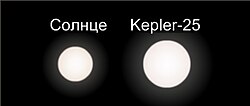
Kepler-25 is a star in the northern constellation of Lyra.1 It is slightly larger and more massive than the Sun, with a luminosity 21⁄2 times that of the Sun.5 With an apparent visual magnitude of 10.6,3 this star is too faint to be seen with the naked eye.
Planetary system
In 2011, two candidate planets were found transiting this star by the Kepler space telescope.10 These planets are very close to yet not lie in the 1:2 orbital resonance to each other, indicating the absence of other planetary objects in the inner part of the planetary systems.11 These planets were confirmed through transit-timing variation method.12 A third planet was discovered through follow-up radial velocity measurements and was confirmed in January 2014.8
The plane of planetary orbits is well aligned with the equatorial plane of the star, misalignment angle equal to 7±8°13
| Companion (in order from star) |
Mass | Semimajor axis (AU) |
Orbital period (days) |
Eccentricity | Inclination (°) |
Radius |
|---|---|---|---|---|---|---|
| b | 8.7+2.5 −2.3 M🜨 |
0.068 | 6.238297±0.000017 | 0.0029+0.0023 −0.0017 |
92.827+0.084 −0.083 |
2.748+0.038 −0.035 R🜨 |
| c | 15.2+1.3 −1.6 M🜨 |
0.11 | 12.7207±0.0001 | 0.0061+0.0049 −0.0041 |
92.764+0.042 −0.039 |
5.217+0.070 −0.065 R🜨 |
| d | 71.9±9.8 M🜨 | — | 122.4+0.0 −0.7 |
0.13+0.13 −0.09 |
— | — |
References
References
- Roman, Nancy G. (1987). "Identification of a constellation from a position". Publications of the Astronomical Society of the Pacific. 99 (617): 695. Bibcode:1987PASP...99..695R. doi:10.1086/132034. Constellation record for this object at VizieR.
- Vallenari, A.; et al. (Gaia collaboration) (2023). "Gaia Data Release 3. Summary of the content and survey properties". Astronomy and Astrophysics. 674: A1. arXiv:2208.00211. Bibcode:2023A&A...674A...1G. doi:10.1051/0004-6361/202243940. S2CID 244398875. Gaia DR3 record for this source at VizieR.
- Henden, A. A.; et al. (2016). "VizieR Online Data Catalog: AAVSO Photometric All Sky Survey (APASS) DR9 (Henden+, 2016)". VizieR On-line Data Catalog: II/336. Originally Published in: 2015AAS...22533616H. 2336. Bibcode:2016yCat.2336....0H. Vizier catalog entry
- Schneider, Jean, "Star: Kepler-25", Extrasolar Planets Encyclopaedia, archived from the original on 2012-06-16, retrieved 2013-12-18
- Silva Aguirre, V.; et al. (2015). "Ages and fundamental properties of Kepler exoplanet host stars from asteroseismology". Monthly Notices of the Royal Astronomical Society. 452 (2): 2127–2148. arXiv:1504.07992. Bibcode:2015MNRAS.452.2127S. doi:10.1093/mnras/stv1388.
- Huber, Daniel; et al. (2013). "Fundamental Properties of Kepler Planet-candidate Host Stars using Asteroseismology". The Astrophysical Journal. 767 (2). 127. arXiv:1302.2624. Bibcode:2013ApJ...767..127H. doi:10.1088/0004-637X/767/2/127.
- McQuillan, A.; Mazeh, T.; Aigrain, S. (2013). "Stellar Rotation Periods of The Kepler objects of Interest: A Dearth of Close-In Planets Around Fast Rotators". The Astrophysical Journal Letters. 775 (1). L11. arXiv:1308.1845. Bibcode:2013ApJ...775L..11M. doi:10.1088/2041-8205/775/1/L11.
- Marcy, Geoffrey W.; et al. (2014). "Masses, Radii, and Orbits of Small Kepler Planets: The Transition from Gaseous to Rocky Planets". The Astrophysical Journal Supplement Series. 210 (2). 20. arXiv:1401.4195. Bibcode:2014ApJS..210...20M. doi:10.1088/0067-0049/210/2/20.
- "Kepler-25". SIMBAD. Centre de données astronomiques de Strasbourg. Retrieved 2019-10-02.
- Borucki, William J.; et al. (2011). "Characteristics of Planetary Candidates Observed by Kepler. II. Analysis of the First Four Months of Data". The Astrophysical Journal. 736 (1). 19. arXiv:1102.0541. Bibcode:2011ApJ...736...19B. doi:10.1088/0004-637X/736/1/19.
- Migaszewski, Cezary; Gozdziewski, Krzysztof (2018), "A periodic configuration of the Kepler-25 planetary system?", Monthly Notices of the Royal Astronomical Society, 480 (2): 1767–1777, arXiv:1803.10285, doi:10.1093/mnras/sty1972, S2CID 55395774
- Steffen, Jason H.; et al. (2012). "Transit timing observations from Kepler - III. Confirmation of four multiple planet systems by a Fourier-domain study of anticorrelated transit timing variations". Monthly Notices of the Royal Astronomical Society. 421 (3): 2342–2354. arXiv:1201.5412. Bibcode:2012MNRAS.421.2342S. doi:10.1111/j.1365-2966.2012.20467.x.
- Albrecht, Simon; Winn, Joshua N.; Marcy, Geoffrey W.; Howard, Andrew W.; Isaacson, Howard; Johnson, John A. (2013), "Low Stellar Obliquities in Compact Multiplanet Systems", The Astrophysical Journal, 771 (1): 11, arXiv:1302.4443, Bibcode:2013ApJ...771...11A, doi:10.1088/0004-637X/771/1/11, S2CID 17247029
- Mills, Sean M.; et al. (2019). "Long-period Giant Companions to Three Compact, Multiplanet Systems". The Astronomical Journal. 157 (4). 145. arXiv:1903.07186. Bibcode:2019AJ....157..145M. doi:10.3847/1538-3881/ab0899.