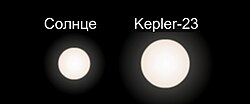
 Kepler-23 compared to the Sun | |
| Observation data Epoch J2000 Equinox J2000 | |
|---|---|
| Constellation | Cygnus1 |
| Right ascension | 19h 36m 52.5355s2 |
| Declination | +49° 28′ 45.253″2 |
| Apparent magnitude (V) | 13.5473 |
| Characteristics | |
| Evolutionary stage | subgiant2 |
| Spectral type | G2V3 |
| Astrometry | |
| Radial velocity (Rv) | −26.97±2.382 km/s |
| Proper motion (μ) | RA: 2.275(12) mas/yr2 Dec.: 3.879(14) mas/yr2 |
| Parallax (π) | 1.1395±0.0101 mas2 |
| Distance | 2,860 ± 30 ly (878 ± 8 pc) |
| Details | |
| Mass | 1.078±0.0774 M☉ |
| Radius | 1.548±0.0484 R☉ |
| Luminosity | ~2.35 L☉ |
| Surface gravity (log g) | 4.00±0.145 cgs |
| Temperature | 5828±1004 K |
| Metallicity [Fe/H] | −0.09±0.145 dex |
| Age | 4-85 Gyr |
| Other designations | |
| KOI-168, KIC 11512246, GSC 03564-01806, 2MASS J19365254+4928452, Gaia DR2 21350191074517511683 | |
| Database references | |
| SIMBAD | data |
| Exoplanet Archive | data |
| KIC | data |
Kepler-23 is a G-type main-sequence star about 2,860 light-years (880 parsecs) away in the northern constellation of Cygnus, the swan. With an apparent visual magnitude of 13.5,3 it is too faint to be seen with the naked eye. This star is similar in mass and temperature to the Sun, but is larger and more luminous.54 Kepler-23 is orbited by three known exoplanets.6
Planetary system
Three transiting exoplanets orbit this star, discovered using the Kepler space telescope. Two planets, Kepler-23b and Kepler-23c, were discovered in 2011 and were confirmed in 2012.5 A third planet, Kepler-23d, was confirmed in 2014 as part of a study validating hundreds of Kepler candidates.7 All three planets are between Earth and Neptune in size (sub-Neptunes), and their masses have been measured via transit-timing variations, showing that they have lower densities than Earth.4
| Companion (in order from star) |
Mass | Semimajor axis (AU) |
Orbital period (days) |
Eccentricity | Inclination (°) |
Radius |
|---|---|---|---|---|---|---|
| b | 2.56+0.43 −0.40 M🜨 |
0.075 | 7.106995(73) | 0.017+0.019 −0.014 |
— | 1.638±0.047 R🜨 |
| c | 7.81+1.32 −1.20 M🜨 |
0.099 | 10.742434(39) | 0.021+0.009 −0.014 |
— | 3.005±0.074 R🜨 |
| d | 4.44+1.30 −1.21 M🜨 |
0.124 | 15.27429(17) | 0.010+0.014 −0.008 |
— | 2.206±0.057 R🜨 |
References
References
- Roman, Nancy G. (1987). "Identification of a constellation from a position". Publications of the Astronomical Society of the Pacific. 99 (617): 695. Bibcode:1987PASP...99..695R. doi:10.1086/132034. Constellation record for this object at VizieR.
- Vallenari, A.; et al. (Gaia collaboration) (2023). "Gaia Data Release 3. Summary of the content and survey properties". Astronomy and Astrophysics. 674: A1. arXiv:2208.00211. Bibcode:2023A&A...674A...1G. doi:10.1051/0004-6361/202243940. S2CID 244398875. Gaia DR3 record for this source at VizieR.
- "Kepler-23". SIMBAD. Centre de données astronomiques de Strasbourg. Retrieved 31 January 2018.
- Leleu, A.; Delisle, J.-B.; et al. (January 2023). "Removing biases on the density of sub-Neptunes characterised via transit timing variations. Update on the mass-radius relationship of 34 Kepler planets". Astronomy & Astrophysics. 669: A117. arXiv:2207.07456. Bibcode:2023A&A...669A.117L. doi:10.1051/0004-6361/202244132.
- Ford, Eric B.; Fabrycky, Daniel C.; Steffen, Jason H.; Carter, Joshua A.; Fressin, Francois; Holman, Matthew J.; Lissauer, Jack J.; Moorhead, Althea V.; Morehead, Robert C.; Ragozzine, Darin; Rowe, Jason F.; Welsh, William F.; Allen, Christopher; Batalha, Natalie M.; Borucki, William J.; Bryson, Stephen T.; Buchhave, Lars A.; Burke, Christopher J.; Caldwell, Douglas A.; Charbonneau, David; Clarke, Bruce D.; Cochran, William D.; Désert, Jean-Michel; Endl, Michael; Everett, Mark E.; Fischer, Debra A.; Gautier III, Thomas N.; Gilliland, Ron L.; Jenkins, Jon M.; et al. (2012), "Transit Timing Observations Fromkepler. Ii. Confirmation of Two Multiplanet Systems Via a Non-Parametric Correlation Analysis", The Astrophysical Journal, 750 (2): 113, arXiv:1201.5409, Bibcode:2012ApJ...750..113F, doi:10.1088/0004-637X/750/2/113, S2CID 4528963
- "Kepler-23 Overview". NASA Exoplanet Archive. Retrieved 13 June 2024.
- Rowe, Jason F.; Bryson, Stephen T.; Marcy, Geoffrey W.; Lissauer, Jack J.; Jontof-Hutter, Daniel; Mullally, Fergal; Gilliland, Ronald L.; Issacson, Howard; Ford, Eric; Howell, Steve B.; Borucki, William J.; Haas, Michael; Huber, Daniel; Steffen, Jason H.; Thompson, Susan E.; Quintana, Elisa; Barclay, Thomas; Still, Martin; Fortney, Jonathan; Gautier III, T. N.; Hunter, Roger; Caldwell, Douglas A.; Ciardi Edna Devore, David R.; Cochran, William; Jenkins, Jon; Agol, Eric; Carter, Joshua A.; Geary, John (2014), Validation of Kepler's Multiple Planet Candidates. III: Light Curve Analysis & Announcement of Hundreds of New Multi-planet Systems, arXiv:1402.6534, Bibcode:2014ApJ...784...45R, doi:10.1088/0004-637X/784/1/45, S2CID 119118620
- Van Eylen, Vincent; Albrecht, Simon (2015), "Eccentricity from Transit Photometry: Small Planets in Kepler Multi-Planet Systems Have Low Eccentricities", The Astrophysical Journal, 808 (2): 126, arXiv:1505.02814, Bibcode:2015ApJ...808..126V, doi:10.1088/0004-637X/808/2/126, S2CID 14405731