| Observation data Epoch J2000 Equinox J2000 | |
|---|---|
| Constellation | Lyra1 |
| Right ascension | 19h 09m 45.40270s2 |
| Declination | +43° 49′ 55.4994″2 |
| Apparent magnitude (V) | 14.530±0.0573 |
| Characteristics | |
| Evolutionary stage | Main sequence2 |
| Spectral type | K54 |
| Apparent magnitude (G) | 14.274±0.0032 |
| Apparent magnitude (J) | 12.791±0.0215 |
| Apparent magnitude (H) | 12.293±0.0215 |
| Apparent magnitude (K) | 12.184±0.0185 |
| Astrometry | |
| Radial velocity (Rv) | −101.06±3.942 km/s |
| Proper motion (μ) | RA: −38.959±0.016 mas/yr2 Dec.: −18.117±0.017 mas/yr2 |
| Parallax (π) | 2.6013±0.0142 mas2 |
| Distance | 1,254 ± 7 ly (384 ± 2 pc) |
| Details | |
| Mass | 0.710+0.041 −0.0363 M☉ |
| Radius | 0.680+0.032 −0.0283 R☉ |
| Luminosity | 0.1966 L☉ |
| Surface gravity (log g) | 4.630+0.024 −0.0303 cgs |
| Temperature | 4724.0±25.03 K |
| Metallicity [Fe/H] | −0.360±0.1243 dex |
| Rotation | 43.7 days7 |
| Rotational velocity (v sin i) | 1.28 km/s |
| Age | 4.900+5.260 −3.1403 Gyr |
| Other designations | |
| Kepler-174, KOI-518, KIC 8017703, TIC 158434144, 2MASS J19094540+43495555 | |
| Database references | |
| SIMBAD | data |
| Exoplanet Archive | data |
Kepler-174 is a K-type main-sequence star located in the Milky Way galaxy at a distance of about 1,254 light-years (384 parsecs) away from the Sun. It is located inside the boundaries of the Lyra constellation, but it is too dim to be visible to the unaided eye and is not part of the main outline.
Planetary system
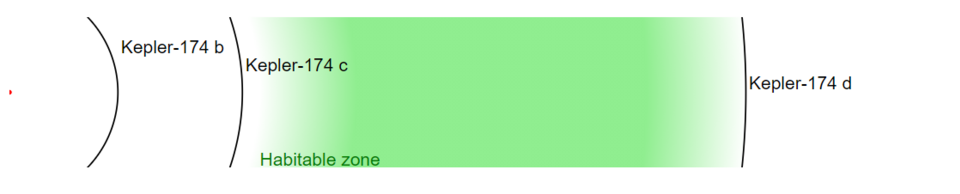
Kepler-174 has three confirmed super-Earth planets orbiting it, Kepler-174b, Kepler-174c and Kepler-174d, discovered by the Kepler space telescope using the transit method. The discovery of all three planets was announced in 2014 by a team led by Jason F. Rowe, as part of a study validating hundreds of Kepler planets.9 Kepler-174d is notable as it is within the star's habitable zone, meaning it is potentially habitable.1011
| Companion (in order from star) |
Mass | Semimajor axis (AU) |
Orbital period (days) |
Eccentricity | Inclination (°) |
Radius |
|---|---|---|---|---|---|---|
| b | — | 0.100 | 13.981790±0.000024 | — | — | 1.96±0.11 R🜨 |
| c | — | 0.214 | 44.000529±0.000265 | — | — | 1.49±0.09 R🜨 |
| d | — | 0.677 | 247.353730±0.002001 | — | — | 2.19±0.13 R🜨 |
In popular culture
The planet Kepler-174d is mentioned in the Star Trek: Discovery episode, Terra Firma, Part 1.13 in which it is inhabited and is referred to as "quite beautiful".
References
References
- Roman, Nancy G. (1987). "Identification of a constellation from a position". Publications of the Astronomical Society of the Pacific. 99 (617): 695. Bibcode:1987PASP...99..695R. doi:10.1086/132034. Constellation record for this object at VizieR.
- Vallenari, A.; et al. (Gaia collaboration) (2023). "Gaia Data Release 3. Summary of the content and survey properties". Astronomy and Astrophysics. 674: A1. arXiv:2208.00211. Bibcode:2023A&A...674A...1G. doi:10.1051/0004-6361/202243940. S2CID 244398875. Gaia DR3 record for this source at VizieR.
- "Kepler-174". NASA Exoplanet Archive. Retrieved 3 February 2023.
- Su, Tianhao; Zhang, Li-yun; Long, Liu; Han, Xianming L.; Misra, Prabhakar; Meng, Gang; Pi, Qingfeng; Yang, Zilu; Yang, Jiawei (2022). "Magnetic Activity and Physical Parameters of Exoplanet Host Stars Based on LAMOST DR7, TESS, Kepler, and K2 Surveys". The Astrophysical Journal Supplement Series. 261 (2): 26. Bibcode:2022ApJS..261...26S. doi:10.3847/1538-4365/ac7151.
- "Kepler-174". SIMBAD. Centre de données astronomiques de Strasbourg. Retrieved 3 February 2023.
- Ostberg, Colby; Kane, Stephen R.; Li, Zhexing; Schwieterman, Edward W.; Hill, Michelle L.; Bott, Kimberly; Dalba, Paul A.; Fetherolf, Tara; Head, James W.; Unterborn, Cayman T. (2023). "The Demographics of Terrestrial Planets in the Venus Zone". The Astronomical Journal. 165 (4): 168. arXiv:2302.03055. Bibcode:2023AJ....165..168O. doi:10.3847/1538-3881/acbfaf.
- Mazeh, Tsevi; Perets, Hagai B.; McQuillan, Amy; Goldstein, Eyal S. (2015). "Photometric Amplitude Distribution of Stellar Rotation of KOIs—Indication for Spin-Orbit Alignment of Cool Stars and High Obliquity for Hot Stars". The Astrophysical Journal. 801 (1): 3. arXiv:1501.01288. Bibcode:2015ApJ...801....3M. doi:10.1088/0004-637X/801/1/3.
- Brewer, John M.; Fischer, Debra A. (2018). "Spectral Properties of Cool Stars: Extended Abundance Analysis of Kepler Objects of Interest". The Astrophysical Journal Supplement Series. 237 (2): 38. arXiv:1804.00673. Bibcode:2018ApJS..237...38B. doi:10.3847/1538-4365/aad501.
- Rowe, Jason F. (2014). "Validation of Kepler's Multiple Planet Candidates. III. Light Curve Analysis and Announcement of Hundreds of New Multi-planet Systems". The Astrophysical Journal. 784 (1): 20. arXiv:1402.6534. Bibcode:2014ApJ...784...45R. doi:10.1088/0004-637X/784/1/45. S2CID 119118620. 45.
- "Exoplanet-catalog". Exoplanet Exploration: Planets Beyond our Solar System.
- "Kepler's Tally of Planets". www.nytimes.com.
- "Open Exoplanet Catalogue - Kepler-174 d". www.openexoplanetcatalogue.com. Retrieved 2024-08-16.
- "STAR TREK: DISCOVERY Review: "Terra Firma, Part 1"". Trek Core. 10 December 2020. Retrieved 17 December 2020.