| Katë | |
|---|---|
| Kati, Kâmkata-vari, Kâmkata-mumkṣta-vari | |
 | |
| Native to | Afghanistan, Pakistan |
| Region | Nuristan, Kunar, Chitral |
Native speakers | 150,000 (2011-2017)1 |
Early forms | |
| Dialects | |
| Arabic script (Nastaliq) | |
| Language codes | |
| ISO 639-3 | Either:bsh – Katixvi – Kamviri |
| Glottolog | kati1270 |
| ELP | Kati |
| Linguasphere | 58-ACB-a |
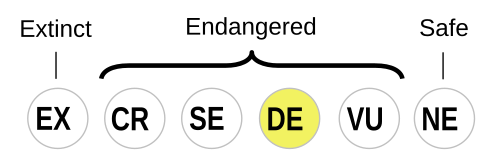 Katë is classified as Definitely Endangered by the UNESCO Atlas of the World's Languages in Danger | |
Katë, also known as Kati or Kamkata-vari, is a Nuristani language. It is a dialect continuum comprising three separate dialects spoken mostly in Afghanistan, with additional speakers in the Chitral District of Pakistan deriving from recent migrations a century ago. The Kata-vari (comprising Western and Northeastern) and Kamviri (comprising Southeastern) dialects are sometimes erroneously reckoned as two separate languages, but according to linguist Richard Strand they form one language.3
The Katë language is the largest Nuristani language, spoken by 40,000–60,000 people, from the Kata, Kom, Mumo, Kshto and some smaller Black-Robed tribes in parts of Afghanistan and Pakistan. The most used alternative names for the language are Kati or Bashgali.
Name
The name, pronounced [kaˈtɘ], is the ethnonym of the Kata people. Cognates of the ethnonym in other Nuristani languages include Nuristani Kalasha Kā̃ta [kãːˈta]. According to Halfmann4, the names descend from a Proto-Nuristani form *Kānta-ka-.
Dialects
There are three main dialects according to Halfmann (2024): Western Katë, Northeastern Katë, and Southeastern Katë (including Kamviri and Mumviri). The dialects are sometimes erroneously defined as separate languages. The Northeastern Katë dialect is commonly referred to as Shekhani in Chitral. In older literature, Southeastern Katë is split into Kamviri and Mumviri.5
Classification
It belongs to the Indo-European language family and is in the Nuristani group of the Indo-Iranian branch. Glottolog proposes the following phylogenetic classification:6
- Nuristani
- Ashkun-Kate-Waigali
- Ashkun-Kate
- Katë (Kamviri, Kataviri and Mumviri)
- Ashkun-Kate
- Ashkun-Kate-Waigali
Status
Literacy rates are low: below 1% for people who have it as a first language and between 15% and 25% for people who have it as a second language. The Kata-vari dialect can be heard on radio in Afghanistan.
Phonology
Vowels
Katë has six primary vowel qualities, with some variation in the pronunciation: /i, ɛ~ɜ, ɐ~a, u, ɘ~ɨ, ɔ/.7
| Front | Central | Back | |
|---|---|---|---|
| Close | i | ɘ~ɨ ⟨ë⟩ | u |
| Mid | ɛ~ɜ ⟨e⟩ | ɔ ⟨o⟩ | |
| Open | ɐ~a ⟨a⟩ |
In the Northeastern dialect, vowel length and nasalization are both phonemic in all vowels except /ɘ~ɨ/.8
Consonants
| Labial | Dental/ | Retroflex/ | Palatal | Velar | Postvelar/ | Glottal | ||
|---|---|---|---|---|---|---|---|---|
| Nasals | m | n̪ ⟨n⟩ | ɳ ⟨ṇ⟩ | ŋ | ||||
| Plosives | voiceless | p | t̪ ⟨t⟩ | ʈ ⟨ṭ⟩ | k | (q) | (ʔ) | |
| voiced | b | d̪ ⟨d⟩ | ɖ~ɽ ⟨ḍ~ṛ⟩ | g | ||||
| Taps | ɾ ⟨r⟩ | |||||||
| Affricates | voiceless | t̪͡s̪ ⟨ċ⟩ | ʈ͡ʂ ⟨c̣⟩ | t͡ɕ ⟨č⟩ | ||||
| voiced | d͡ʑ ⟨ǰ⟩ | |||||||
| Fricatives | voiceless | (f) | s | ʂ ⟨ṣ⟩ | ɕ ⟨š⟩ | (χ ⟨x⟩) | (h) | |
| voiced | ʋʷ ⟨v⟩ | z | ʐ ⟨ẓ⟩ | (ʁ ⟨ɣ⟩) | ||||
| Approximants | oral | l̪ (l) | ɻ ⟨r̆⟩ | j ⟨y⟩ | ||||
| nasal | ɻ̃ ⟨n̆⟩ | |||||||
Notes
- Marginal phonemes are in parentheses.
- /ɽ/ is considered an allophone of /ɖ/ in the Northeastern dialect, but is perceived by native speakers as a separate sound.
- /ɳ/ may also be realized as /ɽ̃/, especially intervocalically.
Grammar
Nouns
Nouns in Katë are inflected for number, gender, and case. Number in Katë distinguishes between singular and plural, and nouns can be masculine or feminine, although there is no predictable pattern for determining the gender of a noun.10
Cases
There are a maximum of 7 cases in Katë: direct, oblique, genitive, instrumental, locative, ablative, and vocative. However, this differs between dialects and no one noun has a distinct form for all cases.11 Cases that express a syntactic function only appear on the final element of a phrase, and preceding elements in a noun phrase appear in the direct case.
iki
DEM.MED.SG
purd-ë
old-M
kašir-dari
white-beard.DIR
iki purd-ë kašir-dari
DEM.MED.SG old-M white-beard.DIR
That old whitebeard
References
References
- Kati at Ethnologue (21st ed., 2018)

Kamviri at Ethnologue (21st ed., 2018)
- Hammarström, Harald; Forkel, Robert; Haspelmath, Martin (eds.). "Katë". Glottolog . Jena, Germany: Max Planck Institute for the Science of Human History.
- "Richard Strand's Nuristân Site: Peoples and Languages of Nuristan". nuristan.info. Retrieved 2022-06-04.
- Halfmann 2024, p. 4.
- Torwali, Zubair (2020). "Countering the challenges of globalization faced by endangered languages of North Pakistan". Language Documentation and Description. 17: 51.
- Hammarström, Harald; Forkel, Robert; Haspelmath, Martin (eds.). "Katë". Glottolog . Jena, Germany: Max Planck Institute for the Science of Human History.
- Halfmann 2024, p. 24.
- Halfmann 2024, p. 46.
- Halfmann 2024.
- Halfmann 2024, pp. 143–146.
- Halfmann 2024, p. 147.
Sources
Sources
- Halfmann, Jakob (2024). A Grammatical Description of the Katë Language (Nuristani) (PhD thesis). Köln: Universität zu Köln.
Further reading
Further reading
- Strand, Richard F. (2010). "Nurestâni Languages". Encyclopaedia Iranica, Online Edition. Archived from the original on 2016-11-06. Retrieved 2012-01-16.
- Strand, Richard F. (2022). "Ethnolinguistic and Genetic Clues to Nûristânî Origins". International Journal of Diachronic Linguistics and Linguistic Reconstruction. 19: 267–353.
External links
External links
- Strand, Richard F. (1997). "Nuristan: Hidden Land of the Hindu-Kush". Retrieved 2012-01-16.
- Strand, Richard F. (1997). "The kâtʹa, kʹom, mumʹo, kṣtʹo, biniʹo, ǰâmčʹo, and ǰâšʹa". Retrieved 2012-01-16.
- Strand, Richard F. (1999). "Kâmvʹiri Lexicon". Retrieved 2012-01-16.
- Strand, Richard F. (1997). "The Sound System of Kâmvʹiri". Retrieved 2012-01-16.
- Strand, Richard F. (2011). "Kâtʹa-vari Lexicon". Retrieved 2012-01-16.
- Strand, Richard F. (2011). "The Sound System of Kt'ivřâ·i vari". Retrieved 2012-01-16.