  | |
| Observation data Epoch J2000 Equinox ICRS | |
|---|---|
| Constellation | Ophiuchus |
| Right ascension | 16h 57m 40.09785s1 |
| Declination | +09° 22′ 30.1126″1 |
| Apparent magnitude (V) | 3.202 |
| Characteristics | |
| Evolutionary stage | red clump3 |
| Spectral type | K2 III4 |
| U−B color index | +1.162 |
| B−V color index | +1.162 |
| Astrometry | |
| Radial velocity (Rv) | −55.85±0.105 km/s |
| Proper motion (μ) | RA: −292.131 mas/yr Dec.: −10.381 mas/yr |
| Parallax (π) | 35.66±0.20 mas1 |
| Distance | 91.5 ± 0.5 ly (28.0 ± 0.2 pc) |
| Absolute magnitude (MV) | +0.964 |
| Details | |
| Mass | 1.19±0.146 M☉ |
| Radius | 11.02±0.077 R☉ |
| Luminosity | 50.67±1.147 L☉ |
| Surface gravity (log g) | 2.49±0.078 cgs |
| Temperature | 4,449±688 K |
| Metallicity [Fe/H] | +0.02±0.038 dex |
| Rotational velocity (v sin i) | 4.75 km/s |
| Age | 4.929 Gyr |
| Other designations | |
| κ Oph, 27 Ophiuchi, BD+09 3298, HD 153210, HIP 83000, HR 6299, SAO 12196210 | |
| Database references | |
| SIMBAD | data |
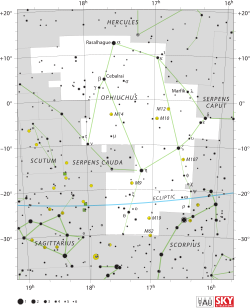
Kappa Ophiuchi, Latinized from κ Ophiuchi, is a star in the equatorial constellation Ophiuchus. It is a suspected variable star with an average apparent visual magnitude of 3.20,2 making it visible to the naked eye and one of the brighter members of this constellation. Based upon parallax measurements made during the Hipparcos mission, it is situated at a distance of around 91.5 light-years (28.1 parsecs) from Earth.1 The overall brightness of the star is diminished by 0.11 magnitudes due to extinction from intervening matter along the line of sight.11
The spectrum of this star matches a stellar classification of K2 III,4 with the luminosity class of 'III' indicating this is a giant star that has exhausted the hydrogen at its core and evolved away from the main sequence of stars like the Sun. Since 1943, the spectrum of this star has served as one of the stable anchor points by which other stars are classified.12 It is 19% more massive than the Sun, but the outer envelope has expanded to around 11 times the Sun's radius.7 With its enlarged size, it is radiating 51 times the luminosity of the Sun7 from its outer atmosphere at an effective temperature of 4,449 K.8 This is cooler than the Sun's surface and gives Kappa Ophiuchi the orange-hued glow of a K-type star.13
Although designated as a variable star,10 observations with the Hipparcos satellite showed a variation of no more than 0.02 in magnitude. In designating this as a suspected variable star, it is possible that Kappa Ophiuchi was mistaken for Chi Ophiuchi, which is a variable star.14 Kappa Ophiuchi belongs to an evolutionary branch known as the red clump, making it a clump giant.3 The surface abundance of elements other than hydrogen and helium, what astronomers term the star's metallicity, is similar to the abundances of those elements in the Sun.5
References
References
- van Leeuwen, Floor (November 2007), "Validation of the new Hipparcos reduction", Astronomy and Astrophysics, 474 (2): 653–664, arXiv:0708.1752v1, Bibcode:2007A&A...474..653V, doi:10.1051/0004-6361:20078357, S2CID 18759600 Note: see VizieR catalogue I/311.
- Jennens, P. A.; Helfer, H. L. (September 1975), "A new photometric metal abundance and luminosity calibration for field G and K giants.", Monthly Notices of the Royal Astronomical Society, 172 (3): 667–679, Bibcode:1975MNRAS.172..667J, doi:10.1093/mnras/172.3.667
- Adelman, Saul J. (2001), "On the Photometric Variability of Red Clump Giants", Baltic Astronomy, 10 (4): 593–597, Bibcode:2001BaltA..10..593A, doi:10.1515/astro-2001-0404
- Morgan, W. W.; Keenan, P. C. (1973), "Spectral Classification", Annual Review of Astronomy and Astrophysics, 11: 29–50, Bibcode:1973ARA&A..11...29M, doi:10.1146/annurev.aa.11.090173.000333
- Massarotti, Alessandro; et al. (January 2008), "Rotational and Radial Velocities for a Sample of 761 HIPPARCOS Giants and the Role of Binarity", The Astronomical Journal, 135 (1): 209–231, Bibcode:2008AJ....135..209M, doi:10.1088/0004-6256/135/1/209
- Stello, D.; et al. (2008), "Oscillating K giants with the WIRE Satellite: Determination of their asteroseismic masses", The Astrophysical Journal Letters, 674 (1): L53–L56, arXiv:0801.2155, Bibcode:2008ApJ...674L..53S, doi:10.1086/528936, S2CID 15094067
- Baines, Ellyn K.; Armstrong, J. Thomas; Schmitt, Henrique R.; Benson, James A.; Zavala, R. T.; van Belle, Gerard T. (2014-01-13), "Navy Precision Optical Interferometer Measurements of 10 Stellar Oscillators", The Astrophysical Journal, 781 (2): 90, arXiv:1401.3342, Bibcode:2014ApJ...781...90B, doi:10.1088/0004-637x/781/2/90, ISSN 0004-637X
- Soubiran, C.; Creevey, O. L.; Lagarde, N.; Brouillet, N.; Jofré, P.; Casamiquela, L.; Heiter, U.; Aguilera-Gómez, C.; Vitali, S.; Worley, C.; de Brito Silva, D. (2024-02-01), "Gaia FGK benchmark stars: Fundamental Teff and log g of the third version", Astronomy and Astrophysics, 682: A145, Bibcode:2024A&A...682A.145S, doi:10.1051/0004-6361/202347136, ISSN 0004-6361
- Luck, R. Earle (September 2015), "Abundances in the Local Region. I. G and K Giants", The Astronomical Journal, 150 (3): 88, arXiv:1507.01466, Bibcode:2015AJ....150...88L, doi:10.1088/0004-6256/150/3/88, ISSN 0004-6256
- "kap Oph". SIMBAD. Centre de données astronomiques de Strasbourg. Retrieved 2012-02-03.
- Famaey, B.; et al. (January 2005), "Local kinematics of K and M giants from CORAVEL/Hipparcos/Tycho-2 data. Revisiting the concept of superclusters", Astronomy and Astrophysics, 430: 165–186, arXiv:astro-ph/0409579, Bibcode:2005A&A...430..165F, doi:10.1051/0004-6361:20041272, S2CID 17804304
- Garrison, R. F. (December 1993), "Anchor Points for the MK System of Spectral Classification", Bulletin of the American Astronomical Society, 25: 1319, Bibcode:1993AAS...183.1710G, archived from the original on 2019-06-25, retrieved 2012-02-04
- "The Colour of Stars", Australia Telescope, Outreach and Education, Commonwealth Scientific and Industrial Research Organisation, December 21, 2004, archived from the original on March 18, 2012, retrieved 2012-01-16
- Kaler, James B., "Kappa Ophiuchi", Stars, University of Illinois, retrieved 2012-03-12