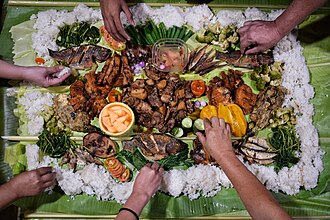
 Kamayan (eating with the hands) as applied through a boodle fight (a separate concept) | |
| Alternative names | Kinamo, kinamut |
|---|---|
| Place of origin | Philippines |
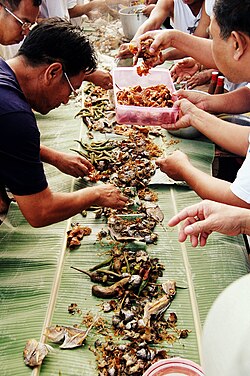

Kamayan is a Filipino cultural term for the various occasions or contexts in which pagkakamay (Tagalog: "[eating] with the hands") is practiced.12 Eating with hands is also known as kinamot or kinamut in Visayan languages.3
While eating with the hands started out as a common practice before the arrival of European colonizers, its cultural significance has become elevated in the Philippines' postcolonial culture, since the practice had been discouraged by the Philippines' Spanish and American colonizers who instead encouraged the use of spoons and forks.4
While kamayan or pagkakamay can be an ordinary everyday activity for many in their own homes, it may also be part of communal feasting (called salu-salo in Tagalog).567 Such feasts traditionally served the food on platters laid on large leaves, such as banana or breadfruit, spread on a table, with the diners eating with their hands from their own plates.89
A separate410 tradition which involves the food being served directly on large leaves spread on a table and the diners eating with the hands without plates or utensils straight off the leaves and sitting or (more authentically) standing side by side is the boodle fight, a tradition of the Armed Forces of the Philippines originally practiced by Philippine Military Academy cadets,11 and named for military slang from the United States Military Academy West Point.4 The intent is to build military camaraderie by getting military personnel to enjoy the same food together, regardless of rank.11
Among restaurants both inside and outside of the Philippines, the concept of "boodle fight" has often been erroneously conflated with kamayan and salu-salo, and the latter terms tend to be wrongly used synonymously when marketing the Filipino food experience. In commercial contexts, the term "Kamayan feasts" tends to be used for boodle fights in practice. While all boodle fights are kamayan, not all boodle fights need be a salu-salo (particularly with respect to its military and not pre-colonial origins), not all salu-salo feasts are kamayan, and not all kamayan eating is part of salu-salo celebrations.101213
Etymology
The Tagalog term kamayan is formed from the root word kamay and the noun-forming suffix "-an" which indicates "collectivity, object, place, and instrument."14 Both pagkakamay and kinamot mean "[eating] with the hands", from the root words kamay and kamot, both meaning "hands".15
Meanwhile, salu-salo means "feast" or "banquet", a reduplication of salo, "to eat together" or "to share food".
Kamayan and salu-salo
Traditional salu-salo communal feasts, which embrace the traditional use of banana leaves on tables wherein rice and various dishes are placed (often on platters or bowls), may also be traditionally eaten kamayan, with one's hands, from individual plates. Generally, only dry foods paired with rice are served; soups, stews and saucy foods are not practical to eat without utensils or bowls, so salu-salo occasions are not necessarily kamayan. When banana leaves are used to cover the table, they are washed and slightly wilted over open flames to bring out an oily sheen before they are laid out.8 In the Batanes Islands in the northern Philippines, large breadfruit (tipuho) leaves are used instead in a serving tradition called vunung or vunong.9
Method of pagkakamay
Pagkakamay describes the act of eating with the bare hands, which is the traditional pre-colonial method of eating in Filipino culture. This is done by forming a small mound of rice, adding a piece of the accompanying dish for flavor (the ulam), compressing it into a small pyramid with the fingers, lifting it to the mouth nestled in four cupped fingers, and then pushing it into the mouth with the thumb. The entire process only uses the fingers of one hand. It never uses the palms of the hands and the fingers also never enter the mouth. The other hand is not used and may instead be used to hold the plate or a drink.71617
Social significance
As in other countries, eating with the hands is an informal and intimate method of dining. It does not have the strict etiquette and rules of western dining with utensils. Eating with the hands may be done in private family meals, or at gatherings, parties, picnics, or fiestas.6158
History
The practice of eating with hands is pre-colonial. It has been described by Antonio Pigafetta in the Magellan expedition, as well as by Spanish missionaries during the Spanish colonial period.6 While utensils like wooden spoons and ladles existed for serving and cooking in pre-colonial Filipino culture, they were not used for eating.1819
The practice was tolerated during the Spanish period, but it was suppressed during the American colonial period when American dining etiquette and the use of spoons and forks were aggressively promoted.2021
Eating with hands became a particularly popular way of celebrating Filipino culture in the 1980s and 1990s, a fact reflected in the ubiquitous popularity of an upscale restaurant chain called "Kamayan". This and other copycat restaurants offered socially acceptable outlets for eating with the hands when dining out, and offered either dining from individual plates or the fully communal boodle fight experience or both, but the terms kamayan' and salu-salo began to be conflated with each other and with "boodle fight", which eventually spread to the Filipino diaspora.22
Boodle fight
A boodle fight is a meal that dispenses with cutlery and dishes.23 Diners instead eat with their hands straight off the table or leaves on the table where the food is spread, unlike typical kamayan instances of eating with the hands off individual plates regardless of how the food is placed on the table.24 The food is placed on top of a long banana leaf-lined trestle table and diners do not sit in chairs but stand shoulder to shoulder in a line on both sides of the table.25
A senior officer or enlisted personnel then utters the traditional command for the boodle fight to begin:
"Ready on the left,
Ready on the right,
Commence boodle fight!"
The term "boodle" was originally American military slang at West Point for contraband sweets26 such as cake, candy and ice cream.4 A "boodle fight" originally only meant a party in which boodle fare is served.274 Cadets would compete with their fellows to grab as much ice cream, cake and other boodle fare as they could before it ran out.4 With the American colonization of the Philippines, the term "boodle" was carried over to the communal meals the Philippine armed forces ate in training and in the field, often off leaves and by hand due to necessity due to lack of utensils and plates.4
A growing number of Filipino restaurants are serving meals boodle fight-style. In commercial contexts, the dishes in a boodle fight are arranged equidistantly throughout the table to ensure everyone has equal access. Rice is typically plain steamed white rice, sinangag (garlic rice), or rice cooked in coconut leaves (puso). Typical dishes aside from rice tend to be dry, and include inihaw (barbecues, including lechon, whole roasted pork), lumpia, fried meats (like crispy pata), tocino (cured pork), tapa, longganisa (sausages), boiled eggs or salted eggs, seafood, dried fish, and blanched, fresh, or stir-fried vegetables. These are provided with a variety of sawsawan (dipping sauces), calamansi, bagoong, as well as pickled vegetables (atchara). Desserts are also included, like ripe or unripe Philippine mangoes, pineapples, watermelons, papaya, young coconut, and various kakanin (rice cakes). Drinks are usually fruit juices, beer, wine, or softdrinks. As a rule, foods that are less practical for eating with hands, like soups, stews, saucy dishes, pancit noodles and syrupy desserts like leche flan are not included.87282930
In contrast to commercial boodle fights, true military boodle fights remain regimented affairs. While the soldiers may eat together regardless of rank, rank does not disappear. The food is often utilitarian and not festive, and they have a strict time limit to consume the food.4
In 2000, during the Philippine government's all-out war approach against the Moro Islamic Liberation Front, then-President Joseph Estrada held and participated in boodle fights for government troops after the Battle of Camp Abubakar. Estrada and the soldiers feasted on truckloads of lechon and beer right in the captured camp. Since pork and alcohol are haram, this provoked the Muslim extremists further and garnered criticisms of insensitivity to Muslim Filipinos in general.4
References
References
- Cordero-Fernando, Gilda. 1976. The Culinary Culture of the Philippines. Manila, Philippines: Bancom Audiovision Corporation.
- Doreen G. Fernandez, “Food and the Filipino,” in Philippine World-View, Virgilio G. Enriquez, ed. (Singapore: Institute of Southeast Asian Studies, 1986), pp. 20–44
- "Cebu's 'puso'". SunStar. Retrieved 11 November 2024.
- Bender, D. E., & De Leon, A. (2018). Everybody was boodle fighting: military histories, culinary tourism, and diasporic dining. Food, Culture & Society, 21(1), 25–41. https://doi.org/10.1080/15528014.2017.1398469
- "The practice of kamayan and how it fosters Pinoy pride". Rappler. 11 December 2018. Retrieved 22 August 2021.
- Makalintal, Bettina (20 January 2018). "With A Show Of Hands, Filipino-American Chefs Rekindle Kamayan Feasts". NPR. Retrieved 22 August 2021.
- Abbey, Francis (18 November 2019). "Love and pork - The Filipino feast you eat with your hands". WUSA9. Retrieved 22 August 2021.
- Mendiola, Idge (8 July 2019). "How to Create a Boodle Fight: A Guide to This Easy but Festive Way of Entertaining". Esquire. Retrieved 22 August 2021.
- "The Ivatan Cuisine: Must-Try Batanes Dishes". The Girl Behind The Pen. Retrieved 17 June 2022.
- Yap, Liz. "A Seat at the Table". Out of Print. Archived from the original on 2021-04-10. Retrieved 2024-04-07.
- "Kadayawan's Boodle Fight by Park Inn". SunStar. 23 August 2015.
- Marcaida, Joana Joyce (26 August 2015). "The boodle fight". Retrieved 16 June 2017.
- "What is a Boodle Fight? - Ang Sarap". Ang Sarap (A Tagalog word for "It's Delicious"). 2015-05-21. Retrieved 2020-02-10.
- "Appendix:Tagalog affixes". 16 April 2024.
- Sogn, Jamie (9 August 2017). "Filipino Kamayan Dining from the San Fernando Valley to the Mission". KCET. Retrieved 22 August 2021.
- "Kamayan - Eat Using Your Hands Culture". Filipino-Recipe.com. Archived from the original on 22 August 2021. Retrieved 22 August 2021.
- "Use Your Hands: Traditional Filipino Way of Eating". Primer.com.ph. Retrieved 22 August 2021.
- Kohnen, Norbert; Kohnen, Petra (1986). Igorot: Traditional Ways of Life and Healing Among Philippine Mountain Tribes. SDK Systemdruck Köln GmbH.
- Limos, Mario Alvaro (11 March 2021). "These Precolonial Filipino Words Recorded by Pigafetta Are Still Used Today". Esquire. Retrieved 22 August 2021.
- Ting, Jasmine P. (4 January 2019). "Cooking for the Kamayan". Saveur. Retrieved 22 August 2021.
- Greaves, Vanessa (29 September 2020). "Getting in Touch Through Kamayan, the Ultimate Filipino Feast". allrecipes. Retrieved 22 August 2021.
- "Is Eating With Spoon And Fork Something To Be Frowned Upon? | SPOT.ph". Archived from the original on 2017-03-28. Retrieved 2025-11-15.
- Boorman, Charley (2009). Right To The Edge: Sydney To Tokyo By Any Means: The Road to the End of the Earth. Hachette. ISBN 978-0748113156.
- Lowry, Dave (6 January 2016). "Hand-to-Mouth Combat: Experiencing a Kamayan Dinner at Hiro Asian Kitchen". Retrieved 16 June 2017.
- Dumdum Jr., Simeon (10 June 2012). "The boodle fight". Philippine Daily Inquirer. Retrieved 19 March 2008.
- Dolph, Edward Arthur (1942). "Sound off!" Soldier Songs from the Revolution to World War II. Farrar & Rinehart. p. 579.
- Dickson, Paul (2014). War Slang: American Fighting Words & Phrases Since the Civil War. Courier Corporation. p. 132. ISBN 978-0486797168.
- "Cebu's 'puso'". SunStar Philippines. 19 May 2013. Retrieved 22 August 2021.
- Chavez-Bush, Leigh. "Kamayan: These epic Filipino feasts feature lavish spreads and forego utensils". Atlas Obscura. Retrieved 22 August 2021.
- "How To Prepare A Boodle Fight At Home, a.k.a. "Kamayan Feast" on Banana Leaves". Jeanelleats. Retrieved 22 August 2021.